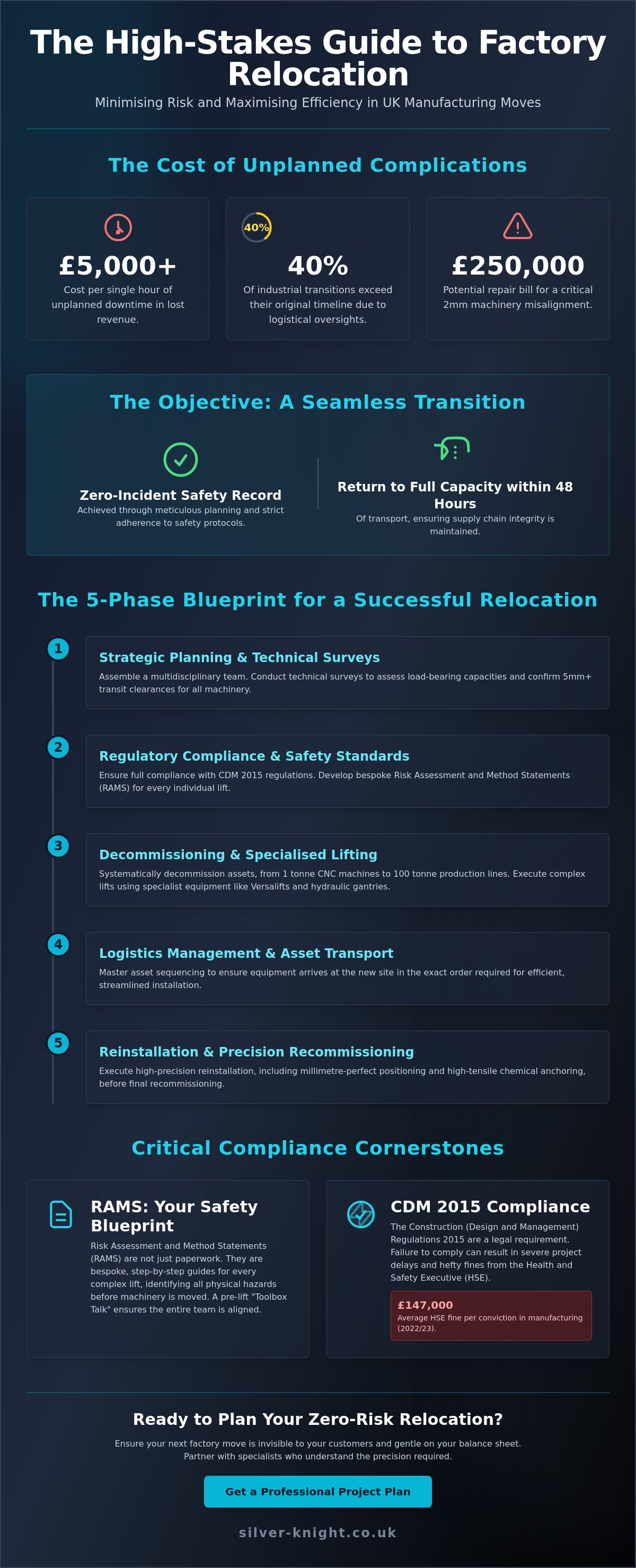
A single hour of unplanned downtime during a UK manufacturing move can cost upwards of £5,000 in lost revenue, yet 40% of industrial transitions exceed their original timeline because of logistical oversights. You're likely aware that shifting a 100 tonne hydraulic press isn't just about haulage; it's a high-stakes surgical operation where a 2mm misalignment can result in a £250,000 repair bill. It's natural to feel anxious about the sheer scale of the Risk Assessment and Method Statements (RAMS) required to keep your workforce safe and your insurers satisfied. You need a transition that's invisible to your customers and gentle on your balance sheet.
This guide provides a robust factory relocation project plan designed to eliminate those risks. We'll show you how to ensure your facility achieves a zero-incident safety record and returns to full operational capacity within 48 hours of transport. We'll break down the technical requirements for heavy lifting, UK HSE compliance, and the precise sequencing needed to maintain your supply chain integrity from start to finish.
Key Takeaways
-
Learn how to assemble a multidisciplinary team to align your relocation objectives with long-term production continuity.
-
Understand your legal obligations under CDM 2015 and the critical role of bespoke RAMS in managing heavy lifting risks.
-
Discover how to develop a robust factory relocation project plan that integrates specialist machinery dismantling and systematic decommissioning.
-
Master asset sequencing and logistics to ensure equipment arrives at the new site in the exact order required for efficient installation.
-
Gain technical insights into high-precision reinstallation, from millimetre-perfect positioning to high-tensile chemical anchoring.
Table of Contents
Strategic Planning and Initial Technical Surveys
A successful factory relocation project plan begins long before the first bolt is loosened. It's about aligning the move with high-level business goals, whether that's a 25% increase in production capacity through expansion or a 15% reduction in overheads via facility consolidation. Effective logistics management ensures that every variable is accounted for, from the initial risk assessment to the final commissioning phase.
You'll need to assemble a multidisciplinary team to lead the charge. This group should pair Silver Knight's specialist project managers with your internal plant engineers who understand the nuances of your specific machinery. Together, they'll perform a technical site survey to assess load-bearing floor capacities in square metres. This prevents catastrophic slab failure during the move. We document all machinery dimensions to ensure 5mm clearance during transit through restricted access points. It's this level of detail that separates a successful move from a costly delay.
Should your technical site survey indicate a need for groundwork remediation or structural reinforcement to accommodate the new layout, you can learn more about GCS Contractors Ltd and their specialist civil engineering services.
To better understand the complexities of this process, watch this helpful factory relocation Q&A:
Defining Project Scope and Objectives
The scope must be exhaustive. It's not enough to list major items; you need to document every asset from 1 tonne CNC machines to 100 tonne production lines. Setting a "Golden Hour" for production restoration is vital. This is the precise moment when the first saleable product must roll off the line at the new site to maintain supply chain continuity. To help you get started, you can find comprehensive scope templates via our factory relocation services page. This ensures no small but critical component, like a specific calibration tool or spare parts inventory, is left behind.
Site Access and Load Bearing Assessments
Precision is non-negotiable when executing a factory relocation project plan. We measure all entrance heights and widths to millimetre precision to ensure we maintain at least 5mm clearance for every asset during transit. We also scrutinise the integrity of floor slabs at both the origin and destination. This ensures they can support the concentrated loads exerted by heavy-duty hydraulic gantries or air film movers during the positioning phase. For a deeper look at these technical requirements, refer to the Machinery Movers UK Guide for industry survey standards. These assessments prevent structural damage and ensure the safety of the entire rigging team.
Regulatory Compliance and Health and Safety Standards
Safety isn't a checkbox; it's the foundation of any successful factory relocation project plan. As heavy lifting specialists, we advocate for early engagement with the Construction (Design and Management) Regulations 2015 (CDM 2015). This legal framework ensures that every person involved in the move understands their responsibilities from day one. Failing to align with these standards can result in project delays or significant HSE fines, which reached an average of £147,000 per conviction in the manufacturing sector during the 2022/23 period.
Risk Assessment and Method Statements RAMS
Every individual lift requires a bespoke RAMS document. This isn't just paperwork. It's a step-by-step guide for complex tasks, such as the precise sequence required for a powerful 27 tonne Versalift manoeuvre within a confined production bay. Engineers must identify physical hazards like overhead power lines or fragile underground services before any weight is shifted. Best practice dictates a "Toolbox Talk" on-site before a single piece of machinery is unbolted. This briefing ensures the team is fully aware of the specific Health and Safety Standards regarding machine guarding and moving parts during the machinery dismantle service phase.
CDM Regulations and Legal Requirements
Under UK law, you must assign the roles of Principal Designer and Principal Contractor. These roles are vital for coordinating health and safety during the pre-construction and construction phases of your move. We maintain a site-specific safety file for every project, containing all technical equipment manuals and maintenance records. You'll also need to verify insurance cover for high-value assets during the lifting phase. Standard transit insurance often falls short for specialist CNC machines or industrial ovens, so bespoke plant and machinery cover is essential for any factory relocation project plan.
Beyond the physical move, you'll need to organise environmental disposal permits for industrial waste or hazardous materials. All lifting equipment used during 2026 operations must carry valid LOLER (Lifting Operations and Lifting Equipment Regulations) certification. This includes thorough examinations every 6 or 12 months depending on the specific gear. If you're unsure about the compliance status of your current site, a professional factory relocation service can audit your equipment and permits to ensure everything meets current UK legislation.
Decommissioning and Specialised Lifting Strategies
Success in any factory relocation project plan hinges on the technical precision of the decommissioning phase. It isn't just about unplugging machines; it's a systematic reversal of the installation process. Our team executes a methodical mechanical and electrical disconnection of every production asset to ensure nothing's damaged during the transition. For complex CNC centres and integrated robotic cells, we deploy our machinery dismantle service to handle delicate isolation tasks that standard movers often overlook.
Electrical and Mechanical Decommissioning
Precision at this stage saves days of troubleshooting during the restart. We label every cable, terminal, and pipework connection using a standardised coding system. This ensures your engineers achieve rapid recommissioning once the assets reach the new site. To prevent environmental hazards and comply with UK health and safety regulations, we drain all hydraulic fluids, oils, and coolants before haulage. Moving parts like tool changers or robotic arms are secured with bespoke transit brackets. This prevents internal calibration drift or physical damage caused by vibrations during transit on UK motorways.
Lifting strategies are determined by the specific physics of each asset. We don't guess weights. We calculate the exact centre of gravity and total tonnes for every machine. If a load is top-heavy or has an offset balance point, the rigging must reflect that reality to prevent tipping. For heavy loads where factory ceilings are low, we deploy hydraulic gantry systems. These systems provide the necessary lift capacity without the height requirements of traditional mobile cranes.
Selecting Heavy Lifting Equipment
Choosing the right tool for the job is vital for safety and efficiency. Our fleet includes specialised machinery designed for the toughest industrial environments:
-
Versalift 40/60: This is a powerhouse for confined spaces. It offers a 27 tonne lifting capacity whilst maintaining a compact footprint that fits through standard factory doors.
-
Jack and Slide Systems: When we encounter massive 100 tonne transformers or turbines, we use these systems to move loads horizontally where cranes can't reach.
-
Iron Fairy Fleet: We specify these for precision yard movements. Their low-profile design and pick-and-carry capabilities make them ideal for navigating tight external spaces.
By integrating these specialised lifting strategies into your factory relocation project plan, you reduce the risk of equipment failure. Every lift is planned with a detailed RAMS (Risk Assessment and Method Statement) to ensure the project stays on schedule and within budget.
Logistics Management and Asset Transport
The transport phase of a factory relocation project plan requires more than just haulage; it demands a logical sequence that mirrors your new facility's floor plan. Effective project managers organise the loading of assets so that the first items off the vehicle are the first items required for installation. This prevents congestion at the new site and ensures that heavy machinery doesn't block the access routes needed for secondary equipment. By reducing double handling, firms often see a 12% reduction in total installation time.
Safety during transit is non-negotiable. Every asset must be secured using heavy-duty lashing chains specifically rated for the machinery's weight and centre of gravity. Standard straps often fail under the lateral forces generated by a 20-tonne press during cornering. To manage these specialist requirements, many firms utilise heavy moving equipment hire to access low-loader trailers. These trailers provide the necessary height clearance for tall industrial units whilst maintaining a lower centre of gravity for stability.
Moving oversized loads across the UK involves strict legal compliance. If a load exceeds 2.9 metres in width or 18.65 metres in length, you must notify the police and local authorities via the ESDAL (Electronic Service Delivery for Abnormal Loads) system. Coordination ensures that narrow village roads or weight-restricted bridges don't halt your progress. Failing to file these notices at least two to five days in advance can lead to immediate vehicle seizures and heavy fines.
Heavy Haulage and Route Planning
A physical route survey is a vital component of your factory relocation project plan. Surveyors identify low bridges, typically those under 5.03 metres, and tight junctions that a multi-axle low-loader cannot clear. Scheduling movements between 20:00 and 06:00 helps avoid peak traffic and minimises the risk of delays. Every driver must hold a valid Driver Certificate of Professional Competence (CPC) and specific heavy haulage qualifications to ensure they can handle the unique dynamics of industrial loads.
Export Packing for International Relocation
International moves introduce environmental risks like salt air and humidity. Specialists apply vapour corrosion inhibitors (VCI) to sensitive electronics and polished metal surfaces to prevent oxidation during sea freight. We construct bespoke timber crates designed to withstand 5G of transit force, ensuring the internal components remain seated. For comprehensive support across borders, consult our international machine movers team to manage customs documentation and global shipping lanes.
Ready to move your facility with precision? Speak to our industrial relocation experts today for a tailored logistics strategy.
Reinstallation and Precision Recommissioning
The final phase of a factory relocation project plan requires a transition from heavy logistics to high-precision engineering. It isn't enough to simply place a machine in its new bay. We ensure every asset is positioned according to the new factory floor plan with 5mm precision. This level of accuracy is vital for maintaining lean manufacturing workflows and ensuring that automated systems, such as conveyor interfaces or robotic arms, function without interference.
Once the footprint is verified, we anchor equipment to the floor using high-tensile chemical or mechanical fixings. The choice of fixing depends on the slab depth and the dynamic loads the machine generates during operation. For high-vibration equipment, chemical resin anchors often provide superior dampening compared to standard mechanical bolts. We level all production lines using precision optical or digital levelling tools to ensure the foundation for operation is perfectly flat across the entire site.
Precision Positioning and Levelling
Multi-section production lines present a unique challenge during reinstallation. We verify the alignment of these interconnected units to ensure seamless operation across the entire length of the line. Even a 2mm deviation over a ten-metre span can cause accelerated wear on belts and bearings. We also check the verticality of tall assets, such as silos or vertical machining centres, to prevent eccentric loading and structural stress.
Precision is non-negotiable for modern industrial standards. As heavy lifting specialists, we advocate for dual-verification of all levelling data. This means two separate engineers must confirm the readings before we finalise the anchoring process. This rigorous approach minimises the risk of operational downtime once the factory resumes full-scale production.
Final Testing and Handover
The reconnection phase relies on the meticulous labelling performed during the initial decommissioning. We reconnect all electrical, pneumatic, and hydraulic services according to these original markers. It's a systematic process that prevents cross-wiring and ensures safety from the moment the power is restored. Before you introduce raw materials into the production line, we perform comprehensive dry-run testing. This allows us to verify that all sensors, limit switches, and emergency stops are fully functional.
The project concludes with a formal sign-off. We provide a comprehensive completion file that includes safety certificates, load test results, and updated layout drawings. For more details on the final stages of the move, consult the Plant Relocation Guide for final handover protocols. This ensures your factory relocation project plan is fully compliant with UK health and safety regulations, such as PUWER (Provision and Use of Work Equipment Regulations 1998), providing peace of mind for your operational team.
Secure Your Operational Future with Precision Engineering
Relocating a manufacturing facility requires more than simple haulage; it demands technical excellence at every stage. Successful moves hinge on meticulous decommissioning and the use of specialised lifting equipment to protect high-value assets. Adhering to UK health and safety regulations, such as the CDM 2015 regulations, ensures your business remains compliant whilst minimising costly production delays. Our team brings 180 years of collective industry experience to every project. This depth of knowledge ensures your factory relocation project plan is executed with absolute precision from the initial survey to final recommissioning. We utilise a specialised fleet, including Versalifts and hydraulic gantries, to manage complex lifts that standard providers cannot handle. Whether you're moving across the United Kingdom or require global relocation capabilities, we provide the technical expertise to get your plant operational again without unnecessary friction. You don't have to navigate these technical complexities alone when professional support is available to safeguard your machinery. We're ready to help you transition to your new facility with confidence.
Contact our specialist team to discuss your industrial move today
Frequently Asked Questions
How long does a factory relocation take?
A typical factory relocation takes between 6 and 18 months from the initial feasibility study to full operational status at the new site. Small workshops under 500 square metres often complete the process in 12 weeks, whereas complex industrial facilities frequently require a 24-month lead time. Your factory relocation project plan should allocate at least 30% of this timeline to the pre-move audit and decommissioning phase to prevent delays.
What is the most critical part of a factory move?
Meticulous pre-move planning and site auditing represent the most critical stages of any industrial transition. Industry data from logistics specialists suggests that 40% of project delays stem from inaccurate floor plans or utility specifications at the destination. You've got to verify that floor loading capacities and electrical supplies match your machinery requirements before any equipment leaves the original loading bay.
How much does an industrial plant relocation cost?
Costs for industrial moves vary significantly based on scale, ranging from £10,000 for small workshop transfers to over £1,000,000 for complex production lines. According to UK industrial benchmarks, transport usually accounts for 20% of the budget, while specialist decommissioning and reinstallation make up 50% of the total spend. Factors like heavy lifting requirements and hazardous material handling will further influence the final invoice from your contractors.
What equipment is used for heavy machinery moving?
Specialist teams use heavy-duty equipment such as Versa-Lift forklift trucks with 27-tonne capacities and hydraulic gantry systems for loads up to 500 tonnes. For delicate or heavy items in tight spaces, engineers employ air skates and machine skates to glide equipment across factory floors. These tools ensure that even the most cumbersome CNC machines or presses move without damaging the building's structural integrity or the machine's calibration.
Do I need special insurance for moving factory machinery?
You definitely need specialist insurance because standard business policies rarely cover machinery whilst it's in transit or being lifted by a crane. Most UK firms opt for 'Marine Cargo' or 'Goods in Transit' cover that specifically includes 'Loading and Unloading' risks. Ensure your policy covers the full replacement value of the assets, as a single precision lathe can cost upwards of £150,000 to replace if it's damaged during the move.
How do you minimise downtime during a factory move?
Minimising downtime requires a phased relocation approach where you move production lines in stages rather than all at once. Successful projects often build up a 4-week buffer stock of finished goods before the move begins to satisfy customer orders during the transition. Integrating this strategy into your factory relocation project plan ensures that revenue continues to flow even whilst your primary machines are offline and being reinstalled.
What are RAMS in industrial relocation?
RAMS stands for Risk Assessment and Method Statement, which is a mandatory safety document for UK industrial sites. These documents outline the specific hazards involved in the move and the exact steps contractors'll take to mitigate those risks. Under the Health and Safety at Work Act 1974, you must have these in place before any heavy lifting or electrical decommissioning starts on your site.
Can you move machinery internationally?
You can move industrial machinery internationally using a combination of heavy road haulage and sea freight. This process requires specialist export crating that meets ISPM 15 international standards to prevent the spread of pests in timber packaging. Moving a production line from the UK to mainland Europe typically involves 40-foot flat-rack containers and detailed customs declarations to manage post-Brexit regulatory requirements efficiently.

Article by
David Ashby
I'm the Managing Director of Silver Knight Haulage & Machinery Ltd. Silver Knight Ltd is a family-run firm established in the West Midlands in 2005, with the aim of providing a cost-effective, yet professional, service to businesses for the removal, transportation, and installation of machinery, plant, and equipment here in the UK and worldwide. Between us, the Silver Knight workforce has over 50 years of experience with machinery and its operation.
Disclaimer
This article is intended for informational purposes only. Please ensure you seek expert advice or carry out your own research to confirm the information is suitable for your specific needs.