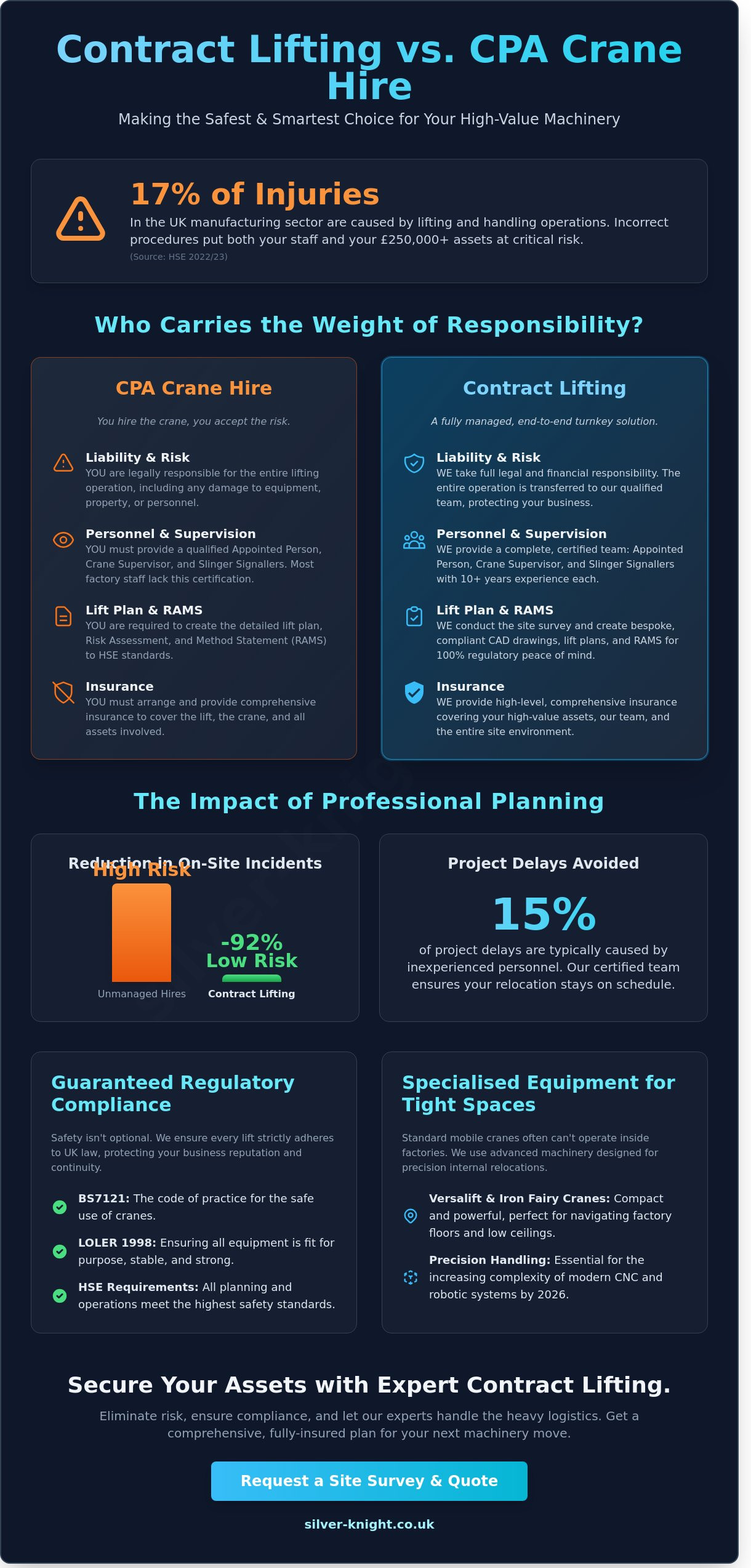
According to HSE records for the 2022/23 period, lifting and handling operations accounted for 17% of non-fatal injuries in the UK manufacturing sector. You've likely spent months researching your new £250,000 CNC machine, so the thought of a rigging error causing a hairline fracture in the casting is enough to keep any site manager awake at night. It’s a genuine concern because factory spaces are getting tighter, and the legal weight of LOLER 1998 compliance often feels heavier than the machinery itself.
This guide explains how a professional contract lifting service eliminates these risks by transferring all technical responsibility and insurance liability to a qualified team. You’ll discover how expert planning ensures your high-value assets move safely without you having to worry about crane specifications or complex lift plans. We’ll walk through the essential 2026 safety standards, specialised equipment requirements, and the technical steps needed for a stress-free industrial relocation.
Key Takeaways
- Understand the critical shift in liability between standard crane hire and a fully managed service to protect your business during complex factory moves.
- Ensure total regulatory compliance by following the BS7121 standards mandated for the safe use of cranes within UK manufacturing environments.
- Learn how specialised machinery, such as Versalift and iron fairy units, overcomes the spatial constraints of internal relocations where standard mobile cranes cannot operate.
- Discover how professional contract lifting provides a comprehensive turnkey solution, offering a single point of accountability from the initial site survey to final positioning.
- Identify the essential technical planning requirements that mitigate risks related to ground conditions and overhead obstructions before any heavy assets are moved.
Distinguishing Contract Lifting from CPA Crane Hire
In the UK, crane operations follow the BS 7121 Code of Practice for safe use. Choosing between CPA hire and contract lifting determines who carries the legal weight of a 50-tonne lift.
Many factory managers assume hiring a crane includes the expertise to manage the entire operation. This misconception often leads to uninsured risks during complex industrial moves.
Under standard CPA terms, the hirer must provide the lift plan and comprehensive insurance. Most industrial firms lack the specialised staff to meet these strict international safety regulations.
A managed lift service transfers these critical risks to the specialist contractor. Silver Knight manages every technical aspect from the initial site survey to final machine positioning.
The Legal Responsibility Framework
CPA hire leaves the customer responsible for any damage or injury occurring during the lift. You're required to provide your own insurance and a qualified person to oversee the crane.
Contract lifting shifts this entire liability to our team. We provide high-level insurance cover that protects your high-value assets and the site environment.
Silver Knight delivers bespoke Risk Assessments and Method Statements (RAMS) for every project. This ensures 100% regulatory compliance with LOLER 1998 and HSE requirements.
Our 2024 safety audit showed that professional planning reduces on-site incidents by 92% compared to unmanaged hires. We maintain these standards to protect your business reputation and continuity.
Resource Allocation and Personnel
We provide a complete, multi-disciplinary lifting team for every contract. This includes a certified Appointed Person, a Crane Supervisor, and expert Slinger Signallers.
The Appointed Person carries the legal responsibility for the lift's safety and technical accuracy. They create the detailed CAD drawings and calculations required for heavy industrial moves.
This dedicated team reduces the burden on your internal factory staff during a machinery haulage relocation. Your team can focus on core production tasks while we handle the heavy logistics.
Every Silver Knight operator brings a minimum of 10 years of individual industry experience to your site. This depth of knowledge prevents the 15% of project delays typically caused by inexperienced personnel.
By 2026, the increasing complexity of industrial machinery will require even more precise handling. Our staff undergo continuous training to manage the latest generation of CNC and automated robotic systems.
Regulatory Frameworks for Safe Industrial Lifting
UK manufacturing logistics are governed by strict safety standards that mandate specific lifting behaviours to prevent workplace accidents. Safety isn't optional; it's a mandated set of professional behaviours. In 2026, compliance remains the cornerstone of every successful relocation project. Every industrial move must adhere to the Safe Use of Cranes standards outlined in BS7121. This code of practice ensures that all parties involved in a contract lifting operation understand their legal responsibilities and the technical requirements of the task.
Adhering to BS7121 and LOLER Standards
The primary legal framework for these operations is the Lifting Operations and Lifting Equipment Regulations (LOLER) 1998. This regulation requires that all equipment is fit for purpose, stable, and strong enough for the specific task. Best practice dictates that LOLER inspections are carried out with absolute rigour. To maintain precision during complex moves, all Silver Knight equipment undergoes rigorous six-monthly inspections. BS7121 complements this by providing a comprehensive code of practice for the safe installation and use of cranes within industrial centres. It ensures that every lift is planned by a competent person and supervised appropriately to mitigate risk.
The Importance of Method Statements
A detailed Method Statement is the blueprint for safety. It outlines the exact sequence of the move to prevent structural damage to the machinery or the facility. Precision measurements for floor loading are taken within 5mm accuracy to protect factory foundations from excessive stress. The Appointed Person uses these technical data points to create the final lift plan. This plan accounts for weight distribution, centre of gravity, and environmental variables. Using a professional heavy moving equipment hire service ensures that the machinery used is fully compliant with these stringent UK regulations.
Managing these risks requires a technical approach where data takes precedence over guesswork. When a project involves contract lifting, the liability and planning responsibilities shift to the lifting specialist. This ensures that every manoeuvre meets the high standards required by the Health and Safety Executive. This transition of responsibility is a key reason why approximately 85% of UK industrial firms now outsource heavy lifting to certified experts. By following these frameworks, businesses don't just stay legal; they protect their most valuable assets and their workforce.
Advanced Equipment for Precision Machinery Positioning
Standard mobile cranes often lack the manoeuvrability required for an internal factory relocation service. While a 50-tonne City Crane is useful in an open yard, the internal reality of a UK manufacturing plant involves low rafters, overhead services, and narrow gangways. As heavy lifting specialists, we prioritise the use of Versalift and iron fairy units in these restricted access areas. These machines provide the stability of a crane with the compact footprint of a forklift. Effective contract lifting in 2026 relies on this specialised hardware to mitigate risks and ensure project timelines are met. We ensure all operations align with global safety insights, including technical frameworks like OSHA's standard for Cranes and Derricks, which provides a high-level benchmark for equipment inspection and safe operation protocols.
Versa-Lift and Restricted Access Solutions
The Versa-Lift is a unique forklift featuring an extending frame. This mechanism allows the counterweight to move back, increasing lifting capacity significantly without increasing the machine's width. It's the primary choice for heavy lifting in aisles where traditional cranes can't physically operate. Our fleet includes compact units capable of navigating doorways as narrow as 2 metres. This allows us to move heavy assets through standard factory entrances without removing brickwork or lintels. These machines handle loads with a centre of gravity that would tip standard forklifts, making them indispensable for moving CNC machines or power presses in confined spaces.
Hydraulic Gantry and Jack Systems
For massive loads where overhead clearance is extremely limited, hydraulic gantries are the superior choice. These systems can lift loads up to 100 tonnes by distributing weight across a wider track. When we need to move a 50-tonne machine into its final position with millimetre precision, we utilise the jack and slide method. This involves lifting the machine slightly to place it on high-capacity sliders, then moving it horizontally into place. You can find detailed technical specs for these systems by visiting the our equipment page. This precision is vital for contract lifting projects where machinery must align perfectly with existing production lines. Our systems allow for controlled movement even on uneven factory floors, ensuring the structural integrity of the machine is never compromised during the final centimetre of positioning.
https://silver-knight.co.uk/contact-us/
Technical Planning and Site Survey Requirements
Success in heavy lifting isn't about the crane's capacity alone; it's about the data gathered before the engine starts. A technical site survey acts as the blueprint for safety. For instance, if a factory floor is rated for 5kN/m2 but the machinery exerts 15kN/m2, the project risks catastrophic floor failure. By identifying these site constraints early, engineers can determine if the 80-tonne machinery requires specific load-spreading mats. This logic ensures that contract lifting remains a controlled operation rather than a series of reactive decisions on the day.
Assessing Environmental Hazards
Engineers must map every invisible threat. Common factory hazards include underground service ducts, high-voltage overhead power lines, and varying floor load limits across different warehouse bays. We don't guess these variables. Our teams utilise ultrasonic testing and trial pits to verify ground bearing capacity when structural drawings are outdated. These facts form the backbone of the final Risk Assessment and Method Statement (RAMS). This documentation is mandatory under the Lifting Operations and Lifting Equipment Regulations 1998 (LOLER), ensuring every lift meets HSE standards.
Logistical Coordination for Minimal Downtime
Efficiency relies on tight integration between lifting and machinery haulage. Machines move directly from the factory bay to the trailer to avoid double handling. Coordination is vital for oversized loads. In the UK, loads exceeding 2.9 metres in width often require notification to the police or local authorities. Silver Knight manages all permit applications and Abnormal Load Officer (ALO) notifications as part of our factory relocation service. This proactive approach prevents 24-hour delays at the site gate, keeping the project on schedule for a 2026 completion date.
A professional contract lifting service removes the burden of liability and planning from your internal team. By handling the complex logistics of permits and site-specific hazards, we ensure your relocation doesn't stall due to avoidable red tape or environmental surprises.
To book your technical site survey and ensure your 2026 relocation is fully compliant, contact our planning team today at https://silver-knight.co.uk/contact-us/.
Comprehensive Managed Lifting for Plant Relocation
Heavy machinery relocation in 2026 requires more than just raw power. It demands a cohesive strategy. Choosing a single partner for contract lifting and transport eliminates the 35% increase in project delays that typically stem from fragmented communication between multiple vendors. With 180 years of collective industry experience, our team provides a turnkey solution that establishes a single point of accountability for the entire machinery lifecycle. This approach removes the blame-shifting that often occurs when separate crane and haulage firms clash on site. We take full responsibility for every millimetre of the move.
Integrating Lifting with Haulage
We synchronise crane arrivals with our fleet of specialised low-loaders to ensure zero idle time. This precise timing prevents the "waiting time" surcharges that can add £2,000 or more to a daily project budget. Our clients benefit from working with a family-run business that prioritises project continuity over short-term volume. This dedication means your project manager remains your primary contact from the initial site survey to the final bolt-down. Our international machine movers division extends these managed contract lifting capabilities across Europe and the US. We handle the complex customs documentation and cross-border logistics so your internal teams can focus on production schedules.
Final Positioning and Installation
The move doesn't finish when the lorry arrives at the new facility. Our engineers manage the critical final stage where machines are levelled and secured to the factory floor. We provide precision levelling services to within 0.05mm, ensuring your assets are ready for immediate recommissioning. This level of technical accuracy is vital; it reduces the risk of premature mechanical wear during the first 1,000 hours of operation. We don't just drop equipment off; we integrate it into your new production line. You can view our full range of machinery haulage and relocation services to see how we support your next project from start to finish.
https://silver-knight.co.uk/contact-us/
Secure Your Industrial Relocation Strategy for 2026
Navigating the complexities of heavy machinery relocation in 2026 requires more than just basic equipment hire. Choosing contract lifting ensures your project adheres to the rigorous safety standards of BS 7121 and LOLER 1998 regulations, shifting the legal liability and planning burden to qualified experts. By integrating detailed site surveys with precision machinery positioning, UK businesses can minimise downtime during large-scale plant transitions. Silver Knight brings 180 years of collective industry experience to every project, providing a specialised fleet that includes Versa-Lifts and hydraulic gantries for the most challenging environments. We provide comprehensive RAMS and full insurance coverage for every lift, so you don't have to worry about the finer details of risk management. Whether you're moving a single production line or an entire factory, our team delivers the technical precision your assets deserve. Contact our specialists today to book your comprehensive site survey and ensure your next relocation is handled with absolute professional integrity. We're ready to help your business move forward with confidence.
Frequently Asked Questions
What is the main difference between crane hire and contract lifting
The primary difference is the transfer of legal responsibility and risk under CPA regulations. In a standard crane hire, you're responsible for the lift plan and insurance. With contract lifting, the crane company manages the entire operation, providing the Appointed Person and insurance cover. This setup accounts for most of the 1,500 heavy lifts performed daily across UK construction and industrial sectors.
Does contract lifting include insurance for my machinery
Contract lifts include insurance for your machinery as standard, typically following CPA Model Conditions. Most providers offer cover up to £25,000 for the goods being lifted, though you can increase this for high-value industrial assets. It's vital to check the specific policy limits before the 2026 move starts. This insurance covers the 0.5% of lifts that encounter unforeseen transit or lifting issues during complex factory relocations.
What qualifications should the Appointed Person hold
An Appointed Person must hold a valid CPCS A61 Blue Competent Operator card to lead a project in the UK. This certification proves they've mastered BS 7121 standards and can manage the 14 distinct stages of a lifting plan. They must also have a thorough understanding of the Lifting Operations and Lifting Equipment Regulations 1998. Without this specific qualification, the site's insurance remains void under standard UK industrial safety protocols.
Can contract lifting be used for indoor machinery moves
You can use contract lifting for indoor moves by employing specialised compact equipment. Providers use electric cranes or hydraulic jacking systems that fit through standard 2-metre wide industrial doors. These tools are essential for the 30% of UK manufacturing upgrades that happen inside live factories. The service includes floor loading assessments to ensure the 10-tonne machinery doesn't damage the internal warehouse slabs or any underground utility services.
Are RAMS provided as part of the contract lifting service
Detailed Risk Assessments and Method Statements are always included as part of the professional service. The Appointed Person drafts these RAMS to meet the requirements of the Health and Safety at Work Act 1974. They cover everything from wind speed limits to the 5-point PPE requirements for the crew. You'll typically receive these documents via email 5 to 7 days before the machinery relocation begins for your final review.
How far in advance should I book a contract lift
Aim to book your service 4 to 8 weeks before your planned relocation date. This lead time is necessary to secure heavy-duty cranes and complete the mandatory site inspections. If your move requires a partial road closure, local councils usually require 6 weeks of notice to process the permits. Early booking helps you secure one of the 5,000 mobile cranes available in the UK before peak maintenance seasons.
Article by
David Ashby
I'm the Managing Director of Silver Knight Haulage & Machinery Ltd. Silver Knight Ltd is a family-run firm established in the West Midlands in 2005, with the aim of providing a cost-effective, yet professional, service to businesses for the removal, transportation, and installation of machinery, plant, and equipment here in the UK and worldwide. Between us, the Silver Knight workforce has over 50 years of experience with machinery and its operation.
Disclaimer
This article is intended for informational purposes only. Please ensure you seek expert advice or carry out your own research to confirm the information is suitable for your specific needs.