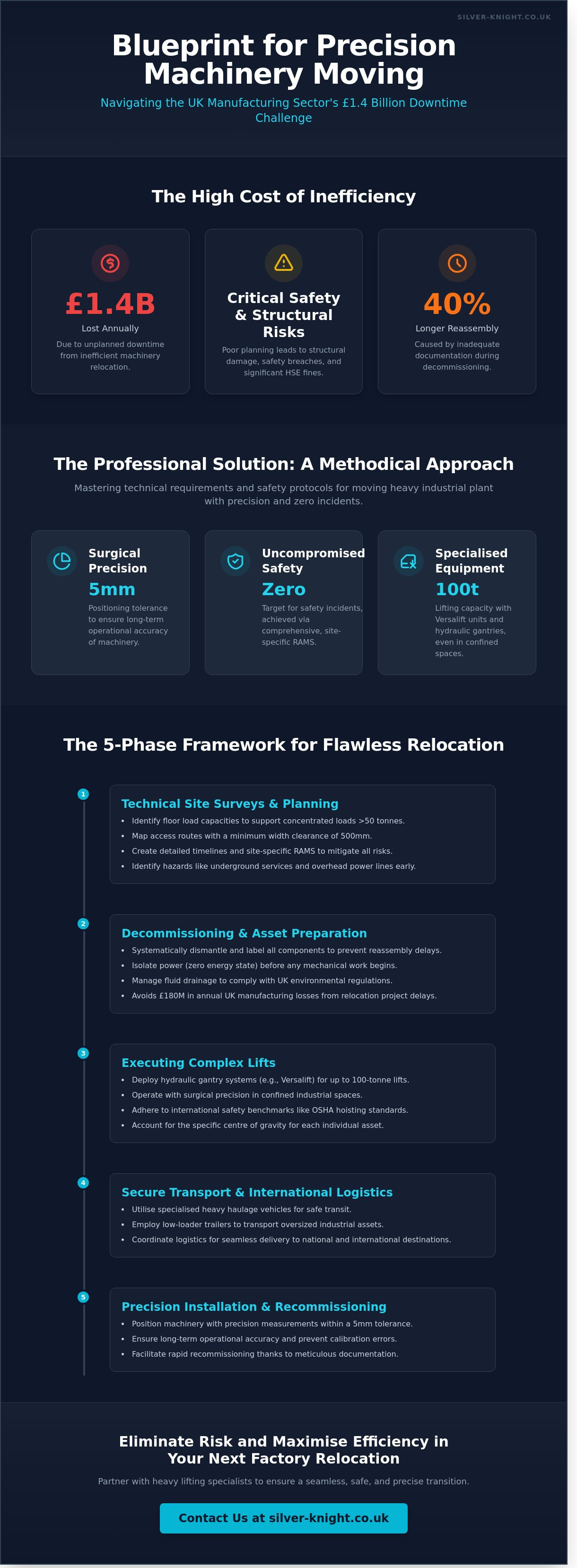
The UK manufacturing sector loses an estimated £1.4 billion annually due to unplanned downtime often caused by inefficient machinery moving and asset relocation.
When you're coordinating the movement of a 40-tonne CNC machine or a complex production line, the margin for error is non-existent.
Poorly planned projects frequently result in structural damage to the plant or site floors that lack the required load-bearing capacity.
Crucially, professional logistics management ensures that every lift stays within a 5mm precision tolerance.
You likely understand that a single safety breach during a factory relocation can halt production for weeks and lead to significant HSE fines under the Health and Safety at Work Act 1974.
As heavy lifting specialists, we advocate for a methodical approach that allows you to master technical requirements and safety protocols for moving heavy industrial plant with precision.
This article provides a best practice blueprint for successful asset relocation using 100-tonne capacity Versalift units and comprehensive RAMS documentation to ensure zero safety incidents.
Key Takeaways
- Identify floor load capacities through initial site surveys to prevent operational bottlenecks during complex factory relocations.
- Reduce revenue loss by following systematic decommissioning protocols that ensure every component is documented for precise reassembly.
- Deploy hydraulic gantry systems for machinery moving to achieve lifting capacities of up to 100 tonnes in confined spaces.
- Utilise specialised heavy haulage and low-loader trailers to transport oversized industrial assets safely to international ports.
- Ensure long-term operational accuracy by positioning machinery with precision measurements within a tolerance of 5mm.
Technical Site Surveys and Project Planning
UK manufacturing output reached £224 billion in 2023, necessitating surgical precision during factory transitions. Effective industrial relocation starts with 100 per cent accuracy during the initial site survey. As heavy lifting specialists, we advocate for a zero-margin approach to prevent operational bottlenecks. Precision planning ensures every asset moves within a 5mm tolerance of its designated footprint.
Technical planning must account for the specific centre of gravity for every individual asset. Crucially, failing to identify the weight distribution of a 20-tonne press can lead to equipment instability during transit.
We utilise specialised material handling equipment to manage these complex load dynamics. This includes our fleet of Versalift units capable of handling up to 100 tonnes in confined industrial spaces.
Establishing Floor Load Limits and Access Routes
Structural engineers must verify that factory floors can support concentrated loads exceeding 50 tonnes. This assessment prevents structural damage to the sub-floor or underground voids during the movement of heavy industrial plant.
Access routes require a minimum width clearance of 500mm beyond the widest point of the machinery. This space is essential for technicians to monitor skate positioning or the movement of iron fairy units. Identifying these clearance factors is the first step in any professional machinery moving operation.
Initial walk-throughs identify potential hazards such as underground services or overhead power lines. Identifying these risks early allows us to implement protective steel plating or height-restrictors to ensure total safety.
Creating a Detailed Relocation Timeline
We sequence the move to ensure critical path machinery is prioritised for decommissioning and transport. This logic ensures that high-value production lines are the first to be operational at the new facility.
Coordination with production teams is vital to minimise the impact of downtime on existing manufacturing contracts. Our factory relocation service focuses on maintaining output through phased equipment removals and installations.
Include buffer periods for technical challenges such as seized floor bolts or complex electrical disconnections. These time slots prevent a single delay from derailing the entire machinery moving schedule.
Comprehensive Risk Assessments and Method Statements (RAMS) are the foundation of every safe industrial relocation. Best practice dictates that RAMS must be site-specific rather than generic templates to address the unique variables of your facility.
https://silver-knight.co.uk/contact-us/
Decommissioning and Asset Preparation
Research indicates that UK manufacturing facilities lose over £180 million annually due to avoidable delays during plant relocation projects. This financial drain often stems from poor decommissioning protocols that compromise asset integrity before the first lift occurs. When managing a complex machinery moving project, the transition from operational state to transport-ready status requires millimetre-perfect planning. Inadequate documentation leads to reassembly timelines extending by 40% beyond original estimates. As heavy lifting specialists, we advocate for a rigorous documentation phase that captures every mechanical and electrical interface.
Systematic dismantling ensures that every component is documented for precise reassembly at the destination. Labeling all electrical and pneumatic connections using a standardised coding system facilitates rapid recommissioning.
It's vital to record the exact orientation of sensors and limit switches to avoid calibration errors during the final install. Crucially, fluid drainage and internal securing are essential to prevent environmental contamination and internal mechanical damage.
Safe Disconnection and Fluid Management
Isolate all power sources and verify zero energy states before any mechanical dismantling begins. Best practice involves draining hydraulic oils and coolants into certified containers to comply with UK environmental regulations.
For complex plant requiring specialist engineering input, our machinery dismantle service provides the technical oversight needed for high-precision assets. Adhering to international safety benchmarks, including OSHA hoisting and rigging standards, ensures that every lift remains within safe working load limits during the dismantling phase.
Internal mechanical damage often occurs when internal counterweights or spindles aren't properly locked. Our engineers ensure that all residual energy is purged from pneumatic systems to prevent accidental activation during the machinery moving process.
Protecting Sensitive Components and Surfaces
Apply anti-corrosive coatings to machined surfaces to prevent oxidation during transit. We secure moving parts with custom steel bracing to withstand the vibrations of heavy haulage.
As heavy lifting specialists, we advocate for export packing techniques for high-value assets destined for international transport. Our fleet, including Versalift 40/60 units and iron fairy cranes, handles loads up to 100 tonnes with precision measurements within 5mm.
Utilising specialised machinery moving equipment ensures that the asset remains level throughout the loading process. This protection phase is the foundation of a successful relocation, ensuring your equipment arrives in the same condition it left the factory floor.
Table of Contents
The UK manufacturing sector contributes approximately £191 billion to the national economy annually.
Modernising these facilities requires the frequent relocation of high-value production assets within existing footprints.
Standard mobile cranes often lack the vertical clearance required to operate safely under factory roofs.
Specialised hydraulic lifting systems provide the necessary capacity to manage these heavy loads in restricted environments.
https://silver-knight.co.uk/contact-us/
Executing Complex Lifts with Specialised Equipment
As heavy lifting specialists, we advocate for using equipment that matches the specific spatial constraints of the factory floor. Hydraulic gantry systems provide vertical lifting capacity up to 100 tonnes in areas with restricted head height.
These systems distribute weight across a wider track to protect the integrity of the industrial floor during a lift. Crucially, this technology allows for the installation of heavy presses where overhead crane access is physically impossible.
Versa-Lift units offer a unique combination of high capacity and compact manoeuvrability for internal warehouse moves. These specialised forklifts feature a telescopic chassis that extends to increase lifting capacity while maintaining a small footprint.
Jack and slide systems allow for the precise positioning of massive loads to within 5mm of the required location. This method is essential for machinery moving projects where equipment must be aligned with existing utility connections or production lines.
Selecting the Correct Lifting Technology
Mobile cranes require significant outrigger footprints and vertical clearance that most UK workshops simply don't have. Hydraulic gantries are the superior choice for indoor environments because they operate entirely within the machine's footprint.
Versa-Lifts are ideal for moving CNC machines within tight production lines due to their telescopic chassis. You should review our equipment to understand the technical specifications of each lifting unit in our fleet.
Our 40/60 Versa-Lift model can handle loads up to 27 tonnes while remaining narrow enough to navigate standard factory aisles. This versatility reduces the need for dismantling complex machines, which saves significant time during a relocation.
Managing Load Stability and Safety
Best practice dictates that qualified slinger signallers must oversee every lift to ensure load stability and personnel safety. Adherence to HSE guidelines on safe lifting operations is mandatory for every project we undertake.
Engineers must verify the weight of the load against the rated capacity of all lifting tackle and equipment before the operation starts. We utilize load cells to provide real-time data on weight distribution during the initial lift-off phase.
Maintain a clear exclusion zone of at least 5 metres around the lifting area during all machinery moving operations. This physical barrier ensures that only essential personnel are present within the immediate work area.
Riggers must inspect all slings and shackles for wear or damage prior to attaching them to the lifting system. Providing full RAMS ensures every technician understands the specific hazards and control measures required for the task.
https://silver-knight.co.uk/contact-us/
Secure Transport and International Logistics
Over 90 per cent of UK manufacturing exports rely on specialised heavy haulage for safe delivery to international ports.
This reliance necessitates a logistical framework that handles both the physical weight and the legal requirements of transit.
Moving a 50 tonne CNC machine across the M6 requires more than just a standard flatbed.
As heavy lifting specialists, we advocate for the use of low-loader trailers that provide a deck height of just 300mm to clear low bridges.
This specialised equipment ensures that oversized assets remain within the national height restriction of 4.9 metres.
Efficient machinery moving depends on this synergy between heavy equipment and meticulous route surveying.
Heavy Haulage and UK Road Logistics
Route planning must account for bridge heights and weight limits across the national road network.
Crucially, any load wider than 2.9 metres requires an ESR1 form submitted to the police at least two clear days before movement.
Abnormal load permits are required for any machinery exceeding standard width or weight dimensions.
Our fleet includes specialised units like the Versalift and iron fairy cranes to manage heavy components in tight loading bays.
These tools allow for the precise positioning of assets within 5mm of their designated transport footprint.
Utilise the machinery haulage relocation transport moving service for nationwide delivery requirements.
Export Packing and Global Shipping
Vacuum packing and desiccants protect sensitive electronics from salt air during sea freight.
This prevents corrosion on precision surfaces that must remain accurate within 5mm upon arrival.
Custom timber crates must be ISPM 15 compliant for all international machinery shipments.
Best practice dictates the use of heat-treated wood to prevent the spread of timber pests across borders.
Maritime logistics also require detailed packing lists and certificates of origin to clear customs without holding fees.
Consult our international machine movers for guidance on global relocation logistics.
Strategic Storage and Buffer Logistics
Secure asset storage provides a strategic buffer during complex factory relocations or site preparations.
We provide 24 hour monitored facilities to house equipment if a destination site isn't ready for immediate installation.
This buffer ensures that the machinery moving process isn't stalled by construction delays at the new facility.
International moves require meticulous documentation to navigate customs and maritime logistics without delay.
Our storage solutions include climate-controlled zones to protect high-value industrial assets from temperature fluctuations.
If you require a secure transition, view our secure warehousing storage service for your project.
This level of care maintains the integrity of internal components during the transition period.
https://silver-knight.co.uk/contact-us/
Precision Installation and Recommissioning
UK manufacturing output reached £224 billion in 2023, necessitating high-precision installation for all relocated production lines.
Final positioning of industrial machinery requires precision measurements within a strict tolerance of 5mm.
When relocating heavy assets like a 40-tonne press, the interface between the machine base and the factory floor must be perfectly managed.
Inaccurate levelling leads to excessive vibration, which damages sensitive internal components and reduces output quality.
As heavy lifting specialists, we advocate for a systematic recommissioning process that includes precision optical levelling and heavy-duty anchoring.
Leveling and anchoring are critical to prevent vibration-related damage and ensure long-term operational accuracy. A successful move concludes only when the asset is fully operational and meets original production specifications.
Final Positioning and Levelling
Our teams use precision optical levels to ensure the machine base is perfectly horizontal across all axes within a 5mm tolerance. This prevents gravitational stress on internal moving parts and ensures the machinery moving process results in a stable production environment.
We install heavy-duty floor anchors to secure the equipment against operational forces and lateral movement. It's often beneficial to integrate the move with a broader factory relocation service for seamless site transitions between industrial units.
As heavy lifting specialists handling loads up to 100 tonnes, we use Versalift and iron fairy units for final millimetre-perfect positioning. This level of control is essential when navigating tight factory footprints where floor loading limits are restricted.
Reconnecting Utilities and Testing
Engineers verify all electrical phases and pneumatic pressures before initiating the first power-up of the relocated asset. Checking the phase rotation prevents motors from running in reverse and causing internal mechanical damage to gearboxes.
We conduct a series of dry runs to ensure all safety interlocks and emergency stops are fully functional. Best practice involves a final inspection against the original decommissioning report to confirm all components are present and correctly fitted.
Recommissioning involves a systematic checklist to restore full power and utility connections safely. This final phase guarantees that the machinery moving project delivers an asset ready for immediate production cycles.
https://silver-knight.co.uk/contact-us/
Secure Your Industrial Asset Relocation
Precision planning ensures site safety and operational continuity during every phase of the project. Our team provides comprehensive RAMS for every project to mitigate complex site risks and adhere to UK health and safety regulations.
Crucially, professional machinery moving requires a specialised fleet including Versa-Lift units and hydraulic gantries for loads up to 100 tonnes. As heavy lifting specialists, we advocate for precision installation within 5mm tolerances to protect your high-value industrial assets.
Best practice dictates that decommissioning and asset preparation must be handled by qualified engineers to prevent mechanical damage. We utilise iron fairy units and bespoke lifting frames to navigate restricted factory environments with total control.
Our logistics experts manage the entire movement from your UK facility to any global destination. This includes managing complex customs documentation and providing specialised packing solutions with full insurance coverage.
With 180 years of collective industry experience, our engineers manage the entire logistics chain from decommissioning to precision recommissioning. We look forward to supporting your next factory relocation with technical excellence and proven reliability.
https://silver-knight.co.uk/contact-us/
Frequently Asked Questions
Documentation required for the machinery moving process
Best practice dictates that every project starts with a comprehensive RAMS to ensure site safety. Crucially, this includes a detailed risk assessment of the site and a step-by-step method statement for the lift to maintain 100% safety compliance.
These technical documents provide the essential framework required for insurance validation and operational efficiency on complex industrial projects.
Lifting capacities of the Versa-Lift fleet
The Versa-Lift fleet includes models capable of lifting loads ranging from 11 tonnes up to 45 tonnes. As heavy lifting specialists, we advocate for these units when machinery moving must occur in confined factory environments where traditional cranes can't operate.
These compact, high-capacity units allow for the safe handling of heavy industrial assets within restricted aisles and low-ceiling areas.
Global machinery relocation service areas
We offer a complete global relocation service covering Europe, the US, India, and Asia. Our team manages the entire logistics chain for assets up to 100 tonnes, ensuring safe passage across international borders and varying transport regulations.
Crucially, we handle all technical documentation and customs requirements to streamline the movement of entire manufacturing lines between global facilities.
Moving heavy machinery in restricted spaces
Specialist equipment such as hydraulic gantries and jack and slide systems are designed for tight spaces. These systems allow for precision placement within 5mm in areas where overhead clearance or floor loading restrictions prevent the use of standard forklifts.
Best practice involves using these tools to ensure heavy assets are positioned correctly without risking damage to sensitive factory infrastructure.
Secure storage for industrial machinery
We provide secure indoor storage for heavy machinery and industrial components at our dedicated facilities. This service supports phased factory relocations where assets must be held securely before the new site is ready for final installation and commissioning.
Crucially, our monitored facilities are equipped to handle heavy loads, providing a safe and professional environment for your high-value industrial equipment.
Insurance cover for machinery moving projects
All machinery moving projects are covered by comprehensive goods in transit and public liability insurance. This protection ensures that your industrial assets are financially secure from the moment the lift begins until the final positioning is complete at the destination.
Crucially, we maintain these high levels of cover to meet the stringent safety and liability requirements of modern UK manufacturing contracts.
Article by
David Ashby
I'm the Managing Director of Silver Knight Haulage & Machinery Ltd. Silver Knight Ltd is a family-run firm established in the West Midlands in 2005, with the aim of providing a cost-effective, yet professional, service to businesses for the removal, transportation, and installation of machinery, plant, and equipment here in the UK and worldwide. Between us, the Silver Knight workforce has over 50 years of experience with machinery and its operation.
Disclaimer
This article is intended for informational purposes only. Please ensure you seek expert advice or carry out your own research to confirm the information is suitable for your specific needs.