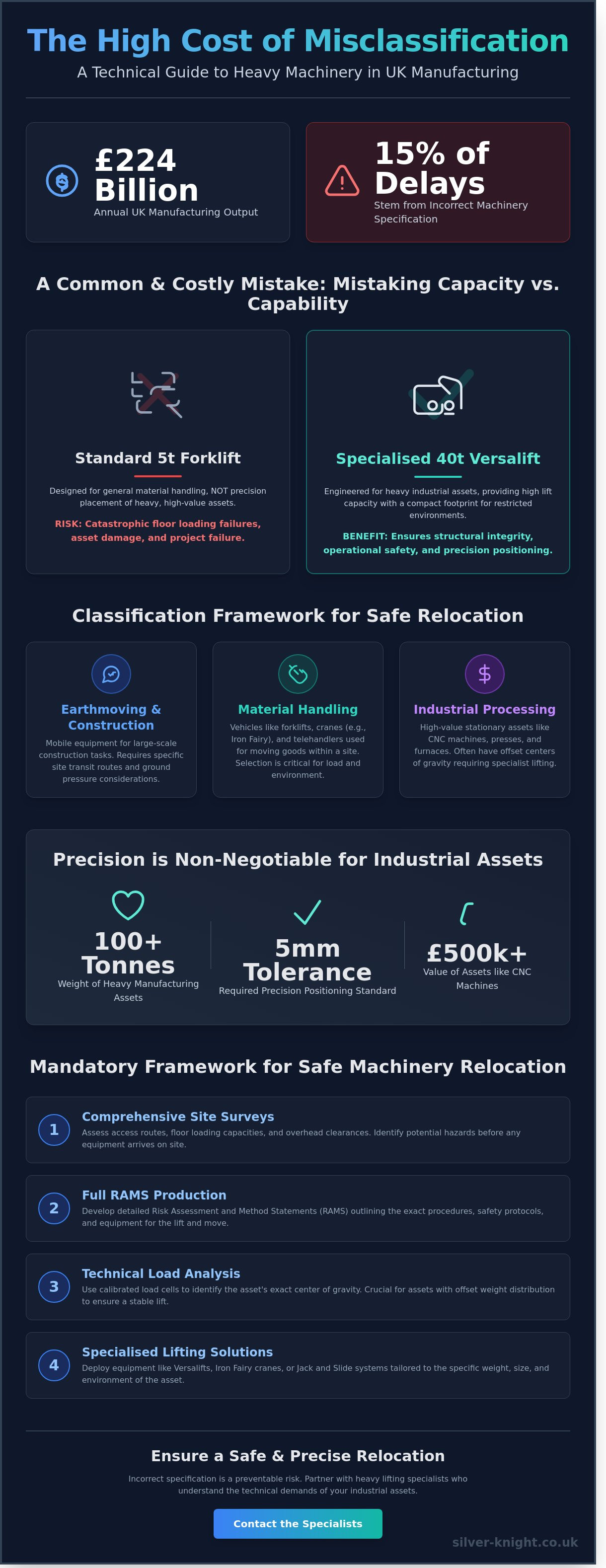
UK manufacturing output reached £224 billion in 2024, yet 15% of project delays stem from incorrect specification of the various types of heavy machinery during plant relocation.
Effective material handling equipment is essential to move heavy loads safely within the defined boundaries of a modern factory or warehouse; for those seeking reliable industrial solutions, PHS Lift provides a comprehensive range of electric forklifts and pallet jacks.
Identifying the specific equipment required for a site move is the first step in ensuring structural integrity and operational safety.
Crucially, mistaking a standard 5 tonne forklift for a specialised 40 tonne Versalift can lead to catastrophic floor loading failures.
Many facility managers struggle to distinguish between general construction plant and high-precision industrial assets, leading to avoidable damage during transport.
As heavy lifting specialists, we advocate for a best practice classification system that prioritises technical specifications over general industry labels.
You likely recognise that protecting a £500,000 CNC machine requires more than just a standard haulage contract.
This guide provides the technical classifications and logistical requirements for the most common types of heavy machinery used in UK industry today.
We'll examine the specific lifting gear needed for safe transit and establish a framework for managing non-standard asset relocations within 5mm precision tolerances.
Key Takeaways
- Categorise the various types of heavy machinery into earthmoving, material handling, and industrial processing groups to streamline your asset management.
- Master the technical requirements for manufacturing assets that weigh up to 100 tonnes and require precision positioning within a 5mm tolerance.
- Discover the logistical framework required for safe machinery relocation, including the mandatory production of full RAMS and comprehensive site surveys.
- Evaluate specialised lifting solutions such as iron fairy units to ensure safe equipment movement within restricted factory environments.
Table of Contents
Classifying Heavy Machinery by Industrial Application
https://silver-knight.co.uk/contact-us/
Classifying Heavy Machinery by Industrial Application
The UK manufacturing sector contributes approximately £224 billion to the national economy annually.
This output relies on a vast array of heavy equipment to process materials and assemble goods.
Heavy machinery refers to heavy-duty vehicles and stationary plant designed for large-scale construction or manufacturing tasks.
Industry experts typically categorise these assets into earthmoving, material handling, and industrial processing groups.
Crucially, every machine type presents unique challenges regarding weight distribution and structural centre of gravity.
As heavy lifting specialists, we advocate for a technical survey before any machinery is moved or installed.
UK logistics firms moved over 1.4 billion tonnes of goods using various types of heavy machinery last year. The specific classification of an asset dictates the complexity and safety protocols required for any factory relocation project.
Heavy assets often have offset centres of gravity that make standard lifting procedures dangerous for untrained operators. Our teams use calibrated load cells to identify the exact balance point before any lift begins.
The Distinction Between Mobile and Stationary Equipment
Mobile equipment includes vehicles like excavators and haulers that operate on tracks or heavy-duty tyres. These units often weigh between 10 and 50 tonnes and require specific transit routes within a site.
We utilise a fleet of Versalift units to manage internal moves where overhead clearance is restricted to less than 3 metres. These compact machines provide the lifting capacity of much larger units while maintaining a small footprint.
Stationary plant refers to fixed industrial assets like presses or furnaces that require specialised heavy equipment moving for relocation. Moving these assets involves precision Jack and Slide systems to navigate tight factory spaces within 5mm tolerances.
Understanding this distinction is vital for determining the required transport permits and escort vehicles. Heavier stationary units exceeding 44 tonnes may require STGO Category 2 or 3 permits for UK road travel.
Primary Power and Traction Systems
Most heavy machinery utilises high-torque diesel engines or advanced electric motors for hydraulic power. These systems generate the immense force needed to lift loads that frequently exceed 80 tonnes in industrial settings.
Modern electric-drive machinery is becoming standard in food-grade environments to eliminate exhaust emissions. These units provide the same high-torque performance as diesel counterparts while adhering to strict UK health and safety regulations.
Traction systems vary between off-the-road (OTR) tyres and continuous tracks for low ground pressure. Tracks are essential for soft UK terrain to distribute weight and prevent the machine from sinking into the subsoil.
Best practice dictates that traction type must match the site terrain to prevent surface damage during operation. Using the wrong tyre compound on a finished factory floor can result in surface repairs costing thousands of pounds.
Table of Contents
Precision Manufacturing and Industrial Processing Machinery
Frequently Asked Questions
https://silver-knight.co.uk/contact-us/
Precision Manufacturing and Industrial Processing Machinery
The UK manufacturing sector contributes approximately £224 billion to the national economy annually. These high-value industrial manufacturing environments rely on heavy machinery that often weighs up to 100 tonnes. Maintaining a precision positioning tolerance within 5mm is the standard requirement for these assets. Relocating these units involves complex machinery dismantle services to ensure safe passage through restricted factory exits. Structural integrity remains highly sensitive to vibration and tilting during transit. As heavy lifting specialists, we advocate for comprehensive surveys before any physical movement begins.
CNC Centres and Milling Machines
Computer Numerical Control (CNC) machines represent the primary types of heavy machinery used in modern precision engineering. Large-scale milling centres can occupy over 50 square metres of floor space and require multi-part transport. The sheer size of these units makes them difficult to move through standard industrial doorways. Crucially, these machines must be levelled with extreme accuracy to maintain manufacturing tolerances. As heavy lifting specialists, we advocate for the use of laser-levelling tools and specialised jacks to ensure stability. Our team recently managed the relocation of a 45 tonne milling centre using iron fairy units to navigate tight workshop corners.
Injection Moulding and Power Presses
Injection moulding machines for plastic production are characterized by their long horizontal footprints and heavy clamping units. These units are among the most difficult types of heavy machinery to transport due to their uneven weight distribution. Power presses utilised in metal stamping exert thousands of tonnes of force and feature massive vertical heights. Moving these units often requires navigating overhead obstructions within a factory environment. Best practice involves using specialised hydraulic systems like our Versalift fleet to manage these top-heavy assets safely. Compliance with OSHA equipment safety standards ensures that mechanical equipment is properly secured during such high-risk lifts. We also provide factory relocation services that integrate the removal and reinstallation of these complex press lines.
https://silver-knight.co.uk/contact-us/
Frequently Asked Questions
How do you handle 100 tonne machines in tight spaces
We utilise a combination of heavy-duty skates and compact Versalift units to navigate narrow factory aisles. This approach allows for precision movement within 5mm of the designated installation point. Every project includes the provision of full RAMS to ensure all safety protocols are strictly followed.
What is the risk of tilting during machine transport
Excessive tilting can cause internal misalignment in sensitive milling centres and power presses. We monitor tilt angles constantly using digital sensors to prevent any breach of the manufacturer's structural integrity limits. Our team provided full RAMS for a recent 80 tonne press relocation to guarantee a zero-incident delivery.
https://silver-knight.co.uk/contact-us/
Earthmoving and Construction Equipment Categories
UK construction output reached a record high of £15,500 million in monthly value during 2024.
This growth drives a continuous demand for heavy plant across national infrastructure frameworks.
Transporting massive earthmovers presents a significant logistical hurdle for site managers.
As heavy lifting specialists, we advocate for integrated transport planning to ensure machinery arrives on schedule.
Earthmoving equipment is designed for excavating, grading, and moving large volumes of soil or debris. These machines are ubiquitous on UK infrastructure projects and vary significantly in size and capacity.
Best practice involves selecting the specific machine type based on the required bucket volume and reach. Selecting an undersized unit can increase fuel consumption by 15 percent due to excessive cycle times.
Crucially, understanding the different types of heavy machinery available allows for better site resource allocation. We provide specialized machinery haulage to move these assets between project phases.
Haulage of these vehicles often requires low-loader trailers to accommodate their height and width. Moving a 3.5-metre wide unit often requires a police escort or private pilot car depending on the route.
Excavators and Backhoes
Excavators are versatile machines featuring a rotating platform and a powerful hydraulic boom for digging. These machines range from 1-tonne micros to massive 80-tonne units used in quarrying.
Backhoes combine a front-loading bucket with a rear-mounted digger for multi-purpose site work. They're ideal for urban projects where space constraints prevent the use of multiple dedicated machines.
As heavy lifting specialists, we advocate for checking the lifting chart of an excavator before attempting any pipe-laying tasks. Precision hydraulic controls allow these units to place components within a 10mm tolerance.
Bulldozers and Motor Graders
Bulldozers utilize heavy metal blades to push massive quantities of material across a site. The D11 class bulldozer can move up to 25 cubic metres of earth in a single pass.
Motor graders feature long blades used to create flat surfaces for road construction. These machines are essential for achieving the precise 1 in 40 falls required for UK drainage standards.
Both machine types require careful track maintenance to ensure efficient power delivery to the ground. Worn grousers or loose track tension can reduce pushing force by up to 20 percent during heavy operations.
Crucially, selecting the right types of heavy machinery for grading ensures that the sub-base meets engineering specifications. Using a grader with 3D GPS control can improve grading accuracy to within 5mm of the design level.
https://silver-knight.co.uk/contact-us/
Material Handling and Specialized Lifting Systems
Over 3,000 UK manufacturing plants relocated or upgraded their internal layouts in 2024 to accommodate automated production lines, which often rely on specialized conveyor components like roll-end bearings; read more.
Effective material handling equipment is essential to move heavy loads safely within the defined boundaries of a modern factory or warehouse.
Standard cranes often lack the necessary access to restricted industrial spaces where height and floor loading are constrained.
Our specialized fleet utilizes Versa-Lift units and iron fairy cranes to overcome these specific logistical obstacles.
Crucially, these machines must be operated by qualified personnel to ensure full compliance with LOLER 1998 regulations. Our team provides full RAMS for every lift to mitigate risks associated with these complex types of heavy machinery.
Iron fairy cranes are specifically designed for low-headroom environments where a telescopic boom is required to reach over obstacles. These compact units offer high manoeuvrability within active production environments where space is at a premium.
As heavy lifting specialists, we advocate for the use of specialized lifting systems when traditional methods fail to meet site constraints. Properly selected equipment reduces the risk of downtime during critical equipment installations.
Versa-Lift and Heavy-Duty Forklifts
The Versa-Lift is a unique forklift featuring an extendable counterweight frame that increases lifting capacity while maintaining a compact footprint. These units can lift up to 45 tonnes, which makes them ideal for moving heavy machinery through tight factory aisles.
As heavy lifting specialists, we advocate for Versa-Lifts when overhead clearance is limited to less than 3 metres. They provide the versatility required for complex internal relocations without the need for dismantling high-level infrastructure.
Modern heavy-duty forklifts often incorporate non-marking tyres to protect epoxy-coated factory floors from damage. This level of technical detail ensures that the relocation process doesn't compromise the integrity of the facility.
Hydraulic Gantries and Jack Systems
Hydraulic gantry systems provide a safe lifting solution for loads exceeding 100 tonnes where traditional mobile cranes are impractical. These systems distribute weight across a wider area to protect sensitive industrial flooring from structural cracking.
Jack and slide systems allow for the horizontal movement of massive assets with precision within 5mm. Best practice involves using these systems for the final positioning of heavy industrial plant in confined basements or mezzanine levels.
By using low-profile jacks, engineers can lift heavy machinery just high enough to insert skates or slide tracks. This method is often the only viable solution for installing large transformers or press machines in restricted areas.
To ensure your project meets all safety standards, you can hire our specialized lifting equipment for your next relocation.
Logistics and Safety Standards for Machinery Relocation
UK heavy haulage regulations require specific permits for any industrial load exceeding 2.9 metres in width. Transporting diverse types of heavy machinery requires meticulous route planning across the UK motorway network. Bridge clearances and axle loading limits often restrict movement for units weighing over 44 tonnes. We utilize a professional factory relocation service framework to manage these technical variables.
Moving heavy machinery requires a rigorous framework to mitigate risks during transit. Every move must be preceded by a comprehensive site survey and the production of full RAMS.
Technical facts regarding axle loading and bridge clearances must be verified for all UK transport routes. As heavy lifting specialists, we advocate for a zero-compromise approach to industrial safety.
Risk Assessments and Method Statements
RAMS are the legal foundation of any safe machinery move in the United Kingdom. These documents outline every technical step of the lift, including equipment capacities up to 100 tonnes and emergency procedures.
Crucially, all staff must be briefed on the method statement before any equipment is engaged. This ensures that operators of our Versalift units understand the specific weight distribution of the load.
International Transport and Export Packing
Global relocation requires specialized export packing to protect machinery from sea spray and impact. Heavy machinery must be securely lashed and blocked within containers or on flat-rack trailers to prevent shifting.
Best practice involves utilizing moisture-barrier foils for high-precision electronic components. These foils prevent corrosion on sensitive circuits that require alignment within 5mm during re-installation.
https://silver-knight.co.uk/contact-us/
Frequently Asked Questions
What documents are required for a machinery move
Every lift requires a comprehensive site survey and the production of full RAMS. These documents outline the technical steps and specific equipment capacities needed for the project. We ensure all legal safety standards are met before any machinery is moved.
How is machinery secured for sea freight
We use specialized export packing and moisture-barrier foils to protect against corrosion. Machinery is securely lashed and blocked within containers to prevent movement during transit. This process ensures that precision components remain within their 5mm alignment tolerances.
Can you move equipment in tight industrial spaces
Our fleet includes iron fairy units designed specifically for low headroom and restricted access environments. We utilize these compact cranes to navigate factory floors where traditional lifting gear cannot operate. This allows for the safe relocation of heavy plant without requiring major structural alterations to your facility.
https://silver-knight.co.uk/contact-us/
Optimising Your Industrial Asset Strategy
Selecting the right types of heavy machinery requires a balance between technical capacity and strict onsite safety protocols. Best practice dictates that every installation project must be supported by full RAMS to mitigate operational risks across UK factory floors.
Crucially, modern manufacturing demands precision positioning within 5mm to ensure complex production lines integrate without mechanical failure. As heavy lifting specialists, we advocate for using specialised plant like Versalift or iron fairy units for intricate internal relocations.
Managing loads up to 100 tonnes involves more than just raw power; it requires a detailed understanding of logistics and floor loading limits. Engineering teams must evaluate structural integrity before any heavy plant enters the facility to prevent costly substrate damage.
Accurate weight assessment is a critical component of this evaluation; for those seeking professional industrial weighing solutions, discover Independent Scale Service for expert equipment and support.
Your equipment strategy must focus on operational longevity and total compliance within current UK industrial safety standards. It's essential to partner with experts who provide full RAMS and precision engineering for every move.
We're ready to support your next major project with expert technical guidance and heavy lift engineering. This ensures your facility remains competitive and efficient throughout 2026.
https://silver-knight.co.uk/contact-us/
Frequently Asked Questions
What qualifies as heavy machinery
Heavy machinery includes high-capacity mechanical devices designed for complex industrial tasks such as construction, manufacturing, and logistics. Crucially, these assets typically weigh over 5,000kg or exert force exceeding 100kN to handle materials that standard plant cannot manage.
As heavy lifting specialists, we advocate for the provision of full RAMS before any 10-tonne unit is moved to ensure total site safety.
How are industrial machines classified
Industrial assets are classified by their primary function, such as earthmoving, lifting, or processing, alongside their gross vehicle weight. These types of heavy machinery often fall into categories defined by UK health and safety regulations for plant operations to maintain workplace standards.
Best practice dictates that every machine is logged by its specific lifting capacity, such as a 40-tonne gantry system, to ensure site compliance.
Which heavy machinery is used in factory relocations
Factory relocations require specialised equipment like Versalift 40/60 units and iron fairy cranes to manage tight internal spaces and high-value assets. We use hydraulic gantry systems to move production lines with precision measurements within 5mm of the original floor plan.
Every relocation project we manage includes a comprehensive RAMS document to mitigate risks during the movement of 25-tonne CNC machines.
What is the difference between earthmoving and material handling equipment
Earthmoving equipment like 360-degree excavators is designed for displacing soil and rock on construction sites during the initial groundworks phase. In contrast, material handling units like 10-tonne forklifts focus on the internal movement of palletised goods or heavy machinery components.
As heavy lifting specialists, we advocate for using the correct class of equipment to ensure load stability during every 50-tonne lift.
How do you transport oversized heavy machinery
Transporting oversized units requires multi-axle low-loader trailers and strict adherence to UK STGO regulations for abnormal loads on public highways. Crucially, any load exceeding 2.9 metres in width requires a 48-hour notice to the police and potential escort vehicles to ensure safe passage.
We ensure all transport plans include a detailed site survey to confirm the route can handle a 60-tonne gross vehicle weight.
Are specialized lifting systems considered heavy machinery
Specialised lifting systems like hydraulic jacks and heavy-duty skates are classified as essential heavy machinery for precision engineering and internal plant movements. These systems allow for the controlled movement of assets weighing up to 100 tonnes within confined factory environments where cranes cannot operate.
Best practice involves testing every skate system to its maximum rated capacity before starting a machine installation.

Article by
David Ashby
I'm the Managing Director of Silver Knight Haulage & Machinery Ltd. Silver Knight Ltd is a family-run firm established in the West Midlands in 2005, with the aim of providing a cost-effective, yet professional, service to businesses for the removal, transportation, and installation of machinery, plant, and equipment here in the UK and worldwide. Between us, the Silver Knight workforce has over 50 years of experience with machinery and its operation.
Disclaimer
This article is intended for informational purposes only. Please ensure you seek expert advice or carry out your own research to confirm the information is suitable for your specific needs.