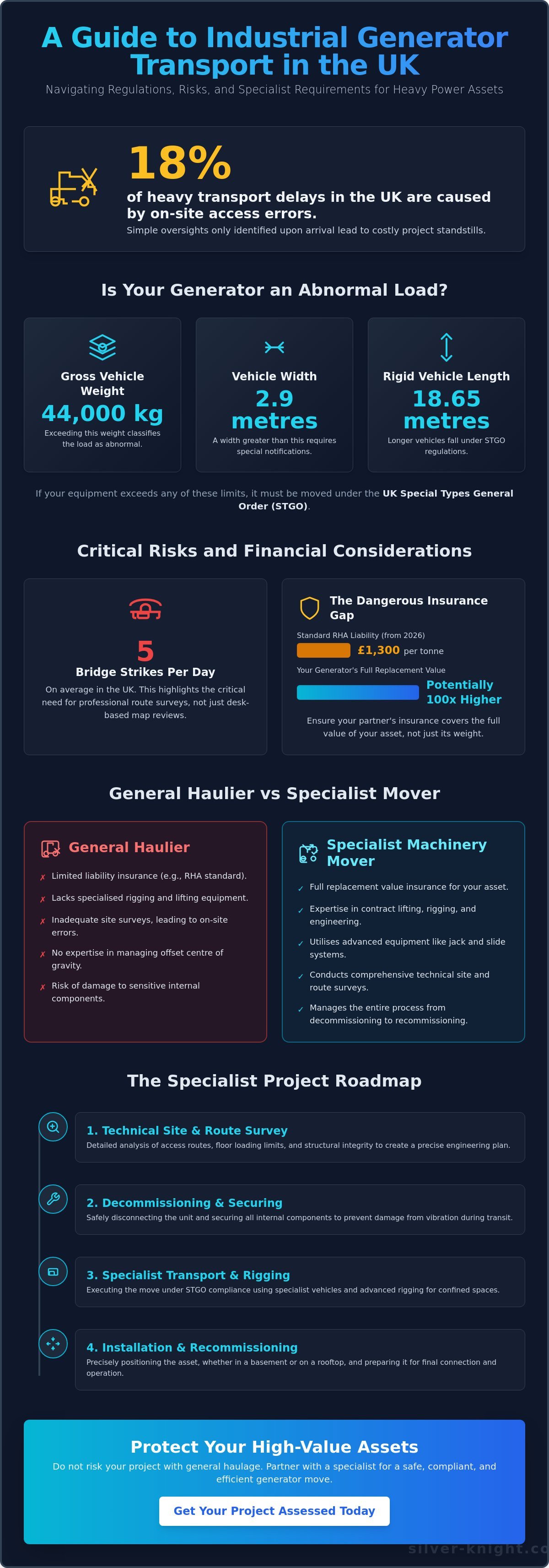
Did you know that 18% of heavy transport delays in the UK are caused by site access errors that are only identified once the vehicle arrives? When you are planning an industrial generator transport project, a simple oversight regarding structural integrity or a narrow access route can lead to expensive delays. It's not just a haulage task; it's a complex rigging and engineering challenge that requires absolute precision.
You likely feel the pressure of managing these high-value assets whilst worrying about hidden costs from road permits or police escorts. With the GB Type Approval Scheme now in effect and stricter Direct Vision Standards enforced for HGVs, the legal landscape is more demanding than ever. It's understandable to feel anxious about moving heavy assets into confined spaces like basements or rooftops without a clear plan.
This guide will help you manage the technical and legal complexities of moving heavy power generation equipment across the United Kingdom safely and efficiently. We will break down the essential 2026 regulations, explain the difference between general haulage and specialist machinery moving, and provide a roadmap for a successful project.
Key Takeaways
- Understand why industrial generator transport requires precise engineering calculations for weight distribution and centre of gravity rather than standard haulage methods.
- Learn how to identify when your power equipment qualifies as an abnormal load under UK STGO categories to avoid legal penalties and site delays.
- Discover the advantages of specialised jack and slide systems over traditional crane hire for moving generators into restricted basement or rooftop locations.
- Master the essential steps for decommissioning and securing internal components to protect your assets during the transit phase.
- Identify the critical differences between general hauliers and specialist industrial movers to ensure your project benefits from expert rigging and contract lifting expertise.
You can find expert support for your next project by visiting the Silver Knight machinery moving website.
The Complexity of Industrial Generator Transport
Moving a massive power unit isn't as simple as loading it onto a flatbed. Industrial generator transport involves managing heavy, sensitive equipment that often has an offset centre of gravity. Unlike a standard crate, a generator's weight isn't always evenly distributed. This makes the lifting and securing process a high stakes engineering task. If the rigging isn't precise, the unit can tilt or shift, causing catastrophic damage to the frame or the surrounding site.
To better understand this concept, watch this helpful video:
Beyond the physical weight, internal components are highly vulnerable to vibration during transit. Sensitive control panels and cooling systems can fail if the haulage isn't properly dampened or if the route planning is poor. This is why a technical site survey is the absolute foundation of a successful move. It identifies structural weak points, such as hidden voids or weak floor slabs, and clearance issues before the equipment even leaves the ground. Without this detailed assessment, you risk unexpected site damage that could halt your entire power project.
Critical Weight and Dimension Factors
Calculating the total weight is more than just reading the manufacturer's plate. You must account for full fuel tanks and heavy weather enclosures which can add several tonnes to the total. These dimensions often push an industrial generator transport project into the category of abnormal load regulations, requiring specific notifications and permits. Height is equally critical; an extra few centimetres can turn a direct route into a hundred mile detour to avoid low bridges and overhead cables.
Site Access and Environmental Restrictions
Many power projects occur in noise sensitive areas or city centres where working hours are strictly controlled by local councils. You might also face floor loading limits, especially when moving assets into basements or through narrow corridors. When a generator is destined for a rooftop, the complexity increases significantly. It requires specialist heavy moving equipment and careful planning to ensure the building's structure isn't compromised during the lift or installation phase.
You can find expert assistance for your project by choosing a specialist machinery moving company to handle the logistics.
Navigating UK Regulations for Abnormal Loads
Compliance is the most critical hurdle in any industrial generator transport project. In the UK, a load is classified as abnormal if it exceeds a gross vehicle weight of 44,000kg, a width of 2.9 metres, or a rigid length of 18.65 metres. Most large scale power units fall into these categories, meaning they must be moved under the Special Types General Order (STGO). Failing to adhere to these UK abnormal load regulations can result in heavy fines and the immediate seizure of the vehicle.
Safety standards like the Fleet Operator Recognition Scheme (FORS) provide a framework for maintaining high operational quality. Beyond basic road safety, you must consider the financial protection of your assets. As of January 1, 2026, the standard Road Haulage Association (RHA) liability limit is £1,300 per tonne. This is often far below the actual value of a modern industrial generator. You should always ensure your heavy haulage partner provides insurance that reflects the full replacement cost of the equipment rather than just its weight.
Route Surveys and Feasibility Studies
With an average of five bridges struck by vehicles in the UK every single day, route planning is a matter of public safety. A desk based map review isn't enough for oversized power assets. Specialist movers conduct physical route walk-throughs to identify low hanging cables, weak bridges, and narrow village corners. Since 18% of heavy transport delays are caused by site access errors identified only upon arrival, these surveys prevent costly stand-down time for your engineering teams. You may also need to coordinate the temporary removal of street furniture, such as bollards or traffic lights, to allow for the tight turning circles required by multi-axle trailers.
Police Liaison and Escort Vehicle Coordination
Moving an abnormal load requires formal notification through the Electronic Service Delivery for Abnormal Loads (ESDAL) system. Depending on the dimensions, you must notify the police, highway authorities, and bridge owners between two and five days before the move. Whilst some projects only require a private escort vehicle to warn other road users, massive units may require a full police escort. The Crime and Policing Bill of 2026 has introduced a more consistent national framework for police escort charging, helping to reduce the £584 million annual cost of inconsistent enforcement. If you are unsure about the specific permits your project requires, you can speak with a logistics expert to clarify the necessary legal steps.
To ensure your heavy assets are moved with the highest level of precision, you can explore professional machinery moving services today.
Specialist Lifting and Rigging for Power Assets
Industrial generator transport is often viewed as a haulage task, but the rigging phase is where the real technical skill is required. Standard crane hire is excellent for open sites with clear overhead space. However, many UK power projects take place in restrictive environments where a large mobile crane simply cannot reach. In these scenarios, jacking and sliding systems become the primary solution. These tools allow heavy units to be moved horizontally with millimetre precision, which is vital when positioning a generator onto a pre-cast concrete plinth.
For faster deployment, lorry mounted cranes provide a versatile option. They combine transport and lifting capabilities in a single vehicle, reducing the number of moving parts in your logistics chain. When dealing with exceptionally tall generator sets, low-loaders or modular trailers are essential to maintain safe bridge clearances. All of these operations must strictly adhere to the Specialist Lifting and Rigging Regulations set out by the HSE. These rules ensure that every lift is planned by a competent person and performed with thoroughly inspected equipment. As of January 19, 2026, new ABA training categories for workplace transport have also increased employer accountability, meaning every operator handling your power assets must be specifically competent on the machinery they use.
Hydraulic Gantry and Jacking Systems
Hydraulic gantry systems offer a safer alternative to traditional cranes in low-headroom areas like factory floors or plant rooms. They can lift multi-megawatt power stations vertically before sliding them into position along a track. This method minimises the risk of "swing" associated with suspended crane loads. Using jack and slide systems allows for controlled movement in three dimensions, ensuring that even the most complex generator installations are completed without damaging the surrounding infrastructure or the unit itself.
Versa-Lift and Forklift Applications
When space is at a premium, the versa lift is often the preferred tool for heavy machinery moving. Its extendable chassis and high lifting capacity allow it to handle massive weights whilst remaining compact enough to drive through standard warehouse doors. Alongside these heavy lifters, forklift moving services play a vital role in managing peripheral equipment like fuel tanks and switchgear. To protect the site, specialist floor protection mats are used to distribute the weight of the rigging equipment, preventing cracks in industrial floor slabs during heavy indoor operations.
You can find professional support for your project by choosing a specialist machinery moving company to handle the technical aspects of the relocation.
Managing the Decommissioning and Recommissioning Phases
Industrial generator transport involves far more than the physical move. The process begins with a systematic approach to machinery dismantling, ensuring every connection is safely isolated. Before the unit is even lifted, all fluids must be managed and internal components secured. Sensitive internal panels or cooling fins can easily be damaged by transit vibrations if they aren't properly braced. This phase requires a high level of technical understanding to prevent the generator from being compromised before it even reaches the public highway.
Once the move is complete, the recommissioning phase demands a collaborative effort between the moving team and the site's power engineers. Precision levelling is essential for the long-term health of the engine. If the generator sits at even a slight angle, it can lead to uneven wear on internal bearings or serious issues with the exhaust alignment. Recommissioning is the stage where the physical asset is integrated into the site's operational framework; this requires careful coordination to ensure all safety systems are fully functional before the power is restored.
Technical Disconnection and Site Preparation
Safely disconnecting electrical and fuel lines is the first critical step. Every wire and pipe should be documented to ensure the reinstallation process is as smooth as possible. This preparation extends to the transport base itself. During an industrial generator transport project, the unit must be securely bolted to the trailer, with specific attention paid to the weight distribution discussed in earlier sections. This ensures the load remains stable throughout its journey, regardless of road conditions or sudden braking. Proper documentation during disconnection serves as the roadmap for a successful rebuild at the destination.
Precision Positioning and Final Installation
When the generator arrives at its destination, the challenge shifts to micro-positioning. Aligning the unit with existing infrastructure and exhaust systems often requires the use of specialised skates. These allow for tiny adjustments that would be impossible with a crane alone. Once perfectly aligned, the unit is anchored to its permanent location. This final stage is what turns a piece of transported equipment back into a functional power asset. It's a delicate process where patience and high-quality equipment are more valuable than speed. If you need professional support with your next project, contact our team for expert advice on machinery installation.
If you are planning a complex power project, you can find more information about our specialist services on the Silver Knight website.
Selecting an Industrial Transport Partner
Choosing the right partner for industrial generator transport is the most important decision in your project timeline. Whilst a general haulier might have the vehicles, they often lack the deep engineering knowledge required for complex rigging. A specialist industrial moving company brings a different level of expertise to the site. They understand that a generator is a precision instrument, not just a heavy weight. This distinction is vital when you consider that 180 years of collective experience provides a safety advantage that cannot be replicated by standard transport firms.
Working with a family run business often leads to better project communication and a higher degree of personal accountability. You aren't just another booking in a massive corporate system; your project is handled by people who value their reputation for reliability. This personal touch ensures that if challenges arise on site, you have direct access to decision makers who can solve problems quickly. It's this combination of technical skill and dedicated service that keeps complex UK power projects on schedule and within budget.
Risk Assessments and Method Statements
A professional project plan is defined by the quality of its Risk Assessments and Method Statements (RAMS). You should look for documents that go beyond generic templates. Detailed RAMS should outline every stage of the move, from the initial decommissioning to the final positioning. These plans reduce the likelihood of site delays by identifying potential hazards before the work begins. It's also essential to ensure that all staff are qualified under the new ABA training categories enforced from January 19, 2026. This ensures that every operator is specifically competent on the exact machinery used for your lift.
Professional Credentials and Global Reach
Whilst local knowledge is helpful, your partner should ideally offer national coverage and international machinery transport capabilities. This global reach demonstrates a high level of operational maturity and an ability to manage complex logistics across different regulatory environments. When evaluating a partner, check their safety records and industry-specific certifications. A company that invests in modern equipment, such as hydraulic gantry systems and Versa-Lift units, is better equipped to handle the evolving demands of the power sector. This balance of local expertise and national reach provides the flexibility needed for large scale industrial generator transport across the UK.
For expert assistance with your power project, visit the Silver Knight homepage for a full list of our services.
Securing Your Power Infrastructure for the Future
Managing a power project in 2026 requires more than just logistical planning; it demands a deep understanding of evolving UK transport laws and precise engineering. You've seen how technical site surveys and a mastery of abnormal load regulations prevent the delays that affect nearly a fifth of heavy moves. By prioritising specialist rigging and decommissioning over general haulage, you ensure your high value assets remain protected from the risks of vibration and structural stress.
Successful industrial generator transport relies on the right equipment and the right expertise. With 180 years of collective industry experience and a specialist fleet including Versa Lifts and hydraulic gantries, our team provides comprehensive national and international support. We handle the complexities so you can focus on delivering power where it's needed most.
If you're ready to plan your next move, you can contact Silver Knight for a professional generator transport quote today. With the right partner, even the most challenging installations become straightforward and safe.
Frequently Asked Questions
Do I need a special permit for industrial generator transport in the UK
You need a special permit if your generator meets the criteria for an abnormal load. This applies if the gross vehicle weight exceeds 44,000kg, the width is over 2.9 metres, or the rigid length is more than 18.65 metres. You must submit notifications through the Electronic Service Delivery for Abnormal Loads (ESDAL) system to inform the police and highway authorities before the move begins.
Can you move a generator from a basement or rooftop
Moving a generator from a basement or rooftop is possible with specialist equipment like hydraulic gantry systems or jack and slide systems. These tools allow for precise horizontal and vertical movement in confined spaces where a standard crane cannot operate. A technical site survey is essential to check floor loading limits and structural integrity before the lift starts.
What is the difference between a contract lift and crane hire
The main difference lies in who takes responsibility for the lift. In standard crane hire, you are responsible for the planning, insurance, and safety of the operation. With a contract lift, the machinery moving company manages the entire process, including the risk assessments and method statements. This provides a safer and more comprehensive service for complex power projects.
How long does it take to plan a heavy generator move
Planning timelines vary based on the complexity of the route and the size of the equipment. For an industrial generator transport project that qualifies as an abnormal load, you generally need to allow at least two to five days for statutory notifications. More complex moves involving physical route surveys or street furniture removal can take several weeks to organise properly.
Are your drivers and riggers trained for abnormal load handling
Every member of a professional rigging and transport team must be specifically trained to handle heavy assets. From January 19, 2026, new ABA training categories for workplace transport have increased the requirements for operator competency. This ensures that every rigger and driver understands the specific technical challenges of moving multi-megawatt generators safely.
Do you provide storage for industrial generators during a relocation
Machinery storage is available for industrial generators that cannot be moved directly to their final destination. This is often necessary during factory relocations or when site preparations are delayed. You should check that any storage facility is secure and capable of handling the significant weight and dimensions of power generation equipment.
Can you manage international generator transport to Europe or the US
International machinery transport services cover the movement of generators to Europe, the US, and beyond. This involves managing customs documentation, shipping container packing, and coordinating with international haulage partners. A specialist mover will oversee the entire journey, ensuring the generator is decommissioned correctly before it leaves the UK and recommissioned upon arrival.

Article by
David Ashby
I'm the Managing Director of Silver Knight Haulage & Machinery Ltd. Silver Knight Ltd is a family-run firm established in the West Midlands in 2005, with the aim of providing a cost-effective, yet professional, service to businesses for the removal, transportation, and installation of machinery, plant, and equipment here in the UK and worldwide. Between us, the Silver Knight workforce has over 50 years of experience with machinery and its operation.
Disclaimer
This article is intended for informational purposes only. Please ensure you seek expert advice or carry out your own research to confirm the information is suitable for your specific needs.