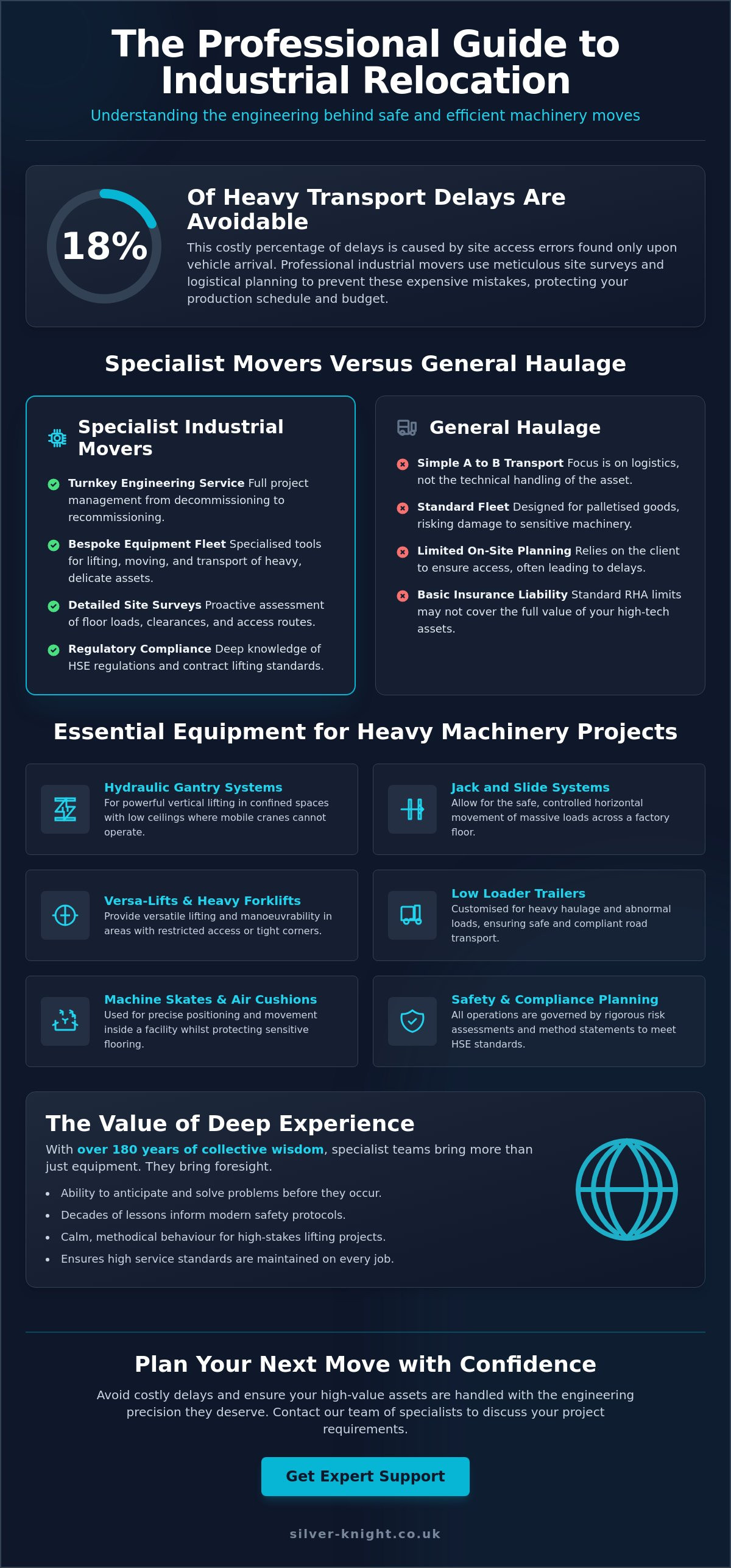
Did you know that 18% of heavy transport delays across the country are caused by site access errors that are only spotted when the vehicle arrives? This statistic highlights why choosing experienced industrial equipment movers UK is a decision that impacts your entire production schedule. It isn't just about moving a crate from one place to another; it's a precise engineering task that requires careful planning to avoid expensive mistakes.
Most factory managers feel a sense of dread when they have to relocate high-value assets. You likely worry about potential damage during transit, the impact of production downtime, or whether the project stays compliant with the latest HSE regulations. This guide shows you how specialist industrial movers protect your assets and maintain operational continuity during complex relocations. You'll learn about the latest 2026 safety standards, the realities of RHA liability limits, and the technical strategies used to ensure your machinery arrives safely and on time.
Key Takeaways
- Understand how professional industrial equipment movers UK use engineering expertise to mitigate the risk of site access delays and logistical errors.
- Learn about the specialised tools like hydraulic gantry systems and Versa-Lifts that ensure safe lifting and movement within confined factory spaces.
- Discover the critical planning differences between moving a single CNC machine and relocating an entire production line without losing operational time.
- Identify the legal standards for contract lifting and equipment safety to ensure your business remains fully compliant with current UK health and safety regulations.
- Find out the key criteria for vetting a relocation partner to guarantee your machinery is protected by technical skill and the correct insurance coverage.
If you are planning a complex move, you can find professional support from a leading provider of machinery moving services.
The role of specialist industrial equipment movers in the UK
To better understand the precision required during these operations, watch this video showing technical movement in action:
Why general haulage is not enough for industrial assets
Standard hauliers typically lack the specialised kit needed for precision engineering tools. When moving various types of industrial machinery, it is vital to understand the delicate internal components that can be thrown out of alignment by vibration or improper securing. General transport fleets are designed for palletised goods, whereas industrial equipment movers UK use bespoke trailers and lifting frames. Professional movers conduct detailed site surveys to check for floor loading capacities and doorway clearances long before a vehicle arrives. This level of preparation prevents the 18% of transport delays that occur when access issues are only identified on the day of the move.
The importance of 180 years of collective experience
Experience is the most valuable asset in this industry. With over 180 years of collective wisdom to draw upon, a specialist team can anticipate problems before they happen. This deep knowledge, often fostered through a family run business model, ensures that high service standards are maintained across every project. Historical expertise doesn't mean doing things the old way; it means using decades of lessons to inform modern safety protocols and risk assessments. This level of insight is what separates a successful relocation from a costly disaster. When a team has seen every possible challenge over several generations, they develop the calm, methodical behaviour required for high stakes heavy lifting.
You can learn more about the technical capabilities of a leading machinery installation specialist by visiting their website.
Essential equipment for heavy machinery moving projects
Professional industrial equipment movers UK rely on a diverse inventory of machinery to handle assets that are often both extremely heavy and incredibly delicate. Standard transport equipment is rarely sufficient for the precision required in modern factory environments. To ensure a safe relocation, teams use a combination of heavy duty tools designed for specific lifting challenges. You can explore our equipment to see the specific capabilities of the fleet used for these complex tasks.
Essential kit for these projects includes:
- Hydraulic gantry systems for vertical lifting in confined spaces
- Jack and slide systems for horizontal movement of massive loads
- Versa-Lifts and heavy duty forklifts for restricted access
- Low loader trailers for heavy haulage and abnormal loads
- Machine skates and air cushions for floor protection
Hydraulic gantry systems are indispensable when working in buildings with low ceilings or overhead obstructions. They provide a stable lifting platform where a mobile crane simply wouldn't fit. Similarly, jack and slide systems allow teams to move massive loads horizontally across a floor. This is particularly useful when a machine needs to be positioned deep within a facility where overhead lifting is impossible. All these operations must adhere to UK safety and compliance standards to ensure the protection of both staff and assets.
Versa Lift and forklift solutions for restricted access
Versa Lift hire provides a unique advantage for industrial equipment movers UK. These machines are compact but offer an incredible lifting capacity, making them perfect for navigating tight factory aisles. Using specialised forklifts reduces the need for extensive decommissioning and dismantling, which saves time during the recommissioning phase. These tools allow for the movement of heavy items without the need for large exclusion zones, keeping other factory operations running smoothly whilst the move takes place.
Heavy haulage and low loader transport
Once a machine is safely out of the building, heavy haulage takes over the logistics of the move. Low loaders are used to transport oversized industrial equipment, keeping the overall height within safe limits for UK bridges. Moving abnormal loads, which are often defined as being over 2.55 metres wide or 4.2 metres high, requires careful route planning and notification of the relevant Highway Authority. This process ensures that the transport vehicle avoids weight restricted roads or low structures. If you need help planning a complex move, you can contact our team for expert guidance on logistics and equipment requirements.
If you're planning a complex move, you can find expert support from a leading provider of factory relocation services.
Comparing single machine moves and full factory relocations
Whether you're moving a single CNC machine or an entire production line, the level of technical care remains the same. Professional industrial equipment movers UK understand that even a single asset represents a significant investment. However, the logistical planning for these two scenarios differs greatly. A single move focuses on the specific weight and dimensions of one piece of kit. In contrast, a comprehensive factory relocation service involves a complex choreography of multiple assets, teams, and timelines. The goal is always the same: to get your business back to full capacity as quickly as possible.
Project management must scale to meet the volume of assets involved. For a full plant relocation, the sequence of the move is critical. You can't simply load everything at once. Instead, movers must prioritise machines that are essential for the start of the production process at the new site. This requires a deep understanding of your operational flow. During these busy periods, it's vital to follow HSE guidance on safe loading and unloading to manage the increased risks associated with multiple vehicles and lifting operations on a single site.
Managing the decommissioning and dismantling process
International machinery transport and global logistics
For a safe and compliant relocation, it is essential to work with a team that specialises in contract lifting and heavy machinery transport.
Planning for safety and compliance during industrial moves
Safety is the most critical element of any machinery relocation. Professional industrial equipment movers UK operate within a strict legal framework designed to protect people and property. This begins with the creation of detailed Method Statements and Risk Assessments (RAMS) for every project. These documents are not just a box-ticking exercise; they are a step by step blueprint for the entire operation. They identify every potential hazard and outline the specific controls used to mitigate them. This methodical approach ensures that every member of the team knows exactly what to do at each stage of the move.
Insurance is another vital part of the planning process. Many businesses are surprised to learn that the standard liability for hauliers under the RHA Conditions of Carriage, updated on 1 January 2026, is limited to £1,300 per tonne. For high value precision engineering tools, this is rarely enough. Specialist industrial movers often provide or arrange "all-risks" insurance that covers the full replacement value of your assets. This protects your business against the financial impact of unforeseen accidents, giving you peace of mind whilst your equipment is in transit.
Technical site surveys and route planning
A successful move starts long before the equipment is lifted. Technical site surveys are used to assess the physical constraints of both the collection and delivery sites. Surveyors measure doorway clearances and verify floor loading capacities to ensure the building can support the weight of the machinery and the lifting gear. They also plan the internal path for the machine, identifying any obstacles like pipes or overhead cables. External route planning is equally important. It involves checking for low bridges and road weight restrictions to avoid delays. If you want to ensure your site is ready for a move, you can request a site survey from our technical team.
Health and safety standards for heavy lifting
The core requirements for lifting operations are set out in the Lifting Operations and Lifting Equipment Regulations 1998 (LOLER), with the most recent HSE guidance update issued on 22 January 2026. These regulations mandate that all lifting equipment must be fit for purpose and subject to regular thorough examinations. Operators of specialised kit, such as hydraulic gantry systems or Versa-Lifts, must have the correct training and certifications to work safely. A safety first culture amongst industrial equipment movers UK reduces the likelihood of accidents. By prioritising training and equipment maintenance, professional teams ensure that every lift is executed with total precision and control.
To ensure a seamless transition for your production line, you should partner with a specialist in machinery installation and relocation.
Selecting the right industrial relocation partner for your business
Choosing a partner for your move is a decision that affects your bottom line. When vetting industrial equipment movers UK, you should look for a firm that offers more than just basic transport. A truly professional partner provides a sense of accountability that is often found in family run businesses; the reputation of the company is built into every project. These firms tend to take a more personal interest in the safety of your assets and the success of your relocation. Choosing a partner that manages both machinery haulage and relocation ensures that there are no gaps in the logistical chain, providing a single point of contact from start to finish.
Evaluating technical competence and equipment range
Turnkey solutions from dismantling to recommissioning
If you are planning a complex machinery move, you can find professional support from a leading provider of machinery installation services.
Securing your next industrial relocation
Silver Knight brings over 180 years of collective industry experience to every project. With a comprehensive fleet that includes Versa Lifts and hydraulic gantry systems, the team provides turnkey solutions that cover everything from decommissioning to recommissioning. This integrated approach guarantees that your equipment is installed safely and is ready for production as soon as possible. You can contact Silver Knight for a professional machinery moving estimate to start planning your move today. With the right expertise by your side, your next relocation will be a smooth and successful transition for your factory.
Frequently Asked Questions
What should I look for when hiring industrial equipment movers in the UK?
You should look for a provider with a proven track record in your specific industry and a comprehensive range of in house lifting equipment. It is vital to verify that they employ their own trained operators and can provide detailed Method Statements and Risk Assessments for every project. A company that offers a turnkey service including decommissioning and recommissioning will often provide a more seamless experience than a firm that only handles transport.
How much does it cost to move heavy industrial machinery?
The cost of moving heavy machinery is determined by several factors including the dimensions and weight of the assets, the distance of the move, and the complexity of the lifting required. Every project is unique, so a fixed mileage rate is rarely used. Instead, you should request a bespoke quote based on a technical site survey that identifies specific equipment needs like hydraulic gantries or Versa Lifts to avoid unexpected costs.
Is insurance included when hiring professional machinery movers?
Most professional industrial equipment movers UK operate under RHA Conditions of Carriage, which provide a standard liability limit of £1,300 per tonne as of January 2026. However, this is often insufficient for high value assets. You should check if your provider offers specialist all risks or agreed value insurance to ensure your equipment is fully protected against the actual replacement cost during transit and installation.
How long does a typical factory relocation take to complete?
A factory relocation can take anywhere from a few days to several weeks depending on the number of machines and the distance to the new site. A single machine move might be completed within a day, whereas a full production line requires careful sequencing of decommissioning, transport, and installation. Detailed project planning is the best way to minimise downtime and ensure a predictable timeline for your operations.
Do I need to dismantle my machinery before the movers arrive?
You don't necessarily need to dismantle your machinery if you hire a partner that offers decommissioning and dismantling services. Professional industrial equipment movers UK can manage the entire process, including disconnecting power and air lines and systematic labelling of parts. This ensures that the same team that takes the machine apart is responsible for reassembling it at the new location, which reduces the risk of errors.
Can industrial movers handle international relocations to Europe or the US?
Yes, specialist movers can manage international machinery transport via sea or air freight to global destinations. This process involves export packing and containerisation to protect assets from moisture and movement during long journeys. The movers will coordinate with customs agents and international logistics partners to manage the complex paperwork and regulatory requirements for shipping oversized industrial kit across borders safely and legally.
What is a technical site survey and why is it necessary?
A technical site survey is a physical inspection of both the collection and delivery locations to identify potential hazards and logistical constraints. Surveyors check floor loading capacities, doorway clearances, and the internal path the machine must travel. This is necessary because 18% of heavy transport delays are caused by site access errors that are only spotted when the vehicle arrives, leading to expensive and avoidable downtime.
What equipment is used to move machinery in tight spaces?
Movers use specialised kit like Versa Lifts, hydraulic gantry systems, and machine skates to navigate restricted factory floors. These tools allow for heavy lifting in areas with low ceilings or narrow aisles where a standard mobile crane would not fit. Jack and slide systems are also used to move massive loads horizontally when overhead clearance is limited, ensuring machines are positioned precisely without damaging the facility structure.

Article by
David Ashby
I'm the Managing Director of Silver Knight Haulage & Machinery Ltd. Silver Knight Ltd is a family-run firm established in the West Midlands in 2005, with the aim of providing a cost-effective, yet professional, service to businesses for the removal, transportation, and installation of machinery, plant, and equipment here in the UK and worldwide. Between us, the Silver Knight workforce has over 50 years of experience with machinery and its operation.
Disclaimer
This article is intended for informational purposes only. Please ensure you seek expert advice or carry out your own research to confirm the information is suitable for your specific needs.