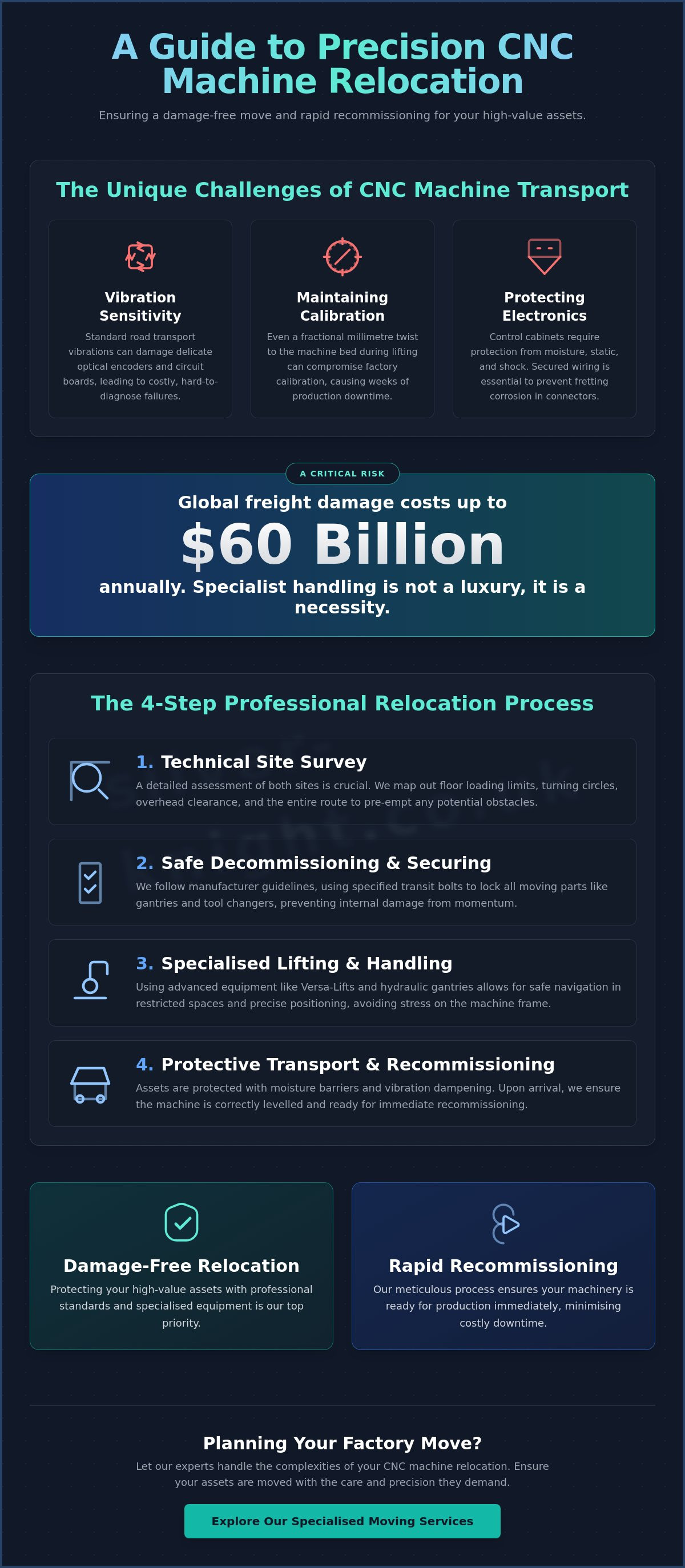
What if the most expensive part of your factory move isn't the haulage fee, but the weeks of lost production caused by a microscopic misalignment? For precision engineering firms, CNC machine transport services are far more than a simple logistics exercise. They're a technical challenge where the value lies in the calibration, not just the heavy iron. You probably feel that a general haulier doesn't appreciate the sensitivity of your equipment, and you're right to worry. With global freight damage costs reaching up to $60 billion annually, the risks of improper handling are very real.
We understand the pressure of avoiding downtime whilst trying to organise a complex relocation in a restricted workspace. This guide will show you how to manage a damage free relocation and ensure rapid recommissioning at your new site. We'll preview the technical standards required for safe lifting, the importance of decommissioning, and how to stay compliant with health and safety regulations throughout the process.
If you're planning a move and require expert assistance, you can find out more about our specialised machinery moving services to ensure your equipment is handled with care.
Key Takeaways
- Identify why CNC machines are more vulnerable to vibration than standard equipment and how this impacts sensitive optical encoders.
- Conduct a thorough technical site survey to map out floor loading limits and turning circles before the relocation begins.
- Discover how specialised equipment like Versa-Lift hire and hydraulic gantry systems can safely navigate restricted factory spaces.
- Learn the professional standards for CNC machine transport services to ensure your equipment is correctly levelled and ready for immediate recommissioning.
- Protect your high value assets during long distance moves by using advanced moisture barriers and export packing techniques.
If you're planning an industrial relocation, you can find out more about our professional machinery moving services to ensure your equipment is handled correctly.
The unique challenges of CNC machine transport
Moving a traditional manual lathe involves managing weight and balance, but Computer numerical control (CNC) systems introduce a level of complexity that basic haulage can't handle. The internal components are incredibly sensitive to shock and vibration. Whilst a manual machine might survive a bumpy journey, the delicate optical encoders and circuit boards inside a CNC unit are often compromised by standard transport methods. Professional CNC machine transport services focus on the technology inside, not just the heavy iron. With the global logistics industry incurring an estimated $50 to $60 billion in annual costs due to freight damage, the risk to your high value assets is significant without specialist care.
To better understand the level of care required when handling these machines, watch this helpful video showing the rigging process:
Structural rigidity is another major concern during a move. If the machine bed twists by even a fraction of a millimetre during lifting, the factory calibration is lost. This isn't just a minor inconvenience; it can lead to weeks of expensive downtime whilst you wait for a manufacturer's engineer to recommission the unit. The financial consequences of a botched move often far outweigh the cost of the transport itself, as lost production time in a high volume facility can run into thousands of pounds per hour.
Protecting sensitive electronic components
The control cabinet is the brain of your machine. Before transit, you must ensure all internal wiring and boards are secured against movement. Anti static measures and moisture control are essential, especially if the move involves changes in temperature that could cause condensation. General hauliers often don't account for the high frequency vibrations caused by road transport. These vibrations can cause fretting corrosion in connectors or lead to premature component failure that's difficult to diagnose later. Using specialised dampening equipment helps mitigate these risks.
Maintaining mechanical alignment and calibration
Precision relocation requires more than just a crane and a truck. Using the wrong lifting points can permanently warp the frame of the machine. It's vital to use manufacturer specified transit bolts to lock moving parts, such as the tool changer or the gantry, in place. This prevents internal momentum from damaging the ball screws or guide rails. Identifying the difference between a physical move and a precision relocation is the first step toward a successful factory change. A professional approach ensures the machine arrives in the same state it left, ready for rapid installation and immediate use.
If you are preparing for a major site move, you can view our comprehensive range of machinery moving solutions to see how we manage complex industrial projects.
Essential planning for a successful CNC relocation
Floor loading limits are perhaps the most critical factor in the planning phase. A CNC machine creates a high point load that can easily exceed the capacity of standard factory floors or mezzanine levels. When calculating these loads, you must also account for the weight of the moving equipment, such as heavy duty forklifts or hydraulic gantries. Adhering to international safety benchmarks, such as OSHA rigging equipment standards, ensures that every shackle, sling, and spreader beam used during the lift is fit for purpose and within its certified weight limit.
Risk Assessment and Method Statements (RAMS) are not merely a box ticking exercise. They provide the technical blueprint for the entire move. This documentation should detail every stage of the process, from the initial isolation of utilities to the final positioning at the new site. Coordinating with utility engineers is vital to ensure that power, compressed air, and data cables are safely decommissioned before the rigging team arrives. If you need help mapping out these requirements, you can speak with our planning team for expert advice.
Technical site surveys and access audits
Checking doorway clearances is a fundamental step. Even a discrepancy of a few millimetres can prevent a machine from entering a new facility. You must also evaluate floor gradients; moving a 10 tonne machine down a slight slope requires specialised braking systems and experience. Mapping the internal route should identify potential obstacles like overhead crane rails or existing machinery that might restrict turning circles for heavy machinery skates. Our factory relocation service includes these detailed audits as standard to prevent any surprises on the day of the move.
Decommissioning and preparation checklists
Before the machine is lifted, it must be properly prepared for transit. Draining all coolants and lubricants is a priority to prevent environmental hazards or internal leaks during the journey. All moving parts, including tool changers and gantry arms, must be secured with manufacturer specified transit brackets. We recommend documenting the machine's current state with high quality photographs and running a final test piece. This provides a clear baseline for the recommissioning phase and ensures that any pre existing issues are noted before the relocation begins.
If you are planning an industrial move and require expert support, you can visit our website to explore our full range of machinery moving services.
Advanced lifting equipment for precision machinery
Standard lorry mounted cranes are often the most visible part of an industrial move, but they are rarely enough for the delicate task of extracting equipment from a factory floor. Precision machinery requires a tiered approach to lifting where each tool is chosen for its specific role in the process. When delivering CNC machine transport services, professionals must often work in environments where headroom is measured in centimetres rather than metres. This is why membership in organisations like the Specialized Carriers & Rigging Association (SC&RA) is so important; it ensures that the rigging team is trained in the latest safety protocols and equipment usage.
For units weighing up to 30 tonnes, hydraulic gantry systems offer a superior alternative to traditional cranes. These systems provide a stable vertical lift within confined spaces, allowing the machine to be raised directly from its anchor points without the swing risk associated with a crane boom. If the machine needs to be moved across a factory floor where the ceiling height is too low for a gantry, jack and slide systems are used. These systems allow for horizontal movement with extreme precision, ensuring that the machine frame remains perfectly stable whilst navigating narrow aisles.
The final transition from the factory exit to the transport vehicle often involves a lorry mounted crane. These units provide the necessary reach to load the machine onto a flatbed for the journey. However, the internal extraction is where the real technical skill is required. By combining compact loaders with external cranes, a specialist team can manage the entire move without exposing the machine to unnecessary stress or environmental hazards.
Specialised forklifts and compact loaders
The use of Versa-Lift hire has become the industry standard for moving high value machining centres. Unlike a standard forklift, a Versa-Lift features an extending counterweight frame that increases its lifting capacity without increasing its physical footprint. This makes it ideal for operating in tight production areas. These machines are fitted with non marking tyres to protect factory floor coatings and prevent debris from being tracked through clean environments. Modern loaders also feature integrated load monitoring technology, which helps the operator maintain the centre of gravity throughout the lift.
Rigging and skating systems for internal moves
Before a machine can be extracted, it must be raised onto a skating system. This is achieved using hydraulic toe jacks, which provide a low profile lift point to create enough clearance for the skates. Selecting the correct machinery skates is vital for protecting the floor and ensuring a smooth journey. Nylon or polyurethane rollers are typically chosen to prevent surface damage whilst offering low rolling resistance. Precision rigging is used to secure the load, ensuring the machine remains level and balanced. This attention to detail prevents the bed from twisting, which is essential for preserving the factory calibration mentioned earlier in this guide.
If you need to secure your machinery for a long distance move, you can learn more about our heavy machinery transport options to keep your assets safe.
Securing and protecting high value industrial assets
Protecting your machinery involves more than just a few straps and a tarpaulin. When engaging CNC machine transport services, you're protecting a high precision investment that is vulnerable to environmental changes and physical shock. In the global logistics industry, damage rates for truckload shipping typically sit between 0.5% and 2%. These figures can rise significantly if the equipment is not properly prepared for the journey. A single scratch on a guideway or a drop of moisture on a control board can lead to a total loss of function and weeks of repair work.
Protective packaging and corrosion control
Standard shrink wrapping is often insufficient for long term protection or international moves. It can trap moisture against the metal surfaces, leading to rapid corrosion. For sensitive electronic interfaces, we recommend vacuum packing combined with high quality desiccant bags to absorb any internal humidity. If your project involves sea freight or long distance travel, professional export packing is essential. This process involves building custom timber crates and internal bracing to keep delicate components stationary whilst the vehicle is in motion. Organising timber bases that distribute weight evenly across transport beds is also vital to prevent the machine frame from flexing during transit.
Insurance and liability considerations
Standard haulage insurance is rarely sufficient for high value engineering equipment. It often covers weight based liability rather than the actual replacement value of the machine. You should verify that your partner has specialist machinery cover that reflects the true value of your assets. Maintaining a detailed asset inventory, including high resolution photographs of the machine's condition before it leaves the factory, is a crucial part of the process. This documentation provides a clear trail in the unlikely event of a claim. Choosing an experienced partner with a proven track record in factory relocation naturally reduces your overall risk profile. If you're unsure about the level of cover required for your next move, you can request a detailed protection plan from our team.
If you need expert assistance with your relocation, you can visit our website to explore our full range of machinery relocation services designed for industrial precision.
Professional standards in CNC machinery movement
The final stage of a move is often where the most critical mistakes happen. Many businesses make the error of assuming that once the machine is off the lorry, the hard work is over. However, professional machinery installation is a distinct discipline that differs significantly from a simple drop off. Working with a family run business that brings 180 years of experience ensures that these final, technical steps are handled with the same care as the initial lift. CNC machine transport services must culminate in a machine that is not just in the right building, but in the right condition to produce parts to its original specification.
Precision positioning and levelling
Compliance and safety documentation
Safety on a factory floor is non negotiable. Every operator involved in the move must be fully qualified and experienced in handling complex loads. This is why professional machinery haulage is considered a national requirement for engineering safety. It's about more than just driving a truck; it's about understanding the physics of the load and the environment. By maintaining a clear audit trail of every safety check, you protect your business from liability and ensure that your new facility is compliant with all current health and safety legislation from day one.
If you are looking for expert advice on your next project, you can discover more about our machinery moving services to see how we handle complex industrial assets.
Secure your precision engineering future
A successful relocation hinges on the transition from simple haulage to technical engineering. We've seen that protecting sensitive electronics and maintaining mechanical alignment requires more than standard lifting equipment. It needs a meticulous approach to planning, specialised rigging, and precision levelling at the final destination. By investing in professional CNC machine transport services, you're not just moving iron; you're protecting the future productivity of your facility.
Our team brings over 180 years of collective industry experience to every project. We operate a specialised fleet, including Versa-Lifts and hydraulic gantries, to navigate the most restricted factory spaces. Whether you're moving a single unit or an entire production line, we provide a reliable nationwide service across the United Kingdom. You can contact our specialist machinery moving team for a technical survey to ensure your assets are in safe hands. Your next successful move is just a conversation away.
Frequently Asked Questions
How much does CNC machine transport services cost?
The cost of CNC machine transport services depends on the specific weight of the unit, the distance of the journey, and the complexity of the access at both sites. Factors such as the requirement for specialised lifting gear or overnight storage will also influence the final price. We recommend a technical site survey to provide a precise and tailored quote that accounts for the unique requirements of your precision equipment.
Do I need to hire a separate electrician for decommissioning?
You don't necessarily need a separate electrician if you choose a provider that includes decommissioning and recommissioning in their service. Our team can handle the safe isolation of power and air supplies before the move begins. However, you should always check with your internal maintenance team or the machine manufacturer to ensure that any specific warranty requirements are met during the disconnection process.
What insurance cover is provided during CNC machine transport?
Specialist machinery movers typically provide transit liability insurance that is based on the actual value of the asset rather than just its weight. Standard haulage insurance often uses a calculation based on weight which might not cover the full replacement cost of a high value CNC machine. You should always request a copy of the insurance schedule to verify that the cover limits match your specific equipment valuations.
Can you move a CNC machine into a basement or upper floor?
Moving heavy machinery into basements or onto upper floors is possible using specialised equipment such as hydraulic gantry systems or contract lifting with cranes. These projects require a detailed structural assessment of the building to ensure floor loading limits are not exceeded. We use precision rigging and jack and slide systems to navigate tight vertical spaces where a standard forklift cannot operate safely.
How long does a typical CNC machine relocation take?
A single machine move within the same site can often be completed in one working day. Larger factory relocations involving multiple CNC centres may take several days or weeks depending on the distance and the complexity of the installation required. The timeline usually includes decommissioning, packing, transport, and the final precision levelling at the new location to ensure the machine is ready for use.
What information do I need to provide for an accurate quote?
To receive an accurate quote for CNC machine transport services, you should provide the machine's make and model, its total weight, and its exact dimensions. Photographs of the current location and the intended destination are also helpful for identifying potential access issues. Mentioning any specific floor gradients or height restrictions will help the planning team determine the correct lifting equipment for your project.
Is it possible to move a CNC machine whilst it is still fully assembled?
Many CNC machines can be moved whilst fully assembled if the transport route and doorway clearances allow for it. However, larger units or those with wide gantries may require partial dismantling to ensure safe passage and to prevent structural stress during the move. We always prioritise the manufacturer's recommendations regarding the removal of external components like tool changers or coolant tanks before the lift begins.
How do you ensure the machine is level after the move?
We ensure the machine is perfectly level by using high precision master levels or digital laser systems during the installation phase. This process involves adjusting the machine's feet or using specialised shims to achieve the exact geometric tolerances required by the manufacturer. Correct levelling is vital because even a tiny deviation can lead to premature wear on the machine's internal guide rails and ball screws.

Article by
David Ashby
I'm the Managing Director of Silver Knight Haulage & Machinery Ltd. Silver Knight Ltd is a family-run firm established in the West Midlands in 2005, with the aim of providing a cost-effective, yet professional, service to businesses for the removal, transportation, and installation of machinery, plant, and equipment here in the UK and worldwide. Between us, the Silver Knight workforce has over 50 years of experience with machinery and its operation.
Disclaimer
This article is intended for informational purposes only. Please ensure you seek expert advice or carry out your own research to confirm the information is suitable for your specific needs.