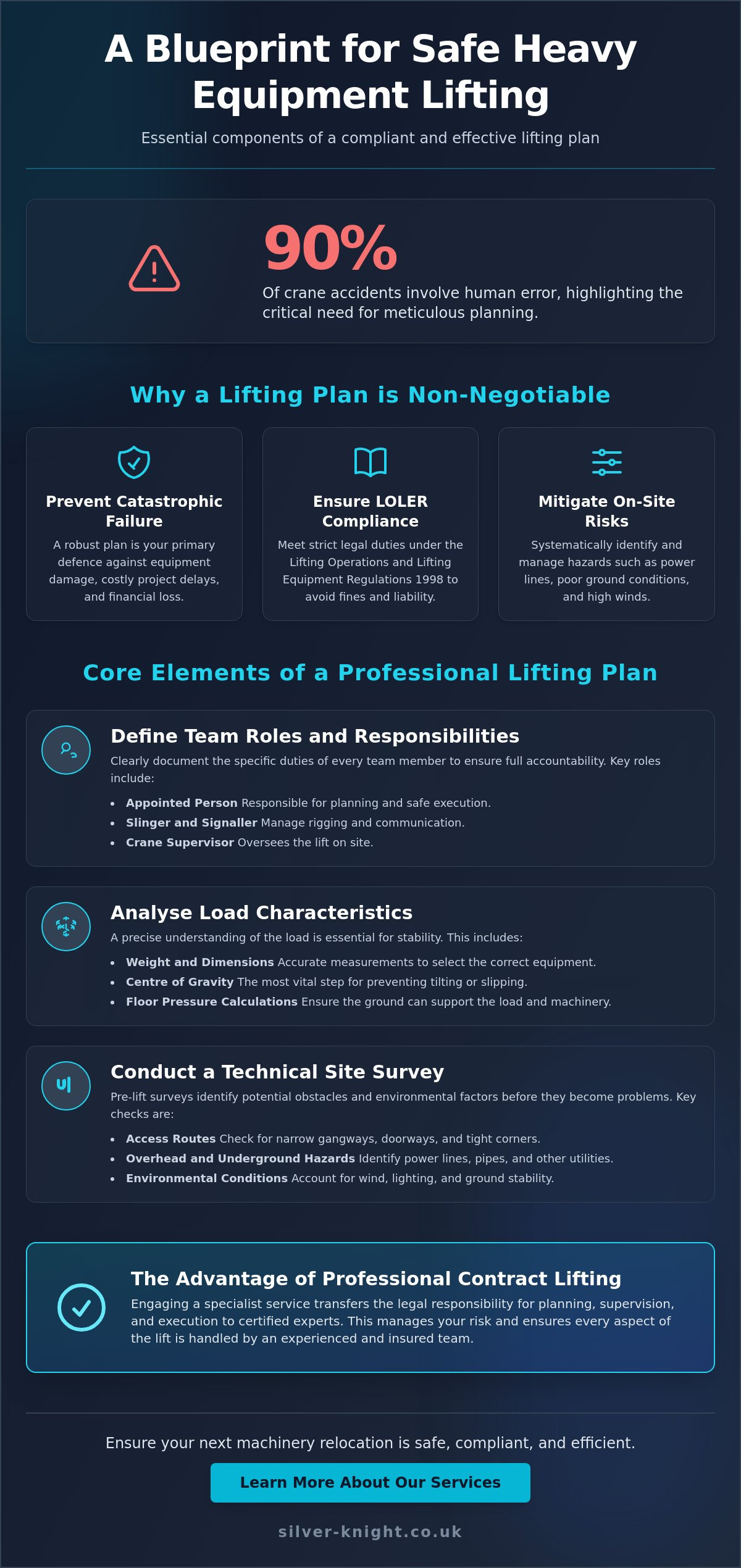
Did you know that human error is a factor in over 90% of crane accidents according to recent industry data? When you are responsible for moving heavy industrial assets, the pressure to maintain site safety can feel overwhelming. It is completely natural to feel anxious about the risk of equipment damage or the complexities of staying compliant with LOLER regulations. To mitigate these risks, you must implement a robust lifting plan for heavy equipment that leaves nothing to chance.
We recognise that safety and liability are your primary concerns during any machinery relocation. This guide promises to provide a clear path forward, teaching you how to develop a compliant and safe lifting plan for heavy industrial machinery. By following these steps, you can ensure every lift is executed with precision and confidence whilst avoiding the stress of unexpected mishaps.
We will preview the essential components of a modern lift plan, including the 2026 requirements for digital record keeping and the necessity of proof load testing amongst other safety protocols. You will also find a practical checklist to help you choose the right partner for your factory relocation or machinery installation.
If you require professional support for your next project, you can learn more about our specialist contract lifting services.
Key Takeaways
- Understand why a detailed lifting plan for heavy equipment is the most effective way to prevent catastrophic failure and ensure site safety.
- Discover the essential core elements required for every professional plan, including precise load dimensions and weight calculations.
- Learn how to categorise your lifting operations correctly to determine if a basic approach or a more complex solution is necessary.
- Follow a clear process for conducting technical site surveys to identify potential obstacles before any machinery arrives on site.
- Explore how professional contract lifting services can help you manage risk by transferring planning liability to experienced experts.
If you are preparing for a complex move, you can rely on our expert machinery moving services to handle every detail of your project.
Why a lifting plan for heavy equipment is essential for safety
A lifting plan for heavy equipment is much more than a simple administrative requirement; it is a vital safeguard against disaster. Without a structured approach, you risk catastrophic equipment failure which can lead to massive financial losses and project delays. Most industrial insurers require proof of a formal plan before they will honour a claim. If an accident occurs and no plan exists, your insurance validity could be at risk, leaving your business exposed to significant liability. Detailed planning also helps reduce downtime during complex factory relocations by identifying potential bottlenecks before they happen.
In the UK, the role of the Appointed Person is central to this process. This individual is responsible for the safe planning and execution of every lift. Unlike some general guidelines that gloss over this role, UK safety standards require this person to have the specific training and experience to assess risks accurately. They ensure that the rigging for heavy equipment is correctly specified and that every team member understands their specific duties. This level of oversight is what keeps personnel safe whilst high value assets are in the air.
To better understand how these calculations work in practice, watch this helpful video:
Legal compliance and LOLER regulations
The Lifting Operations and Lifting Equipment Regulations 1998, commonly known as LOLER, place a strict legal duty on businesses to ensure all lifting is properly planned. This means every lift must be supervised by a competent person and carried out in a safe manner. You must also maintain thorough examination reports for all gear used in the operation. Failing to meet these standards doesn't just invite heavy fines; it endangers everyone on the factory floor and amongst the wider site team.
Risk mitigation in industrial environments
Industrial sites are full of hidden dangers that a lifting plan for heavy equipment must address. A comprehensive plan identifies hazards such as overhead power lines, poor lighting, or insufficient floor loading capacity. It also accounts for environmental factors like high winds which can turn a stable load into a dangerous pendulum. By establishing a dedicated exclusion zone, you protect personnel from the line of fire. This ensures that even if something goes wrong, nobody is in harm's way during the move.
If you are planning a complex machinery move, you can find our full list of machinery moving services on our main website.
Core elements of a professional lifting plan
Creating a lifting plan for heavy equipment requires a meticulous approach to every variable. It isn't just about the machine; it's about the people and the environment. You must identify every member of the team, from the Appointed Person to the slinger and signaller. Each person needs to know their specific responsibilities before the first chain is tensioned. Personnel roles must be documented in the plan to ensure accountability. Clear communication is the backbone of a successful lift. Whether using standardised hand signals or dedicated radio channels, the protocol must be understood by everyone within the exclusion zone to prevent confusion during the operation.
Load characteristics and centre of gravity
Identifying the centre of gravity is the most vital step for maintaining stability throughout the lift. If the load is offset and you haven't accounted for it, the rigging tension will be uneven, potentially causing the machine to tilt or slip. You must also consider the physical dimensions and how they affect access through narrow factory gangways. Floor pressure is another critical factor often overlooked by less experienced planners. You need to ensure the surface can withstand the concentrated weight of the equipment and the lifting machinery combined. To calculate the total weight accurately, you must sum the mass of the machinery, all lifting accessories, and the weight of the hook block itself.
Equipment selection and rigging requirements
Choosing the right machinery is about more than just capacity. Whilst cranes are excellent for outdoor work, indoor environments often require specialised solutions. Hydraulic gantry systems provide incredible stability in tight spaces with low headroom. For moving heavy assets across a floor, jack and slide systems or a Versa-Lift hire might be the most efficient choice. These tools allow for precision positioning that a standard crane simply cannot match. Jack and slide systems are particularly useful when you need to move massive transformers into positions where overhead lifting is impossible. You can view our full range of specialised machinery on our our equipment page to see what might fit your project needs.
Rigging selection is equally important. Slings, shackles, and spreader beams must be chosen based on their Safe Working Loads (SWL) and the specific geometry of the lift. Every piece of tackle should have a valid certificate of thorough examination to ensure it is fit for purpose. If you are unsure which configuration is best for your site, our team can help you navigate these technical requirements. To ensure your project remains compliant and safe, you may wish to contact our specialists for a detailed consultation.
For expert advice on categorising your next project, visit our machinery moving homepage to see how we can assist with your specific requirements.
Different categories of lifting operations
Not every lift is the same. To develop a compliant lifting plan for heavy equipment, you must first determine the complexity of the task at hand. This prevents over-complicating simple jobs whilst ensuring high risk operations receive the scrutiny they deserve. Industry standards generally split these tasks into three tiers based on the nature of the load and the environment. By assessing these variables early, you can allocate the right level of resources and expertise to the project. This framework is essential for maintaining safety without causing unnecessary delays to your operational schedule.
Intermediate lifts sit between routine and high risk tasks. These often involve unusual loads that might not have standard lifting points or require slightly more sophisticated rigging. For these operations, a bespoke plan is necessary to account for the unique geometry or fragile nature of the machinery. You cannot rely on a one size fits all approach when the load is unbalanced or the path of travel is uneven. A dedicated method statement ensures that every potential pivot point and snagging hazard is accounted for before the machinery is ever moved.
Basic and standard lifting operations
Routine lifts are defined by known weights and established lifting points. These tasks usually take place in familiar environments where the ground conditions are stable and well understood. Because the risks are predictable, a generic risk assessment may suffice for these tasks, provided it is reviewed by a competent person. For standard palletised machinery or smaller assets, using a professional forklift moving service is often the most efficient route. These operations are straightforward but still require a basic level of planning to ensure the load remains secure during transit across the factory floor.
Complex and high risk lifts
A lift becomes complex when the variables are no longer predictable. Tandem lifting, where two cranes or gantry systems work together to move a single load, is a prime example of a high risk operation. These tasks require perfect synchronisation to prevent one piece of equipment from becoming overloaded. Lifts performed in confined spaces or over live plant equipment also fall into this category. Because the margin for error is so slim, these operations require a dedicated Appointed Person to oversee the entire process. They will produce a detailed technical drawing and a step by step method statement to manage the increased risks. This level of planning is the only way to ensure safety when moving massive assets amongst sensitive industrial infrastructure.
If you need a team that understands the technicalities of industrial moves, you can explore our full range of heavy machine moving services here.
Steps to create a lifting plan for industrial machinery
Creating a lifting plan for heavy equipment is a linear process that demands technical accuracy. In the UK, this process is led by the Appointed Person. This individual holds the ultimate responsibility for the safety of the plan. They don't just sign a document; they verify every calculation and confirm that the chosen equipment is capable of the task. They must also ensure that the ground can support the weight of the crane or gantry system without any risk of subsidence. Calculating the required capacity is not just about the machine weight. You must account for the dynamic loading that occurs when the load starts to move. This includes a safety factor that ensures the equipment is never operating at its absolute limit.
Site surveys and environmental assessment
A technical site survey is the first physical step. You must check the floor load bearing capacity to ensure it can handle the concentrated pressure of the machinery and the lifting gear combined. Measuring access points is equally vital. If you are using heavy haulage vehicles, they need enough room to manoeuvre safely without damaging site infrastructure. Sometimes, a machine is too large to move in one piece. In these cases, you should consider a machinery dismantle service to break the load down into manageable sections. This reduces the risk and simplifies the lifting requirements whilst protecting the integrity of the asset.
Drafting the method statement and risk assessment
The method statement provides a clear, step by step sequence of the lifting operation. It starts with the arrival of the team and ends with the final placement of the asset. Each step must include specific control measures for identified risks. For example, if you are working near overhead cables, the plan must state exactly how close the equipment can get. Before the work begins, a pre lift briefing is mandatory. This toolbox talk ensures that everyone, from the crane operator to the site manager, understands the plan. It's the moment where the written document becomes a live safety tool that protects everyone on site.
No plan is complete without robust emergency procedures. You must document what happens if a piece of tackle fails or if the weather changes suddenly. This includes identifying the nearest first aid station and the protocol for an immediate emergency stop. Once the draft is finished, the Appointed Person must conduct a final review. Their sign off is the legal confirmation that the operation is safe to proceed. This ensures your lifting plan for heavy equipment remains compliant with current UK safety standards and insurance requirements.
To get started with a professional site survey and a tailored lifting strategy for your next project, contact our expert team today.
To ensure your project is managed by industry experts, you can learn more about our professional contract lifting options.
The advantages of professional contract lifting services
Choosing a professional partner for your machinery move offers far more than just muscle. When you engage in a contract lift, you are effectively transferring the planning liability to the experts. The provider becomes responsible for the entire lifting plan for heavy equipment, covering everything from the initial site survey to the final insurance sign off. This shift in responsibility protects your business from the legal and financial fallout of a potential incident. It is a strategic move that prioritises safety and compliance above all else.
Our team brings over 180 years of collective experience to every project. This longevity in the industry means we have developed a deep understanding of complex logistics. We don't just lift; we integrate the operation with our heavy haulage and international machinery transport capabilities. This ensures a seamless transition for your assets, whether they are moving across the factory floor or across the globe. Having a single point of contact for the entire process reduces the risk of communication breakdowns and project delays.
Access to specialised equipment like jack and slide systems or Versa-Lift hire is another major advantage. These tools allow for the movement of heavy assets in confined spaces where traditional cranes are impractical. Using the correct machinery reduces the risk of floor damage and ensures the load remains stable throughout the move. This specialised kit is maintained to the highest standards, ensuring reliability during your critical relocation window.
Benefits of a fully managed lifting solution
A fully managed service provides you with a dedicated Appointed Person and a qualified Slinger. These professionals ensure that the lifting plan for heavy equipment is followed to the letter. By avoiding equipment damage and site accidents, you protect your bottom line and maintain your reputation. Professional movers also have the experience to spot potential issues before they become costly problems. For a complete overview of how we manage these logistics, visit our machinery haulage relocation service section.
Expertise in heavy machinery relocation
Relocating heavy machinery requires more than just lifting; it requires precision installation. Our specialists focus on the precision levelling of assets to guarantee they are ready for immediate recommissioning. We also possess the expertise to manage international relocations to major industrial hubs in the US or Asia. Our international machine movers team handles all the complexities of transport and customs. This level of service ensures your machinery arrives safely and is installed correctly, no matter where in the world your business is expanding.
If you are looking for professional support for your industrial project, you can visit our machinery movers homepage to learn more about our capabilities.
Secure your next industrial move today
Developing a robust lifting plan for heavy equipment is the foundation of any successful machinery relocation. By focusing on detailed site surveys and selecting specialised equipment like hydraulic gantries or Versa-Lifts, you can eliminate the anxiety surrounding site safety and equipment damage. A well structured plan doesn't just satisfy LOLER regulations; it provides a roadmap for efficiency and precision during complex factory relocations. Safety is never a compromise.
Our team provides 180 years of collective industry experience to ensure every lift is managed with absolute care. With a nationwide UK presence and global relocation reach, we have the resources to handle assets of any scale. Expertise makes all the difference.
Enquire about our expert machinery moving and lifting services to discuss your project requirements with our specialists. We look forward to helping you achieve a safe and successful move.
Frequently Asked Questions
What is the difference between a lifting plan and a risk assessment?
A risk assessment identifies potential hazards and control measures whilst a lifting plan provides the technical details of the operation. The plan specifies the equipment, the rigging configuration, and the step by step sequence for the move. Both documents are essential for a safe operation and work together to protect the team.
Who is responsible for creating the lifting plan for heavy equipment?
The Appointed Person is legally responsible for developing and approving the lifting plan for heavy equipment. This individual must have the necessary training and experience to assess the risks and technical requirements of the task. They ensure the operation remains compliant with current safety regulations and insurance requirements.
Does every lift require a written lifting plan?
Yes, every lifting operation must be planned to ensure it is carried out safely. Whilst a simple, routine lift might only require a generic plan, more complex tasks demand a bespoke, written method statement. The level of detail should always reflect the complexity and risk level of the specific job.
How often should a generic lifting plan be reviewed?
You should review generic plans periodically or whenever there is a change in the working environment. If new obstacles appear on site or different equipment is used, the original plan may no longer be valid. Keeping these documents updated ensures that your safety protocols remain effective and relevant to current conditions.
What qualifications does an Appointed Person need in the UK?
An Appointed Person typically holds a recognised qualification such as the CPCS A61 certificate. Beyond formal training, they must possess significant practical experience in machinery moving and lifting operations. Their competency is judged by their ability to manage the specific technical and environmental challenges of your project.
What happens if a lifting operation deviates from the original plan?
You must stop the lifting operation immediately if any deviations occur. The Appointed Person needs to assess the new situation and update the plan to reflect the changes. Work can only resume once the amended plan has been communicated to the entire team and signed off by the competent person.
Can I use a standard forklift for heavy machinery lifting?
You can only use a forklift if its rated capacity exceeds the weight of the machine and it is fitted with the correct attachments. Standard forklifts often lack the precision and stability required for sensitive industrial assets. Specialist equipment like a Versa-Lift is usually a safer and more efficient choice for these tasks.
How do I calculate the weight of a machine if the manual is missing?
You can find the weight by checking the manufacturer data plate or using a calibrated weighbridge if the machine is mobile. If these options aren't available, an engineer can calculate the weight based on the volume and density of the materials. Steel, for example, weighs approximately 7.85 tonnes per cubic metre.

Article by
David Ashby
I'm the Managing Director of Silver Knight Haulage & Machinery Ltd. Silver Knight Ltd is a family-run firm established in the West Midlands in 2005, with the aim of providing a cost-effective, yet professional, service to businesses for the removal, transportation, and installation of machinery, plant, and equipment here in the UK and worldwide. Between us, the Silver Knight workforce has over 50 years of experience with machinery and its operation.
Disclaimer
This article is intended for informational purposes only. Please ensure you seek expert advice or carry out your own research to confirm the information is suitable for your specific needs.