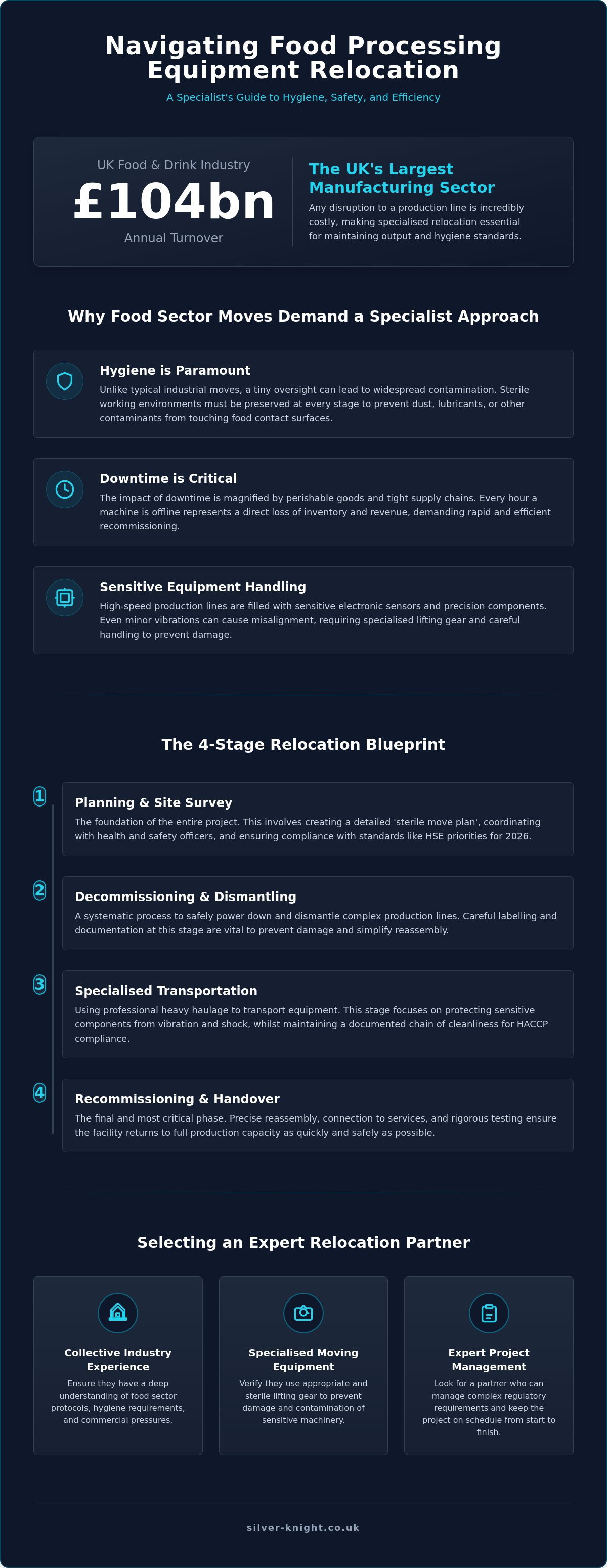
Did you know that the UK food and drink industry generates over £104 billion in annual turnover, making it the largest manufacturing sector in the country? With such high stakes, any disruption to your production line can be incredibly costly. You likely understand that a successful food processing equipment relocation requires much more than just moving heavy metal from one site to another. It's a delicate balance of industrial power and surgical cleanliness where even a tiny oversight can lead to contamination or a breach of the latest 2026 safety standards.
We recognise that the thought of lengthy downtime and the risk of damaging expensive, sterile machinery is enough to keep any operations manager awake at night. That's why we've put together this comprehensive guide to help you navigate the process with confidence. You'll learn how to plan a move that protects your equipment, maintains strict hygiene protocols, and ensures a rapid return to full production capacity.
In the following sections, we'll walk through the essential steps of decommissioning, transport, and recommissioning. We'll also explore how expert project management can help you meet complex regulatory requirements whilst keeping your project on track from start to finish.
Key Takeaways
- Learn why a successful food processing equipment relocation requires a specialised approach that combines heavy lifting with strict hygiene protocols.
- Discover why a comprehensive technical site survey is the foundation of any move, ensuring all safety and regulatory standards are met before work begins.
- Understand the systematic process of decommissioning and dismantling complex production lines to prevent damage and simplify the reassembly stage.
- Explore how professional heavy haulage and precise recommissioning strategies can significantly reduce downtime and get your facility back to full capacity.
- Identify the key factors to consider when choosing an expert partner, focusing on collective industry experience and the use of specialised moving equipment.
If you are planning a facility move, you can find expert assistance through our professional machinery moving services.
Understanding food processing equipment relocation
Food processing equipment relocation is far more complex than standard industrial moving. It is a highly specialised field that demands a deep understanding of the machinery used to prepare, cook, and package what we eat. When we talk about understanding food processing, we must also consider the physical movement of the assets involved. This includes everything from massive industrial ovens and refrigeration units to complex, high speed conveyor systems and robotic picking arms. Standard machinery movers often lack the specific protocols needed to handle these sensitive assets without compromising their integrity or their hygiene status.
To better understand the high standards required for these machines, watch this helpful video:
Why food sector moves are unique
The most significant factor that sets these moves apart is the absolute requirement for hygiene. In most industrial settings, a bit of dust is a minor nuisance; in the food sector, it is a contamination risk that could shut down an entire brand. Sterile working environments must be preserved throughout every stage of the move. Movers must ensure that lubricants, dust, or hydraulic fluids never come into contact with food contact surfaces during the transition. Additionally, the impact of downtime is magnified by the nature of the products. Perishable goods and tight supply chains mean that every hour a machine is offline represents a direct loss of inventory and revenue. This is why businesses rely on professional machinery haulage and relocation services that understand these specific commercial pressures.
Key challenges in food machinery logistics
Modern food production facilities are often designed for maximum output efficiency rather than easy equipment removal. This frequently leads to restricted access, where machines must be manoeuvred through narrow corridors or clean rooms with minimal clearance. Another challenge lies in the delicate nature of the equipment itself. High speed FMCG lines are packed with sensitive electronic sensors and precision components that can be knocked out of alignment by the slightest vibration. Professional movers must use specialised lifting gear to prevent this. Finally, compliance is non-negotiable. Hazard Analysis and Critical Control Point (HACCP) compliance in machinery transport involves maintaining a documented chain of cleanliness to ensure that equipment remains safe for food production upon arrival at the new site.
To ensure your machinery is handled with the highest level of care, you can explore our range of specialised machinery moving services.
Planning for hygiene and safety standards
Meticulous planning is the foundation of any successful food processing equipment relocation. It is not enough to simply book a haulage firm; you need a strategy that addresses the specific biological and chemical risks inherent in food production. This requires early and constant coordination with on site health and safety officers. By involving these experts from the start, you can ensure that every movement complies with the latest HSE priorities for 2026, particularly regarding the management of occupational health risks and dust exposure. A sterile move plan acts as a roadmap for the entire project, outlining exactly which zones are considered clean and how the machinery will be transitioned through them without introducing pathogens.
This plan should include specific instructions for the moving crew, such as required personal protective equipment (PPE) and the use of food grade lubricants for any temporary reassembly. Coordination with health and safety officers ensures that these plans are not just theoretical but are strictly enforced on the day of the move. When everyone understands the hygiene protocols, the risk of a breach that could delay your production restart is greatly reduced.
The role of technical site surveys
A comprehensive technical site survey is the first practical step in this journey. This process involves a deep dive into the physical constraints of both your current facility and your new location. Engineers must verify floor loading capacities, as food machinery like industrial ovens or large scale mixers can exert immense pressure on a factory floor. This level of factory relocation planning helps to identify potential bottlenecks, such as narrow doorways or overhead clearances, before the heavy lifting begins. Adhering to best practices for relocating a food business allows you to design a layout that optimises workflow whilst maintaining strict segregation between raw and cooked product areas.
Maintaining sterile working conditions
Preserving sterile working conditions throughout the move is a significant challenge. It starts with a rigorous cleaning protocol where every piece of equipment is sanitised before it leaves the production floor. Once cleaned, protective wrapping and secure packaging are applied to prevent any ingress of dust or contaminants during transit. For complex lines, utilising professional machinery dismantle services is often the safest route. This approach ensures that delicate components, electronic sensors, and high speed parts are removed and packed individually, protecting their integrity. If you are worried about the complexities of keeping your equipment sterile during a move, you can speak with our specialist team for a detailed consultation.
If you need assistance with a complex move, you can find more information about our specialised machinery moving and installation services.
Technical dismantling and specialised lifting methods
The physical phase of a food processing equipment relocation begins with a systematic decommissioning process. This is not a simple case of taking machines apart; it is a controlled breakdown of complex systems. Every electrical connection, fluid line, and pneumatic hose must be isolated and disconnected according to a pre-set plan. This meticulous approach ensures that the machinery remains in peak condition and is ready for a swift reassembly at the new site. Without this level of care, you risk damaging sensitive internal components that are often expensive and difficult to source.
In the confined spaces of a modern food factory, traditional lifting methods often fall short. This is where specialised equipment like the Versa-Lift becomes indispensable. These machines are designed specifically for industrial environments, featuring extendable counterweights that provide immense lifting power within a compact footprint. They can manoeuvre through narrow production aisles that would be impossible for a standard forklift to navigate. By using these tools, we can lift and move heavy assets without the need for extensive structural changes to your facility.
Precision lifting for sensitive machinery
When moving massive loads like industrial ovens or large scale mixers, precision is everything. Jack and slide systems allow for the movement of heavy machinery with millimetre precision, sliding the load along a controlled track. This method is far safer than traditional rolling, especially when working on the polished or treated floors common in the food industry. For indoor moves, hydraulic gantry systems are almost always preferred over cranes. Gantries provide a stable, vertical lift within the confines of the factory roof, eliminating the risks associated with the wide swing radius and high clearance requirements of a crane. You can read more about these technologies in our guide to specialised lifting and versa lift hire.
Safe dismantling and asset protection
Protecting your assets during the move requires a detailed documentation strategy. Every component is marked and indexed, often with photographic evidence, to create a clear map for the engineers who will perform the recommissioning. We also use specialised lifting gear, such as nylon-wheeled skates and non-marking tyres, to ensure that your factory floors remain undamaged throughout the process. This is particularly important for high speed bottling or packing lines where the precision of the mechanical timing is critical. The intricate calibration of these lines means that even a minor misalignment during the dismantling phase can lead to significant mechanical failures or production delays during the eventual restart.
If you are looking for a partner to manage your next project, you can learn more about our factory relocation specialists.
Transportation and recommissioning for production continuity
The transition from the factory floor to the road is a critical phase in any food processing equipment relocation. Once the machinery has been decommissioned and cleaned, it must be loaded onto specialised transport vehicles. This stage requires more than just standard haulage. It involves precise weight distribution and secure strapping to protect sensitive electronic components from road vibrations. For many UK brands, this movement is not just local. In the first quarter of 2026, food and drink exports were valued at £5.7 billion, highlighting the constant flow of machinery and goods across borders even during periods of market fluctuation.
Heavy haulage and international logistics
Moving oversized food industry equipment across the UK often requires low loaders and extendable trailers. These vehicles allow for the transport of tall silos or wide conveyor systems whilst staying within legal height and width limits. When your project crosses borders, the complexity increases significantly. Our international machine movers service manages the intricate paperwork and customs requirements that are now a standard part of global logistics. This includes preparing for the anticipated changes in sanitary and phytosanitary (SPS) rules expected to evolve through 2026 and into mid-2027.
Proper protection is vital for long distance travel. High quality shipping container packing ensures that equipment is braced against the movement of a ship or aircraft. We use moisture-absorbing materials and vacuum sealing to prevent corrosion. This is particularly important for stainless steel machinery that must remain food-safe and free from oxidation upon arrival at the destination.
Recommissioning and final positioning
The final goal is to get your production line running again as quickly as possible. Recommissioning starts with the precise positioning and levelling of each unit at the new site. Even a slight tilt can cause premature wear on bearings or lead to product spills. Once the machinery is secured, a rigorous testing phase begins. This involves dry runs to check mechanical timing and wet runs to ensure that all seals and sensors are functioning correctly under load. It's a systematic process that mirrors the initial decommissioning to ensure nothing has shifted during transit.
Sometimes, project timelines don't align perfectly. If your new facility isn't quite ready to receive its assets, using secure warehousing provides a safe, climate-controlled environment to store your machinery. This prevents the equipment from being exposed to the elements or dust on an active construction site. If you need a tailored logistics plan for your machinery, you can contact our logistics experts today for a detailed consultation.
To ensure your project is handled by experienced professionals, you can explore our comprehensive machinery relocation solutions.
Selecting an expert partner for your relocation
Choosing the right team for your food processing equipment relocation is the most important decision you'll make during the entire project. In a sector where a single hygiene breach or a damaged sensor can cost thousands in lost production, you need more than just muscle. You need a partner that understands the nuances of food safety, sterile environments, and the pressure of tight deadlines. Experience isn't just a number on a website; it's the difference between a smooth restart and a week of mechanical failures. When the stakes involve consumer safety and brand reputation, there's no room for error.
The Silver Knight difference
Our team brings over 180 years of collective industry experience to every project we undertake. Since 1996, we've operated as a family-run business, which means you get a level of personal accountability that large corporate entities often struggle to match. You aren't just another job on a spreadsheet to us. We pride ourselves on clear communication and a hands-on approach to project management from start to finish. Whether you need a single machine moved or a complete factory clearance, we apply the same level of meticulous care. We use our own specialised gear, ensuring that we maintain total control over the quality of the move.
Final checklist for food factory managers
Before signing a contract, ensure your chosen provider can meet these essential criteria to guarantee a safe and compliant move.
- Insurance: Do they have comprehensive goods in transit and public liability insurance specifically for industrial machinery?
- Certifications: Can they provide up to date certifications for their lifting equipment, such as Versa-Lifts and hydraulic gantries?
- Hygiene Records: Do they have a documented history of following sterile move protocols and maintaining hygiene standards?
- References: Can they provide references from other food and beverage manufacturers they've worked with recently?
Taking the time to verify these details will protect your assets and your brand reputation. Always remember that the cheapest quote often carries the highest risk of hidden costs through downtime or equipment damage. It's always better to prioritise proven expertise and a track record of safety over a lower initial price to ensure your production line returns to full capacity without delay.
If you are ready to begin your next project, you can access our expert machinery moving and installation services.
Secure your production future with expert machinery moving
Successfully managing a food processing equipment relocation comes down to balancing industrial strength with meticulous hygiene standards. You've seen how technical surveys and specialised dismantling prevent damage, whilst professional haulage ensures your assets arrive ready for rapid recommissioning. By prioritising precision at every stage, you can protect your sterile environments and keep your production timelines on track.
Silver Knight Haulage & Machineries Ltd brings over 180 years of collective industry experience to every project. We use advanced gear like hydraulic gantry systems and Versa-Lifts to navigate tight spaces, providing comprehensive support for both nationwide and international moves. You can request a technical site survey from Silver Knight Haulage & Machineries Ltd to start planning your move with precision. Taking the right steps today ensures your facility remains productive and compliant for years to come.
Frequently Asked Questions
What is the typical timeline for a food processing equipment relocation?
The duration of a project depends entirely on the scale and complexity of the production lines involved. A single machine move might be completed within a few days, whilst a full factory relocation can take several weeks or even months of planning and execution. We provide a detailed schedule after the initial site survey to help you manage production downtime effectively.
How do you ensure hygiene is maintained during the machinery move?
We maintain strict hygiene standards by implementing a comprehensive sterile move plan. This includes deep cleaning and sanitising all equipment before it is wrapped in protective materials. Our team uses food grade lubricants where necessary and follows documented protocols to ensure no contaminants are introduced to food contact surfaces during the transition.
Can you move food processing machinery to international locations like Asia or the US?
Yes, we provide comprehensive international machinery transport services to global destinations including Asia and the US. We manage the entire process, from export packing and containerisation to navigating complex customs requirements. This ensures your equipment arrives safely and complies with the specific regulations of the destination country.
What specialised lifting equipment is used for indoor food factory moves?
We use a range of specialised tools designed for the unique constraints of indoor factory environments. This includes hydraulic gantry systems for vertical lifting in low clearance areas and Versa-Lifts for manoeuvring heavy loads through narrow aisles. Jack and slide systems are also used to move massive equipment with millimetre precision across sensitive factory floors.
Do you provide decommissioning and recommissioning services for food lines?
Yes, we offer full decommissioning and recommissioning services as part of our relocation packages. Our engineers systematically isolate, mark, and document every component of your production line during the breakdown phase. This meticulous approach allows for a faster and more accurate reassembly at your new site, ensuring your operations resume as quickly as possible.
Is insurance included for high value food processing equipment during transport?
We provide comprehensive insurance coverage for all machinery whilst it is in our care. This includes high value food processing equipment during transit and lifting operations. You can discuss specific valuation requirements with our team during the planning stage to ensure your assets are fully protected against any unforeseen incidents throughout the food processing equipment relocation process.
How do you handle restricted access in old or crowded food production plants?
Restricted access is managed through detailed technical site surveys and the use of compact, high capacity lifting gear. Our Versa-Lifts and hydraulic gantries are specifically chosen for their ability to operate in confined spaces where traditional cranes cannot reach. We plan every movement path in advance to ensure machinery is transitioned safely through narrow doorways or crowded production areas.
What happens if our new facility is not ready for the machinery yet?
If your new site isn't ready to receive equipment, we offer secure machinery storage in our climate controlled warehouses. This prevents your sensitive assets from being exposed to dust or moisture on an active construction site. Your equipment remains protected and ready for delivery as soon as your new facility is prepared for the installation phase.
Article by
David Ashby
I'm the Managing Director of Silver Knight Haulage & Machinery Ltd. Silver Knight Ltd is a family-run firm established in the West Midlands in 2005, with the aim of providing a cost-effective, yet professional, service to businesses for the removal, transportation, and installation of machinery, plant, and equipment here in the UK and worldwide. Between us, the Silver Knight workforce has over 50 years of experience with machinery and its operation.
Disclaimer
This article is intended for informational purposes only. Please ensure you seek expert advice or carry out your own research to confirm the information is suitable for your specific needs.