Did you know that forklifts are responsible for roughly 34,900 serious injuries every year? When you're planning a factory relocation or moving heavy industrial plant, the stakes are high. Choosing the wrong forklift rental doesn't just risk your timeline; it puts your entire team and expensive machinery at risk.
We recognise that the pressure of a critical move often comes with fears of equipment failure and the headache of hidden rental costs. You need a solution that integrates perfectly with your project schedule without the stress of managing logistics or hunting for certified operators. This guide helps you select the ideal lifting equipment for heavy industrial projects whilst ensuring total safety and operational efficiency. We'll explore how to verify lifting specifications, manage compliance documentation, and ensure your rental arrives exactly when your machinery movers need it.
Key Takeaways
- Learn how to move from heavy capital expenditure to flexible operational costs by selecting the most suitable forklift rental for your specific project.
- Identify the exact lift capacity needed for heavy industrial parts to ensure you use specialised machinery movers instead of standard warehouse gear.
- Understand the advantages of fully operated plant hire for reducing operational risk and ensuring your personnel remain safe.
- Master the legal requirements of LOLER and PUWER to ensure your equipment hire is fully compliant with current safety standards.
- See how a single point of contact for lifting and haulage can simplify the logistics of a nationwide factory relocation.
To ensure your next relocation is handled by experts, explore the range of heavy machine movers available for your project.
Maximising Efficiency with Forklift Rental for Industrial Projects
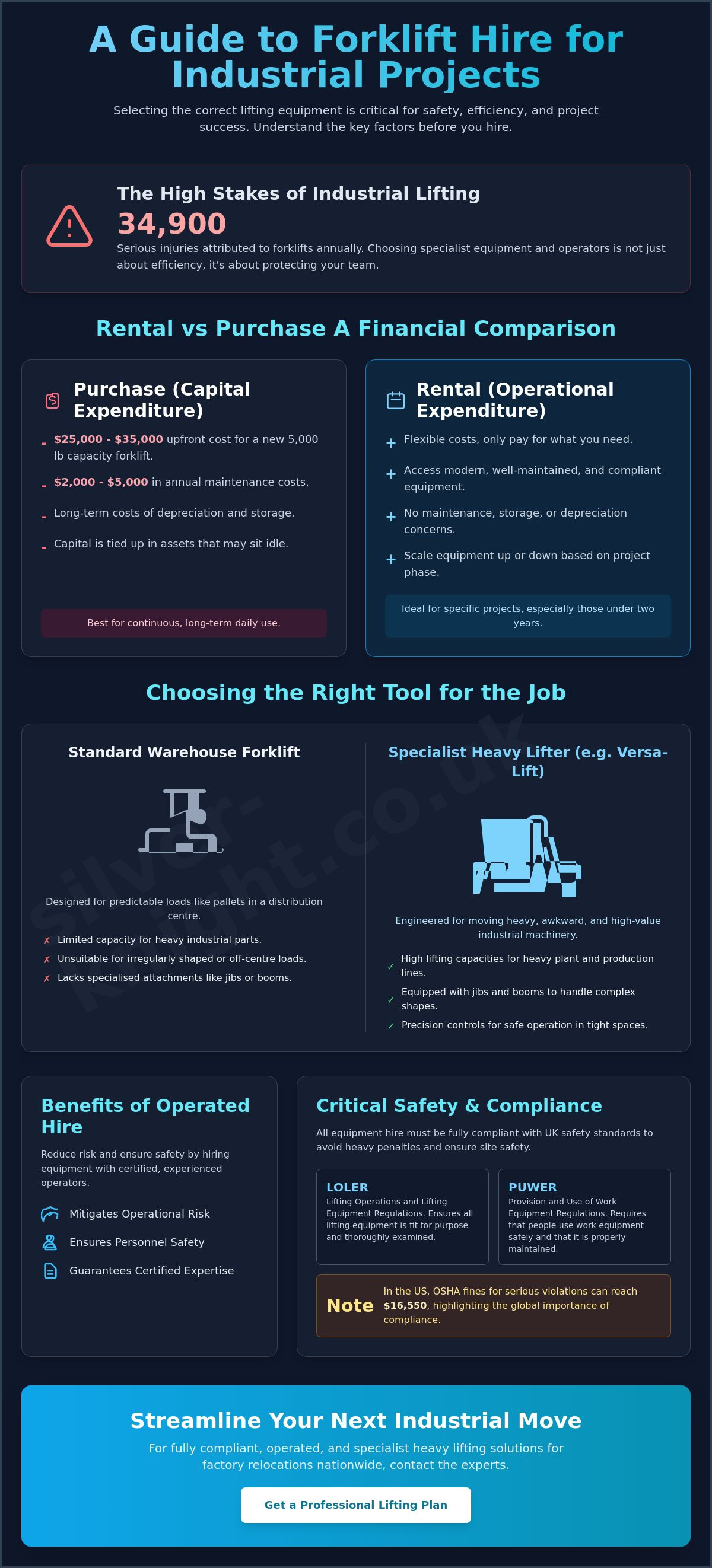
The term forklift rental in an industrial context refers to more than just hiring a standard warehouse truck for a few hours. It involves sourcing high capacity machinery specifically designed to handle the unique stresses of moving production lines or heavy plant. Whether you're decommissioning a single unit or organising a full factory relocation, having the right lifting capacity is vital. A standard Forklift might suffice for moving pallets in a distribution centre, but industrial moves often require specialised attachments and significantly higher weight limits to ensure the job is done safely.
Moving from a capital expenditure model to a flexible operational expenditure model is a smart strategic shift for many businesses in 2026. Instead of tying up hundreds of thousands of pounds in assets that sit idle between projects, companies can use forklift rental to access the exact tools they need for a specific window of time. This approach ensures that you always have modern, well maintained equipment on site, which is essential for protecting high value industrial assets during a move. Modern lifting equipment also plays a critical role in maintaining site productivity, as newer models often feature better precision controls and safety sensors that help prevent accidents.
To better understand how to choose the right equipment for your business, watch this helpful video:
Financial Advantages of Industrial Rental
Preserving capital is a priority for any facility manager. Buying a new 5,000 lb capacity forklift can cost between $25,000 and $35,000, and that doesn't include the $2,000 to $5,000 spent on maintenance every year. For projects lasting less than two years, equipment hire is often the more sensible financial path. It allows you to keep funds available for core business operations whilst still accessing premium machinery. There are also often tax benefits associated with hire costs, as they can frequently be deducted as a business expense. By renting, you also eliminate the long term costs of depreciation and the need for permanent storage space for rarely used kit.
Project Based Flexibility for Machineries
Factory relocations rarely follow a linear path, and your lifting requirements will likely change as the project progresses. You might need a compact electric model for tight indoor decommissioning during the first week and a high capacity heavy lifter for the final loading phase. Utilising a heavy moving equipment hire service allows you to scale your capacity up or down as needed. This flexibility ensures you always have the latest technology for complex machinery installation. Staying current with technology is also a safety requirement. With OSHA fines for serious violations reaching $16,550 in 2026, using modern rentals with up to date safety features is a vital part of risk management.
To ensure your relocation is handled by professionals, consider the services of these factory relocation specialists.
Comparing Forklift Types for Specialist Heavy Lifting
Selecting the correct machine for a heavy lift requires more than just checking the manufacturer's plate. You must account for the centre of gravity, which is rarely a perfect cube in industrial settings. Whilst a standard warehouse truck might be fine for simple pallet work, industrial machinery moving demands a higher class of forklift rental. These specialist machines often come with jibs or booms to handle awkward shapes that don't sit flush against the carriage. Adhering to Critical Safety Standards ensures that every lift is calculated and controlled, reducing the risk of tipping or structural failure.
High Capacity Forklifts and Versa-Lift Hire
For many industrial projects, standard equipment simply cannot manage the weight or the space constraints. This is where versa lift hire becomes essential. These machines are designed with an extending frame. This allows them to increase their lifting capacity without increasing their physical width, making them perfect for navigating tight factory aisles. Understanding the compact footprint and massive lifting power of specialised machinery movers is key to a successful move. When you compare the stability of telescopic forklifts versus standard counterbalance units, you'll find that specialised movers offer superior control for heavy, low-profile loads.
Selecting Power Sources for Industrial Use
Power selection isn't just about fuel cost; it's about the environment. Electric forklifts are the only choice for food grade or clean room environments where emissions are strictly prohibited. They offer quiet, fume-free operation that won't compromise sensitive production areas. However, for outdoor heavy haulage and loading bay operations, diesel and LPG options provide the torque needed for rougher surfaces and inclines. Always check your floor loading capacities before the equipment arrives. A high capacity forklift is extremely heavy, even when unladen. Selecting the right forklift rental for your specific environment is crucial for both safety and efficiency. You can review our heavy moving equipment hire service for more details on specific model weights. If you're unsure which model suits your site, you can speak with a specialist for expert advice.
If you need expert assistance with your next project, you can find a wide range of professional machinery moving solutions tailored to your requirements.
Benefits of Choosing Operated Forklift Hire for Complex Moves
Choosing the right machine is only half the battle. The person behind the controls is just as important. Most standard forklift rental agreements assume you have your own qualified staff, but for high risk industrial moves, this can be a dangerous assumption. Operated hire provides a level of safety that self drive options simply cannot match. When you hire an operator alongside the equipment, you aren't just getting a driver; you're getting a specialist who understands the physics of heavy lifting. This distinction is critical when moving high value assets that require precision handling to avoid costly damage.
Professional machinery moving personnel bring a depth of experience that goes beyond basic warehouse operations. They understand the nuances of decommissioning complex plant and can anticipate potential hazards before they become accidents. By utilising an expert operator, you significantly reduce the liability on your own business. If an incident occurs during a self drive hire, the burden of proof regarding operator competence falls on you. With operated hire, you're hiring a guaranteed result, not just a tool. This speeds up the entire relocation process, as an experienced hand can navigate obstacles much faster than a novice.
Expertise in Machinery Moving
A specialist forklift moving service involves more than just driving from point A to point B. It requires an understanding of how to manage complex weight distributions, especially when lifting off centre or top heavy industrial components. Professional operators usually hold CPCS (Construction Plant Competence Scheme) or NPORS (National Plant Operators Registration Scheme) certifications. These aren't just pieces of paper; they're proof that the operator has been tested in rigorous, real world scenarios. They know how to secure a load properly and how to react if a machine becomes unstable during a lift, which is vital for maintaining site safety regulations.
Risk Mitigation and Safety Standards
Safety in industrial moves isn't an accident. It's the result of meticulous planning involving Risk Assessment Method Statements (RAMS). When you choose operated hire, you transfer the immediate operational risk to the specialist provider. They ensure that every lift is overseen by a lifting supervisor and coordinated by a banksman. This team approach is vital for navigating tight spaces where the operator's view might be obstructed by the machinery itself. The supervisor ensures the move follows the pre-agreed plan, whilst the banksman provides clear signals to guide the machine safely. This coordinated effort ensures that your relocation stays on schedule whilst maintaining the highest possible safety standards.
To ensure your project meets all legal requirements and safety protocols, you should partner with an experienced provider of machinery installation and relocation services.
Critical Safety Standards and Planning for Equipment Hire
Safety is the most important factor in any industrial move. When you arrange a forklift rental, you're responsible for ensuring the equipment is used within a safe legal framework. In the United Kingdom, two primary sets of regulations govern this. The Provision and Use of Work Equipment Regulations (PUWER) ensure that the machinery is fit for its intended purpose and maintained correctly. Meanwhile, the Lifting Operations and Lifting Equipment Regulations (LOLER) specifically address the risks associated with lifting loads. Every lift must be planned by a competent person, supervised appropriately, and carried out in a safe manner.
The financial risks of ignoring these standards are significant. By 2026, serious safety violations can result in heavy fines, sometimes exceeding £16,000 per occurrence. Beyond the legal costs, equipment failure during a move can lead to catastrophic damage to high value assets. You must verify that any rental equipment comes with a current Thorough Examination certificate. This is the industrial equivalent of an MOT and proves that the machine has been inspected by a qualified engineer within the last six or twelve months, depending on its use.
Technical Site Surveys and Access Planning
A successful move starts long before the equipment arrives on site. You must conduct a technical site survey to identify potential hazards like overhead power lines, low ceilings, or restricted doorways. Large lifting equipment often requires delivery via low loaders or heavy trailers, so you need to ensure there is enough space for these vehicles to manoeuvre. Floor strength is another vital consideration. A high capacity forklift carries immense weight over a small area. You must confirm the floor can support the combined weight of the machine and its maximum load to prevent structural damage to your facility.
Regulatory Compliance for Industrial Lifting
Compliance isn't just about the machine; it's about the entire system of work. You need to document a Safe System of Work (SSOW) for every operation. This document should detail the weight of the load, the equipment being used, and the roles of everyone involved. Whilst the rental company is responsible for providing a safe machine, the hirer is responsible for how that machine is used on their site. This includes ensuring all operators have the correct certifications and that the terrain is suitable for the chosen power source. If you're moving heavy plant across outdoor surfaces, you must assess the ground conditions for stability. To ensure your next project is fully compliant, you can request a technical site survey from our expert team.
To ensure every stage of your project is handled with care, you can learn more about our comprehensive heavy machine movers and logistics solutions.
Strategic Equipment Hire for Nationwide Factory Relocations
Integrating your forklift rental into a comprehensive machinery haulage relocation transport moving service is the most efficient way to manage complex logistics. When you have a single point of contact for lifting, transport, and installation, you eliminate the risk of communication breakdowns between different contractors. This unified approach is especially valuable for nationwide projects where timing is everything. It allows for a more fluid movement of assets across the country, ensuring that equipment is ready and waiting at the new site before the haulage trucks even arrive.
Large scale plant relocation projects involve moving parts across hundreds of miles. Managing these logistics requires a partner who can provide high capacity equipment at both the origin and the destination. Specialised hire support ensures that precision machinery installation is possible immediately upon arrival, reducing downtime for your production lines. By centralising your equipment needs, you can better track costs and ensure that every machine used on the project meets the same high safety standards.
Coordinating Lifting and Haulage
Synchronising your lifting equipment with heavy haulage schedules is vital for maintaining project momentum. You don't want expensive trailers sitting idle because a forklift hasn't arrived to load them. During a factory clearance, forklifts are the workhorses that handle asset decommissioning and loading. By coordinating these services under one roof, you ensure a seamless transition between sites. This level of planning prevents bottlenecks and keeps the entire national relocation on track. It also means the team on the ground knows exactly what is arriving and when, which is essential for safely managing a busy site with multiple moving parts.
Long Term Support for Industrial Assets
The project doesn't end when the machinery arrives at its destination. You'll likely need specialised rental equipment for the recommissioning phase at your new facility. If equipment arrival is staggered to suit your production schedule, accessing secure industrial storage solutions provides a safe buffer for your assets. Working with a partner that brings 180 years of collective industry experience means you have access to experts who've seen every possible challenge. They can provide the long term support needed to get your factory back to full capacity quickly. This experience is invaluable when navigating the final hurdles of a relocation, from precision levelling to the final testing of heavy plant.
To ensure your relocation is handled by professionals, consider the services of these machinery moving experts.
Secure Your Next Industrial Move with Expert Lifting
Success in heavy industrial projects depends on precision planning and the right equipment. We've explored how a strategic forklift rental can transform your factory relocation by reducing capital costs whilst maintaining the highest safety standards. Precision is vital. By choosing operated hire and conducting thorough site surveys, you can mitigate the risks associated with moving high value machinery. Integrating these lifting solutions into a nationwide logistics plan ensures your project stays on schedule.
With 180 years of collective industry experience, Silver Knight are specialists in heavy machinery moving and factory relocations. We provide a nationwide service across the United Kingdom, ensuring that your assets are handled with expert care at every stage of the journey. Our team understands the complexities of industrial environments and the critical importance of regulatory compliance. Safety is our priority.
Ready to streamline your next relocation? Contact the Silver Knight team for a tailored forklift rental quote and discover how our expertise can support your business goals. We look forward to helping you move forward with confidence.
Frequently Asked Questions
How much does it cost to rent a forklift for an industrial project
Costs for a forklift rental depend on the required lift capacity and whether you need an operator. Heavy projects often require high capacity units or specialised Versa-Lifts, which carry different rates to standard warehouse models. We recommend a technical consultation to get an accurate quote for your specific needs. Most providers will offer more competitive daily rates if you commit to a longer hire period for your relocation.
Do I need a special licence for forklift rental in the UK
There is no single government issued licence in the UK, but all operators must have recognised training from bodies like RTITB or ITSSAR. For industrial sites, many project managers specifically require CPCS or NPORS certifications to ensure site safety. If you choose an operated hire service, the provider takes responsibility for ensuring all personnel are fully qualified and compliant with current safety standards for the duration of the project.
Is maintenance included in forklift hire agreements
Routine maintenance and breakdown cover are almost always included in a standard hire agreement. This ensures that mechanical failures don't cause expensive delays to your relocation timeline. You should always verify that the agreement covers rapid on site repairs, especially when working in demanding industrial environments. Providers that maintain their own specialised fleet generally offer higher reliability for complex machinery moving projects.
Can I hire a forklift with a qualified operator for a machinery move
You can certainly hire a forklift with a qualified operator, which is often the safest route for complex industrial moves. This service pairs a high capacity machine with a professional who is experienced in the nuances of moving heavy plant. This approach significantly reduces the risk of asset damage and ensures that all lifting operations are conducted in full compliance with LOLER regulations on your site.
What is the difference between short term and long term hire for factories
Short term hire provides maximum flexibility for specific projects like factory relocations, whilst long term hire is a cost effective way to manage a permanent fleet. For most machinery moving tasks, a flexible short term agreement is the preferred choice because it can be extended if project phases shift. This allows you to scale your lifting capacity without the long term financial commitment or depreciation risks of ownership.
What safety documentation is required for industrial forklift hire
Every forklift rental on an industrial site must be supported by a detailed Method Statement and Risk Assessment (RAMS). You must also ensure the machine has a valid Report of Thorough Examination, commonly known as a LOLER certificate. When using an operated service, always verify the operator's training records and ensure the provider has adequate public and products liability insurance to cover the specific risks of moving heavy machinery.
Article by
David Ashby
I'm the Managing Director of Silver Knight Haulage & Machinery Ltd. Silver Knight Ltd is a family-run firm established in the West Midlands in 2005, with the aim of providing a cost-effective, yet professional, service to businesses for the removal, transportation, and installation of machinery, plant, and equipment here in the UK and worldwide. Between us, the Silver Knight workforce has over 50 years of experience with machinery and its operation.
Disclaimer
This article is intended for informational purposes only. Please ensure you seek expert advice or carry out your own research to confirm the information is suitable for your specific needs.