Is your standard warehouse forklift actually the biggest risk to your new production line? Moving heavy, expensive industrial machinery is a high stakes task that often keeps project managers awake at night. You likely worry about floor loading capacities or the devastating cost of a dropped load, especially if your team isn't used to heavy lifting. Securing the right forklift truck hire is about more than just finding a machine; it's about ensuring your assets arrive in one piece.
We understand the pressure of keeping a factory relocation on track and within budget. This guide will show you how to select the perfect equipment for industrial moves and explain why an operated hire service is the safest way to protect your investment. You'll discover how to achieve a safe, efficient relocation whilst staying on the right side of LOLER regulations. We'll also look at specialised equipment like Versa Lifts and explain how expert operators can solve your most difficult lifting challenges.
Key Takeaways
- Learn why industrial moves require specialised forklift truck hire rather than standard warehouse equipment to handle irregular and heavy loads.
- Understand the critical risks of underestimating machine weights and how to calculate the correct lifting capacity for your project.
- Discover how specialised Versa Lifts provide the necessary power and manoeuvrability for complex machinery installations in tight spaces.
- Ensure full compliance with LOLER regulations and find out why hiring a qualified operator is the safest choice for high value lifts.
- Explore the benefits of a consultative hire process to ensure every piece of equipment is perfectly matched to your specific factory environment.
If you are planning a complex relocation, you can find expert support through our dedicated machinery moving services.
Understanding Forklift Truck Hire for Industrial Projects
Industrial projects demand much more than the simple movement of palletised goods. Whilst a standard warehouse operation focuses on speed and volume, industrial lifting involves precision, balance, and the handling of irregular loads. Choosing the right forklift truck hire means finding equipment that can cope with off-centre weights and high-value assets that cannot afford even a minor scratch. You might require a specialised forklift moving service to ensure these delicate tasks are handled correctly. Standard daily rentals often lack the specific attachments or high capacity ratings needed for heavy plant, which is why a tailored approach is vital for success.
A Forklift (Wikipedia) is a versatile tool, but for industrial applications, the choice is often dictated by the specific project timeline. Daily hire might work for a quick offload, but project-based hire is usually more cost-effective for factory relocations. This approach allows for a thorough assessment of the site, ensuring the truck matches the floor loading limits and the height of the access points. It avoids the common mistake of hiring a machine that is too large to fit through a workshop door or too heavy for a mezzanine floor.
To better understand this concept, watch this helpful video:
Counterbalance and Reach Trucks for Factory Use
Counterbalance forklifts are the workhorses of the industrial world. They use a heavy weight at the rear to offset the load on the forks, making them perfect for lifting heavy machinery without the risk of tipping. These machines are essential when you need to move items that don't sit neatly on a pallet. Reach trucks, whilst excellent for high racking in a warehouse, are rarely suitable for moving heavy plant. Their design is optimised for narrow aisles rather than the stability required for shifting a five-tonne lathe or a large industrial oven. For most factory environments, a counterbalance truck with the correct weight rating is the safest starting point for any forklift truck hire agreement.
Fuel Types and Environmental Considerations
The environment where you operate dictates your fuel choice. Electric forklifts have become the gold standard for indoor factory use because they produce zero emissions and operate with minimal noise. If you are working in a confined space, an electric or LPG (Liquid Petroleum Gas) model is essential for maintaining air quality and protecting staff health. Diesel trucks offer superior power and are better suited for outdoor transit or loading onto heavy moving equipment, but their exhaust fumes make them unsuitable for indoor workshops. Choosing the wrong fuel type can lead to a build-up of carbon monoxide, which is a serious safety violation. Always consider the ventilation of your site before making a final decision.
If you need professional assistance with your industrial project, you can find more information about our machinery moving solutions online.
Key Considerations for Selecting the Correct Capacity
Underestimating the weight of industrial machinery is one of the most common and dangerous mistakes in a factory relocation. A machine that looks compact might contain dense internal components or heavy fluid reservoirs, making it far heavier than it appears. When you arrange forklift truck hire, you must account for the actual weight rather than a rough estimate. Relying on an underpowered truck puts the equipment, the floor, and the operator at severe risk. Accurate data is the foundation of any successful lift.
The centre of gravity is rarely in the middle of a piece of industrial plant. If a load is long or uneven, the effective lifting capacity of the truck drops significantly as the distance from the mast increases. Every forklift has a specific load chart that dictates what it can safely lift at various extensions. Ignoring this chart is a breach of OSHA forklift safety standards and relevant UK health and safety laws. To prevent these issues, Silver Knight provides technical site surveys to determine the exact gear required for your specific lift, ensuring nothing is left to chance.
Calculating Load Centres and Total Weight
Industrial machines often have off-centre weights that shift during transit. You should always locate the manufacturer's weight plate on the equipment to get a precise figure before booking your forklift truck hire. If the load centre is further away from the forklift's carriage than the standard 600mm, the truck's capacity is reduced. We recommend including a safety margin of at least 20% when hiring equipment. This buffer accounts for potential inaccuracies in weight data and ensures the machine isn't operating at its absolute mechanical limit.
Assessing Site Access and Floor Loading
The weight of the forklift itself is just as important as the load it carries. A heavy-duty truck can easily crack a factory slab or exceed the weight limits of a mezzanine floor if the point loading is too high. You must measure door widths and ceiling heights accurately to ensure safe passage through the building. For projects with restricted space or low head height, using professional forklift moving services can help you navigate tight corners that a standard operator might struggle with.
If you are unsure about your site's requirements, you can speak with our team for expert advice on equipment selection.
Ensuring you have the correct expertise is vital for any project, and you can learn more about our specialised lifting services by visiting our main website.
Comparing Standard Forklifts and Specialised Versa Lifts
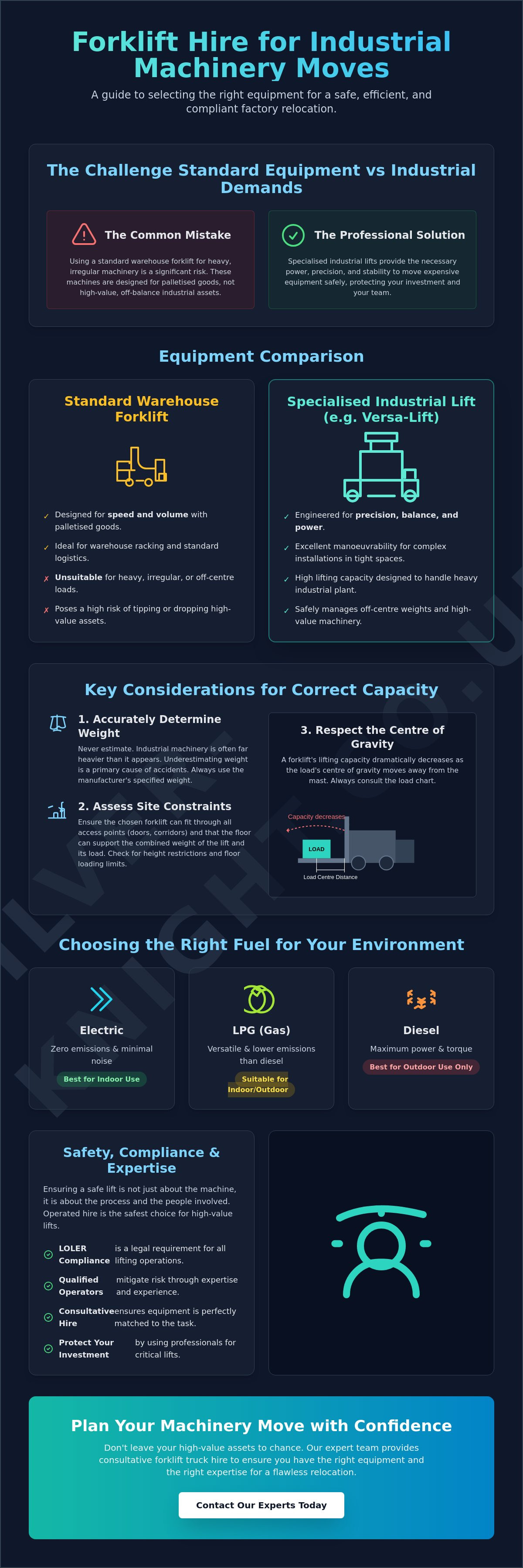
Whilst a standard warehouse truck is ideal for moving pallets, industrial machinery moving requires a different level of engineering. The physical footprint of a standard 15 tonne forklift is often too large for the narrow aisles of a modern factory. This is where the Versa Lift becomes the gold standard for forklift truck hire in industrial settings. These machines are designed specifically for the heavy lifting industry, offering a compact frame that doesn't sacrifice power. They allow you to navigate tight spaces that would be impossible for traditional equipment to access safely.
The secret to the Versa Lift is its extendable counterweight system. By pushing the rear of the chassis outwards, the truck increases its lifting capacity whilst maintaining a short wheelbase for turning. This design provides precision control that standard warehouse gear cannot match. Handling such massive loads in confined areas requires strict adherence to safety protocols. Following established CDC forklift injury prevention advice helps mitigate the risks associated with tip-overs and crushed loads during complex industrial lifts. Precision is the difference between a successful installation and a costly accident.
When to Choose a Versa Lift over a Standard Truck
You should opt for a Versa Lift when space is restricted but the load is extremely heavy. In many indoor environments, there simply isn't enough head height to use a mobile crane. A Versa Lift provides the same heavy lifting capability in the body of a forklift, making it the perfect crane alternative for internal factory work. It can handle loads that would usually require a much larger and more cumbersome machine. For a deeper dive into how these systems compare to other lifting methods, you can read our specialised lifting blog.
The Versatility of Specialised Lifting Attachments
Standard forks aren't always the best way to secure a piece of plant. Using booms and jibs allows an operator to lift a machine from its designated lifting points at the top, which is often safer for sensitive equipment. Specialised forks can also be adjusted to accommodate wide or irregular loads that would be unstable on a standard truck. Our heavy moving equipment hire includes a variety of these attachments to ensure every project is handled with the correct gear. This flexibility ensures that even the most unusually shaped machines are moved with total stability.
To ensure your project meets all safety requirements, you can access our full range of industrial lifting services online.
Safety Standards and the Benefits of Operated Hire
When you arrange forklift truck hire for a factory relocation, you aren't just hiring a machine; you are taking on significant legal and safety responsibilities. Many businesses opt for dry hire to save money, assuming their internal warehouse staff can handle the move. However, shifting a ten tonne CNC machine is fundamentally different from moving a pallet of stock. Professional machinery movers understand the nuances of load stability and the specific risks involved in industrial lifting. They bring a level of precision that protects both your equipment and your staff from harm.
Hiring a professional operator provides an essential layer of insurance and risk management. If an accident occurs during a dry hire project, the liability often falls entirely on the hirer. In contrast, an operated hire service brings its own insurance and a level of expertise that internal staff simply won't have. Professional operators are trained to navigate complex environments whilst working amongst active factory staff, ensuring that production doesn't need to grind to a halt just because a machine is being moved. This specialised focus is what keeps a project on schedule and within health and safety guidelines.
Understanding LOLER and PUWER Requirements
LOLER is the Lifting Operations and Lifting Equipment Regulations 1998. These regulations require that all lifting equipment is fit for purpose and subject to a Thorough Examination by a competent person. For equipment lifting people, this must happen every six months, whilst for other lifting gear, it is every twelve months. Beyond the machine itself, the law dictates that every lift must be properly planned and supervised. This is where many DIY projects fail, as they lack a documented lift plan that identifies potential hazards like floor voids or overhead obstructions.
Why Professional Operators Minimise Project Risk
Our team brings over 180 years of collective experience to every project. This depth of knowledge is vital when a load shifts unexpectedly or when the centre of gravity isn't where the manufacturer's manual suggests. Professional operators can feel how a machine is behaving and adjust their approach in real time. If a machine is too large or unstable to move in one piece, we often recommend our machinery dismantle services to break the load down into safer, more manageable components before transit.
You can contact our team today to discuss your safety requirements and receive a quote for a fully operated hire package.
For a comprehensive overview of our machinery moving capabilities, please visit our homepage.
How to Arrange Your Forklift Truck Hire with Silver Knight
Arranging forklift truck hire for a complex industrial project shouldn't be as simple as adding an item to a digital basket. At Silver Knight, we use a consultative process that ensures the equipment you receive is the equipment you actually need. We don't believe in a one size fits all approach, especially when high value machinery is involved. Every project begins with a conversation about your specific goals, the machinery involved, and the constraints of your site. This ensures that when our team arrives, they have the exact tools required to complete the job safely.
For national projects, we prioritise a site survey to map out the logistics of the move. This is a vital step when integrating lifting gear into a full factory relocation service. Our support isn't limited to the UK either. We provide national and international support for machinery transport, ensuring that your assets are handled with the same level of care whether they are moving across the street or across a border. By coordinating the hire with the transport, we eliminate the communication gaps that often lead to project delays.
Requesting a Technical Site Survey
During a site visit, a Silver Knight technician looks for details that are easily missed in a phone call. They check for floor load limits, the height of roller shutter doors, and the presence of any underground services that might be affected by a heavy lift. This level of detail is what prevents costly delays on the day of the move. It allows us to prepare a detailed lift plan that accounts for every variable. Our machinery haulage and relocation services are built on this foundation of thorough preparation, ensuring that even the most difficult lifts are executed without a hitch.
Tailoring Your Hire Package for Maximum Efficiency
Efficiency comes from having the right mix of equipment. You might find that combining your forklift truck hire with hydraulic gantry systems or jack and slide gear is the fastest way to position a machine in a tight spot. We also offer flexibility in hire duration. Whether you need a truck for a single afternoon or require long term hire to manage equipment within secure warehousing, we can tailor a package to fit. This adaptable approach helps you manage costs whilst ensuring you always have access to the best lifting technology. If you are ready to plan your next move, contact our team for a project quote and let us handle the heavy lifting.
You can browse our full range of machinery moving and installation services to find the right support for your industrial project.
Secure Your Next Industrial Move Today
Success in industrial lifting depends on more than just high capacity equipment. By selecting the most appropriate forklift truck hire and working with experienced professionals, you eliminate the uncertainty that often surrounds heavy machine moves. We have explored the technical requirements of load centres and the specialised capabilities of Versa Lifts, which provide the precision needed for complex factory environments.
Prioritising safety through operated hire and adherence to LOLER standards protects your staff and your assets. With over 180 years of collective industry experience and a fleet of specialised gear, Silver Knight Haulage & Machineries Ltd is equipped to handle national and international relocations of any scale. Taking a consultative approach ensures that every detail is managed with care and expertise.
Contact Silver Knight for expert operated forklift hire and machinery moving to discuss your requirements. We are ready to help you plan a safe and efficient relocation.
Frequently Asked Questions
Do I need a special licence for forklift truck hire in the UK
There is no single "licence" required by law, but every operator must have a Certificate of Training and a written Authorisation to Operate from their employer. Since January 2026, new ABA training categories have been in effect across the industry. Employers must ensure their staff are trained on the specific category of equipment being hired to remain compliant with PUWER regulations and safety standards.
What is the difference between dry hire and operated forklift hire
Dry hire provides you with the machine alone, whilst operated hire includes a professional driver to manage the lifting. For complex machinery moving, operated hire is often the better choice as it brings specialised expertise to the project. This reduces the risk of accidents and ensures the equipment is handled by someone familiar with the behaviour of irregular industrial loads.
Can a standard forklift move a 20 tonne industrial machine
A standard warehouse forklift is usually incapable of moving a 20 tonne machine safely. Most common counterbalance trucks have a capacity between 1.5 and 5 tonnes. For a 20 tonne lift, you would require specialised forklift truck hire involving a Versa Lift or alternative equipment like a hydraulic gantry system to manage the weight without risking a tip over.
How much does it cost to hire a forklift for a day in 2026
The cost of hiring a forklift varies significantly based on the lifting capacity, fuel type, and the duration of the project. Industry rates are influenced by the shift towards electrification and the specific attachments required for the task. It is always best to request a project specific quote to ensure you aren't paying for more capacity than you actually need for your move.
What safety checks should be performed before using a hired forklift
You should always perform a pre-use inspection covering the brakes, steering, hydraulics, and the condition of the forks. It is also vital to check the Report of Thorough Examination to ensure the machine complies with LOLER. If any defects are found, the equipment must not be used until it has been repaired and signed off by a competent person.
Are forklifts suitable for moving machinery in restricted access areas
Specialised forklifts are designed specifically for restricted access areas where a mobile crane cannot operate. Compact models with extendable counterweights provide high lifting power without the large physical footprint of a standard truck. This makes them ideal for moving heavy plant through narrow workshop doors or underneath low mezzanine floors where head height is limited.
Does Silver Knight provide forklift hire for national projects
Silver Knight provides comprehensive support for both national and international machinery relocation projects. Our team manages the logistics of transporting the necessary lifting gear to your site, regardless of the location. This ensures you have access to the same high quality forklift truck hire and professional operators for projects across the country, maintaining consistency and safety standards.
What insurance do I need when hiring a forklift for machinery moving
If you choose dry hire, you will typically need Hired-in Plant insurance to cover the value of the machine and any third party damage. When you opt for a fully operated service, the provider usually includes their own professional liability insurance within the package. You should always verify the specific level of cover and any exclusions before any lifting work begins on your site.
Article by
David Ashby
I'm the Managing Director of Silver Knight Haulage & Machinery Ltd. Silver Knight Ltd is a family-run firm established in the West Midlands in 2005, with the aim of providing a cost-effective, yet professional, service to businesses for the removal, transportation, and installation of machinery, plant, and equipment here in the UK and worldwide. Between us, the Silver Knight workforce has over 50 years of experience with machinery and its operation.
Disclaimer
This article is intended for informational purposes only. Please ensure you seek expert advice or carry out your own research to confirm the information is suitable for your specific needs.