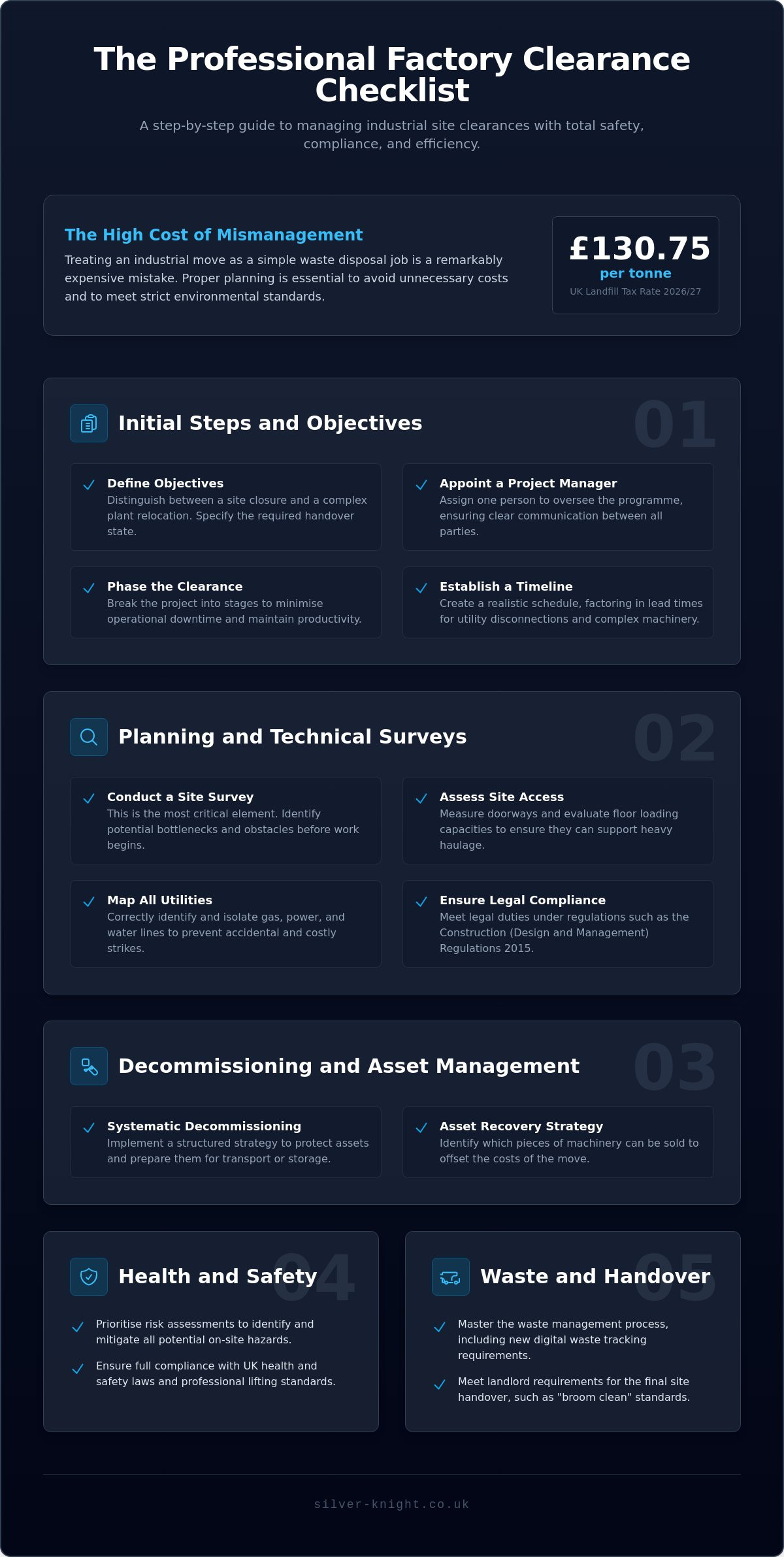
With the UK’s standard landfill tax rate sitting at £130.75 per tonne for the 2026/2027 tax year, treating an industrial move as a simple waste disposal job is a remarkably expensive mistake. You probably recognise that clearing a site involves far more than just emptying a building; it's a high stakes engineering project where health and safety must always come first. Managing multiple contractors whilst ensuring you meet strict environmental disposal standards can feel overwhelming, especially when you need to maintain ongoing operations. Using a structured factory clearance checklist is the only way to ensure nothing is missed and every asset is accounted for properly.
We understand the pressure to complete a clearance quickly whilst avoiding legal pitfalls and maximising the value of your machinery. This article provides a professional step by step guide to managing industrial site clearances with total safety and efficiency. You'll learn how to organise your decommissioning schedule, handle new digital waste tracking requirements, and recover maximum value from your industrial assets to ensure a smooth transition for your business.
Key Takeaways
- Define your primary objectives early to distinguish between a simple site closure and a complex plant relocation project.
- Use a detailed factory clearance checklist to manage technical site surveys and identify potential obstacles before moving any heavy machinery.
- Implement a systematic decommissioning strategy to protect your assets and prepare them for transport or storage.
- Ensure full compliance with UK health and safety laws by prioritising risk assessments and professional lifting standards during the clearance.
- Master the final waste management and site handover process to meet environmental regulations and satisfy landlord requirements.
If you are planning a site move, you can rely on our expert factory clearance services to manage the entire process from start to finish.
Initial steps for a successful factory clearance
Successful industrial site management begins with a clear definition of your primary goals. Whether you're dealing with a total site closure or a complex plant relocation, your factory clearance checklist should serve as the foundation for every decision. You'll need to appoint a dedicated project manager early. This individual oversees the entire programme, ensuring that communication remains clear between facilities management, health and safety officers, and external contractors.
Adopting a multi stage clearance process is vital to avoid operational lag. By breaking the project into phases, you can maintain production in one area whilst decommissioning another. This approach minimises downtime and keeps your workforce productive for as long as possible. It also allows your logistics team to test the workflow before the most intensive stages of the move begin.
To better understand how to assess your current site layout before starting, watch this helpful video regarding warehouse racking inspections:
Defining the clearance objectives
Start by assessing whether the goal is total site vacancy or partial asset relocation. You must determine the exact state required for the final handover to the landlord or new owner. This often involves specific broom clean standards or the removal of all floor fixings and heavy duty racking. Establishing a budget that accounts for professional lifting and heavy haulage costs is essential at this stage. You should also consider asset recovery strategies to identify which pieces of machinery can be sold to offset the costs of the move. For those looking for professional assistance, our uk factory clearance service provides the expertise needed to evaluate and clear equipment efficiently.
Establishing a realistic timeline
Timelines often slip because of overlooked lead times for utility disconnections. Electricity, gas, and water services must be safely isolated before any heavy machinery movers begin their work. Always build in a buffer for the decommissioning of complex machinery, as older equipment may have unique requirements or fragile components. Your schedule should prioritise the removal of the largest, heaviest items first. This creates the necessary floor space to manoeuvre smaller equipment and allows for a more organised flow of traffic through the site's loading bays. Clear communication with your team ensures that everyone knows their role and the deadlines they must meet.
If you are preparing for a complex industrial move, you can book a professional site survey to identify potential risks before the clearance begins.
Essential planning and technical site surveys
A professional site survey is the most critical element of your factory clearance checklist. Skipping this stage often leads to expensive delays or, worse, structural damage to the property. You cannot rely on old building plans; they rarely reflect current modifications or the reality of heavy machinery placement. A technical survey identifies potential bottlenecks before they become active problems during the move. It allows your team to understand the physical constraints of the environment and plan accordingly.
Understanding site access requires measuring more than just the width of a door. You must evaluate floor loading capacities to ensure the concrete can withstand the weight of hydraulic jacks, skates, or heavy haulage vehicles. Utility mapping is equally vital. Ensuring that gas and power lines are correctly identified prevents accidental strikes during dismantling. This level of detail protects your equipment and the landlord's building from costly repairs. Under the Construction (Design and Management) Regulations 2015, these assessments are often a legal requirement to ensure the safety of everyone on site. It's much cheaper to spend time on a survey than to pay for a burst water main or a cracked floor slab.
Conducting technical site surveys
Every exit point and transit route must be measured with the specific dimensions of your heavy plant equipment in mind. Check for overhead obstructions like pipework, lighting rigs, or mezzanine supports that might hinder a crane or gantry system. Ground conditions outside the building are just as important. You'll need to verify that the yard or access road can support the outriggers of a mobile crane or the weight of a fully loaded low loader. Identifying hazardous materials like asbestos or chemical residues early allows you to arrange for specialist handling without halting the entire project. Using specialist moving equipment ensures that even the tightest spaces are navigated safely.
Mapping out site access and logistics
Planning the flow of traffic is essential for a smooth clearance. You'll need to coordinate where cranes and lorries will park to avoid blocking emergency exits or local roads. If your site is in a busy industrial estate, you might need to secure permits for road closures or pavement access from the local council. Coordinating the timing of these removals helps minimise disruption to neighbouring businesses. You don't want to be loading a gantry system during a neighbour's peak delivery time. If you're unsure about the logistical requirements for your specific site, it's worth speaking with a specialist consultant to review your plans.
If you need help with dismantling and moving your equipment, our heavy machinery movers can manage the entire decommissioning process safely.
Decommissioning and asset management strategies
Once the site survey is complete, the physical work of dismantling begins. This phase of your factory clearance checklist requires a methodical approach to prevent damage to sensitive components. Decommissioning isn't just about taking things apart; it's about protecting the value of your assets for their next destination. Complex production lines often involve integrated hydraulic, pneumatic, and electrical systems that must be isolated in a specific order to prevent system shocks or fluid leaks. If you rush this stage, you risk turning a valuable asset into a pile of expensive scrap metal.
Proper documentation is the difference between a successful relocation and a logistical nightmare. Every cable, pipe, and bracket should be labelled clearly. It's best to take high resolution photographs of the original configuration before any bolts are loosened. Store all manuals, software backups, and specific calibration data together in a secure digital file. This level of detail is essential if you plan to recommission the equipment elsewhere or sell it to a third party. Without clear labelling, the cost of reassembling a complex machine can often exceed its market value.
Systematically decommissioning heavy machinery
Isolating power is the first step, but you must also drain all fluids, including oils and coolants, to prevent spills during transport. Since April 2026, the UK has used a mandatory national digital waste tracking service for hazardous materials. You must ensure that any drained fluids or contaminated parts are logged correctly to meet your commercial waste responsibilities. For high value precision equipment, it is often safer to use specialist machinery dismantle services. These experts use specialist equipment to secure moving parts and sensitive electronics, ensuring they arrive at their destination in perfect working order.
Categorising assets for sale or relocation
Not every piece of equipment should move with you. Perform an inventory audit to categorise assets into three groups: relocation, sale, or scrap. This process helps you identify redundant machinery that can be sold to offset your clearance costs. For the items you choose to keep, our factory relocation services provide the logistics needed to move them to your new facility. Items that have reached the end of their service life must be recycled responsibly. With the standard landfill tax rate at £130.75 per tonne for 2026/2027, you should maximise your recycling efforts to avoid unnecessary disposal fees. Be particularly careful with electrical items, as WEEE regulations are now more strictly enforced than ever before.
To ensure your project meets all legal safety standards, you can partner with our experienced industrial movers for a fully managed service.
Managing health and safety during industrial moves
Safety is the most important part of any factory clearance checklist. You have a strict legal obligation to provide a safe working environment for your staff and any external contractors on site. Industrial clearances involve significant risks, from heavy lifting and working at height to the handling of hazardous substances. Failing to manage these risks doesn't just lead to delays; it can result in severe injuries and heavy fines from the Health and Safety Executive. Every movement of machinery must be planned with precision to protect everyone involved.
If your project involves multiple contractors, you'll likely need to appoint a Principal Contractor to oversee site safety. This role is responsible for coordinating the different teams and ensuring that safety protocols are followed across the entire site. Using qualified operators for specialised lifting equipment is a non negotiable requirement. Whether you're using a forklift or a complex gantry system, the person at the controls must have the correct certifications and experience to handle the load safely. This expertise prevents accidents and ensures that your valuable assets aren't damaged during the moving process.
Risk assessments and method statements
You must develop comprehensive Risk Assessments and Method Statements (RAMS) for every stage of the clearance. These documents describe the specific hazards associated with a task and the steps you'll take to mitigate them. It's not enough to have a generic safety policy; each lift requires its own plan. All personnel must be briefed on these documents before work starts so they understand their specific roles and the risks involved. As the site environment changes, you should regularly review your safety protocols. For restricted areas where traditional cranes can't reach, using specialised lifting systems can significantly reduce the risk of manual handling injuries.
Ensuring compliance on site
Compliance with the Construction (Design and Management) Regulations 2015 is often required for factory clearances, as these projects are frequently classified as construction work. You must also verify that all lifting equipment, such as chains, slings, and jacks, has a valid LOLER (Lifting Operations and Lifting Equipment Regulations) certification. This ensures the equipment is fit for purpose and safe to use under load. Throughout the project, you must maintain clear emergency access routes and provide adequate first aid provisions. A cluttered site is a dangerous site, so keeping transit routes clear of debris is a constant priority. If you're concerned about meeting these complex safety requirements, you should contact our safety experts to discuss your project needs.
If you are finalising your site move, our factory clearance team can manage the final stages of waste disposal and site preparation to ensure a smooth handover.
Completing the clearance and waste management
The final stage of your factory clearance checklist is often the most scrutinised. Once the heavy machinery movers have departed, you are left with the task of returning the building to a state that satisfies your lease obligations or sale agreement. A final walkthrough with the landlord or new owner is essential. This is your opportunity to prove that you have met all contractual terms, from the removal of floor fixings to the safe isolation of services. Skipping this step can lead to disputes over dilapidations that might cost your business thousands of pounds in the long term.
Since the introduction of the mandatory national digital waste tracking service in April 2026, the paper trail for industrial clearances has moved away from traditional paper notes. You must ensure all movements of hazardous waste are recorded digitally and are easily accessible for inspection. For non hazardous materials, you still need to obtain waste transfer notes. These documents are your legal proof that you have fulfilled your duty of care under UK law. Without them, you remain legally liable for the waste even after it has left your site, which could result in significant penalties if the material is fly tipped or handled incorrectly.
Legal waste disposal and environmental duty of care
Segregating waste streams is the most effective way to manage your project costs. With the standard landfill tax rate sitting at £130.75 per tonne for the 2026/2027 tax year, every kilogram of metal, plastic, or timber you can divert to recycling represents a direct financial saving. You should only partner with licenced waste carriers who can provide clear evidence of their credentials. Remember that documentation for hazardous waste disposal must be kept for at least three years. This includes records for anything from old battery sets to contaminated rags used during the dismantling phase. Modern WEEE regulations also require specific handling for electronic waste, so ensure your waste partner is equipped for these categories.
Preparing the site for handover
Once the building is empty, a deep clean of the floor space is usually required. This involves removing oil stains, dust, and debris that often accumulate under production lines. You should also check for minor damage to the building fabric, such as holes in the floor from machinery bolts or scuffs on loading bay doors. Repairing these small issues yourself is much cheaper than having the landlord deduct the cost from your deposit. Finally, ensure the premises are secure and return all keys to the relevant authority to conclude the project. A clean and well documented handover is the sign of a professional clearance project well executed.
Our professional machinery movers provide the expertise needed to manage every stage of your industrial project safely.
Secure a successful industrial site handover
Managing an industrial site clearance is a complex undertaking that requires precision, technical expertise, and strict adherence to UK regulations. By following a detailed factory clearance checklist, you can move from initial site surveys to final waste disposal without facing the expensive errors that often plague unorganised projects. Prioritising safety and asset recovery ensures your business remains compliant whilst protecting the financial value of your machinery.
Silver Knight Haulage & Machineries Ltd brings over 180 years of collective industry experience to every project. With our comprehensive national UK coverage and a specialist heavy lifting and haulage fleet, we handle the technical challenges of decommissioning and relocation so you don't have to. Whether you're closing a single unit or relocating an entire production facility, professional support makes all the difference to your timeline and budget.
Contact Silver Knight for a professional factory clearance assessment to start planning your next move with confidence. We look forward to helping you achieve a safe and efficient site handover.
Frequently Asked Questions
How do I start a factory clearance project
You should start by defining your primary objectives and appointing a dedicated project manager to oversee the process. Creating a detailed factory clearance checklist is the next step to help you audit all on site assets and categorise them for relocation, sale, or recycling. Early engagement with professional machinery movers allows for technical site surveys to be completed well before any physical dismantling work begins on the shop floor.
What is included in a professional industrial plant clearance
A professional service includes technical site surveys, the decommissioning of complex production lines, and the safe removal of all heavy machinery. It also encompasses asset recovery to help you regain value from redundant equipment, alongside managed waste disposal that complies with current UK environmental laws. Specialist equipment such as hydraulic gantries or Versa-Lifts is typically used to navigate restricted spaces and ensure the building fabric remains undamaged.
How long does a typical factory clearance take to complete
The duration of a clearance depends on the site size and the technical complexity of the machinery involved. A small industrial unit might be cleared in a few days, whilst a large manufacturing plant with integrated production lines could take several weeks or months. Factors such as utility disconnection lead times and the requirement for specialist heavy haulage permits will significantly influence your project's overall timeline and schedule.
Do I need a special licence for factory clearance waste
You do not usually need a licence yourself, but you must ensure that your chosen waste carrier is fully licenced by the Environment Agency. Under the UK duty of care, you are legally responsible for ensuring your waste is handled and disposed of correctly. Since April 2026, you must also use the mandatory national digital waste tracking service for all hazardous waste movements to remain compliant with national regulations.
How do I dispose of heavy industrial machinery safely
Safe disposal requires professional decommissioning to drain all fluids and isolate power supplies before any movement occurs. Heavy machinery must be handled by expert movers using certified lifting equipment to prevent site damage or personal injury. Assets that cannot be sold for reuse should be transported to a licenced metal recycling facility to minimise landfill tax costs and help your business meet its environmental sustainability targets.
What are the legal requirements for a factory site handover
You must return the building in the specific condition outlined in your lease or sale agreement. This typically involves meeting a broom clean standard, removing all floor fixings, and ensuring that all utilities are safely isolated and capped. You are also legally required to retain waste transfer notes or digital tracking records as proof of responsible disposal for every material removed from the site during the clearance process.

Article by
David Ashby
I'm the Managing Director of Silver Knight Haulage & Machinery Ltd. Silver Knight Ltd is a family-run firm established in the West Midlands in 2005, with the aim of providing a cost-effective, yet professional, service to businesses for the removal, transportation, and installation of machinery, plant, and equipment here in the UK and worldwide. Between us, the Silver Knight workforce has over 50 years of experience with machinery and its operation.
Disclaimer
This article is intended for informational purposes only. Please ensure you seek expert advice or carry out your own research to confirm the information is suitable for your specific needs.