A manufacturing plant relocation isn't a simple logistical task; it's a high-stakes engineering project where a single millimetre of misalignment can cost more than the entire move. Whether you're shifting precision CNC machinery or heavy industrial gear, the margin for error is non-existent. You probably already know that the true cost of moving isn't just the transport; it's the risk of catastrophic asset damage or unforeseen downtime that pushes your restart date back by weeks. This manufacturing plant relocation guide is designed to remove that uncertainty by providing a technical framework for a seamless transition.
We understand the pressure of coordinating multiple contractors whilst trying to adhere to strict health and safety regulations, such as the 2026 Heat Illness Prevention Rule. This article promises a comprehensive roadmap to help you manage every phase of the journey. You'll learn how to plan for complex decommissioning, ensure safe transport, and execute a successful restart within your target timeframe. We will cover the essential steps from the first site survey through to the final machine commissioning at your new facility.
Key Takeaways
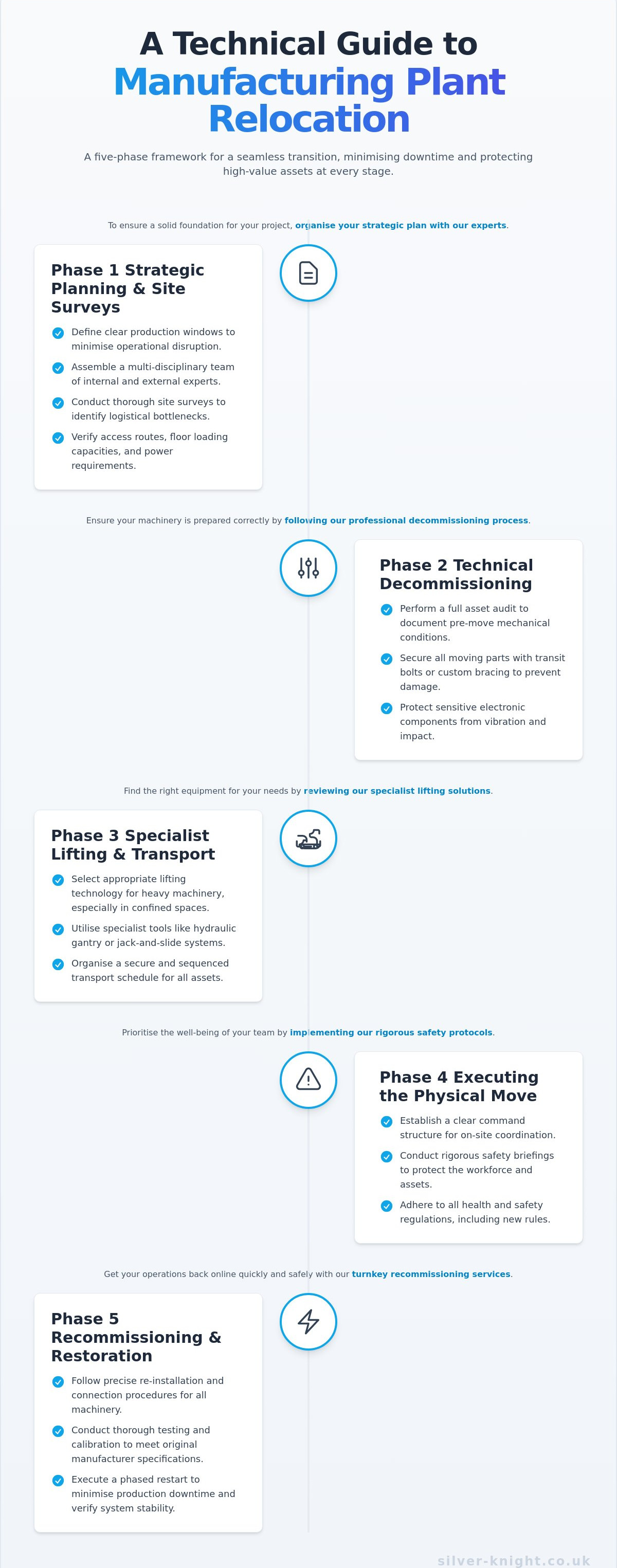
- Learn how to define production windows and build a multi-disciplinary project team to ensure a seamless transition.
- Use this manufacturing plant relocation guide to audit your assets and implement a systematic decommissioning process for sensitive equipment.
- Discover the best methods for selecting specialist lifting technology, such as hydraulic gantry systems, to move heavy machinery in confined spaces.
- Establish a clear command structure and rigorous safety briefing protocols to protect your workforce and assets during the physical move.
- Minimise production downtime by following precise recommissioning steps to restore your machinery to original manufacturer specifications.
Engaging a specialist partner for your factory relocation is the first step toward a successful and stress-free move.
Strategic Planning and Technical Site Surveys
Success in any industrial move starts with technical precision rather than simple logistics. This manufacturing plant relocation guide emphasises that moving a facility is a complex engineering feat that requires meticulous foresight. You must define clear operational goals and identify specific production windows to avoid overrunning. If you don't establish these boundaries early, the risk of unforeseen downtime extending beyond your planned window becomes a reality. It's vital to organise a phased schedule that allows for partial production to continue whilst other sections of the plant are in transit.
A multi-disciplinary project team is the backbone of a smooth transition. This team should include internal department heads and external machinery moving experts who understand the technical nuances of heavy equipment. For a broader manufacturing relocation overview, leaders should consider how location and scale impact their long term operational strategy. Including specialists at the planning stage ensures that the physical constraints of the move are understood before any legal or financial commitments are finalised.
To better understand the scale and complexity of these projects, watch this helpful video:
Establishing Project Objectives and Timelines
Aligning all stakeholders on the reasons for the move helps maintain momentum throughout the project. Whether you're moving to access better talent or to lower your overheads, every decision must support these core objectives. You should create a detailed timeline that accounts for seasonal peaks in demand. Moving during your busiest quarter is a significant risk that could alienate your customers. A phased approach often works best, as it allows you to test and recommission equipment at the new site without completely halting your output.
The Importance of a Professional Site Survey
Technical site surveys are where many relocation projects either succeed or fail. You must conduct a thorough inspection of both the origin and destination sites to identify potential bottlenecks. This includes measuring access routes for oversized loads and heavy haulage vehicles to ensure they can navigate the local roads and site entrances. You also need to verify floor loading capacities and power requirements at the new facility. In 2026, securing sufficient electrical capacity has become as critical as the location itself; in some areas, securing the necessary power for a new plant can take years. A professional survey will also document existing utility connections and plan for machinery storage if the new site isn't ready for immediate installation. Identifying restricted access points or low ceiling heights early allows you to plan for specialist tools like hydraulic gantry systems or jack and slide systems.
Professional machinery moving services ensure that your high-value assets are handled with the technical expertise required for a successful relocation.
Technical Decommissioning and Machinery Preparation
Preparation is the stage where you protect your capital investment from both physical and regulatory risks. This manufacturing plant relocation guide highlights that decommissioning is far more than just unplugging cables; it's a rigorous engineering process. It begins with a comprehensive audit of every asset. You should document the current mechanical condition of each machine and note any existing wear. By establishing this baseline, you can identify which machines require remedial work before the move or which might need extra protection for sensitive electronics.
Securing moving parts is critical to prevent internal damage during transit. For precision equipment like CNC centres or robotic arms, you must use original transit bolts or custom bracing to lock spindles and axes in place. Without these precautions, the vibrations from road transport can cause micro-fractures or misalignment in bearings and drive systems. If you're unsure about the technical requirements for a specific piece of equipment, you might want to speak with a technical specialist to review your decommissioning plan.
Systematic Asset Auditing and Documentation
Using digital logs to track every component ensures nothing is lost during the move. You should take high-resolution photographs of complex wiring and pipework before any dismantling begins. This visual record is invaluable during the recommissioning phase. If you're moving equipment abroad, identify machines that need specialist export packing to meet international machinery transport standards. Proper labelling of every electrical and mechanical disconnection will save your engineers days of frustration at the destination.
Safe Disconnection and Fluid Management
Handling industrial fluids requires strict adherence to environmental protocols. As of early 2026, new TSCA rules require manufacturers to report PFAS-containing articles, making it essential to identify and manage these substances during decommissioning. You must drain all oils, coolants, and hydraulic fluids to prevent leaks. Coordinate with utility providers to ensure gas and high-voltage power lines are safely isolated. To prevent mechanical strain during the breakdown, it's often best to utilise professional machinery dismantle services. This ensures that disconnections are made at the correct joints, preserving the integrity of the equipment for its eventual restart. Following these steps helps you avoid OSHA penalties for serious violations, which can reach $16,550 per instance in 2026.
Finding the right heavy machine movers is essential for ensuring your assets are transported using the latest industry technology.
Selecting Specialist Lifting and Transport Equipment
Moving a 50 tonne press inside a live factory is a world away from standard logistics. This manufacturing plant relocation guide focuses on the technical "how" of shifting massive assets where space is at a premium. You can't simply bring in a standard mobile crane if the ceiling height is only six metres. Matching the lifting equipment to the specific weight and dimensions of your machinery is the only way to ensure safety. It's about selecting the right tool for the specific physical constraints of your site. If you ignore these details, you risk damaging both the machinery and the building structure itself.
Advanced Lifting Technologies for Industrial Assets
Hydraulic gantry systems are often the superior choice for indoor environments. Unlike traditional cranes, they operate within tight footprints and provide vertical lift with extreme stability. If you're working with massive loads that require millimetre perfect positioning, jack and slide systems are the answer. These systems distribute weight evenly. This is vital for protecting factory floors from cracking under concentrated pressure. Utilising specialised lifting equipment allows for movement in restricted spaces where a standard forklift would fail. For versatile, high capacity lifting in narrow aisles, a Versa-Lift offers the reach and power needed without the bulk of larger machines. Choosing contract lifting is another strategic move. It transfers the technical and safety risks to the specialist provider. This ensures that every lift is planned and executed by qualified professionals who carry the necessary insurance and liability.
Heavy Haulage and Transport Logistics
Once the machinery is out of the building, the focus shifts to road transport. You must select the right trailer types to suit the load. Low loaders are essential for tall machinery to clear bridges, whilst flatbeds might suffice for smaller components. Planning your route is a non-negotiable step. In 2026, urban centres are increasingly restricted, and weight limits on bridges are strictly enforced. You need a route that avoids these obstacles to prevent delays or fines. Securing the load is the final critical step. Use industrial grade lashing and restraint systems to ensure nothing shifts during transit. Even a small movement on a heavy haulage trailer can lead to a dangerous imbalance. This phase of the manufacturing plant relocation guide ensures your assets arrive at the new site in the same condition they left the old one. Precision at this stage prevents the structural stress that often leads to machine failure after a move.
Choosing a specialist for your factory relocation ensures that every technical detail is handled with professional care and engineering precision.
Executing the Physical Plant Relocation Safely
On the day of the move, the theoretical plans from this manufacturing plant relocation guide must translate into disciplined action. You need to establish a clear command structure where every operative knows exactly who is in charge of each specific zone. This prevents confusion and ensures that decisions are made quickly when conditions change. Before a single machine is lifted, you must conduct final safety briefings and site inductions for all personnel. In 2026, these briefings must include the federal Heat Illness Prevention Rule requirements. This means ensuring your team has scheduled hydration plans and mandatory rest breaks to maintain focus during physically demanding work.
Monitoring site access and weather conditions is a constant task for the project lead. High winds or heavy rain can turn a standard lift into a high risk operation. You should implement strict exclusion zones around all lifting and loading areas to keep non-essential personnel away from potential hazards. By utilising professional factory relocation services, you gain access to experienced site managers who can handle these logistics whilst you focus on broader operational continuity.
Site Safety and Risk Management
All lifting operations must strictly comply with LOLER and PUWER regulations to ensure equipment is fit for purpose and used safely. Providing adequate PPE and clear signage across the entire site is a basic requirement that cannot be overlooked. A Banksman plays a vital role in industrial lifting by acting as the eyes and ears of the crane or forklift operator to guide loads safely through the site. Failing to manage these risks could result in OSHA penalties for willful violations, which can cost up to $165,514 per instance in 2026.
Coordinating the Loading and Transit Phase
Congestion is the enemy of a safe move. You must synchronise the arrival of haulage vehicles to ensure there is enough space for loading without blocking emergency access or slowing down the process. Verify that all transit insurance and permits are in place before any vehicle departs the site. Waiting for permit changes can add 30 to 50 percent to your final bill, so get this right early. Constant communication between the origin and destination teams is essential. This ensures that the new site is ready to receive the machinery as soon as it arrives. If you need help managing this complex logistical chain, contact our industrial relocation team for a technical consultation.
Partnering with a specialist for machinery installation ensures that your assets are restored to full operational capacity with engineering precision.
Recommissioning and Operational Restoration
The final phase of any project within this manufacturing plant relocation guide is often the most critical for your bottom line. Once the heavy haulage vehicles have departed and the assets are safely inside the new facility, the intricate work of restoring operational capacity begins. You must position and level all machinery according to original manufacturer specifications. Even a slight tilt can cause uneven wear on internal components or lead to a failure in precision during the first production run. Reconnecting utilities such as high voltage power, compressed air, and water must be done systematically. You should verify all safety systems, including emergency stops and light curtains, before the initial power on. This isn't just a safety requirement; it's a vital step in protecting your machinery from electrical faults during the restart.
Precision equipment requires thorough testing and calibration. After the physical move, sensitive sensors or robotic arms might've drifted out of tolerance. Taking the time to recalibrate ensures that your product quality remains consistent from the very first unit produced at the new site. This technical attention to detail is what separates a successful move from one plagued by post relocation defects. You should also perform a post move audit to ensure all assets are accounted for and functional before you officially close the project.
Precision Positioning and Installation
Achieving the correct alignment is an engineering task that requires specialised tools. Professional teams use laser alignment tools for the installation of heavy machinery to ensure that shafts and drives are perfectly true. You must also ensure all floor fixings and anti-vibration mounts are correctly installed to prevent mechanical drift during high speed operations. For a deeper look at the technical requirements, read our sibling article on machinery installation standards. These steps are essential to protect your high value assets and ensure a successful restart within your target timeframe.
Testing and Full Production Restart
You shouldn't jump straight into full capacity production. Instead, implement a phased restart of production lines to identify any minor issues before they become major failures. Execute a dry run of all automated systems before introducing raw materials. This allows you to check that sensors and control logic are functioning as expected after the move. It's also the perfect time to train staff on any new facility layouts or updated safety procedures. By the time you reach the final sign off with the project manager and external specialists, you'll have the confidence that your plant is ready for full output. A final post move audit ensures all assets are accounted for and functional; this closes the loop on your relocation project and provides a clear record for insurance and compliance purposes.
Engaging a professional partner for your plant relocation ensures that every technical challenge is met with engineering expertise and precision.
Securing the Future of Your Industrial Operations
A successful transition relies on technical precision rather than just logistical transport. This manufacturing plant relocation guide has outlined how early site surveys, specialised lifting technology, and systematic recommissioning form the foundation of a move that protects your capital assets. Focusing on asset-specific decommissioning and using tools like hydraulic gantry systems helps you avoid the damage and downtime that often plague complex moves. By following a structured framework, you can ensure your production facility is ready to meet the demands of the modern industrial landscape.
Silver Knight offers over 180 years of collective industry experience. As a family-run business providing nationwide UK coverage, we are specialists in using hydraulic gantry and jack and slide systems to move heavy machinery in restricted environments. We understand the pressure to maintain production windows whilst adhering to the latest safety regulations. Our team is ready to help you navigate every technical challenge from the first survey to the final machine commissioning.
Take the first step toward a seamless transition today. Request a technical site survey for your plant relocation and ensure your production is back on track within your target timeframe. Your machinery is the heart of your business; we're here to keep it beating.
Frequently Asked Questions
How long does a typical manufacturing plant relocation take
Relocation timelines vary from a few weeks to several months depending on the scale and complexity of the facility. Factors include the number of machines, the distance between sites, and the requirement for technical site surveys. Small workshops might move in seven days, whilst large industrial plants require a phased schedule over six months or more.
What are the most common risks during a factory move
The most common risks include physical damage to high value assets, unforeseen downtime, and health and safety violations. Misalignment of precision CNC gear during transit or reconnection can lead to costly repairs. This manufacturing plant relocation guide emphasises that early planning and technical auditing help mitigate these technical and financial hazards.
Do I need specialist insurance for moving industrial machinery
Yes, you should ensure your provider has comprehensive goods in transit and public liability insurance specifically for industrial machinery. Standard commercial policies often don't cover the full replacement value of precision equipment or the specific risks of complex lifting. You should verify the limits of indemnity before the project begins.
Can I move my machinery during normal production hours
Moving machinery during production hours is possible but requires a carefully managed phased approach to maintain safety. It's often safer and more efficient to schedule the most disruptive lifts during planned shutdowns or lower demand periods. This prevents site congestion and protects your workforce from the hazards of heavy lifting operations.
What is the difference between decommissioning and dismantling
Decommissioning is the technical process of isolating utilities and preparing a machine for transit, whilst dismantling involves the physical breakdown of the machine into smaller components. Decommissioning focuses on safety and system integrity. Dismantling is necessary for oversized loads that exceed transport dimensions or weight limits.
How do I choose the right machinery moving company
You should look for a provider with specific experience in your sector and a proven track record in using advanced lifting technology like hydraulic gantries. Check for compliance with LOLER and PUWER regulations. A reliable partner will offer a technical site survey and a clear project roadmap rather than just a basic transport quote.
What permits are required for heavy haulage in the UK
Heavy haulage in the UK requires notifications or permits from the police, highway authorities, and bridge owners for loads that exceed standard dimensions or weights. This often involves using the ESDAL system to plan routes that avoid weight restricted bridges. Your transport partner should manage these notifications to prevent legal delays.
How can I minimise downtime during a plant relocation
Minimising downtime is achieved through meticulous planning and a phased relocation strategy that keeps parts of your plant operational. This manufacturing plant relocation guide suggests conducting recommissioning in stages to ensure a faster restart. Having a multi disciplinary team on site allows for immediate troubleshooting during the installation phase.

Article by
David Ashby
I'm the Managing Director of Silver Knight Haulage & Machinery Ltd. Silver Knight Ltd is a family-run firm established in the West Midlands in 2005, with the aim of providing a cost-effective, yet professional, service to businesses for the removal, transportation, and installation of machinery, plant, and equipment here in the UK and worldwide. Between us, the Silver Knight workforce has over 50 years of experience with machinery and its operation.
Disclaimer
This article is intended for informational purposes only. Please ensure you seek expert advice or carry out your own research to confirm the information is suitable for your specific needs.