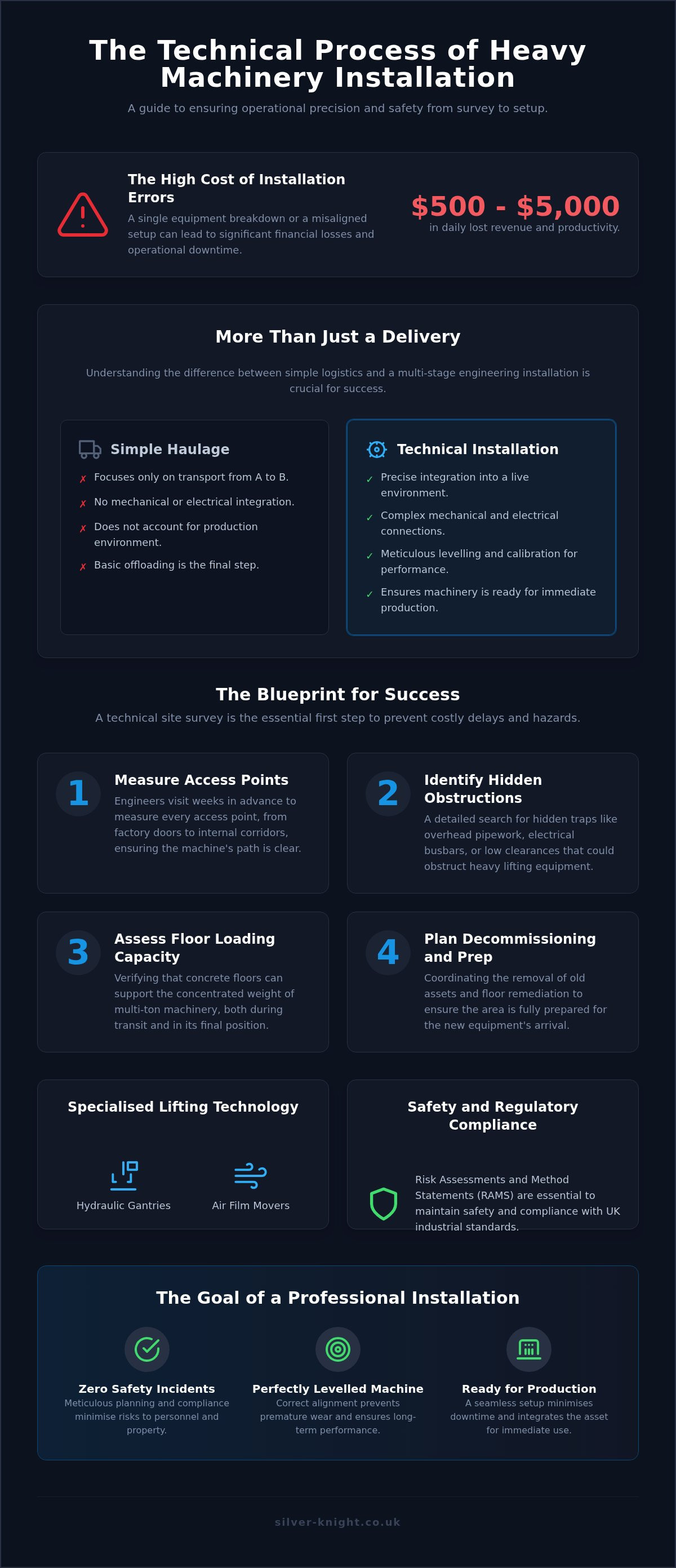
A single equipment breakdown or a botched setup can cost a business between $500 and $5,000 every day in lost revenue and productivity. You likely already feel the weight of this risk when planning a heavy machinery installation. It is a high-stakes engineering discipline where success is determined by the accuracy of your site survey and the choice of specialised lifting technology. Even a tiny error during positioning can lead to expensive equipment damage or a lengthy period of operational downtime that your budget simply can't afford.
We agree that managing the complexity of health and safety regulations whilst trying to maintain production schedules is a constant challenge. This guide explains the technical process of heavy machinery installation to help you ensure safety and operational precision. We will preview the essential steps required to achieve a perfectly levelled machine, from initial planning to final compliance with UK industrial standards. By following these stages, you can aim for zero safety incidents and a setup that's ready for immediate production.
Key Takeaways
- Understand why heavy machinery installation is a complex engineering process rather than just a standard equipment delivery.
- Learn how technical site surveys prevent expensive equipment damage by measuring access points and floor load capacities before work begins.
- Discover the importance of Risk Assessments and Method Statements (RAMS) in maintaining safety and regulatory compliance on industrial sites.
- See how using specialised tools like hydraulic gantries and air film movers ensures precision during internal transit and machine positioning.
- Recognise the benefits of a turnkey service to streamline your factory setup and reduce the risk of extended operational downtime.
For businesses looking to secure their industrial future, the experts at Silver Knight offer comprehensive support for all technical moves.
Understanding the fundamentals of heavy machinery installation
Many people mistake heavy machinery installation for simple logistics or equipment delivery. In reality, it's a sophisticated multi-stage engineering process that requires meticulous planning. Whilst haulage focuses on getting an item from point A to point B, installation involves the precise integration of high-value industrial assets into a live production environment. This requires a deep understanding of heavy equipment fundamentals to ensure that every component is handled with technical care and precision.
The process often includes complex mechanical and electrical integration. It's not enough to just place a machine on the floor; it must be connected to power, compressed air, or water systems and calibrated to work with existing production lines. Precision positioning is the ultimate goal. If a machine is just a few millimetres out of alignment, it can cause a bottleneck for the entire factory. Professional heavy machinery installation ensures that these assets are ready for immediate use without the risk of costly delays or mechanical failures down the line.
Why precision matters for long term machine performance
Precision isn't just about the first day of operation. Incorrect levelling is one of the most common causes of premature mechanical wear in industrial settings. If the weight isn't distributed exactly as the manufacturer intended, internal bearings and motors will fail much sooner than expected. You also need to consider the relationship between stable foundations and calibration accuracy. A machine that shifts even slightly during high-speed tasks will lose its precision. Proper isolation is also vital to prevent vibration from affecting neighbouring equipment, which could otherwise ruin the quality of your output or damage sensitive electronics nearby.
The difference between relocation and new installation
Installing brand new gear is often more predictable than dealing with refurbished plant. New machinery arrives with clear specifications and fresh components, whilst older assets might have quirks or worn parts that require extra care during transit. When moving existing equipment, it's wise to use professional machinery dismantle services to ensure the asset is taken apart safely before the move. Every new installation is also an opportunity to reconsider your factory layout. Simply putting a machine where the old one sat might not be the most efficient choice for your current production goals. Careful planning allows you to optimise the flow of materials and people across the shop floor.
If you are planning a complex project, you can rely on the specialist team at Silver Knight to manage every technical detail from start to finish.
Essential pre installation planning and site surveys
A technical site survey is the blueprint for a safe and efficient installation. It prevents the nightmare scenario of a multi-ton machine arriving only to find it won't fit through the factory doors. Engineers must visit the site weeks in advance to measure every access point and overhead clearance with total accuracy. They look for hidden traps like existing pipework or electrical busbars that could obstruct the path of the equipment. This early evaluation is vital for a successful heavy machinery installation because it identifies physical constraints before they become expensive delays.
This planning stage often bridges the gap between decommissioning old gear and setting up the new plant. You need to ensure that the previous assets are cleared and the floor is remediated before the new equipment arrives. This transition requires a strict timeline to avoid extended downtime. Following recognised safety standards, such as OSHA equipment safety regulations, helps to ensure that the workspace is fully prepared for the arrival of heavy lifting gear and the technicians who will operate it.
Assessing structural requirements and floor loading
You can't just place a heavy machine anywhere on the shop floor. Engineers must verify if the concrete floor can support concentrated loads without cracking or sinking over time. For multi-ton machines, we often use spreader plates to distribute the weight across a larger surface area during the move. If your project involves a mezzanine or an upper floor, you'll need to consult with structural engineers to confirm the building can handle the stress. This level of detail is what separates a professional setup from a risky guess that could damage your facility's foundation.
Mapping utility connections and access routes
The move doesn't end when the machine reaches its final spot. We plan the internal transport path from the delivery bay with millimetre precision. This might involve the temporary removal of doors or even walls in restricted sites to allow the heavy machinery installation to proceed. Coordination for electrical and pneumatic hookups is equally important. You don't want to find that your power source is on the opposite side of the machine after it's been bolted down. If you need help mapping out your next project, you can speak with an expert today to ensure your site is fully prepared.
For businesses requiring expert handling of their most valuable assets, the specialists at Silver Knight provide precision and peace of mind.
The technical stages of heavy equipment positioning
Transitioning from the delivery vehicle to the final installation point is a critical phase of any project. It requires a seamless handoff between the transport teams and the installation crews. Once the asset arrives at your facility, the focus shifts to internal transit. This is where heavy duty skates and air film movers come into play. These tools allow for the smooth movement of massive loads across factory floors without damaging the surface. It's during this stage that the heavy machinery installation truly takes shape as the equipment moves through the planned access routes. Following best practices for safe equipment setup ensures that these movements remain controlled and secure at all times.
The process isn't finished until the machine is perfectly secured. Final alignment with existing production lines is vital to ensure that materials flow correctly from one stage to the next. Once the position is confirmed, the equipment is bolted down to prevent any movement or vibration during operation. This stability is the foundation of a reliable production line.
Unloading and internal transport techniques
Lorry mounted cranes often handle the initial offloading from the transport vehicle. Once the equipment is on the ground, forklift moving services facilitate the transition into the factory. This part of the project relies on tight coordination. If the haulage team and the installation crew aren't in sync, you risk bottlenecks at the delivery bay. Using specialised forklifts with high lifting capacities allows for nimble movement even in busy industrial environments. To keep the process moving, we often use the following tools:
- Heavy duty skates for smooth floor transit
- Air film movers for friction-less positioning
- Hydraulic jacks for precise height adjustments
Precision levelling and alignment
After the machine reaches its final destination, the work of precision begins. Engineers use optical levels and laser alignment tools to ensure the machine is perfectly flat. This isn't just about aesthetics; it's about long term operational health. We often use shims or adjustable mounts to achieve total stability. Once levelled, the machine is bolted down to prevent any shifting. Recommissioning follows this stage to ensure everything meets the original manufacturer specifications and is ready for use.
Using hydraulic gantries and jack and slide systems
Standard cranes often can't work in low ceiling environments. This is where hydraulic gantries become essential. They allow for heavy lifting in restricted spaces where traditional overhead access is impossible. For even tighter spots, the jack and slide method is used to move massive components horizontally across the floor. You can learn more about these advanced techniques in our guide on versa lift and gantry systems. These tools are the backbone of a successful heavy machinery installation in challenging or restricted factory layouts.
For professional assistance with your next industrial project, consider the turnkey services provided by Silver Knight.
Managing safety and regulatory compliance during the move
Safety is the most critical element of any industrial project. When you are undertaking a heavy machinery installation, you must navigate a complex web of UK safety regulations. The Construction (Design and Management) Regulations 2015, or CDM 2015, apply to many industrial setups. These rules ensure that health and safety are considered throughout the life of the project. You also need to adhere to the Lifting Operations and Lifting Equipment Regulations 1998 (LOLER). This requires every piece of lifting tackle and gear to undergo regular inspections to ensure it is fit for purpose whilst in use on your site.
During complex manoeuvres, the role of a banksman and a lifting supervisor is vital. These professionals coordinate the movement of the load and ensure that everyone on site remains safe. They act as the eyes and ears of the operator, especially when visibility is restricted. This level of supervision is a standard requirement for any high quality heavy machinery installation project.
Understanding RAMS and project documentation
Every project requires a bespoke method statement and a thorough risk assessment, collectively known as RAMS. You cannot rely on a generic template because every factory environment is different. These documents identify specific hazards, such as overhead power lines or underground services, and outline exactly how the work will be performed safely. Proper documentation does more than just keep people safe; it protects your business from legal liability if an incident occurs amongst your workforce or equipment.
The role of contract lifting and qualified operators
A contract lift is often the best choice for businesses that want to minimise their exposure. By choosing this option, you transfer the majority of the risk and responsibility to the specialist provider. The provider becomes responsible for planning the lift, providing the equipment, and ensuring all personnel are correctly trained. Operators of heavy moving equipment must hold valid certifications and demonstrate competence in handling multi-ton loads. Insurance coverage is another non-negotiable factor. You must verify that your partner has the correct level of public liability and professional indemnity insurance before work begins. If you need a partner who prioritises safety and compliance, get in touch with our team to discuss your requirements.
To ensure your next project is handled with the highest level of technical expertise, you can partner with the professional movers at Silver Knight.
Selecting the right machinery installation partner for your project
Choosing a family run business with deep industry heritage provides a level of accountability that large corporations often lack. Silver Knight combines 180 years of collective experience with modern technology like hydraulic gantries and jack and slide systems. This heritage means we understand the nuances of precision engineering whilst staying at the forefront of modern safety standards. National coverage is also a major benefit for companies with multiple UK sites. It ensures a consistent standard of work across every facility, regardless of where your branches are located. By centralising your project with one experienced partner, you eliminate the risks associated with using multiple unvetted contractors.
Evaluating experience and specialist equipment
General hauliers often lack the specific tools required for a successful heavy machinery installation. They might get the asset to your door, but they won't have the specialised gear to position it within a millimetre of the plan. This often leads to the client having to hire additional contractors, which increases the risk of damage and complicates the project timeline. A partner with an in house fleet of low loaders, Versa-Lifts, and lifting gear offers far more reliability because they maintain their own equipment to the highest standards. For global projects, using international machine movers ensures that your equipment is handled by experts who understand cross-border logistics and global safety standards.
The benefits of a turnkey installation service
Efficiency is significantly improved when you use a turnkey service that covers everything from a full factory relocation to the final setup. Having a single point of contact reduces project management stress and prevents miscommunications between different transport and engineering teams. This integrated approach is particularly helpful when dealing with restricted access environments where specialist gear must be coordinated with the arrival of the machinery. Integrated storage and transport solutions also help solve scheduling delays if your site isn't quite ready for the new gear. If you are replacing old equipment, uk factory clearance services can manage the removal of redundant assets. This makes the entire heavy machinery installation process much smoother and allows your team to focus on production rather than logistics.
To learn more about our full range of lifting and transport services, please visit the Silver Knight homepage.
Securing your next industrial setup
Success in industrial plant setup depends on meticulous preparation and technical precision. We've explored how a technical site survey acts as the blueprint for safety and how precision positioning prevents premature mechanical wear. These steps are essential for ensuring your equipment operates at peak performance from the very first day. By prioritising site preparation and safety compliance, you protect your investment and avoid the high costs of operational downtime.
When you manage a heavy machinery installation, you need a partner who brings both heritage and modern technology to the site. Silver Knight offers over 180 years of collective industry expertise. We use specialised equipment like hydraulic gantries and Versa-Lifts to handle the most challenging restricted access environments. Whether you require national or international service coverage, our turnkey approach ensures your project is completed with absolute precision. Book a technical site survey for your machinery installation project to get started. We look forward to helping you build a safer and more efficient production environment.
Frequently Asked Questions
What is the difference between a machinery mover and a machinery installer?
A machinery mover focuses on the physical transport and lifting of equipment from one location to another. In contrast, a machinery installer manages the precise positioning, levelling, and anchoring of the unit to ensure it's ready for recommissioning. Professional installers often handle the mechanical and electrical connections needed for the plant to function safely and efficiently in its new environment.
Do I need to provide my own lifting equipment for the installation?
You don't usually need to provide your own lifting equipment when hiring specialists. A reputable heavy machinery installation company arrives with all the necessary tools, such as hydraulic gantry systems, Versa-Lifts, or jack and slide systems. These experts assess the weight and dimensions of your plant beforehand to ensure they bring the correct capacity equipment for a safe and controlled lift.
How long does a typical heavy machinery installation project take?
The duration of a project depends entirely on the complexity and scale of the equipment. A single machine might take one or two days to position and secure, whilst a full industrial plant setup could span several weeks. Factors like site preparation, access restrictions, and the need for precision levelling will all influence the final timeline for your heavy machinery installation.
Are there specific floor requirements for installing heavy industrial plant?
Industrial floors must be level and capable of supporting the static and dynamic loads of the machinery. Most heavy plant requires reinforced concrete foundations to prevent cracking or shifting over time. It's vital to check the floor's weight-bearing capacity and ensure there are no underground voids or utility lines that could be compromised during the installation process or subsequent operation.
What insurance should a machinery installation company have?
A professional installation company should hold comprehensive public liability insurance and employers' liability insurance. They also need specific goods in transit and plant hire insurance to cover the equipment whilst it's being moved or lifted. You should always ask to see valid certificates to ensure your assets and facility are protected against accidental damage or unforeseen incidents during the project.
Can machinery be installed in a restricted access area with low ceilings?
Yes, machinery can be installed in restricted areas by using specialised low-profile equipment. Systems like hydraulic gantries or jack and slide setups allow teams to move heavy loads in spaces where a traditional crane cannot operate. These methods are perfect for factories with low ceilings or narrow gangways, ensuring that heavy machinery installation remains possible even in the most cramped industrial environments.
What are the CDM regulations and do they apply to my project?
The Construction (Design and Management) Regulations 2015 apply to most industrial installation projects that involve construction work. These rules are designed to improve health and safety by ensuring that roles and responsibilities are clearly defined. If your project lasts more than 30 days or involves significant risk, you'll likely need to appoint a principal designer and a principal contractor to manage the safety requirements.
Is it possible to install machinery while the rest of the factory is operational?
It's certainly possible to install new equipment whilst your factory remains operational. This requires careful planning and the use of physical barriers to separate the installation zone from the rest of your production staff. By scheduling the most disruptive lifts during quieter shifts or weekends, installers can minimise downtime and ensure that your daily business activities continue with as little interruption as possible.
Article by
David Ashby
I'm the Managing Director of Silver Knight Haulage & Machinery Ltd. Silver Knight Ltd is a family-run firm established in the West Midlands in 2005, with the aim of providing a cost-effective, yet professional, service to businesses for the removal, transportation, and installation of machinery, plant, and equipment here in the UK and worldwide. Between us, the Silver Knight workforce has over 50 years of experience with machinery and its operation.
Disclaimer
This article is intended for informational purposes only. Please ensure you seek expert advice or carry out your own research to confirm the information is suitable for your specific needs.