A single mistake in export packing can turn a multi million pound international factory relocation into an expensive disaster. If your heavy machinery arrives at its destination with salt-air corrosion or is rejected by customs because of improper timber treatment, the financial impact on your production timeline is massive. It is understandable that the logistics of global transit cause significant anxiety for project managers and engineers alike.
You likely recognise that securing assets for a long sea voyage requires more than just a standard wooden crate. This article promises to teach you the essential engineering techniques and international standards needed to protect your machinery from shifting loads and moisture damage. We will explore how to achieve full compliance with ISPM 15 standards and ensure seamless customs clearance through accurate documentation. By the end of this guide, you will understand the vacuum packing methods and structural supports required to guarantee your assets reach their new global facility in perfect working order.
Key Takeaways
- Understand why export packing is a critical engineering discipline that protects your multi million pound assets during an international factory relocation.
- Learn about the specialised materials used to prevent corrosion and mechanical damage, such as vacuum packing and heavy duty timber.
- Discover how sea and air freight requirements change the structural design of machinery crates to manage weight and volume constraints.
- Ensure your assets pass through customs without delay by adhering to ISPM 15 standards and precise documentation requirements.
- Identify the advantages of using a single turnkey provider to manage everything from decommissioning to global machinery transport.
If you are preparing for a global move, it is essential to partner with expert international machine movers who can manage the entire process from start to finish.
The critical role of export packing in international factory relocation
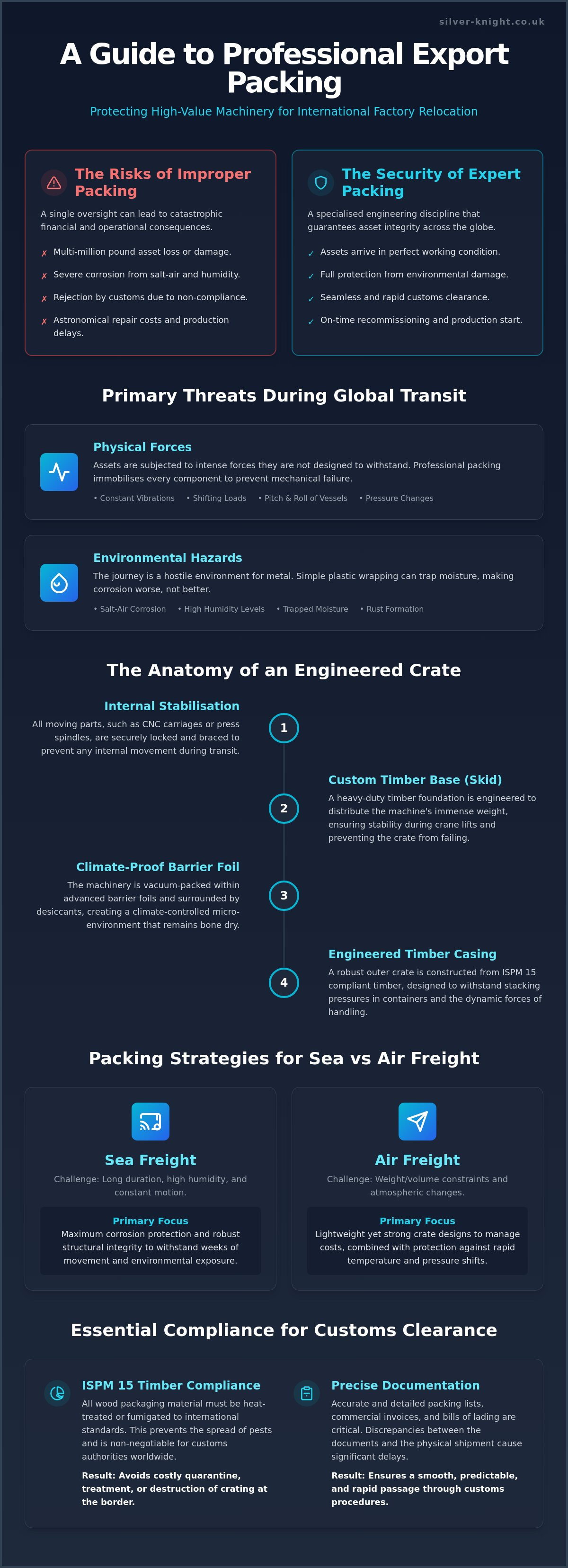
Export packing is far more than just putting items in boxes. For high value industrial assets, it is a specialised engineering discipline that ensures a machine's structural integrity remains intact across thousands of miles. A deep understanding of offshoring reveals that moving production overseas involves significant logistical hurdles, where the physical safety of the machinery is the most critical factor. Inadequate packing during an international factory relocation can lead to astronomical repair costs, missed production deadlines, and even the total loss of a multi million pound asset.
To better understand the scale and precision required for these projects, watch this video on industrial relocation:
During global transit, assets are subjected to intense physical forces that they were never designed to withstand. On a sea vessel, constant low frequency vibrations and the pitch and roll of the ship can cause heavy components to shift or shear. Air freight involves rapid changes in atmospheric pressure and temperature. Without professional packing, these forces can lead to mechanical failure before the machine even reaches its new floor. Environmental protection is equally vital, as equipment may sit in humid ports or salt heavy air for several weeks during its journey.
Preventing physical damage during long distance transit
Professional packing focuses on immobilising every internal part. If a CNC machine or a large press has moving carriages or spindles, these must be locked down before the packing starts. Specialists use bespoke timber bases to distribute the immense weight of heavy machinery across a wider surface area. This prevents the crate from breaking under its own load and ensures stability when the asset is lifted by a crane or moved using specialised lifting equipment.
Mitigating environmental risks for international sea freight
The journey across the ocean is a hostile environment for metal. Salt air and high humidity levels are highly corrosive and can cause rust to form on precision surfaces within days. Whilst many believe standard plastic wrapping is enough, it actually traps moisture against the machine, making the problem worse. For sensitive industrial electronics and polished metal components, vacuum packing with barrier foils is the only reliable solution. This creates a climate controlled micro environment that keeps the asset bone dry until it is ready for recommissioning at the new site.
Choosing a specialist for your shipping container packing service ensures that every asset is prepared according to the highest industry benchmarks.
Specialised materials and techniques for protecting industrial assets
Protecting high value machinery during an international factory relocation requires more than standard industrial supplies. The hierarchy of materials used in export packing starts with heavy duty timber, specifically engineered to support machinery weighing over 10 tons. These timber bases, often called skids, act as the foundation for the entire crate. Following international export packaging standards ensures that these materials can withstand the compressive forces of stacking and the dynamic loads of crane lifting during transit.
When planning an international factory relocation, ensuring your timber meets global biosecurity laws is essential. Beyond the structural frame, the use of advanced barrier foils creates a hermetic seal around the equipment. This is paired with the strategic placement of desiccants to manage the internal environment. These layers of protection work together to ensure that sensitive components remain unaffected by the external conditions found in container ships or cargo planes.
Timber crating and ISPM 15 standards
The International Standards for Phytosanitary Measures No. 15 (ISPM 15) is a non negotiable requirement for any global move. This standard dictates that all timber packaging must be heat treated to a core temperature of 56 degrees Celsius for at least 30 minutes. This process eliminates pests that could devastate local ecosystems at the destination. If your crates don't carry the official ISPM 15 mark, customs officials may refuse entry or demand expensive on site fumigation. For oversized industrial units, bespoke crates are built around the machine's specific dimensions. This ensures a snug fit that prevents movement during the roughest parts of the journey.
Vacuum packing and advanced moisture control
Whilst timber provides structural strength, barrier foils provide chemical protection. Vacuum packing involves wrapping the machine in a multi layer foil and extracting the air to create a hermetic seal. This prevents oxygen and moisture from reaching metal surfaces. Inside this seal, specialists place calculated amounts of chemical desiccants. These moisture absorbers work tirelessly to maintain low humidity levels whilst in transit. This is especially vital for protecting control panels and electrical cabinets, where even a small amount of moisture ingress can lead to short circuits or component failure upon arrival. If you have specific questions about the materials required for your project, it's worth speaking to a professional about your bespoke packing requirements.
Before you begin your journey, it is vital to secure a partner who can manage the technical demands of heavy machinery transport across multiple borders.
Varying packing requirements for different modes of global transport
The method of transport you choose for an international factory relocation fundamentally changes how your equipment is packed. Each mode presents a unique set of physical challenges that the packing must overcome. Sea freight is often the most cost effective for heavy plant, but it subjects machinery to constant motion and high humidity. Air freight is far faster but places strict limits on weight and dimensions. Most projects involve multimodal transport, where your assets move between lorries, ships, and potentially rail. The packing must be robust enough to survive these transition points, where the risk of impact damage is highest.
Road haulage usually handles the first and last mile of the journey. Even over short distances, machinery faces stresses like sudden braking, sharp corners, and road vibrations. These forces are different from the slow, rolling motion of a container ship. If the packing isn't designed for both, a machine that survived a three week sea voyage could still be damaged in the final ten miles of the trip. A successful international factory relocation requires a packing strategy that accounts for every leg of the journey, ensuring the structural integrity of the crate remains sound from door to door.
Securing loads for sea freight containers
When using sea freight, the internal securing of the load is as important as the external crate. Inside a standard shipping container, machinery must be "blocked and braced." This process involves using timber blocks and heavy duty ratchet straps to prevent any lateral or vertical movement. For oversized industrial equipment that doesn't fit in a standard box, specialists use flat rack containers. These are open platforms that require specialised lashing techniques to keep the machine stable against the wind and waves. Using a professional shipping container packing service ensures that your cargo meets the strict safety requirements of international shipping lines whilst protecting the asset from the elements.
Preparing machinery for international air transport
Air freight is the preferred choice for urgent moves or high value, sensitive components. The packing for air cargo is generally lighter than sea freight to minimise costs, but it must still be incredibly durable. Aircraft experience unique high frequency vibrations and rapid changes in atmospheric pressure that can affect sealed systems or fluid reservoirs. It is essential to follow correct export compliance and documentation procedures to ensure your cargo passes through airport security without delays. This includes providing accurate weight declarations and ensuring that any hazardous materials, such as lithium batteries or residual oils, are clearly identified and packed according to aviation safety standards.
For a complete turnkey solution that handles every detail of your move, you can rely on the professional team at Silver Knight Haulage & Machineries Ltd.
Essential compliance and documentation for shipping heavy machinery
Administrative precision is just as critical as engineering when managing an international factory relocation. Even the most robustly packed machine will be held at the border if the documentation is incomplete or inaccurate. The Bill of Lading is perhaps the most important document in this process. It acts as a legal contract between the asset owner and the carrier, serving as a receipt for the goods and a document of title. Without it, you can't legally claim your machinery at the destination port.
Accuracy in your declarations carries significant legal liability. You must provide the exact weight and a clear description of the contents for every crate. If you don't provide the correct details, customs officials may issue expensive fines or even seize your assets. Beyond the paperwork, the physical crates must be clearly marked. Labels should indicate lifting points, the centre of gravity, and any fragile components to ensure port handlers move the equipment safely.
Creating an accurate export packing list
A detailed export packing list is the backbone of a successful customs clearance during an international factory relocation. This document must include the dimensions and net weight of every item, alongside its specific HS (Harmonised System) code. These codes are used by customs authorities globally to identify products and apply the correct tariffs. If you are moving multiple crates as part of a single project, each one must be numbered and documented individually. It's vital that the information on your packing list matches your commercial invoice exactly, as any mismatch is a red flag for customs inspectors.
Health and safety requirements for heavy lifting
Safety protocols must be established long before the machinery leaves the factory floor. Before any packing begins, a technical site survey is necessary to identify potential hazards and determine the best lifting points. This stage often involves a professional machinery dismantle service to break down large units into manageable sections. Ensuring that all moving parts are secured and that the weight is evenly distributed within the crate is essential for the safety of everyone involved in the transport chain. If you are unsure about the specific paperwork required for your destination, you should get in touch with an export specialist for guidance.
If you are looking for professional factory relocation specialists, it's essential to work with a team that provides a comprehensive turnkey service.
Choosing a professional partner for global plant relocation
Selecting the right partner for an international factory relocation is about more than just finding a company that can build a crate. You need a team that understands the mechanical nuances of your equipment as well as the logistical complexities of moving across borders. By using a single provider for both packing and transport, you eliminate the risk of miscommunication between different contractors. This integrated approach reduces the total cost of ownership for your assets. Professional handling prevents the expensive delays and repairs that often follow poor transit protection. It's about protecting your investment from the moment the machine is decommissioned until it's ready for recommissioning. Choosing a family run business can also provide peace of mind, as they often bring a higher level of personal care and meticulous attention to detail to every project.
Integrated haulage and packing services
When your packing team is the same team managing the fleet of low loaders, the entire process becomes much smoother. They can design the crates to fit perfectly on the vehicle, ensuring that every millimetre of space is used efficiently. This turnkey solution for international machinery transport simplifies the project for your internal managers. You don't have to worry about coordinating schedules between multiple firms. Additionally, if your new facility isn't ready for immediate installation, having access to secure industrial storage provides a vital buffer in your timeline. This ensures your assets are kept safe and dry in a controlled environment until the new site is fully prepared, whether that is across the country or across the globe.
The value of industry experience and specialised equipment
Experience is the most valuable asset in industrial moving. The Silver Knight team brings over 180 years of collective industry experience to every project. This depth of knowledge allows them to handle complex plant relocations with meticulous attention to detail. They use advanced technology like hydraulic gantries for precise positioning and jack and slide systems to move heavy machines in restricted spaces where a crane cannot reach. This specialised equipment ensures that even the most awkward assets are packed and loaded safely without risking damage to the factory floor or the machine itself. Their global reach extends to major markets including the US, India, and Asia. For businesses seeking reliable international machine movers, this combination of expertise and high end equipment is indispensable for a successful international factory relocation.
Before you commit to a global move, it's essential to partner with experienced heavy machine movers who understand the complexities of international transit.
Securing your industrial future through expert logistics
Successfully executing an international factory relocation requires a meticulous approach to both engineering and administration. You now understand that high grade barrier foils and ISPM 15 timber are not just optional extras; they are vital components that protect your multi million pound assets from corrosion and customs rejection. By integrating specialised lifting equipment with robust export packing, you ensure your production line restarts on schedule at its new global destination.
Silver Knight Haulage & Machineries Ltd provides full nationwide UK coverage and a global transport network to manage every stage of your move. With over 180 years of collective industry experience, our team are specialists in heavy machinery and plant relocation. We offer the technical expertise needed to decommission, pack, and transport your equipment safely across any border. Our family run business takes pride in the meticulous attention to detail required for complex industrial projects.
Contact Silver Knight Haulage & Machineries Ltd for expert export packing services today and move your assets with total confidence.
Frequently Asked Questions
What is the difference between export packing and standard packaging
Export packing is a heavy duty engineering process designed specifically for the rigours of global transit. Unlike standard packaging used for domestic courier deliveries, it involves bespoke timber crates and advanced moisture protection. This specialised approach ensures that high value industrial assets can withstand the constant vibrations and environmental changes encountered during a long international journey.
Why is ISPM 15 compliance necessary for export crates
ISPM 15 is a mandatory international standard for treated timber that prevents the spread of wood boring pests across global borders. All wooden crates used in an international factory relocation must carry the official heat treatment mark. If your packaging doesn't comply, customs authorities have the legal power to reject your entire shipment or even destroy the crates at the port, causing massive production delays.
How does vacuum packing protect machinery from rust
Vacuum packing works by sealing the machine inside a specialised barrier foil and extracting the air to create a hermetic seal. This process effectively removes the moisture and oxygen that are required for oxidation to occur. By creating this dry, stable micro environment, your machinery remains protected from the corrosive effects of salt air and humidity throughout its time in transit.
Can heavy machinery be packed on site at my factory
Professional machinery movers almost always perform export packing on your site using mobile equipment. This ensures that your equipment is fully protected before it is even lifted onto a transport vehicle. Packing on site minimises the risk of damage during the initial handling stages and allows specialists to secure all internal components whilst the machine is still in its original position.
What information must be included on an export packing list
Your export packing list must be incredibly detailed to ensure smooth customs clearance. It should include a clear description of the goods, the net and gross weights, and the external dimensions of every crate. You must also include the specific HS codes for each item and clear shipping marks that match the physical labels on the exterior of your packaging.
How do you secure a 30 ton machine inside a shipping container
Securing a 30 ton machine requires a technical process known as blocking and bracing. Specialists use heavy duty timber beams to create a frame around the base of the machine, which is then bolted to the container floor. This is combined with high strength ratchet straps to prevent the asset from moving in any direction, even during the rough conditions often experienced at sea.
Is insurance required if the machinery is professionally packed
Whilst professional packing significantly reduces the risk of physical and environmental damage, comprehensive transit insurance is always recommended. High value industrial assets face many risks during an international factory relocation that are beyond the control of the packing team. Having the correct insurance in place provides essential financial protection against unforeseen events or accidents that may occur during global transit.
What is the role of desiccants in export packing
Desiccants are chemical agents, such as silica gel, that are placed inside the vacuum sealed barrier foil. Their primary role is to absorb any residual moisture that remains after the air has been extracted. This maintains a perfectly dry environment for sensitive electronic components and polished metal surfaces, preventing any risk of condensation or corrosion whilst the machinery is in transit for several weeks.

Article by
David Ashby
I'm the Managing Director of Silver Knight Haulage & Machinery Ltd. Silver Knight Ltd is a family-run firm established in the West Midlands in 2005, with the aim of providing a cost-effective, yet professional, service to businesses for the removal, transportation, and installation of machinery, plant, and equipment here in the UK and worldwide. Between us, the Silver Knight workforce has over 50 years of experience with machinery and its operation.
Disclaimer
This article is intended for informational purposes only. Please ensure you seek expert advice or carry out your own research to confirm the information is suitable for your specific needs.