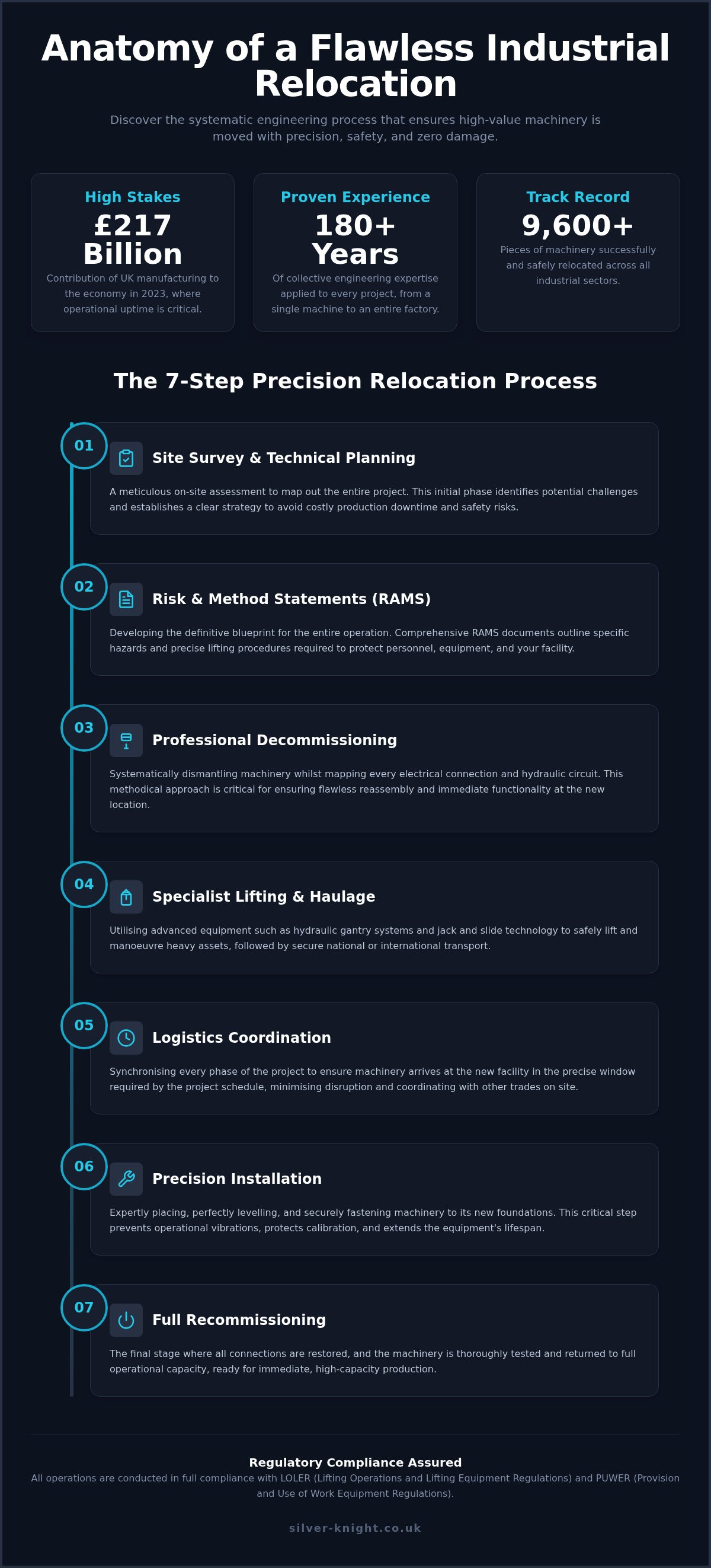
A single millimetre of misalignment during a factory move can translate into tens of thousands of pounds in lost production and irreparable equipment damage. You're likely aware that moving heavy assets is far more than a simple transport job. It's a high-stakes engineering puzzle where the smallest error leads to months of financial recovery. With the UK manufacturing sector contributing £217 billion to the economy in 2023, there's no room for error when it comes to your operational capacity.
This guide reveals how professional industrial movers utilise precision engineering and specialist equipment like hydraulic gantries to manage complex machinery installation West Midlands and across the globe. You'll discover the strategies used to achieve seamless factory relocations with zero damage. We'll show you how to keep machinery fully operational on your agreed schedule whilst remaining in full compliance with LOLER and PUWER regulations. From navigating international borders to managing oversized loads, we'll preview the essential steps for a successful, stress-free relocation that protects your bottom line.
Key Takeaways
- Understand why industrial moving must be treated as a specialist engineering discipline to prevent equipment damage and protect your investment.
- Learn how a systematic site survey ensures your machinery installation West Midlands project avoids costly production downtime and safety risks.
- Discover the advantages of using advanced equipment like hydraulic gantry systems and jack and slide technology for moving heavy loads in confined factory spaces.
- Gain insights into managing the logistical complexities of international machinery transport, including compliance with global regulations and border requirements.
- Identify the essential criteria for selecting a relocation partner with the multi-generational expertise required to manage projects from initial decommissioning to final recommissioning.
Essential Services for Machinery Installation West Midlands and Nationwide
Industrial moving is far more than a simple transport task; it's a specialist engineering discipline that requires a deep understanding of mechanical integrity. When you're planning a machinery installation West Midlands project, you aren't just hiring a haulage firm. You're enlisting a team with over 180 years of collective experience to ensure that high-value assets are handled with technical precision. Whether you need to move a single piece of precision equipment or relocate an entire production facility, the focus remains on protecting the machine's calibration and operational lifespan.
The process begins long before a vehicle arrives on-site. Professional decommissioning is critical for preserving the integrity of complex production lines. By mapping every electrical connection and hydraulic circuit before dismantling, engineers ensure that the equipment can be recommissioned at the new site without technical faults. Using specialist equipment for heavy industrial lifting, expert movers manage the transition from internal factory shifts to external national transport, ensuring that every asset remains secure throughout its journey.
To better understand the precision required in these types of projects, watch this helpful video:
Comprehensive Factory Relocation and Plant Support
Managing large-scale factory moves across the United Kingdom involves complex logistics and the coordination of multiple trades. By using a single partner for the entire project lifecycle, you eliminate the communication gaps that often lead to delays. A family-run specialist can offer the flexibility needed to coordinate electricians, mechanical engineers, and heavy haulage teams simultaneously. This integrated approach ensures that the project moves from the initial survey to final recommissioning as a single, cohesive operation, keeping your production downtime to an absolute minimum.
Professional Machinery Installation and Dismantling Services
Dismantling is a systematic process where every component is carefully disconnected and marked for reassembly. Once the equipment reaches its destination, the machinery installation phase demands extreme precision. It isn't enough to simply place the machine on the floor. Expert installers ensure every piece of equipment is perfectly level and secured to the foundations. This level of detail prevents vibration issues and premature wear, ensuring your machinery is ready for immediate, high-capacity operation. With over 9,600 pieces of machinery successfully moved, this systematic approach has been proven to protect industrial investments across all sectors.
Systematic Steps in the Machinery Relocation Process
A successful industrial move isn't the result of brute force; it's the outcome of a choreographed sequence of technical events. For any complex machinery installation West Midlands project, the process must follow a strict chronological order to ensure safety and precision. We rely on a systematic approach that begins with the creation of detailed Risk Assessments and Method Statements (RAMS). These documents serve as the definitive blueprint for the site, ensuring every operative understands the specific hazards and the exact lifting procedures required to protect your assets.
Logistics coordination is the final piece of the puzzle. It isn't enough to simply move the machine; it must arrive at the new facility in a specific window to align with the wider project schedule. By synchronising the decommissioning, haulage, and recommissioning phases, we ensure that your equipment is ready for use the moment it's secured. If you're unsure where to begin with your project, you can speak with our technical team to discuss a tailored relocation strategy.
Site Surveys and Technical Planning Requirements
Our surveyors begin by evaluating the physical constraints of both the origin and destination sites. They assess floor loadings to ensure the ground can support the concentrated weight of the machinery and the lifting equipment. In many historic West Midlands industrial units, overhead clearances are a significant factor. We measure these to the millimetre to determine if a mobile crane or a low-profile hydraulic gantry system is required. Planning also extends to the UK road network, where we map transport routes to avoid low bridges or weight-restricted zones that could disrupt the timeline. Adhering to global machinery moving safety regulations provides an additional layer of rigour to our material handling processes.
Minimising Operational Disruptions During the Move
Extended production downtime is often the greatest fear for factory owners. We mitigate this through phased relocations, moving specific sections of a plant whilst others remain fully operational. This strategy requires constant, clear communication between our project managers and your staff. For facilities with restricted access or tight internal layouts, our professional machinery dismantle service is essential. By carefully breaking down oversized units into smaller, manageable components, we can extract and reinstall equipment through standard access points without needing to modify the building's structure. This level of planning ensures that your factory remains productive for as long as possible during the transition.
Specialist Equipment for Heavy Industrial Lifting Projects
Standard warehouse forklifts are designed for uniform pallets, not the complex centres of gravity found in industrial assets. When managing a machinery installation West Midlands project, we often encounter high-value equipment that requires more than simple lifting capacity. Modern factory floors are frequently finished with sensitive coatings or built to specific load-bearing tolerances. In these environments, we utilise low ground pressure equipment to distribute weight evenly, preventing structural cracks or surface damage. Remote-controlled technology further enhances safety by allowing operators to position themselves exactly where they can see every potential obstruction, ensuring millimetre-perfect placement in the tightest production cells.
Hydraulic Gantry and Jack and Slide Systems
Traditional mobile cranes often struggle with the low headroom found in many British manufacturing plants. Hydraulic gantry systems offer a safer, more stable alternative for indoor lifts. These systems can be assembled around a machine, lifting it vertically with extreme control and a much smaller footprint than a crane. For situations where headroom is almost non-existent, we deploy jack and slide systems. These allow us to lift a machine just enough to clear the floor and then slide it into position on a low-profile track. This method is particularly effective for tall or top-heavy machinery that might become unstable if lifted by conventional means.
Versa Lift and Heavy Duty Forklift Solutions
The versa lift is a game-changer for restricted access zones. Its unique extending chassis allows it to increase its lifting capacity without increasing its overall width, making it ideal for navigating narrow factory aisles. Its ability to carry heavy loads whilst remaining compact solves the logistical problems often found in older industrial units across the UK.
Whilst standard plant hire might provide the hardware, a professional forklift moving service provides the expertise of a fully operated plant. This is crucial for high-risk lifts where the operator's experience in weight distribution and load dynamics is the primary safety measure. By matching the right specialist tool to the specific site constraint, we ensure that every machinery installation West Midlands project is completed without incident, regardless of the physical challenges involved. This technical approach guarantees that even the most sensitive equipment is positioned with the precision required for immediate recommissioning.
Global Logistics and International Machinery Transport Requirements
Moving heavy industrial assets across international borders requires a level of planning that extends far beyond the technical machinery installation West Midlands manufacturers expect on home soil. When your project crosses oceans or continents, you're dealing with varying legal frameworks, customs protocols, and environmental stressors. Success depends on a reliable global network of partners who understand local port operations and inland transport laws. Coordinating road, sea, and air freight isn't just about booking space; it's about ensuring every transition between modes is handled with the same multi-generational expertise you'd find in a family-run specialist.
Insurance is a critical pillar of global logistics. Whilst standard haulage agreements provide a baseline of protection, they often fall short of the true replacement value of high-precision industrial equipment. Comprehensive, door-to-door cover is essential for high-value assets, protecting your investment from the point of decommissioning to final recommissioning. Managing these risks requires a mover who doesn't just transport equipment but manages the entire risk profile of the journey. If you're planning a move beyond UK borders, you can request a technical consultation for international transport to ensure your assets are fully protected.
Export Packing and Container Securing Methods
Sea air is notoriously aggressive toward precision-engineered surfaces. To prevent rust and degradation during long voyages, we utilise a specialised shipping container packing service that incorporates advanced moisture barriers. This often involves vacuum-sealing machinery in foil bags with desiccant or applying anti-corrosion treatments that neutralise the effects of salt air. Securing the load is equally technical. We use heavy-duty timber blocking and internal lashing systems to ensure that even the heaviest machine remains immobile within the container, regardless of the vessel's movement in heavy seas.
Global Logistics Coordination for Heavy Haulage
Navigating the paperwork of global trade is as vital as the heavy lifting itself. Our role as international machine movers involves the meticulous management of customs documentation and import duties to prevent costly delays at the border. We deploy specialised low loaders and extendable trailers designed to meet the specific road regulations of different countries. This expertise ensures that your machinery doesn't just reach the destination country but is delivered directly to the factory floor, ready for the final stages of machinery installation West Midlands teams will eventually oversee. Understanding foreign transport laws, such as axle weight limits and pilot car requirements, is what separates a basic carrier from a true industrial relocation partner.
Criteria for Choosing an Industrial Relocation Partner
Selecting a partner for machinery installation West Midlands is a decision that directly affects your plant's future productivity. You need a provider that views industrial relocation as a technical craft rather than a simple haulage task. A family-run business often provides a level of accountability and project flexibility that larger, faceless corporations struggle to match. When the owners are directly involved in the project management, there is a personal commitment to ensuring every machine is placed with absolute precision. This reliability is backed by a dedicated fleet of vehicles and specialist equipment, ensuring the right tools are always available without the delays associated with third-party hire.
Safety Standards and SafeContractor Approval
Safety isn't a checkbox; it's a fundamental requirement of industrial engineering. Selecting a provider with SafeContractor Approved status ensures that your project adheres to the highest safety benchmarks in the United Kingdom. This accreditation proves a commitment to rigorous risk management and the ongoing training of lifting supervisors and plant operators. In a high-stakes environment, this expertise significantly reduces the likelihood of expensive onsite accidents. By maintaining strict compliance with LOLER and PUWER regulations, a professional partner protects both your personnel and your high-value assets during every phase of the move.
The Value of Multi-Generational Industry Experience
There is no substitute for time spent on the factory floor. With over 180 years of collective industry experience, a specialist team has likely encountered every possible logistical hurdle. This multi-generational knowledge is invaluable when solving unexpected onsite challenges, such as shifting floor levels or unforeseen structural constraints in older buildings. Having successfully moved 9,621 pieces of machinery, this track record demonstrates a deep understanding of how industrial equipment has evolved over decades. Whether you're moving a vintage hydraulic press or a modern robotic cell, this depth of expertise ensures a seamless transition and a successful recommissioning every time. You gain the peace of mind that comes from a proven history of national and global service coverage.
Securing Your Industrial Future with Precision
Successfully relocating a factory requires technical rigour rather than simple transport. By prioritising systematic site surveys and utilising specialist equipment, you protect both your production schedule and your capital assets. Whether you're managing a complex machinery installation West Midlands project or coordinating a global plant relocation, success depends on meticulous planning and multi-generational expertise.
Silver Knight provides the reliability of 180 plus years of collective experience and SafeContractor Approved standards for every lift. Our nationwide and international coverage ensures that your high-value assets are decommissioned, moved, and recommissioned with absolute precision. Your operational continuity is our priority, and we're ready to help you navigate the complexities of your next move. Contact Silver Knight for a bespoke machinery moving quote and ensure your industrial assets are in the safest possible hands.
Frequently Asked Questions
What is the difference between an industrial mover and a general haulier?
An industrial mover is a specialist engineering partner, whereas a general haulier focuses solely on moving goods from one point to another. Industrial movers manage the entire lifecycle of a machinery installation West Midlands project, including decommissioning, technical lifting, and precision positioning. General hauliers typically don't have the specialist equipment, such as hydraulic gantries or jack and slide systems, required to extract or install heavy assets within a factory environment.
How much does it cost to move a single piece of heavy machinery?
The cost of moving a single piece of heavy machinery depends on several variables, including the machine's dimensions, weight, and the complexity of the site access. Factors such as the need for specialist lifting equipment or abnormal load permits also influence the final price. Because every project is unique, it's standard practice to conduct a technical site survey to provide an accurate estimate based on your specific operational requirements.
Do you provide insurance for high value industrial equipment during a move?
Yes, comprehensive insurance is essential for protecting high-value industrial equipment during transit. Whilst standard liability under Road Haulage Association (RHA) conditions is limited to £1,300 per tonne as of 2026, this is often insufficient for precision machinery. It's best to arrange bespoke insurance cover that reflects the full replacement value of your assets to ensure you're completely protected against any unforeseen incidents during the relocation.
How long does a typical factory relocation take to complete?
A typical factory relocation can take anywhere from a few days to several weeks, depending on the volume of equipment and the distance of the move. Small-scale moves involving a few machines might be completed over a weekend to minimise downtime. Larger plant relocations require a phased approach, where decommissioning and recommissioning are carefully scheduled to keep your production lines running for as long as possible.
Can you move machinery in facilities with restricted access or low ceilings?
We specialise in moving machinery through facilities with restricted access or low ceilings where traditional cranes cannot operate. By using low-profile hydraulic gantry systems and jack and slide technology, we can move massive loads with minimal headroom. Our Versa-Lift fleet also features extending chassis designs, allowing us to carry heavy weights whilst navigating narrow factory aisles that standard forklifts simply can't manage.
What information do I need to provide for an accurate machinery moving quote?
To provide an accurate machinery moving quote, you'll need to provide the exact dimensions, weight, and value of each piece of equipment. We also require details regarding site access, such as door widths and floor loading capacities at both the origin and destination. Photos or technical drawings of the machinery and any potential obstacles, like overhead pipes or narrow corridors, are also extremely helpful for the planning team.
Do you offer short term storage for industrial machinery during a relocation?
Yes, we offer secure machinery storage for industrial assets that cannot be moved directly to their final destination. This is often necessary during complex factory relocations when a new site isn't yet ready for machinery installation West Midlands or nationwide. Our facilities provide a controlled environment to protect your equipment from the elements, ensuring it remains in peak condition until you're ready for the final recommissioning phase.
Are your operators qualified to use specialist lifting equipment like gantries?
Every operator is fully qualified and holds the necessary certifications to operate specialist lifting equipment like hydraulic gantries and heavy-duty forklifts. Our status as a SafeContractor Approved business means we adhere to strict safety protocols, including regular training on LOLER and PUWER regulations. This expertise ensures that even the most high-risk lifts are managed with the technical precision required to prevent onsite accidents.
Article by
David Ashby
I'm the Managing Director of Silver Knight Haulage & Machinery Ltd. Silver Knight Ltd is a family-run firm established in the West Midlands in 2005, with the aim of providing a cost-effective, yet professional, service to businesses for the removal, transportation, and installation of machinery, plant, and equipment here in the UK and worldwide. Between us, the Silver Knight workforce has over 50 years of experience with machinery and its operation.
Disclaimer
This article is intended for informational purposes only. Please ensure you seek expert advice or carry out your own research to confirm the information is suitable for your specific needs.