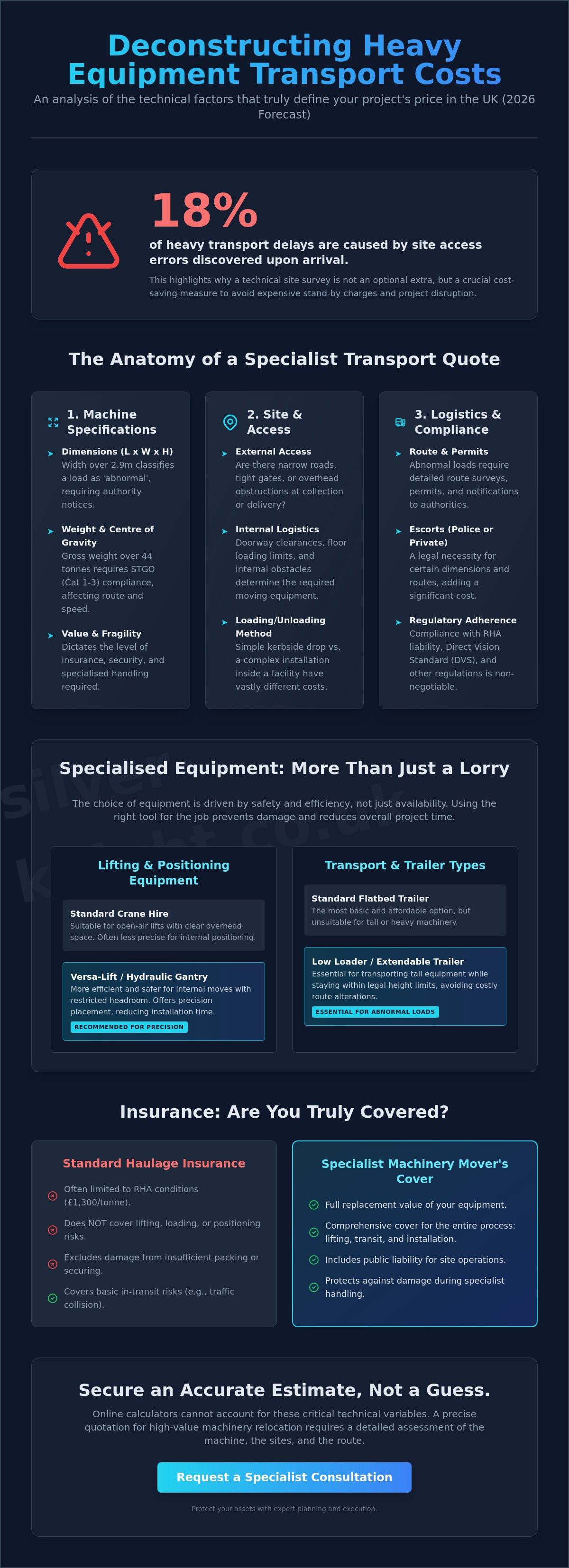
Did you know that 18% of heavy transport delays across the country are caused by site access errors identified only after the vehicle arrives? This statistic highlights why calculating the heavy equipment transport cost UK involves much more than just a simple mileage rate or fuel calculation. You likely feel the pressure of balancing a strict budget against the need to protect expensive, precision machinery from damage during transit. It's frustrating when you're faced with a pile of quotes from general hauliers that don't seem to account for the actual technical risks involved.
We understand that you need certainty and safety, not hidden fees for permits or unexpected escort costs. This guide promises to reveal the technical factors and logistical variables that determine the true price of moving industrial equipment in 2026. You'll gain a clear framework to evaluate specialist quotes and the confidence that your move will remain compliant with the latest regulations, from updated RHA liability limits to the new Direct Vision Standard requirements.
Key Takeaways
- Learn how machine dimensions and weight directly influence the heavy equipment transport cost UK by dictating the specific vehicle and trailer configuration required.
- Understand why choosing specialised equipment like a Versa-Lift or hydraulic gantry system is often more efficient and safer than a standard crane hire.
- Discover the potential expenses associated with abnormal load permits and local authority notices, including when police or private escorts become a legal necessity.
- Identify the critical differences between standard haulage insurance and specialist machinery moving cover to ensure your precision equipment is fully protected.
- Master the process of gathering essential site data to secure an accurate industrial relocation estimate instead of relying on unreliable online calculators.
If you need an expert team to handle your industrial move, you can learn more about our machinery moving and installation services before reading the detailed cost factors below.
Factors that determine heavy equipment transport cost UK
Calculating a heavy equipment transport cost UK quote involves looking at technical risk rather than just distance. A standard haulier might give you a price based on fuel and driver hours, but industrial machinery requires a deeper analysis of engineering variables. The weight and physical size of your equipment determine the trailer type, while its monetary value dictates the level of insurance and security needed for the journey. Because of these complexities, a flat rate per mile rarely applies to high value industrial assets.
Technical site surveys are the most overlooked part of the process. Skipping this step often leads to expensive delays if a vehicle cannot physically reach the loading bay. By identifying these issues early, you avoid the 18% of delays typically caused by site access errors. Ensuring the transport company understands the specific lifting points and fragile components of your machine is vital for a safe transition. This engineering precision is what separates a specialist move from general haulage.
To see the scale of vehicles involved in these operations, watch this video of a heavy transport vehicle in action:
Machine dimensions and weight considerations
Size is the primary driver of cost because it dictates whether you need a standard trailer or a specialised low loader. If your equipment is wider than 2.9 metres, it falls under specific UK regulations for oversize loads, which require advance notice to local authorities. Weight is equally critical. Vehicles exceeding 44 tonnes gross weight must follow STGO categories. These categories, ranging from Cat 1 to Cat 3, affect the speed at which the vehicle can travel and the specific routes it can take. Even the centre of gravity matters. An offset weight distribution might require a trailer with more axles to spread the load safely and remain compliant with road laws.
Site access and loading requirements
The physical environment at both ends of the journey significantly impacts the final price. If a collection point has restricted access or narrow approach roads, the move might require smaller support vehicles or additional labour to navigate the machine to a suitable loading area. There is a massive difference between a simple kerbside delivery and a full positioning service inside a factory. You must also consider internal factors like doorway clearances and floor loading capacities. If a floor cannot support the concentrated weight of the machine and the moving equipment, such as a Versa-Lift, alternative methods like jack and slide systems will be necessary. These technical solutions ensure safety but do add to the overall project duration.
For those planning a complex industrial relocation, it's helpful to consult with professional machinery movers who can provide a detailed breakdown of equipment requirements.
Specialised equipment and its effect on haulage pricing
While distance is a factor, the hardware used to lift and secure your machinery plays a bigger role in the final bill. Standard flatbed trailers are the most affordable option, but they are often unsuitable for tall or heavy industrial units. Specialised low loaders and extendable trailers allow for the transport of taller equipment whilst staying within legal height limits. This matters because exceeding height thresholds often requires expensive route surveys and utility company involvement to move overhead cables. Following the official government guidance on abnormal loads is essential to ensure your heavy equipment transport cost UK stays predictable and legal.
Many general haulage quotes ignore the complexity of moving machines in confined spaces. If your factory has low ceilings or narrow aisles, a standard crane might be impossible to use. In these scenarios, we integrate hydraulic gantry systems or jack and slide systems. These tools allow for the precise movement of multi tonne assets where traditional lifting is restricted. Using these engineered solutions reduces the risk of structural damage to your building and ensures the machinery is positioned with millimetre accuracy. This technical approach is often more cost effective than modifying a building to accommodate a crane.
Costs for Versa Lift and crane hire
Choosing between operated plant hire and general haulage is a critical decision. For heavy indoor lifts, Versa Lift hire is frequently the safest and most efficient choice. These specialised forklifts feature an extendable counterweight, allowing them to lift heavy loads whilst remaining compact enough to navigate factory floors. Mobile cranes are still the most cost effective option for outdoor lifts or when equipment needs to be hoisted over buildings. However, cranes require a larger footprint and more extensive ground preparation, which can increase the total project cost. We evaluate each site to determine which lifting method provides the best balance of safety and value.
Skilled labour and engineering expertise
The machinery moving crew is just as important as the vehicles they use. A typical team includes experienced riggers, banksmen, and lift supervisors who manage the technical aspects of the relocation. Investing in skilled labour prevents the damage that often occurs when using general labourers who lack specific machinery handling training. At Silver Knight, our team brings over 180 years of collective experience to every project. This expertise ensures that even the most fragile precision machinery is handled with care. If you're unsure which equipment or crew size is best for your site, speak to our technical team for a bespoke assessment.
If you are looking for a reliable partner to manage your industrial logistics, explore our comprehensive machinery moving solutions to ensure a smooth project from start to finish.
Transport logistics and route planning for oversized loads
Logistics planning is often the difference between a successful move and a costly failure. When calculating your heavy equipment transport cost UK, you must account for the administrative and physical hurdles that oversized machinery presents. This involves coordinating with local authorities and ensuring the chosen path is physically capable of supporting the load. A professional route survey identifies obstacles like low bridges, narrow village roads, or weak structures that could halt a journey mid transit. These surveys are essential for preventing the site access errors that cause nearly a fifth of all transport delays in the country.
International logistics add another layer of complexity to the budget. Moving machinery across borders requires expertise in customs documentation and the choice between Roll-on/Roll-off (RORO) or containerisation. Each method has different pricing structures and safety implications. By planning the entire route from the factory floor to the final destination, you can avoid the hidden fees that often arise from poor coordination between different transport segments.
Mileage rates versus fixed price contracts
Simple haulage tasks are often priced using a standard mileage rate. This works well for moving standard loads between two accessible points. However, for complex machinery haulage and relocation projects, fixed price contracts provide much better budget certainty. These contracts cover the technical surveys, rigging labour, and specialised equipment needed for the job. Industry best practices, often championed by The Heavy Transport Association, suggest that fixed price agreements protect businesses from the volatile costs of fuel surcharges and unexpected route diversions.
Permit costs and escort vehicle requirements
Any load exceeding standard dimensions requires an abnormal load permit. The lead times for these permits vary, but you should typically allow at least two to ten days for local councils to process the notifications. If a load is exceptionally wide or heavy, the law may require private pilot cars or even a police escort to manage traffic and ensure public safety. These requirements are not optional and add significant costs to the project. The high heavy haulage West Midlands standards for safety and compliance are applied nationally to ensure every move meets legal obligations. Using a specialist who handles the permit applications on your behalf ensures that no legal detail is missed.
To ensure your project is protected by industry leading expertise, consider our professional industrial relocation services before finalising your transport plans.
Risk management and comprehensive insurance for machinery
Standard haulage insurance often falls short when moving precision industrial assets. Under the updated RHA Conditions of Carriage effective January 1, 2026, standard liability is limited to £1,300 per tonne. If you are moving a high value CNC machine that weighs 5 tonnes whilst being worth £250,000, this standard cover is completely inadequate. This gap between the asset value and the carrier's liability is a major factor in the heavy equipment transport cost UK. You must ensure the quote includes comprehensive machinery moving cover that matches the full replacement value of your equipment.
Risk management also involves physical protection. For long distance moves or international sea freight, the cost of protective export packing is an essential investment. This includes vacuum sealing to prevent corrosion and bespoke timber crating to handle the stresses of transit. If your new site isn't ready, secure warehousing provides a safe environment to prevent asset degradation. Using secure machinery storage ensures that sensitive electronics and polished surfaces remain in peak condition until the new facility is ready for installation.
Insurance coverage for high value industrial assets
Indemnity limits are the maximum amount an insurer will pay in the event of a claim. For precision engineering firms, these limits must be high enough to cover the total loss of their most expensive assets. Professional indemnity insurance is also vital during the engineering phase of a relocation. It covers the technical advice and planning provided by the moving team. Adhering to machinery movers UK safety standards ensures that every lift and transport stage is documented and insured correctly, giving you peace of mind throughout the process.
Decommissioning and site preparation costs
Before a machine can be loaded onto a trailer, it must be properly prepared. Decommissioning involves more than just pulling a plug. It requires the professional disconnection of power, pneumatic lines, and coolant systems to prevent leaks or electrical faults. Hiring a machinery dismantle service is often necessary for large plants that cannot be moved in one piece. These costs are a significant part of the relocation budget but prevent terminal damage during the physical move. Additionally, a thorough factory clearance can help manage the move by removing redundant equipment before the main relocation begins.
To guarantee your machinery is fully protected throughout its journey, request a comprehensive risk assessment from our technical team.
If you are ready to plan your next industrial move with a team of experts, you can find more details about our bespoke machinery moving and haulage services to ensure your project stays on budget.
Steps to obtain an accurate industrial relocation estimate
Instant online calculators are useful for moving household goods or standard pallets, but they are often misleading for industrial projects. A tool that only asks for a postcode and a weight cannot account for the technical variables that drive the heavy equipment transport cost UK. Using these platforms often leads to price increases later when the haulier realises they need a specialised trailer or additional labour to navigate a tight corner. For an accurate estimate, you need a process that includes a technical assessment of the specific risks involved in your relocation.
Comparing quotes from different companies requires a keen eye for detail. You should look beyond the final figure and check for the inclusion of project management and insurance. A single point of contact is invaluable for complex moves; it ensures that the decommissioning, transport, and installation phases are perfectly synchronised. This holistic approach prevents the communication breakdowns that often occur when hiring multiple subcontractors for different parts of the journey.
Information needed for a technical site survey
A surveyor will require specific data points to provide a realistic price. You should have floor plans of both the collection and delivery sites ready, along with the exact weights and dimensions of every machine. Photos and videos of the current location and the access route are extremely helpful during the preliminary quoting phase. This information allows the team to begin the factory relocation service planning process with a clear understanding of the physical constraints. Providing accurate data early on ensures that the quote you receive is firm and will not be subject to unexpected surcharges on the day of the move.
Choosing a specialist machinery mover over a general haulier
The long term cost benefits of choosing a professional mover far outweigh the initial savings of a general haulier. Whilst a standard transport company might offer a lower price, they often lack the equipment to position machinery inside your facility. This leaves you with a heavy asset at the kerbside and a significant problem to solve. A specialist understands that minimising downtime is the most important factor. Every hour your production line is inactive costs your business money. By paying for specialist expertise, you ensure the machine is recommissioned and running as quickly as possible. If you are ready to secure a precise quote for your equipment, book a bespoke technical consultation with our engineering team today.
To ensure your next heavy haulage project is handled with precision and care, you can learn more about our professional machinery moving and transport services today.
Secure your industrial relocation strategy for 2026
Choosing the right partner for your move ensures that technical risks don't turn into expensive surprises. You've seen how factors like machine dimensions, site access, and specialised equipment like hydraulic gantries play a vital role in determining the heavy equipment transport cost UK. By prioritising technical surveys and comprehensive project management, you protect your precision assets and minimise production downtime.
Our team brings over 180 years of collective industry experience to every project. We operate a specialised fleet including Versa-Lifts and hydraulic gantry systems to handle even the most challenging confined space moves. From decommissioning to final installation, we manage every detail to keep your project compliant and safe.
Contact our expert team for a bespoke machinery transport quote and let us help you plan a successful move. We look forward to supporting your business with a smooth and efficient relocation.
Frequently Asked Questions
How is the heavy equipment transport cost UK calculated for industrial plant?
The calculation for the heavy equipment transport cost UK is based on a technical assessment of the load's weight, height, and width alongside the specific equipment needed for lifting. Unlike general haulage, it accounts for the engineering required to move the item safely. Factors such as the need for low loaders or extendable trailers are weighed against the distance to be travelled. This ensures the price reflects the actual resources used rather than a generic mileage rate.
Does the transport cost include the lifting and positioning of the machine?
A standard transport quote usually covers transit from point A to point B, but a specialist machinery moving quote often includes full positioning. This means the team will not only transport the asset but also use equipment like hydraulic gantries or Versa-Lifts to place it precisely on your factory floor. It is essential to clarify whether you require a simple kerbside drop-off or a comprehensive installation service to ensure your estimate is accurate and complete.
What insurance cover is included in a standard machinery moving quote?
Most standard quotes include basic Road Haulage Association (RHA) cover, which is limited to £1,300 per tonne for damage or loss. For high value precision machinery, this is rarely enough to cover the replacement cost. Specialist movers provide higher indemnity limits and goods in transit insurance tailored to the specific value of your assets. Always check that the indemnity levels on your quote match the true value of your equipment before proceeding with the move.
How much notice is required to arrange permits for an oversized load?
You should typically allow between two and ten working days to arrange the necessary permits for an oversized load. The exact notice period depends on the dimensions of the machine and the specific requirements of the local councils along the route. For exceptionally large loads that require police escorts or utility company assistance, you may need to provide several weeks of notice to ensure all legal and safety obligations are met for the journey.
Are there extra charges for moving machinery during weekends or nights?
Moving machinery during weekends or at night usually involves additional costs to cover antisocial hours for the crew and drivers. Whilst these out of hours moves can be more expensive, they are often chosen to minimise production downtime during the standard working week. Some urban areas also have strict noise or traffic regulations that make night moves necessary. Your quote will clearly outline any premiums for working outside of standard business hours or during public holidays.
Will I need to pay for a site survey before receiving a firm quote?
A technical site survey is often provided as part of the initial consultation for complex industrial relocations. Whilst some basic moves can be quoted using photos and dimensions, a physical survey is the best way to identify potential obstacles like floor loading limits or tight doorway clearances. This proactive approach prevents unexpected charges on the day of the move. It gives you a firm, fixed price instead of an estimate that might change later.
Do transport costs increase for international machinery relocation?
International relocations involve higher costs due to customs documentation, port handling fees, and the choice of shipping methods like sea freight or specialised road transport. You must also account for different regulatory standards and insurance requirements once the load leaves the country. These projects require meticulous planning to coordinate various transport legs. A single point of contact for international moves helps manage these variables and prevents expensive delays at border crossings or during the customs clearance process.
Can you provide storage for machinery if the new site is not ready?
Secure storage is available if your new facility is not ready to receive the machinery immediately. Specialist warehouses provide a climate-controlled environment that prevents sensitive electronics or polished surfaces from degrading whilst in transit. This service allows for a staggered relocation where machines are moved out of the old site to meet a deadline and held safely until the new factory floor is prepared for the final installation and commissioning. This flexibility helps manage complex factory relocation timelines.

Article by
David Ashby
I'm the Managing Director of Silver Knight Haulage & Machinery Ltd. Silver Knight Ltd is a family-run firm established in the West Midlands in 2005, with the aim of providing a cost-effective, yet professional, service to businesses for the removal, transportation, and installation of machinery, plant, and equipment here in the UK and worldwide. Between us, the Silver Knight workforce has over 50 years of experience with machinery and its operation.
Disclaimer
This article is intended for informational purposes only. Please ensure you seek expert advice or carry out your own research to confirm the information is suitable for your specific needs.