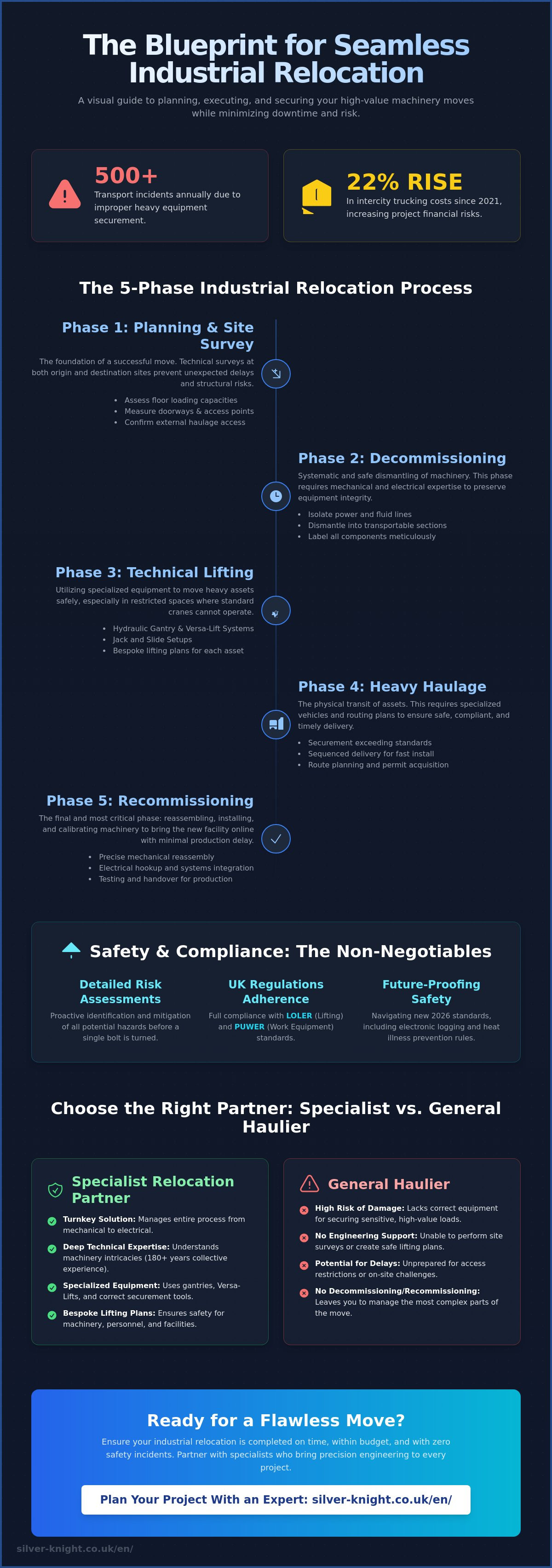
Did you know that improper heavy equipment securement leads to more than 500 transport incidents every single year? When you combine this safety risk with the fact that intercity trucking costs have risen by 22% since 2021, the stakes for your next industrial relocation have never been higher. It's a precision engineering project that requires far more than just a standard haulage service.
We understand that the fear of extended production downtime or damaging sensitive, high-value machinery is a significant burden for any operations manager. You're likely also navigating the pressure of meeting new 2026 safety standards, such as updated electronic logging device requirements and federal heat illness prevention rules. This guide provides a comprehensive roadmap to help you plan and execute a seamless move whilst protecting your revenue and your people. We will preview the essential steps of decommissioning, heavy haulage, and recommissioning to ensure your move is completed on time and with zero safety incidents.
Key Takeaways
- Learn how to build a robust project timeline through technical site surveys to avoid unexpected delays at both your origin and destination.
- Discover how specialised equipment such as hydraulic gantry systems and jack and slide setups ensure the safe movement of heavy plant in restricted spaces.
- Master the complete industrial relocation process by integrating systematic decommissioning and recommissioning into your overall project scope.
- Ensure full legal compliance by understanding the necessity of detailed Risk Assessments and adherence to UK regulations like LOLER and PUWER.
- Gain the confidence to select a qualified specialist partner who offers the technical depth required for complex machinery moves rather than standard haulage.
To ensure your next project is handled with the highest level of technical expertise, consider partnering with expert plant moving specialists who understand the complexities of heavy machinery.
Understanding the Industrial Relocation Process and Scope
Industrial relocation is far more than just shifting boxes from one site to another. It involves the systematic dismantling, transport, and reinstallation of heavy plant assets. Unlike standard commercial removals, this process requires deep technical knowledge and a meticulous approach to engineering. It often mirrors the process of moving a structure in terms of the precision and planning required to maintain the integrity of the equipment.
A successful project provides a turnkey solution that covers both mechanical and electrical work. This means handling everything from decommissioning complex electrical circuits to the final mechanical reassembly at the new destination. In the United Kingdom, sectors such as aerospace, automotive, and food production frequently rely on these services. These industries cannot afford long gaps in production, so the move must be handled with absolute efficiency to keep supply chains moving.
To better understand this concept, watch this helpful video:
Defining Machinery Relocation and Factory Plant Moves
There is a clear difference between moving a single lathe and an entire production line. A single machine move is often a tactical task, whereas an entire factory move involves asset rationalisation. This is the stage where you decide which equipment is worth keeping and which should be cleared to make way for new technology. Dedicated machinery haulage and relocation specialists bridge the gap between your old and new sites. They ensure that every component arrives in the correct sequence for immediate installation, reducing the time your staff spend waiting for parts to arrive.
Why Professional Industrial Movers are Essential
Using non-specialised hauliers for sensitive industrial gear is a recipe for disaster. General carriers often lack the specialised equipment to secure high-value loads properly, which can lead to costly damage. You need a team with 180 years of collective industry experience to manage the many variables involved in an industrial relocation. Professional movers conduct technical site surveys to identify floor load limits and access restrictions before the move begins. They also create bespoke lifting plans that follow strict safety protocols. This level of detail prevents damage to both your machinery and the building itself, giving you peace of mind throughout the project.
Finding a partner for a professional factory move is the first step toward a stress-free transition.
A Step by Step Guide to Planning a Successful Move
Planning an industrial relocation is a complex task that requires a structured approach to avoid costly errors. It's not just about moving items; it's about managing a transition. The process begins with a technical site survey at both the origin and the destination. Once the logistics are understood, you move into creating a project timeline. The third phase involves procuring the right lifting and transport equipment. This is followed by decommissioning and dismantling. The final stage is the transport, reinstallation, and commissioning for production. Each phase must be documented to ensure accountability and safety throughout the process.
Conducting a Comprehensive Site Survey
You must assess the floor loading capacities of your new facility early in the project. If the floor cannot support your heaviest machinery, you'll face immediate delays and potential structural damage. Access points are equally critical. You should measure all doorways and identify low ceilings that might obstruct a crane or a Versa-Lift. Don't forget to check the external approach for heavy haulage vehicles. If your new site isn't ready for immediate installation, you'll need to arrange for secure machinery storage. This foresight ensures that equipment doesn't sit in an unsuitable environment whilst you wait for the new site to be prepared.
Creating a Detailed Relocation Timeline
A successful timeline must be realistic. You should build in buffer periods to account for technical challenges during the dismantling stage. It's often helpful to organise the move in stages. This allows partial production to continue at one site whilst the other is being set up. Coordination with utility providers is also essential. You need to ensure power disconnections happen safely and that new installations are ready the moment the machines arrive. Proper factory relocation project management can help you synchronise these moving parts. This prevents the nightmare scenario of having machinery delivered to a site with no power.
During the procurement phase, you must ensure all rigging equipment meets high industry benchmarks. Even though you are operating in the UK, referencing established OSHA safety standards for rigging gear provides a solid foundation for safe material handling. Using the correct slings and shackles is vital for protecting both your staff and your assets. Every piece of equipment should be inspected before use to ensure it's in good working order. If you're feeling overwhelmed by the planning process, you can contact our team for expert guidance.
If you're planning a complex move, you should speak with a professional team to ensure every piece of equipment is moved safely.
Technical Lifting and Specialised Transport Solutions
Executing a successful industrial relocation requires a suite of specialised tools designed for heavy lifting in restricted environments. Standard lifting methods often fall short when you're working inside a busy factory. Hydraulic gantry systems are frequently the best solution for heavy lifts in low headroom areas. These systems provide a stable and controlled lift for massive components without the need for the overhead clearance a mobile crane requires. For even more precision, jack and slide systems allow movers to shift loads weighing hundreds of tonnes across a floor with millimetre accuracy. This is especially useful when placing machinery onto pre-prepared foundations where there is no room for a forklift to manoeuvre.
Transporting these assets between sites involves more than just a standard lorry. Oversised loads often require low-loaders or extendable trailers to manage the height and weight of the machinery safely. This ensures the load remains stable and stays within legal height limits for road travel. Every stage of the transport process must be carefully planned to avoid obstacles such as low bridges or narrow rural roads that could delay the project.
Specialised Equipment for Heavy Machinery Moving
Accessing tight spaces is one of the most common challenges in a factory environment. Using specialised lifting equipment allows for movement in areas where traditional cranes simply wouldn't fit. Whilst mobile cranes are excellent for outdoor assembly or lifting through a roof, gantry systems provide a much safer and more stable frame for indoor work. The Versa-Lift is the industry standard for indoor heavy lifting because it combines the immense power of a large crane with the compact frame and manoeuvrability of a forklift. It's an essential tool for navigating narrow aisles and placing heavy gear exactly where it needs to be.
Managing International Machinery Transport Logistics
If your move involves crossing borders, the logistics become significantly more complex. You'll need expert export packing to protect sensitive electronic components from sea air and moisture. Loading shipping containers also requires a deep understanding of weight distribution to prevent the cargo from shifting during transit. Silver Knight provides a comprehensive international machinery transport service that handles everything from the initial packing to the customs documentation. Whether you are moving plant to Europe, Asia, or the USA, having a partner who understands global shipping regulations is vital for avoiding delays at the port.
Ensuring your project adheres to the latest safety standards is simple when you partner with an experienced relocation firm.
Managing Safety and Decommissioning Requirements
Safety is the most critical element of any industrial relocation. Without a rigorous approach to risk, you risk not just your machinery but the lives of your employees. In the United Kingdom, every move must comply with LOLER and PUWER regulations. These ensure that all lifting equipment is fit for purpose and that work equipment is maintained and used safely. 2026 standards also place a higher emphasis on the cybersecurity of machinery throughout its lifecycle, including decommissioning. Following these guidelines ensures that your digital assets are as protected as your physical ones during the transition.
A systematic approach to decommissioning is essential. It's not just about pulling plugs. You need to document every connection and mark every component with precision. This makes the eventual reassembly much faster and more accurate. Electrical systems must be safely isolated whilst mechanical parts are carefully lubricated or secured for the journey. Using high-resolution digital photography alongside traditional marking ensures that your engineering team has a clear visual guide for the recommissioning phase. This level of detail prevents the confusion that often leads to extended downtime during reinstallation.
The Role of RAMS and Safety Compliance
RAMS (Risk Assessments and Method Statements) are the foundation of a safe industrial relocation project. They aren't just paperwork; they are a live guide for the team on site. Every operator using specialised gear like Versa-Lifts or gantry systems must have up-to-date training and specific certifications. These documents outline every potential hazard and the exact steps taken to mitigate them. For those needing technical help during the early stages, our machinery dismantle service provides the necessary guidance to ensure assets are prepared correctly.
Precision Recommissioning and Installation Standards
Once the machinery reaches its new home, the work shifts to precision recommissioning. This involves more than just placing a machine on the floor. It must be perfectly levelled and secured to prevent vibration and premature wear. You can find more detail on these engineering standards in our Industrial Machinery Installation Pillar. The final phase is testing, where every system is checked before being handed back to your production team. This includes verifying all safety guards and emergency stops are fully operational. If you want to ensure your next move is fully compliant, you can book a safety consultation with our experts today.
To ensure your project is managed by a team with the right technical skills, you should partner with a specialist mover who understands the intricacies of plant assets.
Selecting the Best Industrial Relocation Partner for Your Project
Choosing the right partner is the most critical decision in your industrial relocation journey. It's the difference between a seamless transition and a project plagued by expensive delays. You need a partner who understands that your machinery is the heartbeat of your business operations. Whilst many companies offer basic transport services, only a true specialist can handle the intricate details of positioning and precision installation. It's also vital to verify that your chosen partner carries adequate insurance coverage specifically for high-value industrial assets. Standard transit insurance often fails to cover the full replacement value of sensitive machinery during the lifting and installation phases.
Comparing Specialist Movers and General Hauliers
General hauliers are excellent at moving standard cargo between locations, but they often lack the equipment for internal factory positioning. They typically don't own Versa-Lifts or hydraulic gantry systems, which means they can't help once the lorry reaches your site. Hiring multiple contractors to bridge this gap creates hidden costs and communication risks that can derail your timeline. A turnkey partner manages the entire scope, from decommissioning to final commissioning. For more help with your evaluation, you can refer to our Industrial Relocation Services Buying Guide. This resource provides a technical framework for comparing quotes and service levels across the industry.
Evaluating Experience and Equipment Capabilities
Before you sign a contract, you should check for a history of successful projects in your specific industrial sector. A company that understands the nuances of food-grade environments or aerospace engineering standards will provide a much better service than a generalist. It's important to verify that the company owns and operates its own fleet of specialised gear. Relying on sub-hired equipment can lead to delays if the gear isn't available on your specific moving day. Silver Knight is a family-run business that prioritises long-term client relationships over quick wins. We offer a comprehensive suite of services, including factory relocation and heavy haulage, managed by a team with 180 years of collective wisdom. This personal touch ensures that your project gets the attention it deserves from start to finish.
When you're ready to start the tender process, ask potential partners about their safety record and their approach to project management. A qualified specialist will be happy to share case studies and provide detailed Method Statements for your review. Choosing a partner like Silver Knight means you're investing in a move that is completed on time, within budget, and with zero safety incidents. We have the technical depth and the specialised equipment to handle even the most complex industrial relocation projects across the United Kingdom and beyond.
To ensure your project is managed by a team with the right technical skills, you should partner with a specialist mover who understands the intricacies of plant assets.
Taking the Next Step Toward Your Successful Move
Organising a successful industrial relocation depends on meticulous planning and the use of the right specialised equipment. From conducting technical site surveys to managing the complex decommissioning of electrical and mechanical systems, every detail matters. We've explored how using tools like Versa-Lifts and hydraulic gantry systems can protect your high-value assets whilst minimising production downtime. By prioritising safety and following UK regulations, you can ensure your move is completed without incident.
Silver Knight brings over 180 years of collective industry experience to every project. As a family-run business, we provide national and global coverage using our extensive in-house fleet of specialised gear. We are dedicated to delivering a clear roadmap that keeps your project on time and within budget. When you're ready to start, request a technical site survey for your industrial relocation today. Your transition to a new facility is an opportunity for growth, and with the right planning, it will be a resounding success.
Frequently Asked Questions
What is the average cost of an industrial relocation project?
Costs for an industrial relocation project are bespoke and depend on the technical complexity of the move. Factors like the weight of the machinery, the distance of the haulage, and the specific lifting equipment required all influence the final price. Since intercity trucking costs have increased by 22% since 2021, it's essential to get a detailed quote that covers all logistics. This ensures you avoid hidden fees whilst protecting your production budget.
How long does it typically take to move a factory production line?
The duration of a move depends on the volume of plant assets and the complexity of the decommissioning process. A single production line might be moved and recommissioned within a week, but a full factory move often takes several months of planning and execution. We build buffer periods into the timeline to account for any technical challenges. This structured approach helps to ensure that your project stays on track and meets your deadlines.
Do I need to hire separate electricians for machinery decommissioning?
You don't need to hire separate electrical contractors if you choose a turnkey relocation partner. We provide integrated mechanical and electrical decommissioning as part of our core service. This includes safely isolating power supplies and documenting every connection for a faster recommissioning phase. Handling both aspects under one project manager reduces the risk of communication errors and ensures that all work follows the same high safety standards throughout the project.
What insurance coverage is required for moving heavy industrial machinery?
You should ensure your partner has comprehensive Goods in Transit insurance and high-level Public Liability coverage. It's vital that the policy reflects the full replacement value of your high-value assets rather than just a standard weight-based rate. This protects your business against the financial impact of accidental damage during transit or lifting. Always ask to see valid insurance certificates during the tender process to verify that the coverage meets your specific project requirements.
Can you move machinery whilst the rest of the factory is still operating?
Moving machinery whilst a factory remains operational is a common way to minimise production downtime. This requires the creation of strict safety zones and clear walkways to separate moving crews from your staff. We use detailed Risk Assessments and Method Statements to manage these interactions safely. By moving equipment in phases, you can maintain a level of output at one site whilst the new facility is being prepared for installation.
What is the difference between machinery moving and industrial relocation?
Machinery moving typically refers to the physical transport of individual items, whereas an industrial relocation involves a wider project scope. This larger process includes the systematic dismantling, packing, and reinstallation of entire plant systems across different sites. It requires a deeper level of engineering knowledge to ensure that complex production lines are recalibrated correctly at the new destination. Relocation is a strategic move that often involves asset rationalisation and facility upgrades.
Do you provide international machinery transport services outside the UK?
Yes, we provide a full international machinery transport service that covers Europe, Asia, and the USA. This service includes professional export packing to protect your gear from moisture and sea air during long journeys. We also manage the complex customs documentation required for global moves to prevent delays at international ports. Having a single partner handle both the UK collection and the global delivery simplifies the logistics and ensures a more secure transition.
What specialised equipment is used for restricted access lifting?
We use hydraulic gantry systems and jack and slide systems to lift and move heavy loads in areas with low headroom. These tools allow us to shift machinery weighing hundreds of tonnes with millimetre precision in spaces where a traditional crane wouldn't fit. Versa-Lift forklifts are also essential for navigating narrow factory aisles whilst maintaining a high lifting capacity. This specialised fleet ensures that we can handle even the most challenging restricted access projects safely.

Article by
David Ashby
I'm the Managing Director of Silver Knight Haulage & Machinery Ltd. Silver Knight Ltd is a family-run firm established in the West Midlands in 2005, with the aim of providing a cost-effective, yet professional, service to businesses for the removal, transportation, and installation of machinery, plant, and equipment here in the UK and worldwide. Between us, the Silver Knight workforce has over 50 years of experience with machinery and its operation.
Disclaimer
This article is intended for informational purposes only. Please ensure you seek expert advice or carry out your own research to confirm the information is suitable for your specific needs.