The global market for heavy equipment transport services was valued at $10 billion in 2024 and is projected to reach $15 billion by 2033, highlighting the massive scale of industrial logistics in 2026. When you're managing oversized machinery transport, the margin for error is non-existent. You've likely spent nights worrying about potential damage to expensive assets or felt overwhelmed by the mountain of paperwork required for UK abnormal load regulations. Coordinating separate teams for contract lifting and heavy haulage often leads to communication breakdowns and unexpected costs that can blow your budget.
It's completely understandable why you might feel apprehensive about an upcoming factory relocation. You want a seamless move where every item arrives in perfect condition, whilst remaining fully compliant with police and highway authorities. This guide provides a clear roadmap for managing these complexities effectively. You'll learn how to streamline your logistics, avoid hidden surprises in your pricing, and ensure your industrial assets are moved with precision and care.
To ensure your heavy assets are moved safely, you can book professional machinery moving and installation services from an experienced team.
Key Takeaways
- Identify the legal differences between standard freight and abnormal loads to ensure your move remains fully compliant with UK road laws.
- Learn how specialist tools like hydraulic gantry systems and low loaders are used to manage heavy assets in confined industrial environments.
- Master the logistics of oversized machinery transport by using the ESDAL system and conducting route surveys well in advance of your moving date.
- Minimise project risks by conducting thorough technical site surveys and preparing detailed Risk Assessment and Method Statements for every stage.
- Evaluate potential partners based on their specific experience with heavy industrial relocations rather than relying on general haulage services.
If you are planning a complex move, you can find professional help for oversized machinery transport here.
Understanding the complexities of oversized machinery transport
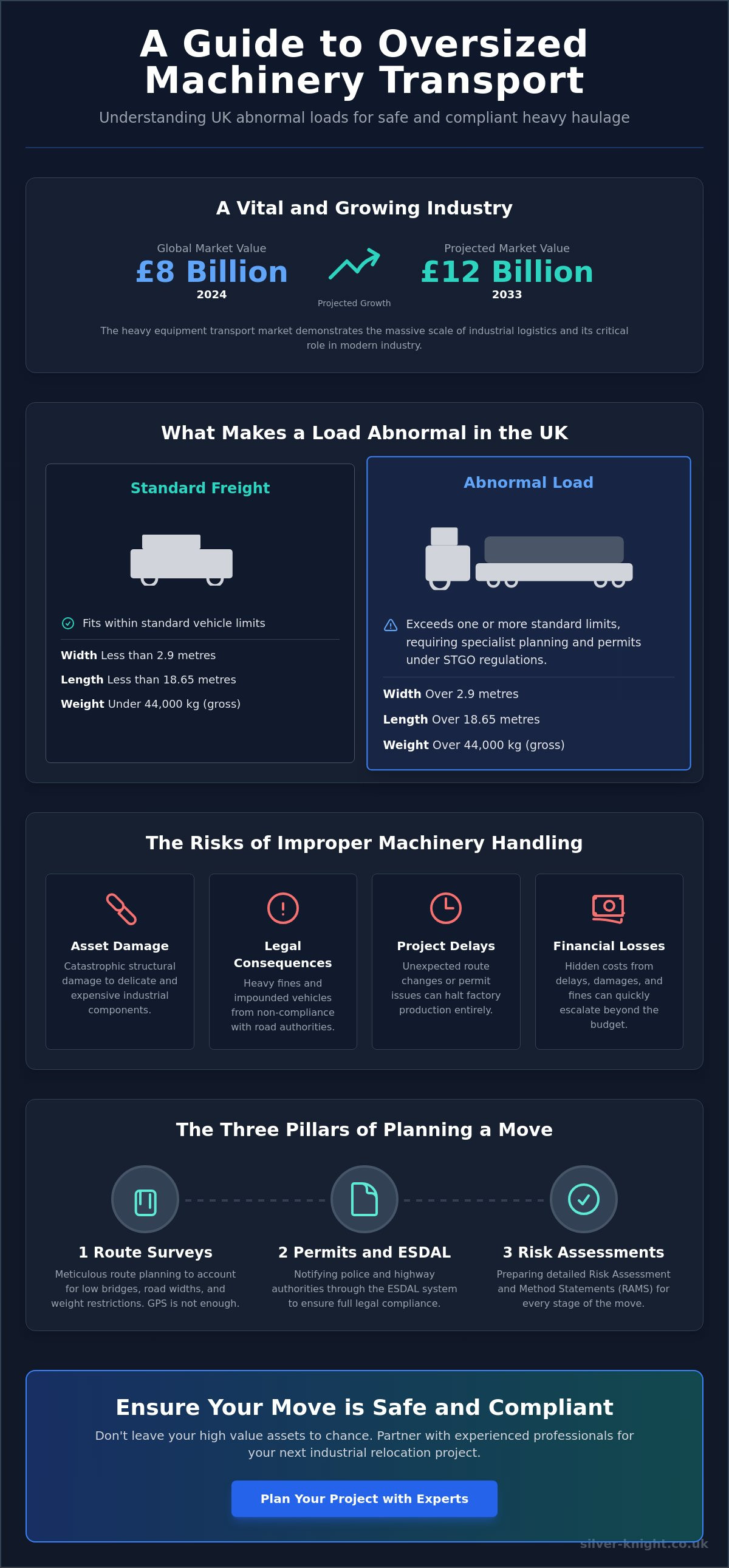
Moving heavy industrial assets is a precision engineering project that happens to be on wheels. It's far more complex than standard haulage because you aren't just moving a crate; you're managing a piece of infrastructure that often exceeds the physical limits of the road network. In the UK, an oversized load requires meticulous planning to ensure it doesn't damage bridges, overhead lines, or the vehicle itself. The global heavy equipment transport market was valued at $10 billion in 2024, and its growth to $15 billion by 2033 shows how vital these movements are to modern industry.
To better understand the scale of these operations, watch this video of a massive industrial asset on the move:
The primary difference between standard freight and an abnormal load lies in the legal requirements. Standard freight fits within the 2.55-metre width and 4.2-metre height limits. Once these are exceeded, you enter the territory of oversized machinery transport. This shift changes everything from your insurance requirements to your choice of route. You can't simply rely on GPS; you need a strategy that accounts for weight distribution and bespoke securing methods. Industrial machines often have uneven centres of gravity that make them prone to shifting during transit, which requires a specialist approach to risk management.
Defining an abnormal load in the UK
In the UK, a load is classified as abnormal if it exceeds 2.9 metres in width or 18.65 metres in length. Weight is also a factor, particularly if the gross vehicle weight exceeds 44,000kg. These loads often fall under the Special Types General Order (STGO) regulations. Height is equally critical because UK bridge clearances vary significantly. A load that is too tall might require a complete route overhaul to avoid low bridges, even if it adds miles to the journey. Identifying these factors early is the only way to avoid project delays.
The risks of improper machinery handling
Cutting corners with an inexperienced provider can lead to catastrophic structural damage. Industrial components are often delicate and sensitive to vibration or tilt. Beyond physical damage, the legal consequences of non-compliance are severe. Authorities can issue heavy fines or impound vehicles if permits aren't in order. There are also hidden costs to consider, such as project delays that stall factory production and lead to massive financial losses for your business. Choosing a partner with the right equipment and knowledge is essential for a safe move.
For expert support with your next project, you can contact heavy machine movers who specialise in complex industrial transitions.
Specialist equipment for moving heavy industrial assets
Success in oversized machinery transport depends on more than just a powerful lorry. Whilst the journey on the road is important, the specialist trailers used to carry the load are the foundation of the move. Low loaders are essential because they reduce the overall height of the cargo. This helps it clear bridges and overhead cables that might otherwise block the route. Extendable trailers provide the flexibility needed for exceptionally long industrial assets, ensuring that weight is distributed safely across multiple axles to meet strict road safety standards.
When planning these moves, it's helpful to look at broader standards, such as Federal vehicle size and weight regulations, which illustrate the global complexity of managing heavy loads. Using an operated equipment fleet is a significant safety advantage for any business. It means the people handling the machinery are intimately familiar with the specific capabilities and limits of the gear. This familiarity reduces the physical footprint required for oversized machinery transport, allowing for complex relocations within active factories without disrupting every other production line.
Hydraulic gantry systems and jack and slide methods
When a machine is too heavy for a standard crane or needs to be positioned deep inside a building, hydraulic gantries are the solution. These systems provide incredibly stable lifting for loads up to 500 tonnes by using multiple telescopic legs to distribute the weight. Unlike cranes that need huge amounts of headroom, hydraulic gantry systems allow for heavy lifting in low ceiling environments. Once the machine is lifted, jack and slide systems offer millimetre precision. They move massive loads along a low profile track, which is perfect for placing equipment exactly where it needs to go when overhead space is limited.
The role of Versa Lifts and heavy forklifts
In factories where space is at a premium, Versa Lifts have become the industry standard for machinery movers. These machines are compact but feature an extendable counterweight that allows them to lift much more than a standard forklift of the same size. This makes them ideal for restricted access moves where a larger machine simply wouldn't fit. Opting for professional forklift hire with a qualified operator ensures that uneven weight distribution is managed safely throughout the lift. Specialised forklifts are designed to handle the awkward shapes and shifting centres of gravity common in industrial gear. If you need to source the right tools for your next project, you can look into a heavy moving equipment hire service to find the best fit for your site.
If you need expert assistance with the logistics of your move, you can book professional oversized machinery transport to ensure every permit is in place.
Planning and permits for large scale transport
Planning is the most critical phase of any industrial move. In the UK, you cannot simply load a vehicle and start the engine; you must navigate a rigorous legal framework. The Electronic Service Delivery for Abnormal Loads (ESDAL) system is the primary tool used to notify the authorities. This system alerts the police, highway agencies, and even bridge owners about your intended route. Failing to provide the correct notice can lead to your vehicle being stopped, which results in costly delays and potential legal action. Professional freight management, much like the standards set by the GSA Freight Management Program, requires a proactive approach to every logistical hurdle.
Route surveys should be conducted weeks before the actual move date. These surveys identify physical obstacles that a standard GPS would miss. You might find that a new traffic island has been installed or that temporary roadworks have narrowed a crucial junction. Contingency planning is essential because road conditions can change overnight. If a planned route becomes blocked by emergency repairs, having a pre-approved secondary route saves the entire project from stalling. You must also manage the logistics of street furniture, whilst coordinating with local councils to temporarily remove signs or bollards that obstruct the path of your oversized machinery transport.
Route surveys and identifying obstacles
A thorough survey checks every millimetre of the journey. This includes measuring bridge heights and assessing the camber of the road to ensure the trailer doesn't bottom out. You also need to check the ground loading capacities at both the collection and delivery sites. If the yard surface cannot support the concentrated weight of the machinery and the trailer, the move cannot proceed safely. For businesses moving assets across the English Channel or further afield, it is vital to work with international machine movers who understand the differing permit requirements in each country.
Coordinating with authorities and escort vehicles
The legal requirement for escort vehicles depends on the width and length of your load. Generally, loads wider than 3.5 metres require at least one private pilot car to warn other road users. If the load is exceptionally large, the police might need to provide a formal escort to manage traffic flow. You should expect the permit approval process to take anywhere from two to ten working days depending on the complexity of the move. Liaising early with the Highways Agency ensures that your timeline remains realistic and that all authorised routes are clear of planned maintenance.
If you are planning a factory relocation, you can find expert machinery moving services here.
Preparing your facility for a machinery move
Preparing your facility is just as important as the journey itself. Before any heavy trailers arrive, a technical site survey must be completed to map out the route from the factory floor to the loading bay. You need to ensure the floor load capacity can handle not just the machine, but the heavy lifting gear required to move it. If the floor lacks the strength to support concentrated weight, you risk structural damage to your building. Clearing access routes is another vital step. This often involves moving other equipment or temporarily relocating stock to create a clear path for the oversized machinery transport vehicle.
The success of the move depends on how well you prepare the equipment for disconnection. Professional planning ensures that your production schedule is disrupted as little as possible. You should also consider the value of a professional machinery dismantle service to ensure safe transport. Breaking down a machine into smaller, manageable components can sometimes simplify the oversized machinery transport process, whilst also protecting sensitive parts from the vibrations of the road. This level of preparation prevents the chaos that often occurs when equipment is moved without a clear plan.
Decommissioning and technical site surveys
Systematic decommissioning is the only way to prevent component loss during a relocation. Every cable, bolt, and sensor should be labelled and documented. This makes the recommissioning process at your new site much faster and more reliable. During the technical site survey, your provider will identify utility disconnection points and potential safety hazards like overhead gas lines or narrow doorways. They will also check for any obstacles that might hinder the use of hydraulic gantries or Versa Lifts. Having this data beforehand prevents expensive delays on the day of the move.
RAMS and health and safety compliance
Health and safety isn't just about ticking boxes; it's about protecting your staff and your assets. Bespoke Risk Assessment and Method Statements (RAMS) are required for every oversized move. These documents detail exactly how each lift will be performed and what safety measures are in place. In the UK, contract lifting operations must be overseen by an Appointed Person who has the training to manage the technical aspects of the lift. All personnel involved in the project must be briefed on these specific risks before work begins. This ensures everyone on site understands their role and the safety boundaries. Ready to prepare your site? Contact our team for a site survey today.
If you need a reliable partner for your next project, you can explore professional factory relocation services to ensure a smooth transition.
Selecting a reliable machinery transport partner
Choosing the right partner for your industrial move is a decision that impacts your entire production timeline. Whilst a general haulier might offer a lower initial quote, they often lack the specialised knowledge required for oversized machinery transport. These moves involve high-value assets that require more than just a strap and a trailer. A specialist provider offers a turnkey service that covers everything from decommissioning and dismantling to final installation at your new site. This approach ensures that a single team is accountable for every stage of the move, which reduces the risk of communication errors and hidden costs.
Insurance coverage is another critical factor. You must ensure that your partner has sufficient liability insurance to cover the full value of your industrial assets during transit. General haulage insurance often has limits that are far too low for expensive manufacturing equipment. A family run business approach often brings a higher level of care and personal accountability to a project. When the owners are directly involved in the operations, you can expect a more helpful and responsive service. This personal touch is vital when you're managing a high-pressure relocation that requires absolute precision.
Why 180 years of collective experience matters
Experience isn't just about the number of years a company has been trading; it's about the depth of institutional knowledge within the team. Solving complex lifting problems in cramped or old industrial buildings requires a level of intuition that only comes from decades of hands-on work. Case studies from diverse sectors like automotive, aerospace, and food production serve as proof of capability. You can learn more about the technical requirements for these moves by reading about heavy haulage West Midlands standards and how they apply to modern industrial transport.
Nationwide and international capabilities
Your business might be moving across the street or across the globe. A reliable partner must be able to manage the transition from UK roads to international shipping lanes seamlessly. This involves coordinating with port authorities and understanding the customs requirements for heavy machinery. Consistency of service is essential, especially during phased relocations where some equipment moves before others. During these gaps, having access to secure machinery storage is a major benefit. It allows you to clear your old facility on schedule whilst your new site is still being prepared, ensuring your assets remain protected amongst the chaos of a move.
To ensure your next move is handled with precision, you can find professional factory relocation support from an experienced team.
Securing a successful industrial relocation
Managing a factory move requires more than just logistical planning; it demands a deep understanding of technical lifting and strict road regulations. You've seen how the right combination of hydraulic gantry systems and detailed route surveys can prevent costly delays and equipment damage. By preparing your facility thoroughly and choosing a partner who understands the nuance of abnormal loads, you turn a high-risk operation into a manageable process. This proactive approach ensures your assets are protected whilst your production timelines remain on track.
Success in oversized machinery transport depends on the expertise of the team behind the move. Our collective industry experience of over 180 years means we've encountered almost every possible site challenge. With a specialist fleet including Versa-Lifts and hydraulic gantries, we provide nationwide and global relocation services tailored to your specific needs. You don't have to navigate these complexities alone when professional support is available to guide you through every stage of decommissioning and installation.
Get a professional quote for your oversized machinery move and take the first step towards a seamless transition for your business. We look forward to helping you move your industrial assets safely and efficiently.
Frequently Asked Questions
What qualifies as an oversized load for machinery transport
An oversized or abnormal load in the UK is defined by dimensions that exceed standard road vehicle limits. This typically includes any cargo wider than 2.9 metres or longer than 18.65 metres. Weight also plays a role, as anything over 44,000kg gross vehicle weight falls into this category. If your equipment exceeds these measurements, you must follow specific notification procedures before the move can begin.
How much notice is required for an abnormal load permit in the UK
You must provide between two and ten working days of notice depending on the dimensions and weight of the asset. For extremely large loads, the notification period for police and highway authorities can be longer. Accurate timelines are vital to avoid project delays, so it is best to start the permit application as soon as your dimensions are confirmed.
Do I need a separate crane company for oversized machinery transport
No, you can choose a provider that offers integrated contract lifting and heavy haulage. Using a single partner for both transport and lifting reduces the risk of coordination errors. Tools like hydraulic gantry systems or Versa Lifts can often replace the need for large external cranes, especially when working in confined factory spaces.
Is my machinery insured during the transport process
Specialist movers carry higher liability insurance than general hauliers to protect high value industrial assets. You should always verify that the coverage limit matches the replacement value of your specific machine. Standard goods in transit insurance is rarely sufficient for complex industrial moves, so checking the policy details is a priority.
What is a route survey and why is it necessary for large moves
A route survey is a physical inspection of the entire journey to identify potential obstacles. This includes checking bridge clearances, narrow junctions, and ground loading capacities. It is a necessary step for oversized machinery transport to ensure the vehicle doesn't become stuck or cause damage to public infrastructure whilst in transit.
Can oversized machinery be transported internationally
Yes, industrial assets can be moved across global borders using international machinery transport services. This process involves coordinating road haulage with shipping lines or air freight providers. A specialist partner manages the customs paperwork and port logistics to ensure a smooth transition between different countries and regulatory zones.
What information do I need to provide for an accurate quote
To receive a precise quote, you should provide the exact dimensions, weight, and centre of gravity of the equipment. Details about site access, such as doorway widths and floor capacities at both ends, are also essential. Providing a clear timeline helps your partner allocate the correct oversized machinery transport equipment and personnel for the job.
How do you manage transport for machinery with a high centre of gravity
Equipment with a high centre of gravity requires specialised trailers like low loaders to keep the weight as close to the road as possible. Bespoke bracing and securing methods are used to prevent tilting during transit. For indoor positioning, jack and slide systems offer a stable way to move tall assets without the risk of tipping that comes with traditional lifting.

Article by
David Ashby
I'm the Managing Director of Silver Knight Haulage & Machinery Ltd. Silver Knight Ltd is a family-run firm established in the West Midlands in 2005, with the aim of providing a cost-effective, yet professional, service to businesses for the removal, transportation, and installation of machinery, plant, and equipment here in the UK and worldwide. Between us, the Silver Knight workforce has over 50 years of experience with machinery and its operation.
Disclaimer
This article is intended for informational purposes only. Please ensure you seek expert advice or carry out your own research to confirm the information is suitable for your specific needs.