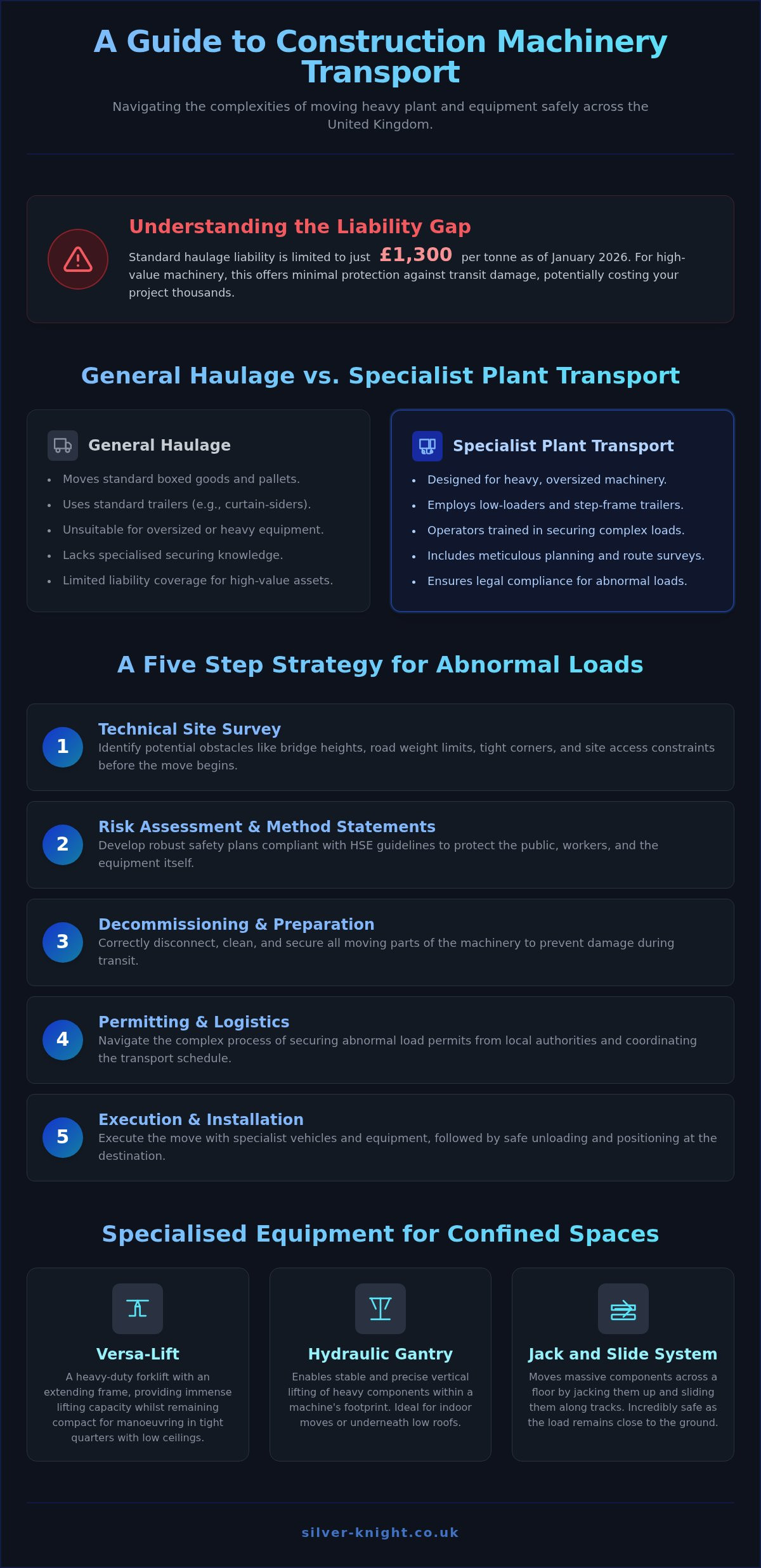
Did you know that as of January 2026, standard haulage liability is limited to just £1,300 per tonne? For a high value excavator or specialist plant, this figure barely scratches the surface if something goes wrong during transit. You likely already know that construction machinery transport is one of the most complex parts of any project. Between the nightmare of securing abnormal load permits and the constant fear of site delays, moving heavy equipment feels like a high stakes balancing act whilst you try to keep your timeline on track.
We understand the pressure of keeping a site running. A single transport delay doesn't just stall one machine; it can halt an entire workforce and blow your budget. This guide will show you how to master the logistics and safety protocols required to move heavy plant across the United Kingdom safely. You'll discover how to navigate the 2026 workplace transport training categories and ensure your moves stay compliant with the latest safety laws.
We will cover everything from selecting the right trailers to understanding the new safety control lever requirements for excavators. By the end, you'll have a clear plan to minimise downtime and protect your equipment during every move.
Key Takeaways
- Learn the precise legal requirements for construction machinery transport to ensure your project remains fully compliant with updated 2026 safety regulations.
- Understand how advanced tools like hydraulic gantry systems enable the safe movement of heavy plant equipment within restricted or confined spaces.
- Master a five step planning strategy for abnormal loads to prevent site delays and navigate complex permit requirements with ease.
- Discover the vital decommissioning steps you must take to protect high value machinery from damage before it even leaves the site.
- Gain insights into why a professional approach to heavy haulage reduces project downtime and ensures a seamless installation at the destination.
If you are planning a complex relocation, working with professional machinery movers ensures your equipment arrives safely and on schedule.
Understanding construction machinery transport requirements
Construction machinery transport is the specialised movement of oversized plant equipment that exceeds standard road dimensions or weight limits. It isn't just about moving a vehicle from one site to another. It involves complex engineering, legal compliance, and meticulous planning. Standard haulage firms often lack the equipment or expertise to move 30-tonne piling rigs or wide-load excavators. These machines require bespoke solutions to prevent structural damage or road safety incidents.
Before any wheels turn, a technical site survey is essential for safe construction machinery transport. This survey identifies bridge heights, weight limits on local roads, and the physical constraints of the destination. The Health and Safety Executive (HSE) plays a significant role in overseeing large scale industrial moves. They ensure that risk assessments and method statements are robust enough to protect the public and the workers involved in the move.
The difference between general haulage and plant transport
General haulage usually involves standard trailers and boxed goods. In contrast, moving heavy construction equipment requires low loaders and step-frame trailers. These specialised vehicles allow for a lower centre of gravity and easier loading of tracked machines. You also need trained operators who understand how to secure these specific loads. Using a provider that doesn't specialise in heavy plant increases the risk of equipment failure or transit damage.
Key factors in site access and ground conditions
Ground conditions are a major hurdle for heavy moves. If the soil is soft or the tarmac is thin, a heavy transport vehicle can cause significant damage or even tip over. We often use outrigger mats and temporary flooring to distribute the weight safely. Restricted access is another common issue on active construction sites. Tight corners and narrow gates require precision planning. Understanding ground pressure and turning circles ensures the machine reaches its destination without causing a site shutdown.
For safe and efficient plant relocation, you can rely on our specialised lifting services to handle your most challenging equipment.
Specialised equipment for moving heavy plant
Moving heavy plant often involves more than just a trailer and a winch. In many industrial environments, you'll find that space is at a premium and traditional cranes simply cannot fit. This is where machinery moving equipment such as hydraulic gantry systems becomes essential. These systems provide a stable and precise way to lift heavy components vertically within the footprint of the machine itself. They're perfect for construction machinery transport projects where you're working inside a factory or beneath a low roof.
Versa Lift and compact lifting solutions
The Versa Lift is a game changer for moves in tight quarters. It's a heavy duty forklift with an extending frame that allows it to carry immense loads whilst remaining compact. If you're dealing with low ceilings where a mobile crane would be blocked, this tool is often the only viable option. It provides the manoeuvrability of a standard forklift but with the capacity of much larger machines. You can learn more about how this technology works by exploring our guide to versa lift hire and its applications.
Hydraulic gantries and jack and slide systems
When you need to move massive components across a floor without the height for a gantry, a jack and slide system is the best choice. The process begins by jacking the machine up to a specific height. We then place it onto a set of tracks or slides. The machine is pushed along these tracks with hydraulic cylinders until it reaches its destination. This method is incredibly safe because the load is always close to the ground, making it a staple technique in modern construction machinery transport for heavy components. It's the preferred choice for sensitive industrial assets that cannot be tilted or subjected to the swinging motions of a crane.
Safety is the foundation of every move we undertake. Following strict protocols, similar to those outlined in OSHA safety regulations for material handling, ensures that every lift is calculated and controlled. Using the wrong tool for the job doesn't just risk the machine; it risks the site and the people on it. If you need advice on the right equipment for your project, speak with our technical team for expert guidance.
Planning a complex move requires precision, and our heavy haulage experts handle every detail from permit applications to final delivery.
Logistics and planning for abnormal loads
Planning the logistics for an abnormal load is a rigorous process that starts weeks before the machine leaves the site. When your equipment exceeds standard road dimensions, it falls under specific legal frameworks that dictate how and when it can travel. A successful construction machinery transport project follows a structured five step planning phase.
- Initial Assessment: Recording the exact weight, height, and width of the machine.
- Permit Application: Notifying the relevant authorities based on the load dimensions.
- Route Survey: Physically or digitally checking the path for obstructions.
- Escort Coordination: Arranging pilot cars or police escorts where required.
- Site Preparation: Ensuring both the origin and destination can accommodate the vehicle size.
Effective coordination with local authorities and the police is essential. For many wide or heavy loads, you must provide advanced notice to every police force area the vehicle passes through. In some cases, an escort vehicle is mandatory to warn other road users and manage traffic flow at narrow junctions or roundabouts.
Understanding STGO categories and permits
The Road Vehicles (Authorisation of Special Types) (General) Order, known as STGO, categorises loads to manage road safety. Category 1 covers loads up to 46,000kg. Category 2 extends to 80,000kg, and Category 3 handles the heaviest equipment up to 150,000kg. Each category has different notice periods. For instance, a Category 3 move often requires at least five days' notice to highway and bridge authorities. Providing accurate weight and dimension data is critical. Even a small error can lead to a permit being invalidated or a vehicle being impounded by the authorities.
Route planning and obstacle management
Identifying potential hazards like low bridges or weight restricted roads is a core part of the planning process. Modern GPS and survey tools allow us to map routes with high precision, but they don't replace the need for technical expertise. Sometimes, we must coordinate the temporary removal of street furniture, such as signposts or bollards, to allow a wide load to pass. These obstacles are often identified during the site survey mentioned earlier, ensuring that the construction machinery transport remains fluid and avoids costly mid route delays.
If you need to prepare equipment for a move, our machinery dismantle services provide the technical expertise required to safely decommission your plant.
Safety protocols and decommissioning procedures
Safety in construction machinery transport begins long before the transport vehicle arrives on site. Decommissioning is a critical first step that ensures a machine is stable and safe for the journey ahead. This process involves more than just turning off the ignition. You must isolate power sources, drain hazardous fluids where necessary, and secure all moving parts like booms or buckets. Failing to decommission correctly can lead to mechanical failure or dangerous weight shifts whilst the vehicle is in motion.
Expert packing and securing are vital for long distance transit. Constant vibration and road movement can cause significant wear if the load isn't perfectly balanced and lashed. We conduct rigorous safety checks during the loading and unloading process to ensure every chain and strap meets the required tension. Given the high value of modern plant equipment, comprehensive insurance is a non negotiable requirement. It protects your investment against the high risk of damage during transit that we discussed earlier.
Professional dismantling and export packing
Some machines are simply too large to move in one piece even with abnormal load permits. In these cases, we break the machinery down into manageable components. For international projects, we use specialised shipping container packing services. This involves using moisture barriers and shock absorbing materials to protect sensitive hydraulic systems and electronic components from the harsh conditions of sea freight or long haul road travel. Every part is labelled and documented to ensure a smooth recommissioning process at the destination.
Risk assessments and method statements
Every project requires a detailed Risk Assessment and Method Statement (RAMS). This document is vital for construction site compliance and ensures that every potential hazard is identified before any lifting begins. We look for overhead power cables, underground services, and ground stability issues that could affect the move. An appointed person oversees the entire operation, ensuring that the team follows the method statement exactly. This level of oversight is essential for maintaining a safe working environment and meeting the strict standards of the Health and Safety Executive.
To ensure your next move is fully compliant and safe, contact our specialist team for a detailed consultation and site survey.
When you choose to work with Silver Knight Haulage, you are tapping into a technical heritage that ensures your project is managed by experts from start to finish.
Professional solutions for heavy haulage projects
Choosing the right partner for construction machinery transport is about more than just finding a vehicle with enough capacity. It's about trust and technical heritage. Our team brings over 180 years of collective industry experience to every project we undertake. This deep well of knowledge allows us to anticipate challenges that less experienced providers might miss. As a family owned and operated business since 1996, we pride ourselves on a personalised service that larger corporations often struggle to match. You aren't just another booking; you're a partner whose project success is our primary goal.
We believe that a successful move begins with a thorough understanding of the equipment and the environment. We always encourage our clients to seek a technical survey before their next construction move. This initial step allows us to identify the specific requirements of the site and the machinery, ensuring that the plan we build is both safe and efficient. It's this commitment to detail that has built our reputation as national experts in the field.
The benefits of a turnkey machinery relocation service
One of the biggest risks in any move is the fragmentation of services. When you use different companies for haulage and machinery installation, you often find yourself caught in the middle of conflicting schedules or responsibilities. A turnkey service eliminates this friction. By managing the entire project from decommissioning to recommissioning, we reduce the risk of damage and ensure that your machine is ready for work as soon as it arrives. Fully managed contract lifts provide additional peace of mind, as we take full responsibility for the lifting plan and execution, allowing you to focus on your core construction tasks.
National and international reach for construction plant
Successfully managing construction machinery transport requires a blend of technical knowledge and meticulous logistics. By prioritising thorough site surveys, understanding the latest STGO permit requirements, and utilising the right decommissioning protocols, you can protect your high value assets and avoid site delays. We've shown that using the right equipment, such as hydraulic gantries and the Versa Lift, makes the difference between a risky move and a compliant, safe project.
Our family run business brings 180 years of collective industry expertise to every project. We use specialist technology and proven methods to ensure we stay fully compliant with all UK heavy haulage regulations. Whether you're moving a single machine or relocating an entire fleet, our team is ready to provide the precision your project deserves. Request a technical site survey for your machinery transport project today and let us handle the heavy lifting for you.

Article by
David Ashby
I'm the Managing Director of Silver Knight Haulage & Machinery Ltd. Silver Knight Ltd is a family-run firm established in the West Midlands in 2005, with the aim of providing a cost-effective, yet professional, service to businesses for the removal, transportation, and installation of machinery, plant, and equipment here in the UK and worldwide. Between us, the Silver Knight workforce has over 50 years of experience with machinery and its operation.
Disclaimer
This article is intended for informational purposes only. Please ensure you seek expert advice or carry out your own research to confirm the information is suitable for your specific needs.