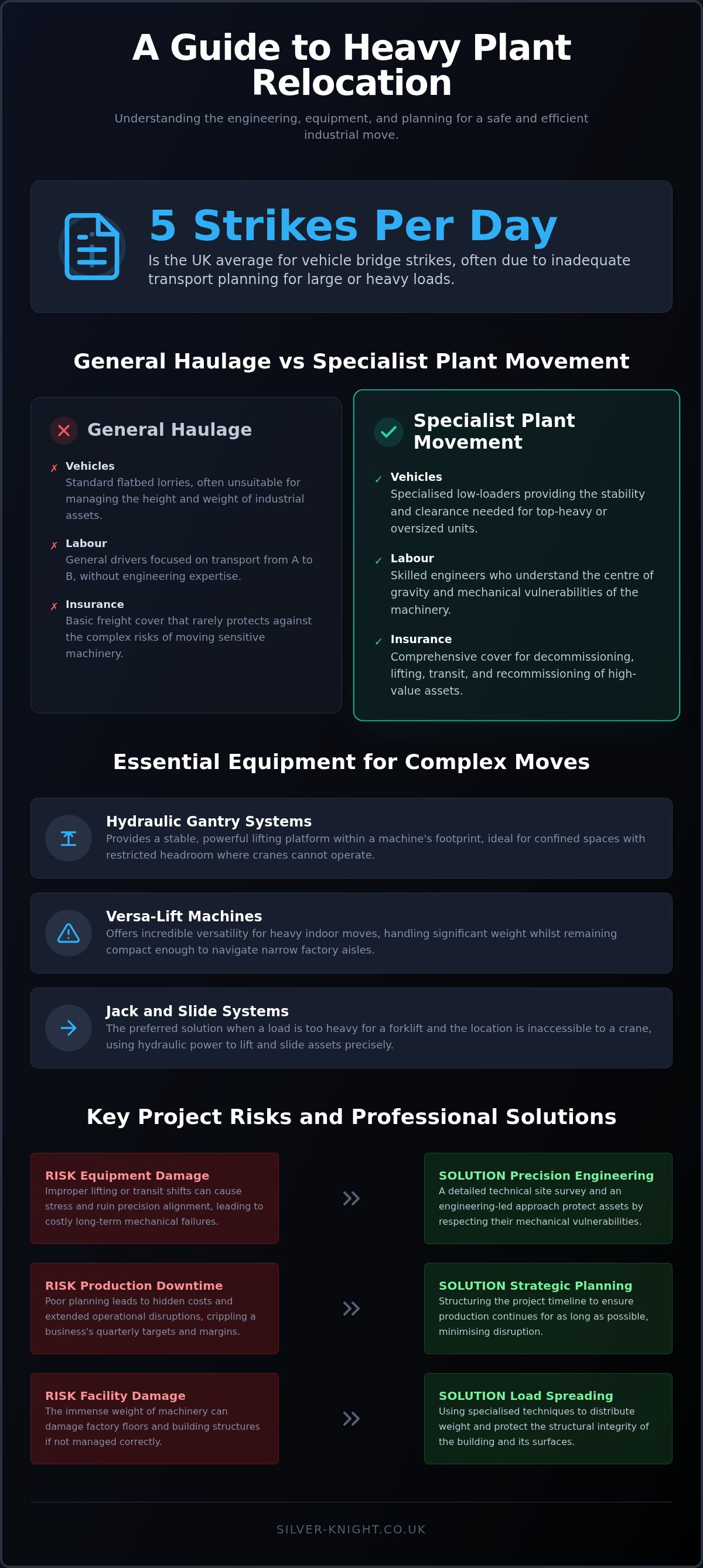
According to Network Rail, an average of five bridges are struck by vehicles every day in the UK, often due to inadequate transport planning. This startling figure highlights exactly how much can go wrong when you move industrial machinery between sites. Managing a heavy plant relocation is one of the most complex tasks your business will ever undertake. You likely worry about the high cost of equipment damage and the dread of extended production downtime that eats into your margins. It's a significant logistical challenge that requires precision and absolute compliance with health and safety regulations.
This guide shows you how to manage these projects safely whilst minimising operational downtime and protecting your industrial assets. We'll draw on over 180 years of collective industry experience to help you achieve a seamless transition to your new site with zero damage to expensive machinery. You'll learn about navigating abnormal load thresholds, the importance of digital compliance from October 2026, and how specialist tools like jack and slide systems ensure a successful move. By the end, you'll have a clear roadmap for a compliant and efficient relocation.
Key Takeaways
- Learn why a technical site survey is vital for identifying potential obstacles before the move begins.
- Discover how specialised tools like hydraulic gantries allow for the safe movement of machinery in confined spaces.
- Understand the engineering principles behind a successful heavy plant relocation to better protect your industrial assets.
- Find out how to structure your project timeline to ensure production continues for as long as possible.
- Identify the essential safety standards and experience levels required when choosing an industrial moving partner.
For expert assistance with your next industrial move, consider the specialist services of Silver Knight Haulage & Machineries Ltd.
Understanding the Complexity of Heavy Plant Relocation
Heavy plant relocation is far more than just a transport job. It is a multi-stage engineering process that begins long before a vehicle arrives on site. Moving industrial assets is often compared to the process of moving a structure because of the sheer scale and technical precision involved. Unlike standard freight, these assets are often bespoke and mechanically sensitive. They require a level of care that goes beyond simple loading and unloading.
Industrial machinery needs extreme caution because even a slight shift during transit can ruin precision alignment. This sensitivity means that traditional lifting methods are rarely enough. Protecting the environment is also vital. Specialist teams must ensure the structural integrity of the building is maintained whilst protecting floor surfaces from the immense weight of the equipment using load spreading techniques. Without this expertise, the cost of repairing a factory floor can sometimes exceed the cost of the move itself.
Identifying Potential Risks and Operational Disruptions
Poor planning amongst industrial moves often leads to hidden costs. These include emergency repairs or lost production time that can cripple a business's quarterly targets. Improper lifting is a major risk. It can cause internal stress on a machine that leads to long term mechanical failure months after the move is complete. Within the context of factory moves, asset rationalisation is the strategic process of reviewing and reducing your inventory of machinery to ensure only efficient and necessary equipment is relocated.
The Difference Between General Haulage and Plant Movement
There is a fundamental difference between general haulage and specialist machinery haulage. Standard flatbed transport is fine for pallets, but heavy plant relocation frequently requires specialised low-loaders to manage height and weight restrictions safely. These vehicles provide the stability needed for top-heavy or oddly shaped industrial units that would be unsafe on a standard trailer.
The labour involved differs significantly. General drivers move goods from A to B. In contrast, plant movers are specialised engineers who understand the centre of gravity and mechanical vulnerabilities of the items they carry. Insurance requirements also differ. Standard freight insurance rarely covers the complex risks associated with decommissioning, lifting, and recommissioning heavy industrial plant. You need a partner who understands these distinctions to protect your investment.
To ensure your project is handled by experts with the right tools, you can explore the range of services offered by Silver Knight Haulage & Machineries Ltd.
Specialist Equipment for Moving Industrial Machinery
A successful heavy plant relocation relies on more than just manpower. It requires an advanced fleet of vehicles, including low-loaders and specialised trailers, designed for high capacity loads in tight environments. Using the right equipment reduces the need for expensive and time consuming building alterations, such as removing roofs or widening doorways. This is where operated lifting equipment rental becomes essential for project safety. It ensures that every lift is performed by a qualified professional using machinery that is maintained to the highest standards. Choosing the correct tool for restricted access areas is not just about efficiency; it is about preventing structural damage to your facility.
Hydraulic Gantry Systems and Versa Lift Capabilities
Many industrial facilities have restricted headroom that makes traditional crane hire impossible. Hydraulic gantry systems solve this by providing a stable lifting platform within the footprint of the machine itself. These systems allow for precise vertical and horizontal movement in confined spaces. For heavy indoor moves, Versa-Lift machines offer incredible versatility. They can handle significant weight whilst remaining compact enough to navigate narrow factory aisles. You can find more details about these tools on our specialised lifting equipment page, which includes information on heavy lifting pillars and other vital machinery.
Precision Moving with Jack and Slide Systems
When a load is too heavy for a forklift and the location is inaccessible for a crane, jack and slide systems are the preferred solution. This method involves using high capacity hydraulic jacks to lift the asset and then sliding it along a controlled track. The physics of this technique focus on low friction and incremental movement, which provides total control over the load. This approach is particularly effective for protecting factory floors from damage because the weight is distributed evenly across the track system. All such operations must strictly adhere to the Lifting Operations and Lifting Equipment Regulations (LOLER) to ensure the safety of personnel and the machinery. If you are planning a move in a challenging environment, contact our specialists for a technical consultation.
If you require professional support for your industrial project, you can find expert help through Silver Knight Haulage & Machineries Ltd.
Strategic Planning for Factory and Plant Moves
The planning phase is the most critical part of any heavy plant relocation. It is not just about logistics; it is about risk mitigation. A well planned move ensures that production downtime is kept to an absolute minimum whilst protecting the high value of your assets. Effective heavy plant relocation requires a deep understanding of the UK's infrastructure and your own site's limitations. Clear documentation is essential at this stage. Every piece of plant should have a detailed file including its weight, dimensions, and any specific handling instructions. This record becomes the blueprint for the entire project, allowing engineers to prepare for every eventuality.
Conducting Technical Site Surveys and Logistics Assessments
A comprehensive technical site survey is the only way to prevent costly surprises on move day. During these surveys, engineers check critical factors such as floor loadings to ensure the surface can withstand the weight of the machinery and the lifting equipment. Logistics assessments also cover route planning across the UK network. Current regulations state that a vehicle's gross weight must not exceed 44,000kg and its width must not be more than 2.9 metres. If these limits are surpassed, the load is classified as abnormal. Identifying these constraints early allows for the necessary permits to be arranged. Surveys also account for axle weight thresholds, such as the 11,500kg limit for a single driving axle, ensuring the entire transport plan is compliant and safe.
Safe Decommissioning and Asset Rationalisation
Coordination is key when matching decommissioning with production schedules. You need a systematic shutdown of industrial equipment to ensure that all power and fluid supplies are safely isolated before any lifting begins. This period is also an ideal time for asset rationalisation. By evaluating which machines are truly needed at the new site, you can streamline your operations and reduce transport costs. Many firms choose a factory clearance during a relocation to remove redundant equipment. For complex machines that require expert handling, using a professional machinery dismantle service ensures that components are marked and stored correctly for easy reassembly at the destination. This structured approach prevents mechanical issues and speeds up the recommissioning process.
For a seamless transition led by industry experts, visit Silver Knight Haulage & Machineries Ltd.
How to Organise a Successful Industrial Relocation
Organising a successful heavy plant relocation involves balancing technical engineering with clear communication. You must brief your staff and stakeholders early to ensure everyone understands their role in the transition. This includes informing customers of potential changes to lead times and coordinating with suppliers for new delivery points. If your new facility is not ready for immediate installation, you may need to arrange machinery storage in a secure, climate-controlled environment. The final stage is recommissioning, where engineers restore full operations by testing every machine against its original performance specifications. This step is vital to ensure that your production quality remains consistent after the move.
Creating a Timeline for Minimal Downtime
A phased approach is often the best way to keep your business running during a move. By relocating one production line at a time, you can maintain a level of output whilst the rest of the facility is decommissioned. Project managers are essential for this process. They act as a single point of contact and keep the move on track by managing every logistical detail. When scheduling heavy moves, many firms choose weekends or holiday shutdowns to avoid peak traffic and minimise the impact on daily operations. This careful timing reduces the pressure on your internal teams and ensures that the most complex lifts happen without interrupting your core staff.
Compliance and Health and Safety Requirements
Safety is the primary concern during any industrial move. You must ensure that all contractors provide detailed Risk Assessment and Method Statements (RAMS) before any work begins. For projects involving contract lifting, an Appointed Person must be designated to oversee the safety and planning of the lift. It is also important to stay updated with the latest regulatory changes. In January 2026, the Accrediting Bodies Association for Workplace Transport (ABA) introduced updated categories to define operator competence more strictly. You should verify that your moving team meets these new standards. Additionally, the Digital Waste Tracking (England) Regulations 2026 are expected to come into force on 1 October 2026. This means any waste generated during your factory clearance or move must be recorded in a new digital system rather than using paper notes. To discuss your specific timeline and safety requirements, speak to our project management team today.
To partner with a team that brings decades of expertise to your project, contact the specialists at Silver Knight Haulage & Machineries Ltd.
Selecting the Right Partner for Heavy Equipment Haulage
Choosing the right partner for your project is the final piece of the puzzle. You need a company that provides a full turnkey service from decommissioning to recommissioning. Look for firms that own their own specialised fleet of low-loaders and trailers, as this gives them total control over the schedule and equipment availability. A heavy plant relocation is a high stakes investment, so verifying insurance cover and safety records is a non-negotiable step in your evaluation. The best partners are those who view the move as an engineering challenge rather than a simple haulage job.
The Value of Industry Experience and Family Run Reliability
Silver Knight Haulage & Machineries Ltd stands out because of its over 180 years of collective industry experience. This deep well of knowledge means the team has seen almost every possible challenge, from restricted site access to complex weight distribution issues. As a family run business, they offer a level of personal accountability that larger corporations often lack. You aren't just another project number; you're a client with a direct line to the people responsible for your assets. This personal touch ensures that every detail of the heavy plant relocation is handled with the care it deserves, providing peace of mind for business owners.
Global Relocation and International Transport Logistics
If your business operates on a global scale, you need a partner with international reach. Moving heavy machinery to Europe, the US, or Asia requires specialised knowledge of global logistics and maritime transport. It is essential to work with international machine movers who understand the nuances of export documentation and containerisation. Professional shipping container packing is a vital part of this process. It involves securing machinery within containers using bespoke timber crating and anti-corrosion materials. This level of preparation protects your precision equipment from the harsh conditions of international transit, ensuring it arrives ready for installation. Whether you are moving a single machine or an entire production facility across the world, the right partner manages every logistical hurdle on your behalf.
To ensure your next move is handled by a team with a proven track record, visit Silver Knight Haulage & Machineries Ltd.
Securing the Future of Your Industrial Operations
Successfully managing a complex industrial move requires a blend of technical engineering and meticulous logistics. By prioritising a comprehensive site survey and utilising specialised tools like hydraulic gantry or jack and slide systems, you protect your valuable assets whilst ensuring operational safety. Remember that the planning phase is where the most significant risks are mitigated, especially when navigating the evolving UK regulatory landscape. Whether you are moving a single machine or an entire factory, the right partnership ensures your production lines are restored with minimal disruption.
Silver Knight Haulage & Machineries Ltd brings over 180 years of collective industry experience to every project. Our nationwide and global relocation capabilities ensure that your equipment is handled by experts, regardless of the destination. If you are ready to plan a seamless transition for your business, contact our expert team for a comprehensive heavy plant relocation quote. We look forward to helping you achieve a safe and efficient move.
Frequently Asked Questions
What is heavy plant relocation and how does it differ from standard haulage?
Heavy plant relocation involves the entire process of moving industrial machinery, including decommissioning, lifting, and recommissioning. Standard haulage usually only covers the transport of goods from one point to another. Relocating plant requires specialist skills to dismantle complex systems and ensure they work correctly at the new site. It often involves using hydraulic gantries or jack and slide systems to handle weights that standard transport cannot manage.
How long does a typical factory or plant relocation project take?
The duration of a project depends on the size and complexity of the machinery involved. A single machine move might take one or two days, whilst a full factory relocation can span several weeks or months. Factors like the distance of the move and the level of decommissioning required will influence the timeline. We focus on detailed planning to minimise downtime and ensure every stage of the heavy plant relocation stays on schedule.
Do I need to hire separate contractors for decommissioning and moving?
You don't need to hire multiple companies because we provide an end to end service. Silver Knight Haulage & Machineries Ltd handles everything from decommissioning and dismantling to transport and final installation. Using a single provider for the whole process reduces the risk of communication errors and ensures a smoother transition. Our team has over 180 years of collective experience, allowing us to manage every technical aspect of the move ourselves.
What equipment is used to move machinery in restricted access areas?
We use specialised tools like Versa-Lifts and jack and slide systems to navigate tight spaces where standard cranes cannot reach. Hydraulic gantries are also essential for lifting heavy loads in buildings with low ceilings or limited floor space. This equipment allows us to move machines precisely without needing to dismantle structural elements of your building. Our fleet is designed to handle complex lifts in challenging industrial environments across the country.
Is my machinery insured during the relocation process?
Yes, your machinery is covered by professional insurance throughout the entire relocation process. This includes the decommissioning phase, the transit period, and the final installation at your new site. We take every precaution to protect your assets, but having comprehensive cover provides peace of mind. It's important to check the specific limits of the policy before the move begins to ensure it meets the full value of your industrial equipment.
Can you manage international machinery transport to the US or Asia?
We provide global relocation services and regularly manage international machinery transport to Europe, the US, India, and Asia. Our team handles the complex logistics involved in moving heavy plant across borders, including coordination with shipping partners. We ensure that your equipment is securely packed for long distance travel and arrives safely at its destination. Whether you are moving a single machine or an entire production line, we can manage the global journey.
What information do I need to provide for a relocation quote?
To give an accurate quote, we need the dimensions and weights of each piece of equipment. You should also provide details about the access points at both the current and new sites, such as door widths and floor loading capacities. Information regarding any specific decommissioning requirements or tight deadlines is also helpful. A site survey is often the best way for us to assess the project and provide a realistic cost for your move.
How do you ensure factory floors are not damaged during the move?
We protect factory floors by using specialised load spreading plates and heavy duty mats. Our team uses jack and slide systems or air skates to move heavy items smoothly without scraping the surface. By distributing the weight of the machinery across a larger area, we prevent cracks or indentations in the concrete or resin. Careful planning and the use of the right equipment ensure that your facility remains in excellent condition throughout the process.
Article by
David Ashby
I'm the Managing Director of Silver Knight Haulage & Machinery Ltd. Silver Knight Ltd is a family-run firm established in the West Midlands in 2005, with the aim of providing a cost-effective, yet professional, service to businesses for the removal, transportation, and installation of machinery, plant, and equipment here in the UK and worldwide. Between us, the Silver Knight workforce has over 50 years of experience with machinery and its operation.
Disclaimer
This article is intended for informational purposes only. Please ensure you seek expert advice or carry out your own research to confirm the information is suitable for your specific needs.