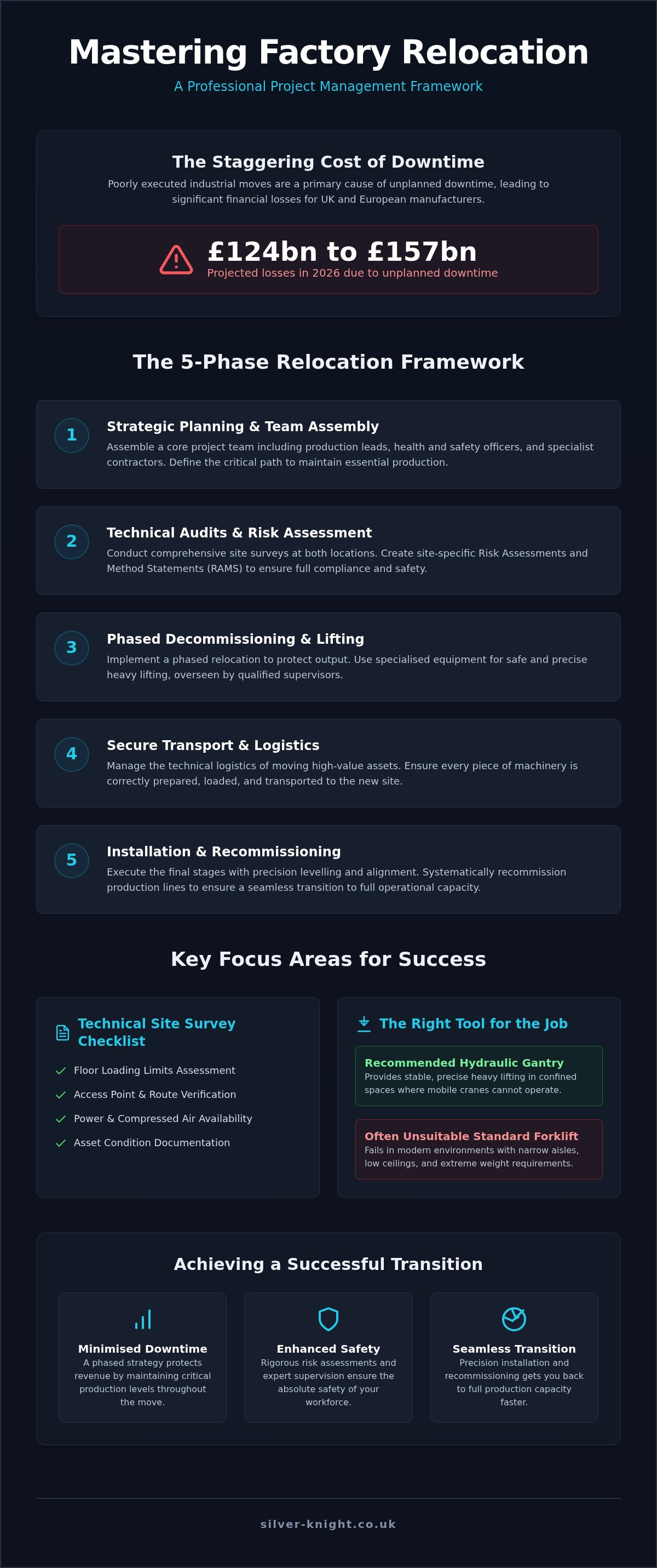
In 2026, manufacturers across the UK and Europe are projected to lose between £124 billion and £157 billion due to unplanned downtime. A significant portion of this loss stems from poorly executed industrial moves where equipment sits idle or arrives damaged. It's why effective factory relocation project management is now seen as a specialised engineering discipline rather than just a logistics task. If you're feeling the pressure of an upcoming move, you aren't alone. Most managers fear the spiral of hidden costs and the stress of coordinating complex internal teams alongside multiple external contractors.
We understand that your primary goal is to maintain production continuity whilst ensuring the absolute safety of your workforce. This guide offers a professional framework designed to help you master these complexities and protect your high value assets. You'll learn how to create a timeline that your team actually meets, navigate current health and safety regulations, and ensure every piece of machinery is recommissioned to full capacity from the moment you open the new doors. We'll cover everything from initial decommissioning to the technical precision required for final installation at your new site.
Key Takeaways
- Learn how to assemble a specialist project team and conduct technical site surveys to assess floor loading limits before any machinery is moved.
- Discover how to use specialised equipment like hydraulic gantry systems to handle heavy lifting safely within the restricted footprints of modern industrial facilities.
- Master the essentials of factory relocation project management by developing site specific Risk Assessments and Method Statements that comply with current safety regulations.
- Understand the benefits of a phased relocation strategy to maintain production levels and protect your revenue whilst the move is in progress.
- Gain insights into the final stages of a move, including the precision levelling and systematic recommissioning of production lines for a seamless transition.
To ensure your project stays on track and within budget, consider working with a team that has over 180 years of collective experience. Explore our comprehensive industrial moving solutions to learn more.
Developing a Strategic Framework for Industrial Moves
Success in factory relocation project management relies on more than just moving equipment from one postcode to another. It's a discipline rooted in the principles of industrial engineering, where every variable is calculated to maximise efficiency and eliminate waste. You must first assemble a core project team that bridges the gap between internal operational knowledge and external technical skill. This team should include your production leads, health and safety officers, and specialist contractors who understand the mechanical nuances of your specific machinery.
To better understand the scale of these operations, watch this helpful video:
Establishing a realistic budget is the next hurdle for any manager. Many businesses underestimate the costs associated with the technical aspects of decommissioning and the subsequent recommissioning at the new site. By identifying the critical path early, you can determine which production lines must stay active until the final moment. This prevents a total shutdown that could otherwise lead to significant revenue loss or broken customer contracts.
Conducting Comprehensive Site Audits
A technical site survey is the most powerful management tool at your disposal for risk mitigation. You need to assess the floor loading limits at both the departure and arrival facilities to ensure the ground can support heavy machinery without structural failure. Access points are equally critical; what worked for a forklift five years ago might not accommodate a modern hydraulic gantry. Checking for high voltage power and compressed air availability ensures your transition is smooth. Documenting the existing condition of every asset creates a baseline for integrity, protecting you against disputes later in the process.
Defining the Project Scope and Timeline
A phased plan is often the safest way to protect your output. Instead of moving the entire facility at once, you can transition departments in logical sequences that allow for testing and validation. It's essential to build contingency periods into your schedule. Unexpected technical challenges, such as a seized component or a damaged sensor, shouldn't derail the entire move. Integrating a professional factory relocation service into your timeline allows you to delegate the technical burden. This ensures that whilst the physical move is happening, your internal team can focus on maintaining customer commitments. Using a proven factory relocation service also provides the specialised equipment needed to navigate tight spaces without compromising safety.
Successful factory relocation project management requires a partner with the right technical kit and experience. You can see how a professional team handles these challenges by visiting Silver Knight.
Managing Complex Lifting and Technical Logistics
Selecting the correct equipment for your factory's specific footprint is a critical management decision. Standard forklifts often fail in modern industrial environments where aisles are narrow and ceilings are low. Instead, managers must look toward hydraulic gantry systems. These systems allow for heavy lifting in confined spaces where a mobile crane simply cannot reach. They provide a stable and precise lift for machines weighing hundreds of tonnes. Managing these technical logistics is a core pillar of factory relocation project management. Every lifting operation must be overseen by a qualified banksman or supervisor. This individual ensures that all personnel remain clear of the lifting zone and that the load remains balanced at all times. This level of oversight is essential for maintaining site safety and ensuring the project remains on schedule.
Selecting Specialist Lifting Equipment
For many moves, Versa-Lift hire is the ideal solution. These machines are designed to move heavy loads through tight aisles whilst maintaining a compact footprint. When you face massive machinery and have no access for overhead cranes, jack and slide systems provide a controlled method for lateral movement across factory floors. This equipment allows for the positioning of heavy assets with millimetre precision. You can view our full range of technical capabilities on the our equipment page to see which tools best fit your site requirements.
Coordinating Heavy Haulage and Transport
Heavy haulage is a specialised logistics branch that focuses on the movement of oversized or overweight loads that exceed standard transport limits. Coordinating this requires meticulous route planning to avoid height and weight restrictions on national roads. A single bridge with a low height limit can derail a project timeline if the route hasn't been surveyed in advance. Managers should organise low loaders and specialised trailers that match the specific dimensions of their equipment. If your move involves crossing borders, you must also manage the complexities of international machinery transport. This includes professional export packing using heat treated timber and moisture barriers to protect assets from sea air or vibration during transit. Effective factory relocation project management ensures that these high value assets are handled with precision. If you're unsure about the logistics of your upcoming move, it's often best to speak with a technical specialist who can review your requirements.
To ensure your industrial move meets all legal safety requirements, it's vital to partner with a specialist who understands the latest regulations. You can find out more about our professional standards by visiting the Silver Knight website.
Ensuring Rigorous Health and Safety Standards
Safety is the most critical element of factory relocation project management. In 2026, the Health and Safety Executive is conducting around 14,000 proactive inspections with a sharp focus on workplace transport and falls from height. These are high risk areas during any industrial move. To protect your workforce and satisfy regulators, you must implement strict exclusion zones whilst heavy assets are in motion. Only essential personnel should be permitted near lifting operations, and these zones must be clearly marked with physical barriers. Organising regular safety briefings is equally important. These daily "toolbox talks" ensure every team member understands their specific role and the hazards present on that particular day. By maintaining this level of rigour, you reduce the likelihood of musculoskeletal disorders or accidents that could halt your project and lead to costly legal complications.
The Role of RAMS in Project Management
A site specific Risk Assessment and Method Statement (RAMS) is your primary tool for managing site safety. The Method Statement acts as a step by step guide for the move, detailing exactly how each machine will be disconnected, lifted, and transported. Before the first bolt is turned, you must identify every potential hazard, from overhead power lines to uneven floor surfaces. This process aligns with the Construction (Design and Management) Regulations 2015, which serve as a mandatory framework for relocation projects. It's also your responsibility to verify that all external contractors provide up to date insurance and professional certifications. This documentation provides peace of mind that the individuals handling your machinery are competent and fully covered should an incident occur.
Compliance with Industrial Safety Standards
All equipment used during the move must comply with the Lifting Operations and Lifting Equipment Regulations (LOLER) and the Provision and Use of Work Equipment Regulations (PUWER). These standards ensure that every gantry, jack, and sling is fit for purpose and has undergone regular inspections. During a factory clearance, professional movers must also manage hazardous materials such as industrial oils, coolants, or residual chemicals. Handling these substances requires specific knowledge to prevent environmental contamination and ensure compliance with the Health and Safety at Work etc. Act 1974. Drawing on over 180 years of collective industry experience allows a project team to anticipate these risks before they become issues. This deep technical knowledge is often what separates a successful relocation from one plagued by safety incidents and regulatory delays.
Minimising the financial impact of an industrial move is the top priority for any operations manager. Learn how a professional team can help you maintain production by visiting our industrial relocation page.
Strategies for Minimising Downtime and Protecting Revenue
Effective factory relocation project management must address the projected £124 billion to £157 billion in downtime losses that manufacturers face in 2026. A phased relocation is one of the most successful ways to combat this financial risk. By moving departments in a logical sequence, you can keep part of your production line active at the current site whilst the new facility is being commissioned. This approach requires the new site to be prepared well in advance. All utility connections, such as high voltage power and compressed air, must be ready for immediate use before the first machine arrives. Using machinery storage acts as a vital buffer during this transition. If the new site isn't ready for a specific asset, it can be held securely rather than blocking the flow of the move. Organising moves during out of hours periods or over weekends also prevents the relocation from disrupting your daily operations.
Protecting the Production Schedule
You should coordinate with your manufacturing team to build up a significant stock surplus before the move begins. This provides a necessary safety net if the recommissioning process takes longer than initially expected. It's best to prioritise the movement order so that critical machinery is the last to leave the old site and the first to arrive at the new one. Professional machinery haulage ensures that these high priority assets are moved with speed and precision, significantly reducing the time they spend in transit and out of production.
Managing Personnel and Internal Communication
A major relocation often causes uncertainty amongst the workforce. The Management of Health and Safety at Work Regulations 1999 require employers to manage psychosocial risks like stress, which can peak during periods of significant change. Keeping your staff informed with regular updates is essential for maintaining morale and reducing anxiety. You can also assign specific roles to internal staff, such as acting as site guides or technical advisors for the relocation team, to improve efficiency. Developing a clear communication chain ensures that any progress or unexpected delays are reported instantly to the project lead. If you are ready to begin planning your move, you can request a technical site survey to identify potential bottlenecks early.
To ensure your production line is ready for operation on day one, consult with the experts at Silver Knight. Visit our homepage for more information.
Delivering a Seamless Transition to Full Production
The final stage of factory relocation project management is often where the most critical technical work happens. Once assets are physically inside the new facility, the focus shifts to precision positioning and levelling. Even a slight misalignment in heavy machinery can lead to premature wear or catastrophic failure during high speed operation. Managers must supervise this process closely, ensuring that every machine is anchored according to the manufacturer's specifications. A final walkthrough is essential before any power is restored. This check ensures that all safety guards, which may have been removed for transport, are correctly replaced and that the work area is clear of debris. Providing a comprehensive documentation pack, including updated site layouts and electrical diagrams, marks the formal end of the physical move.
Technical Recommissioning and Testing
Recommissioning is a systematic process that verifies every machine is calibrated to its original specifications. Specialists must verify all electrical and mechanical connections to ensure they were not loosened by vibration during the transport phase. It's common to find minor issues during this stage, so checking for any transit damage is a priority. Testing should be conducted under load to simulate real production conditions. This ensures that the entire line, rather than just individual machines, functions as a cohesive unit. By following this structured approach, you can be confident that your facility is safe and productive from the moment the first shift begins.
Final Asset Handover and Project Review
The project concludes with a formal sign off for each department once it reaches full operational capacity. This is the time to review the entire relocation against the original timeline and budget established in the strategic framework. Analysing any deviations from the plan provides valuable data for future facility management. If your move has highlighted a need for further upgrades, you might explore additional machinery installation options to further optimise your new layout. This final review ensures that all stakeholders are satisfied and that the technical burden has been successfully managed, allowing your team to focus on hitting their new production targets.
For expert assistance with your industrial move, explore our specialist factory relocation services today.
Achieving a Seamless Factory Transition
Successful factory relocation project management is a complex engineering feat that requires meticulous planning and technical expertise. By establishing a robust strategic framework and prioritising rigorous health and safety standards, you can protect your assets and maintain production continuity. We've explored how specialist equipment and phased timelines are essential for reducing the risk of costly downtime. Silver Knight brings over 180 years of collective industry experience to every project. With nationwide UK coverage and global reach, our team provides the technical support needed to handle even the most challenging industrial moves. We utilise specialist hydraulic lifting systems and advanced gantry technology to solve restricted access problems and ensure your machinery is positioned with millimetre precision.
Don't let the technical burden of a relocation distract you from your core production goals. Partnering with a specialist allows you to focus on your business whilst we handle the heavy lifting. Contact Silver Knight for a professional factory relocation quote to start planning your move today. We look forward to helping you reach full production capacity at your new facility.
Frequently Asked Questions
How long does a typical factory relocation project take?
The duration of a factory relocation varies significantly based on the number of production lines and the distance between sites. A small move involving a few machines might take two weeks, whilst a full scale facility transition can span several months. Meticulous planning is the deciding factor in these timelines. Effective factory relocation project management ensures that every stage, from decommissioning to recommissioning, is scheduled to minimise disruption to your output.
What are the main risks in industrial project management?
The primary risks involve unplanned production downtime and potential damage to high value assets during transit. Safety incidents also pose a major threat to project success. Without a professional framework, businesses often face hidden costs from poorly coordinated contractors or structural issues at the new site. Managing these risks requires technical site surveys and the use of specialised lifting equipment like hydraulic gantries to ensure asset integrity throughout the move.
Do I need a specialist for machinery decommissioning?
Hiring a specialist for decommissioning is essential to protect your machinery and ensure a safe working environment. Professional movers understand the complex electrical and mechanical disconnections required for industrial plant. This process involves more than just unplugging equipment; it requires careful documentation and the securing of internal components for transport. Using a specialist ensures that your assets are ready for a seamless recommissioning phase at the new facility without risking mechanical failure.
How can I reduce downtime during a factory move?
You can reduce downtime by implementing a phased relocation strategy that keeps part of your production active whilst other sections move. Building up a stock surplus before the move starts provides a buffer for your customers. It's also vital to prepare the new site with all necessary utility connections in advance. Coordinating out of hours moves can further protect your daily operations and ensure that critical machinery is the first to be recommissioned.
What insurance is required for heavy machinery relocation?
Comprehensive insurance is a mandatory requirement for moving industrial assets. This typically includes Goods in Transit insurance to cover your machinery during the haulage phase and Public Liability insurance to protect against site incidents. You should also verify that your contractors hold professional indemnity and employer liability cover. Always check that the insurance limits match the full replacement value of your equipment to avoid financial exposure in the event of an accident.
What is included in a technical site survey?
A technical site survey includes a detailed assessment of floor loading limits and access points at both the departure and arrival facilities. Specialists check for overhead obstructions and evaluate the suitability of utility connections such as high voltage power. This survey identifies potential bottlenecks before they impact your timeline. It also documents the existing condition of your machinery, providing a vital baseline for asset integrity throughout the factory relocation project management process.
How do you move machinery with restricted access?
Moving machinery in confined spaces requires specialised lifting gear like hydraulic gantry systems and Versa-Lifts. These tools are designed to lift and position heavy loads where standard cranes cannot operate due to low ceilings or narrow aisles. For extremely tight footprints, jack and slide systems allow for precise lateral movement across the factory floor. These technical solutions enable the safe handling of massive equipment without the need for major structural alterations to your building.
What are the legal requirements for lifting equipment in the UK?
In the UK, all lifting operations must comply with the Lifting Operations and Lifting Equipment Regulations 1998 (LOLER). This requires that equipment is fit for purpose, marked with its safe working load, and subject to regular thorough examinations. Additionally, the Provision and Use of Work Equipment Regulations (PUWER) ensure that machinery is safe to use and maintained correctly. Compliance with these standards is a core legal duty for any business undertaking an industrial move.

Article by
David Ashby
I'm the Managing Director of Silver Knight Haulage & Machinery Ltd. Silver Knight Ltd is a family-run firm established in the West Midlands in 2005, with the aim of providing a cost-effective, yet professional, service to businesses for the removal, transportation, and installation of machinery, plant, and equipment here in the UK and worldwide. Between us, the Silver Knight workforce has over 50 years of experience with machinery and its operation.
Disclaimer
This article is intended for informational purposes only. Please ensure you seek expert advice or carry out your own research to confirm the information is suitable for your specific needs.