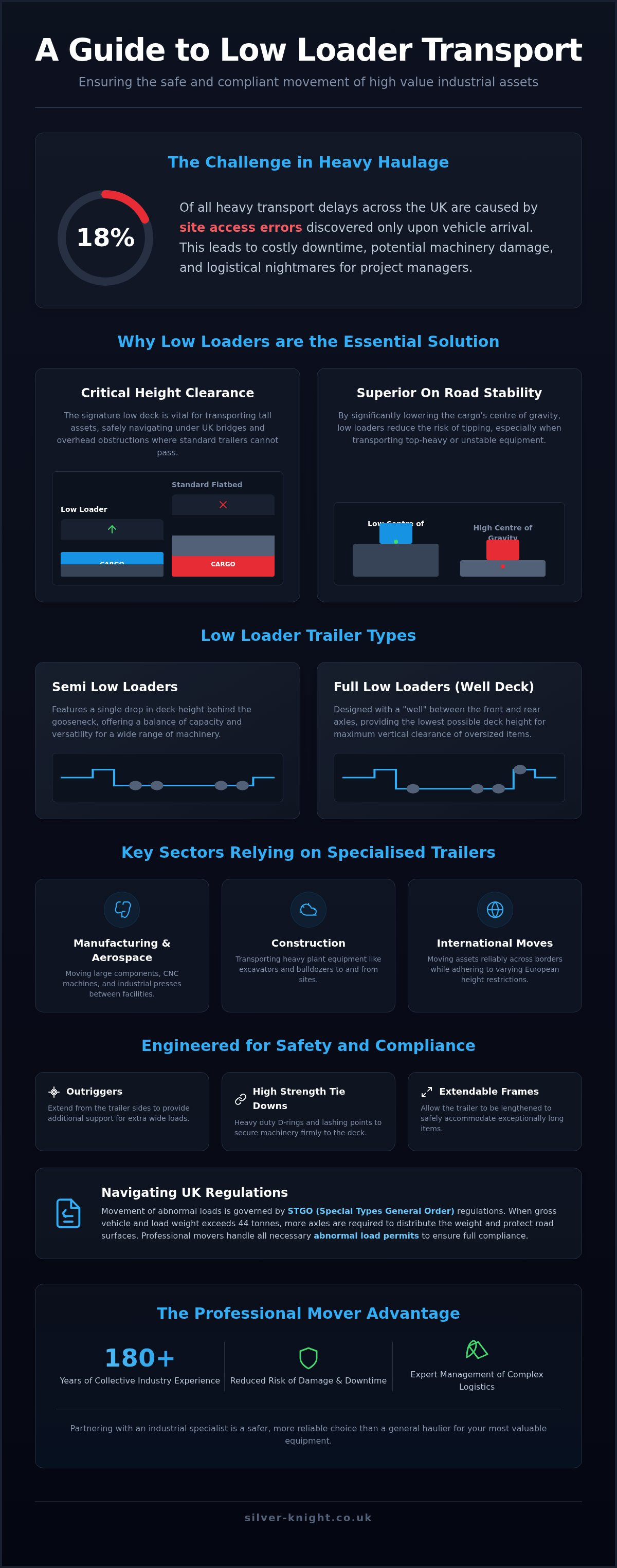
Did you know that 18% of heavy transport delays across the UK are caused by site access errors that only come to light once the vehicle arrives? It is a frustrating statistic for any project manager who is already balancing the fear of machinery damage with the confusion of abnormal load permits. When you are moving high value assets, the stakes are incredibly high. Choosing professional low loader transport services is not just about hiring a haulage firm; it is about securing a partner who understands the intricate logistics of factory relocation and heavy plant movement.
We understand that you need a move that is fully insured and completed with minimal downtime. In this article, you will discover how specialised equipment and expert planning ensure your machinery arrives safely and in full compliance with the latest 2026 transport regulations. We will look at the essential steps for managing site access, navigating STGO categories, and why a specialist industrial mover is always a safer choice than a general haulier for your most valuable equipment.
Key Takeaways
- Learn why low deck heights are critical for moving tall industrial assets safely under UK bridges and overhead obstructions.
- Understand the differences between semi and full low loader transport services to ensure you select the right trailer for your machinery weight and dimensions.
- Gain clarity on STGO regulations and abnormal load permits to avoid legal delays and ensure your move remains fully compliant.
- Discover the essential steps for decommissioning and preparing your plant equipment for a seamless transition from site to site.
- Find out how partnering with an industrial specialist with over 180 years of collective industry experience reduces the risk of damage and costly downtime.
If you require assistance with your next industrial move, you can access professional machinery moving and haulage from the experts at Silver Knight.
Understanding low loader transport services for heavy industry
Low loader transport services are the backbone of the heavy industrial sector. These specialised trailers are designed with a deck that sits very close to the road surface, often featuring a distinct drop in height behind the tractor unit. This unique physical design is essential for two main reasons; height clearance and stability. By lowering the centre of gravity, these vehicles can carry exceptionally tall or heavy items that would otherwise strike bridges or overhead cables if placed on a standard flatbed. Understanding low loader transport involves recognising that these trailers provide the necessary clearance for abnormal loads which exceed standard dimensions. By choosing professional low loader transport services, companies ensure their cargo is handled by specialists who understand these spatial constraints.
Standard flatbed trailers have a uniform height that is often too high for industrial machinery. In contrast, the low loader allows for the transport of items that would be physically impossible to move on other trailer types. This distinction is vital for safety. A lower deck significantly reduces the risk of the vehicle tipping during transit, especially when moving top-heavy equipment. This makes them the preferred choice for heavy haulage tasks that require maximum stability on the road.
The role of low loaders in modern industrial haulage
Modern industrial operations require high levels of precision. Moving high value assets like CNC machines or industrial presses requires more than just a large truck. Low loaders offer a much shallower loading angle compared to other trailers. This is particularly important for machinery with low ground clearance that could be damaged if forced up a steep ramp. For non mobile equipment, these trailers often come equipped with heavy duty winches and hydraulic ramps. These features allow for controlled, steady loading without the need for additional cranes at every stage of the journey.
Key sectors that rely on specialised trailers
Several industries depend on these specialised haulage solutions to maintain their operations. In the manufacturing and aerospace sectors, large components often need to be moved between facilities or to final assembly points. The construction industry also relies heavily on these trailers for plant equipment transport, moving excavators and bulldozers that are too slow or heavy for public roads. Beyond domestic moves, these trailers are a staple of international machinery transport. They provide a reliable way to move assets across borders whilst adhering to varying height restrictions found throughout Europe.
To ensure your machinery is moved using the most appropriate vehicle, you can book professional low loader transport through our experienced team.
Technical features and types of low loader trailers
Professional low loader transport services rely on a variety of trailer designs to meet specific industrial needs. The most common distinction is between semi low loaders and full low loaders. Semi low loaders feature a single drop deck, whilst full low loaders have a lower middle section, or "well", situated between the front swan neck and the rear wheels. This well allows for the lowest possible deck height, which is vital when moving oversized boilers or industrial presses that require maximum vertical clearance.
Axle configuration is another critical technical aspect of low loader transport services. As the gross weight of the machinery and vehicle exceeds 44 tonnes, more axles are required to distribute the load across the road surface. This prevents damage to the UK road network and ensures compliance with STGO regulations. Safety features are integrated into these trailers to protect the cargo and other road users. These include:
- Outriggers which extend from the sides of the trailer to provide additional support for wide loads.
- High strength tie down points such as heavy duty D-rings to ensure the machinery is securely lashed to the deck.
- Extendable frames that allow the trailer to be lengthened to accommodate exceptionally long industrial components.
Semi low loaders versus tandem axle trailers
Choosing between a semi low loader and a tandem axle trailer often depends on the specific clearance required for the journey. Tandem axle trailers are frequently used for standard loads, but they lack the low profile needed for tall factory equipment. Semi low loaders provide a lower loading height, making them much more versatile for a range of machinery moving tasks. When dealing with complex or heavy items, using specialised heavy haulage equipment ensures that the trailer is perfectly matched to the load requirements.
The importance of hydraulic ramps and winches
Loading machinery safely is just as important as the journey itself. Hydraulic ramps are essential for tracked or wheeled plant, providing a stable and shallow gradient for driving equipment onto the deck. For machinery that cannot move under its own power, such as during a factory decommissioning, heavy duty winches are used. These winches allow for the precise and controlled movement of dead weight onto the trailer. This level of control is necessary to prevent sudden shifts that could damage the machine or the trailer. If you are unsure which trailer type fits your project, you can contact our logistics team for tailored advice.
If you are planning a complex machinery move, you can rely on the expert heavy haulage and logistics team at Silver Knight to manage every detail.
Navigating the logistics of abnormal load transport
Under UK law, a load is classified as abnormal if it exceeds standard dimensions or weights. This typically applies to any vehicle with a width over 2.9 metres, a rigid length over 18.65 metres, or a gross weight exceeding 44 tonnes. When these thresholds are crossed, low loader transport services must operate under the Special Types General Order (STGO). These regulations are divided into three distinct categories based on the total weight of the vehicle and its cargo. Category 3 is reserved for the heaviest assets, requiring specific axle configurations to protect the integrity of the road surface.
Safety during transit is managed through the use of escort vehicles and pilot cars. These units are essential for wider loads as they warn other motorists and assist the driver in navigating tight junctions or narrow lanes. Beyond the physical move, comprehensive insurance is a non negotiable requirement for high value industrial assets. It is vital to check your coverage limits before a move. As of January 2026, the standard RHA Conditions of Carriage limit liability to £1,300 per tonne. For precision CNC machines or aerospace components, this standard limit is rarely enough to cover the full replacement value of the equipment.
Legal requirements for wide and heavy loads
Moving abnormal loads requires strict adherence to notification periods. You should allow between two and ten days for local councils and highway authorities to process the necessary notifications. For projects involving international machinery transport, the regulatory landscape is even more complex. Since July 2026, all newly registered goods vehicles over 2.5 tonnes used for international hire and reward must be fitted with smart tachograph version 2. Ensuring your transport partner is compliant with these 2026 updates is essential for avoiding fines and delays at the border.
Route planning and site surveys for safe passage
Precision route planning is what separates a successful move from a logistics failure. Data shows that 18% of heavy transport delays in the UK are caused by site access errors that are only identified when the vehicle arrives. A technical site survey identifies these obstacles in advance. Engineers assess bridge capacities, height restrictions, and the radius of tight corners. In many cases, coordination with local authorities is required to temporarily remove street furniture such as bollards or signs. This proactive approach ensures that low loader transport services can proceed without unexpected stoppages that lead to costly downtime.
If you are preparing for a major factory move, you can find comprehensive support through our machinery installation and relocation services.
How to prepare machinery for transport on a low loader
Preparation is the foundation of any successful move. Before the low loader transport services arrive on site, you must have precise measurements of your assets. Guesswork is the enemy of logistics. Even a few centimetres of error in height can be the difference between a smooth journey and a bridge strike. When you provide dimensions, ensure you include every protrusion, such as control panels, exhaust stacks, or peripheral guarding. Following a structured preparation programme ensures nothing is missed.
- Step 1; Technical Survey. Confirm the weight and dimensions of every item.
- Step 2; Decommissioning. Properly disconnect power, air, and fluid lines.
- Step 3; Dismantling. Remove components that exceed height or width limits.
- Step 4; Securing. Lock internal moving parts to prevent shifting during transit.
- Step 5; Packing. Apply protective wrapping or export packing for long distance moves.
Accurate weight data is equally vital for ensuring the trailer axle configurations are set correctly. If you are moving equipment internationally, consider high quality export packing. This protects sensitive electronics from moisture and salt air during sea freight or long distance road haulage. To get the best results, you should request a site survey before finalising your transport plans.
Decommissioning and securing your equipment
Moving a machine that is still connected to site services is incredibly dangerous. Professional decommissioning ensures all stored energy is dissipated and fluids are drained. If a machine is too tall for the planned route, you might need machinery dismantle services to reduce the overall load height. Once the machine is ready, internal components must be secured. Loose parts can shift under the vibration of the road, causing internal damage that is often only discovered during recommissioning. Using heavy duty lashing and custom bracing ensures the asset remains stationary on the trailer deck.
Ensuring site access for large haulage vehicles
Large trailers require significant space to manoeuvre safely. You must check that your site has the necessary turning circles and that the ground load bearing capacity is sufficient for a loaded vehicle. Clear communication between your site manager and the haulier prevents the site access errors that cause 18% of UK transport delays. If your facility has restricted space or low ceilings, using a Versa-Lift allows for precise positioning in areas where a standard crane or large forklift simply cannot operate.
For a seamless transition between sites, you can book professional machinery relocation services with the team at Silver Knight.
Professional machinery moving and haulage solutions
Silver Knight is a specialist in turnkey machinery relocation. The team possesses over 180 years of collective industry experience, providing a level of expertise that is difficult to find elsewhere. This family owned and operated business, established in 1996, provides a personalised service that larger corporations often struggle to match. By choosing a partner that manages both the lifting and the road transit, you benefit from a single point of contact. This reduces the risk of communication breakdowns and ensures that the low loader transport services are perfectly synchronised with the arrival of the installation crew.
Integrating transport with machinery installation
Haulage is merely one link in the factory relocation chain. Once the trailer arrives at the destination, the challenge of offloading and positioning begins. A combined machinery haulage and relocation service provides the equipment needed for these final stages. This includes hydraulic gantries for heavy lifting in tight spaces and jack and slide systems for moving machines where a forklift cannot reach. This integrated approach ensures that your assets move seamlessly from the trailer deck to their final operational position without the need for multiple contractors.
The value of industrial experience in heavy haulage
General hauliers often lack the technical skills and specialised equipment required for industrial moves. Whilst a standard transport firm might move a container with ease, they may not understand the sensitivity of a precision lathe or the complexities of a production line. Silver Knight manages complex projects from the initial planning stages through to final recommissioning. This deep understanding of industrial assets provides peace of mind for site managers who cannot afford damaged equipment or extended downtime. Using professional low loader transport services from an industrial specialist ensures that every lashing point and weight distribution calculation is handled by someone who understands the machine, not just the truck.
If you are ready to begin your next project, you can access professional machinery moving and haulage from the specialists at Silver Knight.
Securing the future of your industrial assets
Choosing the right low loader transport services involves more than just picking a vehicle. It requires a deep understanding of abnormal load regulations, precise route planning, and technical site surveys. By integrating decommissioning with specialised haulage, you reduce the risk of site access errors and ensure your machinery is ready for immediate installation. The technical features of full low loaders and semi low loaders provide the necessary clearance and stability to move even the most challenging industrial components across the UK or internationally.
Silver Knight provides a fully managed contract lifting and haulage service that covers every detail from planning to recommissioning. With over 180 years of collective industry experience, our family run business ensures your high value assets are handled with the care they deserve. Whether you are moving a single CNC machine or relocating an entire factory, we provide the peace of mind that comes from professional expertise. Contact our expert team for a bespoke machinery transport quote and let us help you move your business forward safely.
Frequently Asked Questions
What is the maximum weight a low loader can carry in the UK?
A standard low loader can usually carry a gross vehicle weight of up to 44 tonnes on UK roads without special STGO classifications. For heavier industrial machinery, specialised trailers operate under STGO rules which allow for much higher limits. These categories range from 50 tonnes up to 150 tonnes depending on the specific trailer and tractor unit configuration. It's essential to check the exact weight of your equipment to ensure the correct vehicle is used.
Do I need a special permit for low loader transport services?
You only need a special permit if your machinery exceeds standard dimensions or weight limits for UK roads. These are known as abnormal loads and require notification to the police and highway authorities. Our low loader transport services include managing these notifications for you. We handle the paperwork for wide, tall, or heavy items to ensure your move stays legal. This process usually involves providing at least two clear days of notice before the journey.
How does a semi low loader differ from a standard flatbed trailer?
A semi low loader differs from a flatbed because it has a lower deck height designed to carry taller items. Whilst a flatbed is a straight platform, a semi low loader features a step that drops the trailer height closer to the ground. This design makes it easier to transport tall industrial machines without hitting overhead obstacles. Most semi low loaders also feature ramps, which allows mobile machinery to be driven directly onto the trailer deck.
Can low loader trailers carry non mobile or broken machinery?
Yes, low loader trailers can definitely carry non mobile or broken machinery. If the equipment cannot be driven onto the trailer, we use specialised loading methods such as winches or external lifting equipment. Our team can provide forklift hire or crane hire to safely place broken items onto the deck. This flexibility ensures that even decommissioned or damaged plant equipment can be moved between sites or to a storage facility without any issues.
What is the typical deck height of a low loader truck?
The typical deck height of a true low loader trailer is usually between 300mm and 600mm from the ground. This incredibly low profile is specifically designed to provide maximum clearance for very tall industrial equipment. By keeping the load close to the road surface, hauliers can navigate under low bridges and power lines that would block a standard trailer. Semi low loaders sit slightly higher, typically around 800mm to 900mm above the road surface.
How much notice is required for an abnormal load move?
Most abnormal load moves require at least two clear working days of notice to be given to the relevant authorities. For very large or heavy machinery that falls into higher STGO categories, this notice period can increase to five or more days. This time allows the police and highway agencies to check the proposed route for potential obstructions or roadworks. We recommend booking your low loader transport services well in advance to ensure all legal notifications are completed.
What information do I need to provide for a haulage quote?
To provide an accurate haulage quote, you need to provide the exact dimensions and weight of the machinery. This includes the length, width, and total height of the item once it's loaded. You should also share the collection and delivery locations, noting any access restrictions like narrow gates or soft ground. Knowing if the machine is mobile or requires a crane for loading helps us determine the right equipment and staff for the job.
Are my industrial machines insured during low loader transit?
Your industrial machines are covered by goods in transit insurance during the entire journey. As specialist machinery movers, we maintain comprehensive insurance policies that are much higher than those held by general hauliers. This provides peace of mind that your valuable assets are protected against damage or loss whilst on the road. We can provide specific details of our cover levels upon request to ensure they meet the requirements of your high value equipment.

Article by
David Ashby
I'm the Managing Director of Silver Knight Haulage & Machinery Ltd. Silver Knight Ltd is a family-run firm established in the West Midlands in 2005, with the aim of providing a cost-effective, yet professional, service to businesses for the removal, transportation, and installation of machinery, plant, and equipment here in the UK and worldwide. Between us, the Silver Knight workforce has over 50 years of experience with machinery and its operation.
Disclaimer
This article is intended for informational purposes only. Please ensure you seek expert advice or carry out your own research to confirm the information is suitable for your specific needs.