Could the cheaper quote for your machinery move actually be the most expensive mistake your business ever makes? When you're tasked with shifting heavy industrial kit, the pressure is immense. You're likely weighing up the risks of crane hire vs contract lifting whilst worrying about damaging expensive factory floors or the safety of your team. It's a high-stakes environment where a single oversight in planning can lead to significant delays or, even worse, a serious breach of health and safety law.
We understand that the legalities of lifting are often the biggest source of confusion for site managers. This guide will help you unpick those choices, ensuring you stay on the right side of LOLER regulations whilst protecting your valuable assets. You'll learn how to select the correct service for complex relocations and how to match crane specifications to restricted industrial spaces. We will clarify your legal responsibilities and show you how to achieve a seamless relocation with minimal downtime for your operations.
Key Takeaways
- Understand the critical differences between crane hire vs contract lifting to determine who carries the legal responsibility for insurance and planning.
- Ensure full compliance with LOLER and BS 7121 standards by following professional lift plans and safety protocols.
- Discover how to accurately match crane capacity and reach to your specific industrial machinery to avoid site delays.
- Learn why a comprehensive technical site survey is essential for identifying floor load limits and restricted access points.
- Gain confidence in managing complex plant relocations by choosing specialised equipment like hydraulic gantries for tight spaces.
Find out more about our professional crane hire and lifting services for your next project.
Understanding Crane Hire for Industrial Projects
Professional crane hire involves the provision of specialised lifting equipment designed to move heavy industrial assets safely. In a factory setting, this goes far beyond simply picking up a pallet. It requires precision engineering to handle multimillion pound machines that cannot be tilted or jolted. While many sites rely on standard forklifts for daily tasks, these machines often lack the capacity or the reach needed for heavy plant relocation. A forklift might struggle with the sheer weight of a CNC machine or the physical dimensions of a large industrial boiler.
Safety is governed by the Lifting Operations and Lifting Equipment Regulations 1998, commonly known as LOLER. These regulations mandate that every lift is planned, supervised, and carried out in a safe manner. When deciding between crane hire vs contract lifting, understanding these legal obligations is the first step. Professional lifting services are available as a national resource for all UK industries, serving sectors from automotive manufacturing to pharmaceutical plants across the country.
The Role of Cranes in Factory Relocation
Industrial buildings aren't always designed for easy equipment removal. Often, the only way to extract a large machine is through roof apertures or from high level mezzanine floors. Cranes provide the vertical lift and horizontal reach that other equipment cannot match. By integrating lifting with heavy haulage, businesses can achieve a seamless transition from the factory floor to the transport vehicle. The synergy between precision lifting and heavy transport ensures that industrial projects remain on schedule and within budget.
Key Terminology for Industrial Lifting
Before hiring any equipment, you must understand the basic language used by lifting professionals. The Safe Working Load is the maximum weight that a piece of lifting equipment can safely carry without risk of failure. This figure is critical; exceeding it can lead to catastrophic accidents.
Another vital concept is the radius, which is the horizontal distance from the centre of the crane's rotation to the centre of the load. As the radius increases, the lifting capacity of the crane decreases. Finally, every lifting operation must have an Appointed Person. This individual is responsible for the planning and execution of the lift, ensuring that the choice between crane hire vs contract lifting aligns with the site's specific safety requirements. Using a Crane (machine) correctly depends entirely on these technical calculations.
Learn more about our specialised lifting services at Silver Knight
CPA Crane Hire versus Contract Lifting
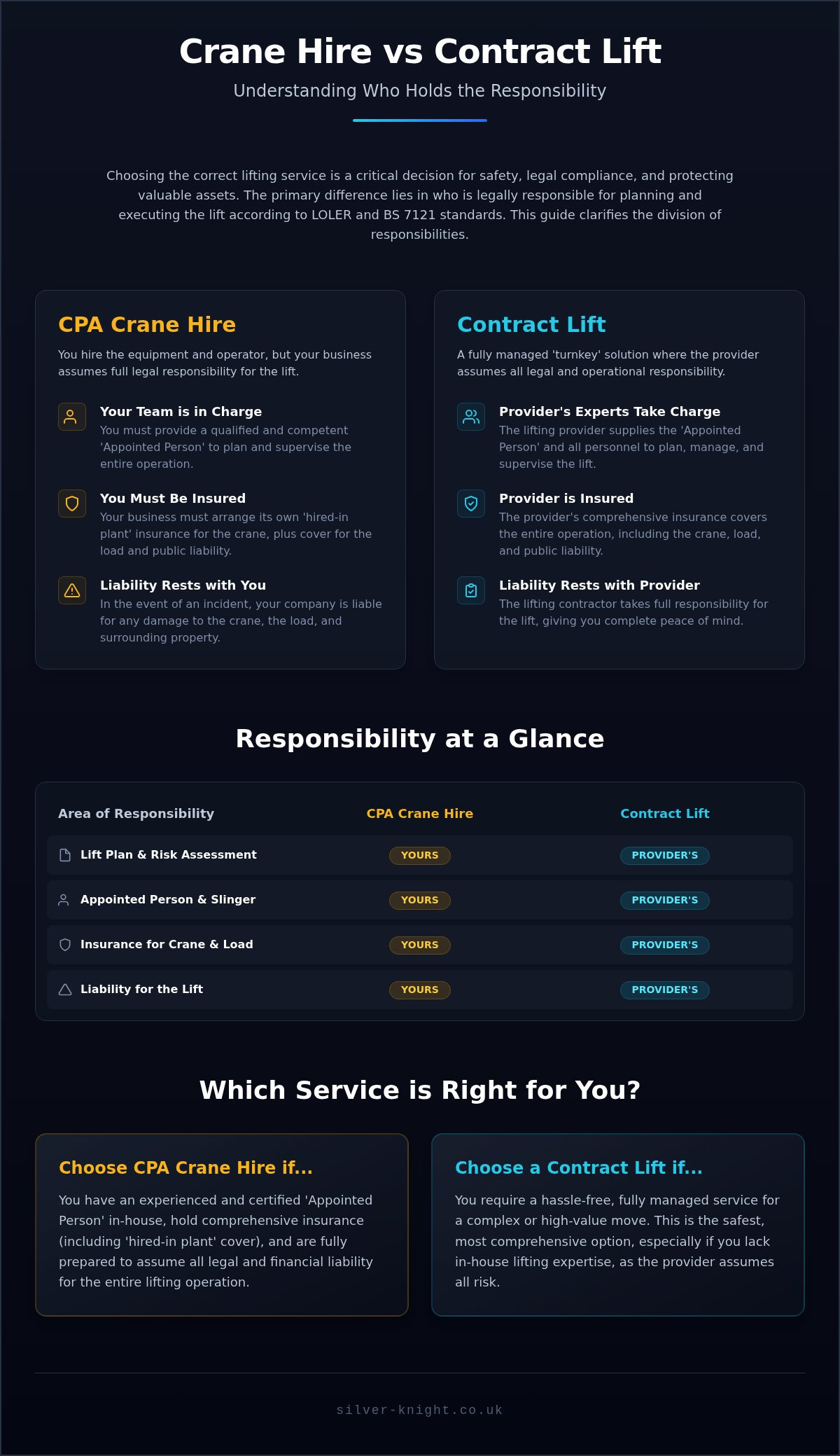
Deciding on the right framework for your project is essential for legal protection and operational success. The main difference in crane hire vs contract lifting comes down to who manages the lift and who holds the insurance. British Standard 7121 defines these two routes clearly to ensure safety across the UK lifting industry. While a standard hire might look simpler on paper, it places a heavy administrative and legal burden on your business that many factory managers are unprepared for.
Most industrial projects in the UK fall under the terms set by the Construction Plant-hire Association. These terms dictate that the user of the crane is responsible for the lift unless a specific contract lift agreement is in place. For complex machinery moves, where the value of the equipment is high and the site conditions are tight, the distinction between these two services is the difference between a controlled move and a significant financial risk.
Responsibilities under CPA Crane Hire
If you choose CPA hire, you're essentially renting a tool and a driver. Your business must provide a qualified Appointed Person who has the training to plan the lift according to LOLER standards. You also need to supply a Slinger Signaller to direct the crane operator. One of the biggest risks involves insurance; you're responsible for the crane from the moment it arrives on your site. This means you must have hired in plant cover to the full value of the crane, along with public liability and cover for the load itself. If a lift fails under these terms, your company is liable for the damage to the machine, the crane, and the factory floor.
Benefits of a Fully Managed Contract Lift
A contract lift removes these headaches by providing a turnkey solution. The provider takes full responsibility for the planning, supervision, and execution of the lift. They supply all the necessary personnel, including the Appointed Person and the Slinger. The provider also manages the insurance risk, covering both the crane and the load within the service price. For managers moving high value assets, this peace of mind is invaluable. The provider creates the detailed Risk Assessment and Method Statement, ensuring every potential hazard is accounted for before the crane even starts its engine. If you're unsure which path fits your project, you can speak with our team for advice.
Explore our full range of machinery moving equipment
Selecting the Right Crane for Heavy Machinery
Choosing the right machine depends on the weight and dimensions of your industrial plant. It is not just about the lift; it is about the reach and the environment. When comparing crane hire vs contract lifting, the choice of equipment often dictates the complexity of the lift plan. For outdoor factory yards or projects on uneven ground, all terrain cranes are essential. Their robust suspension and steering allow them to navigate gravel or unpaved areas that would stop a standard truck crane.
For smaller machinery or delivery tasks, lorry mounted cranes provide a cost effective solution. They combine transport and lifting in one vehicle, though they have lower weight capacities than dedicated mobile cranes. Regardless of the machine type, all equipment must comply with the Lifting Operations and Lifting Equipment Regulations (LOLER) to ensure the safety of the operators and the cargo.
Mobile Tower Cranes for Restricted Access
Industrial estates in the UK are often cramped. Mobile tower cranes are perfect for these environments because they offer exceptional vertical reach while maintaining a small footprint. Unlike standard telescopic cranes, they can lift over buildings and obstructions without needing a massive clearing. Their fast setup times mean they can be ready to work in under an hour, which is vital for minimising disruption to your business operations.
Specialised Equipment for Indoor Lifting
Sometimes, a traditional crane cannot enter a building due to low headroom. In these cases, hydraulic gantry systems are the superior choice. These systems can lift several hundred tonnes within a confined factory space. For moving heavy machinery across a concrete floor, Versa-Lifts offer the power of a crane with the manoeuvrability of a forklift. We often use jack and slide systems alongside traditional crane hire to achieve millimetre-perfect positioning. These tools allow us to slide a machine into its final location after the crane has placed it inside the building. To learn more about these options, you can read our guide on Specialised Lifting, Versa-Lift, Gantry, and Jack Systems. Selecting the right combination of tools is a key part of the crane hire vs contract lifting decision process.
Read our guide on factory relocation services for better planning
Essential Site Preparation for Safe Lifting
A successful lift begins long before the crane enters the factory gates. A technical site survey is the foundation of a safe operation, allowing the Appointed Person to evaluate the physical environment and identify hazards that are not visible on a standard site plan. Whether you are choosing crane hire vs contract lifting, the preparation of the site remains the responsibility of the host business unless specifically managed by the contractor. Skipping this step often leads to costly delays or dangerous equipment failures on the day of the move.
Ground stability is a primary concern for any industrial project. Industrial yards often have hidden voids or underground services, such as drainage pipes and gas mains, that could fail under the massive pressure exerted by a crane. To prevent the machine from sinking or tipping, engineers must use outrigger mats to spread the load across a larger surface area. You must also ensure clear access routes by removing overhead obstructions like power lines or factory signage. The path must be wide enough for the crane to manoeuvre without risk to existing structures or parked vehicles.
Preparing Risk Assessments and Method Statements
Every industrial lift requires a comprehensive set of Risk Assessments and Method Statements, commonly known as RAMS. These documents are a legal requirement for every lift. For a machinery move, the plan must detail the exact weight distribution and the centre of gravity of the asset. Because many machines are top heavy or asymmetrical, a generic lift plan is never sufficient. The site manager plays a vital role in approving these plans to ensure they align with the broader safety protocols of the factory. If you need help with this technical documentation, you can contact our team for expert support.
Coordinating with Personnel and Services
Safety on the day requires strict control of the working environment. You need to inform all staff about the operation and establish clear exclusion zones using physical barriers and marshals. In some cases, if the crane needs to operate on or over a public highway, you must organise road closures or special permits from the local authority well in advance. Coordination with decommissioning teams is also essential. All machines must be fully disconnected, drained of fluids, and ready for transport before the lifting crew begins their work. This prevents the crane from standing idle whilst waiting for basic mechanical tasks to be completed, which is a key factor when weighing up the costs of crane hire vs contract lifting for your project.
Contact Silver Knight for a comprehensive machinery moving quote
Professional Solutions for Complex Machinery Relocation
Selecting a partner for your machinery move requires more than just looking at a crane's lifting chart. Whilst general crane hire companies are excellent for construction sites, they often lack the technical understanding required for high-value industrial assets. A specialist machinery mover understands that a CNC machine or a delicate printing press cannot be treated like a standard steel beam. Silver Knight brings over 180 years of collective industry experience to every project. This depth of knowledge allows our team to solve complex problems, such as tight access or offset centres of gravity, before they become costly site delays.
We provide national coverage across the United Kingdom, offering a consistent level of service for industrial sectors including aerospace, automotive, and food production. When you are weighing up crane hire vs contract lifting, you need a partner who prioritises precision and safety above all else. Our commitment to these values ensures that your equipment is handled with the care it deserves, from the initial decommissioning through to the final installation. We don't just provide a crane; we provide a complete engineering solution tailored to your factory environment.
Integrating Lifting with Global Logistics
Lifting is often just one phase of a much larger journey, especially for businesses expanding into new markets. For projects involving international machinery transport, crane hire must be perfectly timed with global shipping schedules and port arrivals. By working with International Machine Movers, you benefit from a streamlined process where one provider manages the lifting, export packing, and haulage. This integrated approach significantly reduces the risk of damage during transit. It also ensures that all technical specifications and weights are correctly documented for shipping, which is vital for a smooth customs process.
The Silver Knight Advantage for Industrial Clients
We take pride in being a family-run business that offers national capabilities with a personal touch. This means you get the resources of a large firm with the accountability of a dedicated team that actually cares about your project outcome. We handle everything from a single machine lift to a full factory clearance, adapting our equipment and personnel to fit your specific needs. Choosing a partner who understands the true value of your industrial assets is the best way to ensure a successful relocation. Whether you need a simple crane hire vs contract lifting solution or a complex gantry move, we have the expertise to deliver on our promise of safety and efficiency.
Contact the team at Silver Knight for expert machinery moving advice.
Secure Your Industrial Machinery Relocation Today
Balancing site safety with operational speed requires a clear understanding of your legal duties and equipment needs. The choice between crane hire vs contract lifting defines your level of risk and determines who holds the insurance burden for your valuable assets. By ensuring your site is properly prepared with technical surveys and robust RAMS, you protect both your staff and your industrial plant from avoidable accidents and costly delays.
Silver Knight brings over 180 years of collective machinery moving experience to every project. We provide comprehensive contract lifting services managed by experts, offering national coverage for all UK industrial sectors. From the initial decommissioning of plant to the final precision installation, our team ensures a smooth transition with minimal downtime. Don't leave your factory relocation to chance; choose a partner who understands the engineering complexities of heavy lifting.
Request a technical site survey for your machinery move to ensure your next project is safe, compliant, and efficient. We look forward to helping you move your business forward with confidence.
Frequently Asked Questions
What is the difference between CPA hire and a contract lift?
CPA crane hire involves the customer taking responsibility for the lift plan, insurance, and supervision. The crane company provides the crane and operator only. In a contract lift, the crane company manages the entire process, including the Appointed Person, lift plan, and insurance. This choice between crane hire vs contract lifting depends on your in-house expertise and risk management preferences. It is a vital decision for factory relocations.
Do I need my own insurance for crane hire?
Yes, if you choose standard CPA crane hire, you must provide your own insurance cover for the crane, the operator, and the load being lifted. This includes hired in plant insurance and public liability. Under a contract lift arrangement, the crane company typically provides this insurance as part of the service package, which reduces the administrative burden on your business during industrial projects and machinery moves throughout the UK.
How much does it cost to hire a crane for a day?
The cost of hiring a crane for a day varies significantly based on the crane capacity, the complexity of the lift, and the required auxiliary equipment. Prices are influenced by transport costs to your site and whether you require additional personnel like slingers or signallers. You should request a bespoke quote to get an accurate figure for your specific machinery moving or installation requirements across the United Kingdom and industrial sectors.
What information do I need to provide for a crane hire quote?
To receive an accurate quote, you must provide the weight and dimensions of the load, the required lifting height, and the radius from the crane centre. Details about ground conditions and any overhead obstacles are also vital. Providing a clear description of the site access and the type of machinery being moved helps the provider determine the most suitable equipment for your industrial project and transport needs.
Can cranes be used inside a factory or warehouse?
Yes, specialised cranes and lifting equipment can be used inside industrial buildings with restricted space. For indoor environments, compact mobile cranes or electric powered lifting solutions are often used to avoid exhaust fumes. In very tight spaces where a traditional crane cannot operate, industrial movers might use hydraulic gantry systems or Versa-Lift equipment to safely position heavy machinery within a factory or warehouse during a relocation.
What qualifications should a crane operator have?
A professional crane operator in the UK must hold a valid CPCS or NPORS card. This certification proves they have undergone the necessary training and testing to operate specific types of machinery safely. For a contract lift, the team will also include an Appointed Person and a Lift Supervisor who hold relevant qualifications to manage the operation and ensure compliance with all safety regulations and industry standards.
How long does it take to organise a contract lift?
Organising a contract lift typically takes between one and two weeks, though urgent projects can sometimes be accommodated faster. This timeframe allows for a technical site survey, the creation of a detailed lift plan, and the procurement of necessary permits or road closures. Complex moves involving heavy haulage or international transport may require additional planning time to ensure every safety regulation and logistical requirement is met for the project.
What happens if the weather is too bad for the lift to proceed?
If weather conditions like high winds or heavy snow make the operation unsafe, the lift will be postponed. Crane operators use anemometers to monitor wind speeds against the specific limits of the machine. Safety is the priority in any crane hire vs contract lifting scenario. If a delay occurs, the project manager will work with you to reschedule the lift for the next available safe window to complete the task.
Article by
David Ashby
I'm the Managing Director of Silver Knight Haulage & Machinery Ltd. Silver Knight Ltd is a family-run firm established in the West Midlands in 2005, with the aim of providing a cost-effective, yet professional, service to businesses for the removal, transportation, and installation of machinery, plant, and equipment here in the UK and worldwide. Between us, the Silver Knight workforce has over 50 years of experience with machinery and its operation.
Disclaimer
This article is intended for informational purposes only. Please ensure you seek expert advice or carry out your own research to confirm the information is suitable for your specific needs.