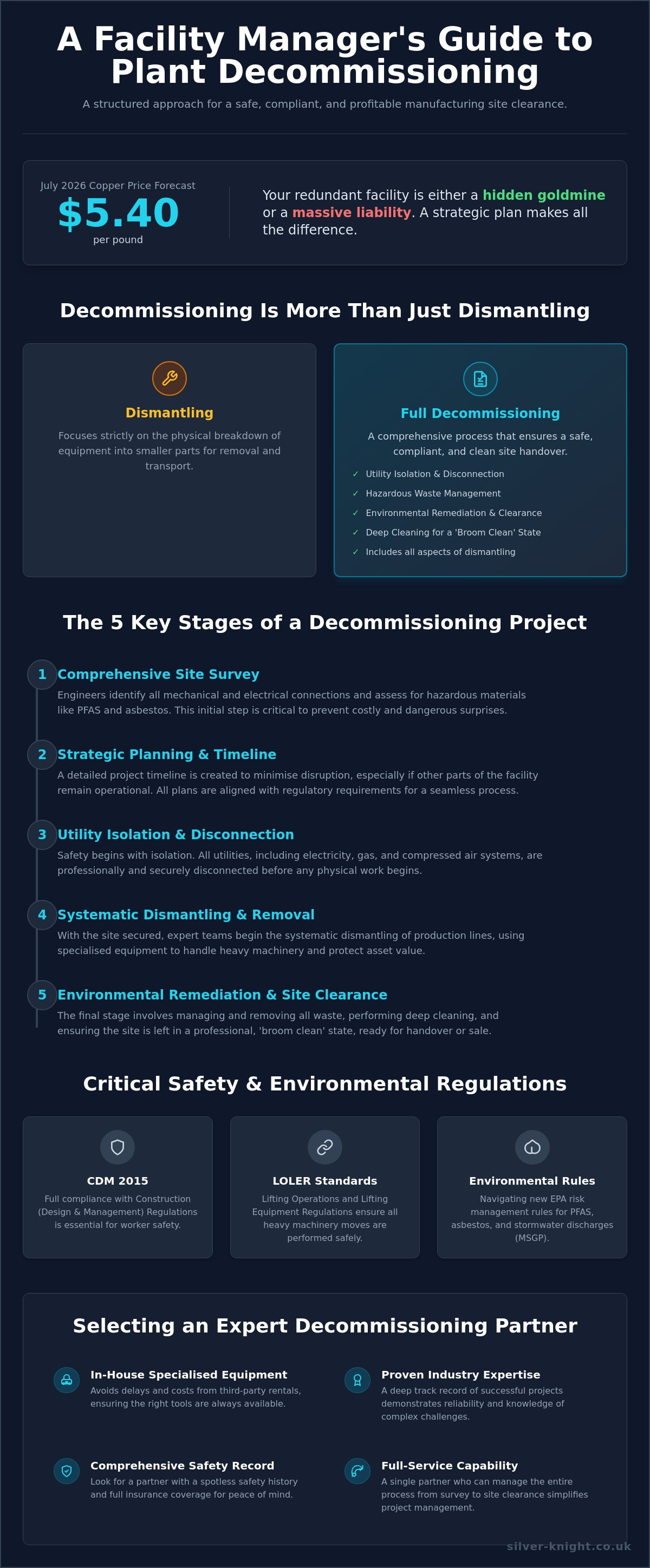
With clean copper prices reaching $5.40 per pound in July 2026, your redundant facility is either a massive liability or a hidden goldmine. Most facility managers feel the intense pressure of balancing tight deadlines with the fear of environmental contamination and the technical complexity of moving heavy machinery. It's a stressful position to be in when the stakes involve both legal compliance and worker safety. This guide ensures your manufacturing plant decommissioning project runs smoothly, safely, and profitably.
We'll provide a clear roadmap to help you protect your assets whilst meeting the latest regulatory standards. You'll discover how to manage hazardous waste costs, navigate new EPA risk management rules for PFAS and asbestos, and implement a strategic plan for maximising recovery value for every piece of equipment on your floor. By following this structured approach, you can eliminate unplanned downtime and ensure your site is cleared without a single safety incident.
Key Takeaways
- Understand why decommissioning involves more than just dismantling, including essential deep cleaning and environmental remediation steps.
- Learn how to structure a manufacturing plant decommissioning project with detailed site surveys and timelines that protect your remaining operations.
- Ensure full compliance with CDM 2015 and LOLER standards to maintain a safe working environment throughout the process.
- Discover strategies for maximising the resale value of redundant machinery whilst leaving your facility in a professional, broom clean state.
- Identify the criteria for choosing a decommissioning partner, focusing on in-house specialised lifting equipment and proven industry expertise.
If you require expert assistance with your site closure, consider the professional machinery moving and factory clearance services available from Silver Knight.
Defining the scope of manufacturing plant decommissioning
Decommissioning is the formal and systematic process of taking industrial facilities or heavy machinery out of service. It involves much more than just switching off the power. For facility managers in 2026, manufacturing plant decommissioning represents a complex engineering challenge that requires careful planning to avoid environmental liabilities and safety risks. It's a technical project that turns an active production line into a safe, empty space.
A successful project ensures that the building is returned to the landlord or owner in a safe, rentable condition. This process avoids future legal issues related to site contamination or hazardous waste. By following a structured approach, you can move from an active production floor to an empty shell whilst protecting the value of your machinery and the integrity of the site. It's about leaving the premises in a broom clean state, ready for its next life.
To better understand how these large scale projects look in practice, watch this helpful video:
Why professional decommissioning is essential for your business
Professional oversight is vital for maintaining legal compliance with UK health and safety legislation. Failing to manage hazardous materials or utility isolations correctly can lead to heavy fines. Beyond the law, professional handling protects high value assets. If you intend to sell your machinery on the global market or move it to another site, expert handling ensures it remains in working order. This approach also helps reduce site holding costs and insurance premiums for redundant buildings. It's a strategic move that saves money in the long term.
Distinguishing between dismantling and full decommissioning
It's easy to confuse these two terms, but they serve different purposes. Dismantling focuses strictly on the physical breakdown of equipment into smaller parts for transport. In contrast, decommissioning includes wider site responsibilities like utility isolation and environmental clearance. Silver Knight offers both services to provide a seamless transition. By using our machinery dismantle service alongside full site clearance, you ensure every mechanical connection and environmental risk is managed by experts with 180 years of collective industry experience.
Managing a site closure requires precision and expertise. You can rely on the nationwide services of Silver Knight for your factory clearance and decommissioning needs.
The technical stages of industrial machinery decommissioning
A structured approach is the only way to ensure a manufacturing plant decommissioning project stays on track. It begins with a comprehensive site survey. During this phase, engineers identify every mechanical and electrical connection point to prevent surprises during the lift. This data allows for the creation of a detailed project timeline. Careful scheduling is essential to minimise disruption if other parts of your facility remain operational.
During the survey, we also look for potential hazardous materials. In 2026, the EPA's focus on PFAS discharges and asbestos risk management means your site survey must be incredibly thorough. We also ensure your project adheres to the 2026 Multi-Sector General Permit (MSGP) requirements for stormwater discharges. Identifying these risks early prevents costly legal delays later in the project.
This process aligns with international standards for Deactivation & Decommissioning (D&D), which ensures that hazardous materials are stabilised before the physical removal of assets. Once the plan is in place, the systematic dismantling of production lines can begin.
Utility isolation and mechanical disconnections
Safety starts with isolation. Before any heavy lifting occurs, all utilities must be securely disconnected. This includes electricity, gas, and compressed air systems. Professional electrical disconnection is a non negotiable step to protect the dismantling crew. You must also manage hydraulic fluids and coolants according to 2026 environmental guidelines to avoid site contamination. Capping gas lines and water supplies properly prevents accidental damage that could devalue the property.
Utilising specialised lifting and transport equipment
Moving massive production lines requires more than just standard forklifts. In restricted access areas where overhead cranes cannot reach, we use hydraulic gantry systems. These allow for controlled, vertical lifting in tight spaces. For the movement of massive loads across factory floors, jack and slide systems provide the necessary precision without damaging the ground surface. You can view our full range of specialised fleet on our equipment page. These tools ensure that even the heaviest industrial machinery is moved safely. If you are planning a complex move, you can speak with our technical team for expert advice on your project.
Once dismantled, each component requires secure packing. We use custom crating and moisture protection for sensitive electronics. This is vital for international machinery transport where humidity can cause corrosion. Our heavy machine movers then coordinate the transport, ensuring every item is accounted for and arrives safely at its destination. Professional transport is the final stage of manufacturing plant decommissioning, turning a complex logistics puzzle into a successful site clearance.
If you are planning a large scale project, you can rely on the nationwide expertise of Silver Knight for professional factory clearance and decommissioning.
Critical safety protocols and environmental regulations
Safety is the primary concern for any facility manager overseeing manufacturing plant decommissioning. In the UK, this process is governed by several strict frameworks that ensure workers and the environment remain protected. The Construction Design and Management Regulations 2015 (CDM 2015) provide the overarching structure for site safety. These regulations are not just for new builds; they apply whenever you are dismantling or removing industrial structures. You must ensure that roles such as the Principal Designer and Principal Contractor are clearly defined to manage risks effectively throughout the project lifecycle.
Lifting operations represent the highest risk during the removal of heavy plant. This is why strict compliance with the Lifting Operations and Lifting Equipment Regulations (LOLER) is essential. Every lift requires a competent person to plan it and a thorough examination of all lifting gear before use. Alongside this, the Provision and Use of Work Equipment Regulations (PUWER) ensure that every tool used by the crew is safe and suitable for the specific task. Before any work begins, we provide detailed Risk Assessment and Method Statements (RAMS) to outline every step of the process whilst maintaining a secure site.
Managing hazardous materials and waste disposal
Identifying hidden dangers is a critical part of site clearance. As of July 2026, asbestos abatement remains a significant cost factor, often adding between $2 and $8 per square foot to project budgets. Beyond asbestos, you must manage chemical residues and modern contaminants like PFAS. The 2026 EPA and UK environmental revisions require strict documentation for the disposal of industrial waste and hazardous liquids. Meeting these standards is the only way to ensure the facility is safe for future commercial use, especially as national vacancy rates for industrial space sit around 8 per cent.
Health and safety documentation for decommissioning projects
A successful project leaves a comprehensive paper trail that protects your business from future liabilities. A site specific health and safety file is a legal requirement that provides future owners or tenants with vital information about the building. Silver Knight manages every aspect of this documentation, from initial RAMS to final waste transfer notes. This level of detail is standard across our machinery dismantle service, ensuring that every worker and the facility itself remain protected. Our 180 years of collective industry experience means we have encountered almost every possible safety challenge amongst diverse industrial sectors.
If you need to recover value from your redundant assets, the team at Silver Knight provides a comprehensive factory clearance and decommissioning service across the UK.
Maximising asset value through strategic site clearance
Successful manufacturing plant decommissioning is not just about removal; it is an exercise in asset recovery. As a facility manager, you must decide which machines are destined for the scrap heap and which can be sold on the global market. Strategic planning allows you to offset the costs of the project by capitalising on current material prices. In July 2026, heavy melting steel is priced between $350 and $375 per gross ton, whilst clean copper remains high at up to $5.40 per pound. These figures can significantly reduce your total project spend if materials are sorted and recovered correctly.
Beyond the financial return, there is a growing trend to view decommissioning as a strategic ESG opportunity. Companies now focus on measurable sustainability wins, such as material donation and Scope 3 emissions data. By choosing a partner who understands these environmental goals, you can turn a site closure into a positive report for your stakeholders. It is about balancing the physical work with the financial and ethical outcomes of the project. This approach ensures your business remains responsible amongst changing industrial standards.
Factory clearance and redundant equipment management
A systematic approach to factory clearance ensures that every non productive asset is removed efficiently. This includes everything from heavy industrial machinery to general industrial waste. The goal is to return the building to the landlord in a broom clean state, which is essential for a smooth handover. You can learn more about our UK factory clearance service to see how we help businesses recover value from their redundant equipment. Clearing the site thoroughly prevents the new owner or landlord from making claims against your business for remaining debris.
Secure storage and international relocation options
Sometimes, the best buyer for your equipment is on the other side of the world. In these cases, professional packing is vital to reach a wider buyer base without risking damage. If assets are not sold immediately, you might require secure warehousing to keep them protected from the elements. We provide specialised export packing services and can organise international machinery transport to facilitate global asset redistribution. This ensures that your high value equipment remains in peak condition until it reaches its new home. If you are ready to begin your site clearance, contact our expert team today to discuss your asset recovery options.
When you are ready to begin your project, you can trust the experts at Silver Knight for all your industrial machinery moving and decommissioning needs.
Selecting an expert partner for industrial plant decommissioning
Choosing the right contractor for manufacturing plant decommissioning is a decision that directly impacts your bottom line and your legal standing. You need a partner who understands that this is a technical engineering project, not just a simple clearance job. A key factor is whether the contractor owns their own specialised lifting and transport equipment. Relying on hired gear can lead to delays and increased costs. By choosing a partner with an in house fleet of hydraulic gantries and jack and slide systems, you ensure that the tools are available exactly when needed.
You should also look for a proven track record in both national and international projects. In 2026, the complexity of global supply chains means your redundant assets might be destined for a buyer on another continent. A partner who can manage the entire process, from the initial technical survey to the final site clearance, provides the continuity you need. This end to end management reduces the risk of miscommunication between different contractors and ensures that your site is returned to a rentable condition without any safety incidents.
The Silver Knight advantage in decommissioning
Silver Knight is a family run business founded in 1996, offering a personal touch that many large corporations lack. We bring over 180 years of collective industry experience to every project, ensuring that we have the technical knowledge to handle the most complex industrial moves. Our nationwide UK coverage is matched by our ability to coordinate global relocations. If your decommissioning project is part of a larger move, our factory relocation service provides a comprehensive solution that includes everything from heavy haulage to recommissioning at your new site. We take pride in our specialised equipment and our ability to solve difficult lifting challenges in restricted spaces.
Planning your next decommissioning project
The first step in any successful project is a technical site survey. This allows our engineers to identify potential challenges, such as restricted access or complex utility isolations, before they become problems. Based on this survey, we develop a bespoke decommissioning plan tailored to your specific site requirements. This plan includes a detailed timeline to minimise disruption to your remaining operations. When you request a quote from us, we provide a transparent breakdown that covers all stages of the process, including asset recovery and waste disposal. This level of detail allows you to plan your budget with confidence, knowing that all environmental and safety regulations are fully addressed.
If you require professional assistance with your site clearance, discover more about the decommissioning and factory relocation services offered by Silver Knight.
Securing the future of your industrial facility
Successful manufacturing plant decommissioning requires a delicate balance of technical precision and regulatory expertise. By prioritising a thorough site survey and strict adherence to UK safety standards like LOLER and CDM 2015, you can mitigate the risks of environmental liability and workplace accidents. Focusing on asset recovery through strategic material sorting also allows you to offset project costs whilst meeting your business's sustainability goals. It's a complex transition that demands careful oversight to avoid costly delays.
Our team provides a nationwide UK service backed by 180 years of collective industry experience. As a family run business established in 1996, we understand the importance of a personal, reliable approach to heavy industrial projects. We use our own specialised in house equipment to ensure every move is handled safely. Whether you're clearing a single production line or an entire facility, we help you transform a redundant space into a clean and valuable asset for your company's next chapter.
Ready to start your project? Contact Silver Knight for a professional decommissioning quote and let our experts guide you through the process.
Frequently Asked Questions
What is the difference between decommissioning and dismantling
Dismantling is strictly the physical act of breaking down machinery into smaller components for removal. Manufacturing plant decommissioning is a much broader process that involves utility isolation, deep cleaning, and environmental remediation to return a site to a safe state. It ensures the entire facility is legally compliant and ready for its next use rather than just removing equipment.
How long does a typical manufacturing plant decommissioning project take
Project timelines depend entirely on the scale and complexity of your industrial facility. A single production line might take five to ten working days to clear, whereas a full factory decommissioning project can last several months. Factors such as the presence of hazardous materials and the complexity of utility isolations will influence the final schedule provided in your project plan.
What are the main safety regulations for decommissioning in the UK
The primary frameworks in the UK are CDM 2015, LOLER, and PUWER. CDM 2015 governs the overall management of the site, whilst LOLER ensures all lifting operations are planned and executed safely. PUWER relates to the safety of the tools and equipment used during the process. You must also adhere to environmental waste regulations for any hazardous materials found on the premises.
Can you relocate machinery to another country after decommissioning
Machinery can certainly be moved to international locations once the decommissioning phase is complete. This process involves specialised export packing to protect sensitive components from moisture and damage during sea or air freight. Silver Knight coordinates international machinery transport to ensure your assets reach their global destination in the same condition they left the factory.
What happens to hazardous waste during the decommissioning process
Hazardous waste is identified during the initial technical survey and handled according to strict environmental guidelines. Materials such as asbestos, hydraulic fluids, and chemical residues are removed and transported to licensed disposal centres. Full waste transfer notes are provided to ensure your business maintains a clear audit trail for regulatory compliance and future site handovers.
How do you calculate the cost of a decommissioning project
Costs are determined by the technical difficulty of the project, the volume of machinery, and the specific safety requirements of the site. Factors include the number of heavy lifts required and the complexity of utility disconnections. You can often lower the net cost by balancing these expenses against the recovery value of redundant assets and scrap materials like copper and steel.
Is a site survey necessary before starting the decommissioning work
A technical site survey is a mandatory first step for any safe decommissioning project. It allows engineers to map out mechanical connection points and identify structural obstacles that could hinder heavy lifting. Without a survey, you risk encountering unplanned downtime or safety hazards that can lead to significant delays and increased project costs.
Can Silver Knight help with asset recovery and factory clearance
Silver Knight provides the technical expertise and specialised equipment needed for efficient factory clearance. We handle the systematic removal and transport of redundant assets to help you prepare them for the global resale market. Our focus is on ensuring your equipment is moved safely and the site is left in a professional, broom clean condition ready for handover.

Article by
David Ashby
I'm the Managing Director of Silver Knight Haulage & Machinery Ltd. Silver Knight Ltd is a family-run firm established in the West Midlands in 2005, with the aim of providing a cost-effective, yet professional, service to businesses for the removal, transportation, and installation of machinery, plant, and equipment here in the UK and worldwide. Between us, the Silver Knight workforce has over 50 years of experience with machinery and its operation.
Disclaimer
This article is intended for informational purposes only. Please ensure you seek expert advice or carry out your own research to confirm the information is suitable for your specific needs.