Hiring a massive mobile crane might seem like the obvious choice for heavy lifting, but it's often the most disruptive and expensive mistake you can make in a tight factory setting. When you're dealing with low ceilings or narrow aisles, professional hydraulic gantry hire offers a far more sensible alternative. It allows for the millimetre accurate placement of your most valuable assets without the need to remove roof sections or clear out half the factory floor.
We understand the genuine fear of damaging a multi-million pound piece of equipment whilst trying to squeeze it into a restricted space. It's a high stakes task that requires more than just raw power; it needs absolute control. This guide explains how opting for a managed gantry system provides a safe and cost effective solution for complex industrial moves. You'll discover how these systems work within existing infrastructure to ensure your machinery is installed with precision and full regulatory compliance.
Key Takeaways
- Understand how hydraulic gantry systems use telescopic legs to provide a portable and stable lifting frame for heavy industrial assets.
- Learn why professional hydraulic gantry hire is the most effective choice for moving machinery in buildings with low ceilings or restricted access.
- Discover how to achieve millimetre accuracy when positioning sensitive equipment with systems capable of lifting 60 tonnes or more.
- Identify the critical planning steps and safety regulations required to ensure your lifting operation is fully compliant and insured.
- See how an operated hire service with qualified personnel can manage all risk assessments and minimise disruption to your factory infrastructure.
To ensure your next heavy lift is managed by industry experts, visit the specialists at Silver Knight for professional machinery moving solutions.
Understanding Hydraulic Gantry Systems for Industrial Lifting
A hydraulic gantry system is a portable lifting frame designed to manage extreme weights in environments where a traditional crane simply cannot fit. These systems use four or more telescopic legs that work in unison to lift heavy assets with high stability. Amongst industry professionals, these setups are frequently referred to as jacking systems. If you're planning a complex machinery move, professional hydraulic gantry hire provides the flexibility needed for indoor projects. While many people have a basic idea of what is a gantry crane, the hydraulic variant is a more compact and specialised tool built for precision in confined factory spaces.
To better understand how these systems operate in real-world conditions, watch this helpful video:
How Hydraulic Gantries Work
The primary mechanism behind the system is the hydraulic cylinder located inside each telescopic leg. These cylinders allow for incredibly smooth and controlled vertical movement, which is essential for protecting sensitive industrial components. For horizontal movement, the legs are typically placed on a dedicated track system. Heavy-duty overhead beams connect the legs, allowing the load to be suspended and moved along the tracks whilst remaining perfectly level. Most modern systems are managed via a remote control unit. This setup gives the operator the freedom to move around the lift area, ensuring they have the best possible visibility and can maintain a safe distance from the load at all times.
Common Applications in Factory Environments
Factory environments often have low ceilings or existing overhead infrastructure that makes traditional lifting methods impossible. This is where hydraulic gantry hire becomes invaluable. It's the standard choice for the installation of heavy CNC machines and massive industrial presses that must be positioned with millimetre accuracy. In the power generation sector, these systems are used to relocate large transformers and generators within substations or power plants. They also play a vital role in factory relocations. When an overhead crane is not available or lacks the necessary capacity, these portable gantries provide a reliable way to decommission, move, and reinstall heavy plant equipment without needing to modify the building structure.
If you need expert advice on the best lifting equipment for your project, contact the team at Silver Knight today.
Comparing Gantry Hire with Traditional Crane Services
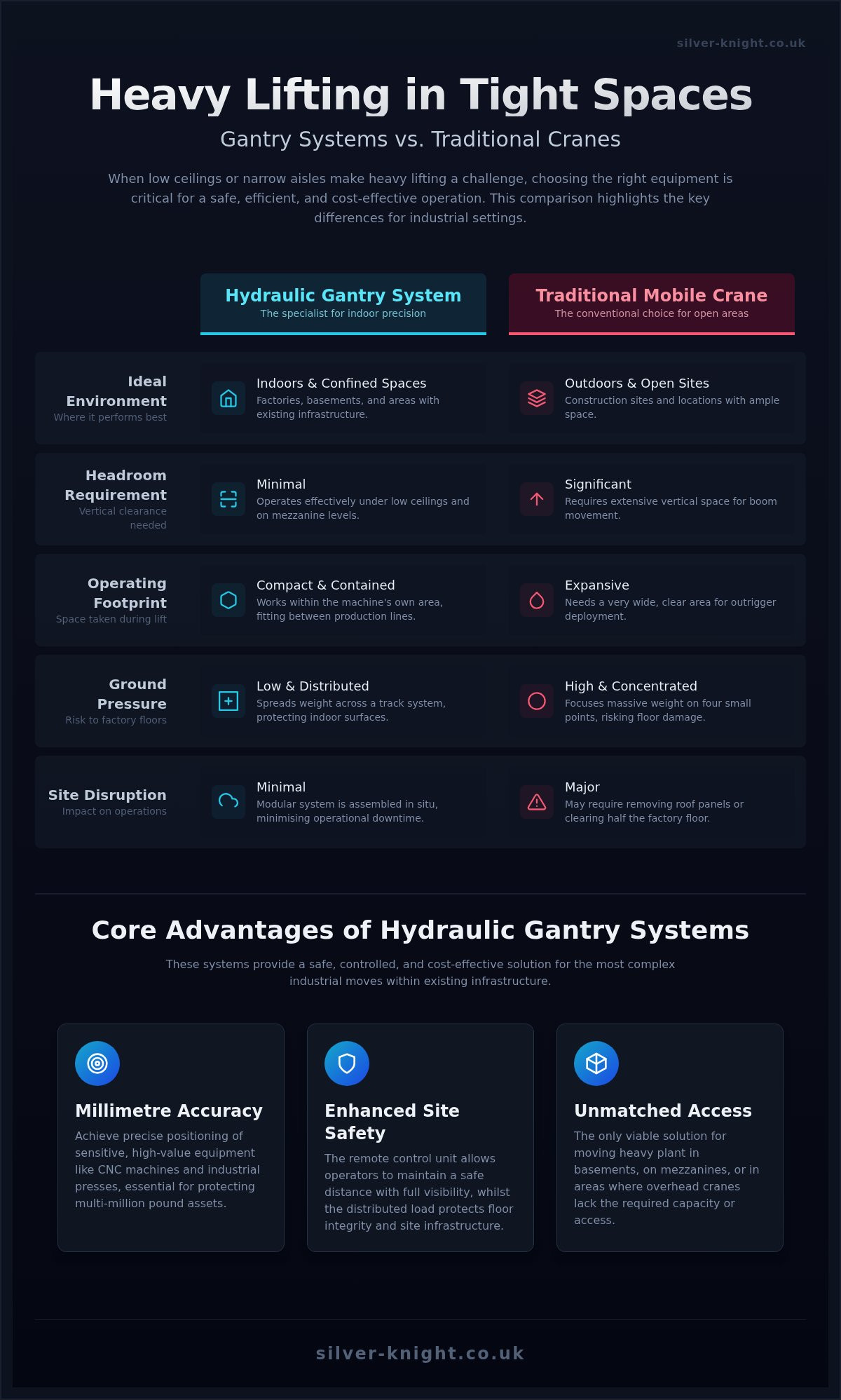
Many project managers assume that a mobile crane is the ultimate solution for every heavy lift. However, in a modern industrial setting, this is often a misconception. Mobile cranes require significant headroom to operate their booms and need wide areas for outrigger deployment. By contrast, hydraulic gantry hire offers a solution that works within the footprint of the machine itself. A major technical difference lies in ground loading pressures. A large crane concentrates its massive weight on four small points, which can easily crack factory floors. A gantry distributes its load across a much wider area via its track system, making it far safer for indoor surfaces. Even though UK sites follow LOLER, international safety standards like OSHA regulations for gantry cranes highlight the strict safety protocols required for these specialised systems.
Advantages in Confined Spaces and Low Headroom
Traditional cranes often force companies to remove factory roof panels or structural steelwork just to gain access to a machine. This is expensive, time consuming, and entirely weather dependent. A gantry system is modular and can be assembled around the machine in situ. Because the footprint is so compact, it fits comfortably between existing production lines without requiring a massive clear out of the surrounding area. This makes it the only viable option for basement installations or mezzanine levels where vertical clearance is limited to just a few metres. It's an ideal choice for facilities where every square centimetre of floor space is already utilised for production.
Cost Efficiency and Rapid Deployment
The logistics of moving a 500 tonne crane are immense. Such a move often requires multiple support vehicles and complex route planning. In comparison, a gantry system can typically be transported on a single standard trailer. This significantly reduces transport costs and simplifies site access. Because the setup is faster, your production lines experience much less downtime. You won't need to spend weeks applying for road permits or managing major site disruptions that frustrate your neighbours. If you are unsure which method suits your facility, you can request a site survey to determine the most efficient approach for your specific building layout.
For more information on how to plan your next heavy lift, visit the experts at Silver Knight for professional machinery lifting services across the UK.
Technical Specifications and Precision Loading Capabilities
When you're looking into hydraulic gantry hire, the technical specifications are the first thing you need to check. Most professional fleets offer capacities starting from 60 tonnes, but systems can be scaled much higher depending on the project. Central to every lift plan is the Safe Working Load or SWL. This figure represents the maximum weight the equipment can safely handle under specific conditions. It isn't just a guideline; it's a legal requirement to ensure the safety of your staff and your assets. Adhering to standards such as OSHA regulations for gantry cranes ensures that every component, from the hydraulic cylinders to the header beams, is operating within its engineered limits. Choosing the right hydraulic gantry hire partner means having access to equipment that offers millimetre accuracy for the most sensitive installations.
Weight Capacities and Vertical Reach
The flexibility of a gantry system comes from its modular nature. By adding more legs or using different header beams, the total capacity can be increased to accommodate even the heaviest industrial presses. Vertical reach is managed by the telescopic stages of the legs. If a project requires a higher lift than the legs alone can provide, specialised beams and spacers are used to bridge the gap whilst maintaining structural integrity. Standard industrial gantry systems can often achieve a maximum lifting capacity of 450 tonnes when configured with four heavy-duty telescopic legs.
Multi Point Lifting for Unbalanced Loads
Industrial machinery rarely has a perfectly symmetrical weight distribution. A massive CNC machine might have a heavy motor on one side and a lighter control cabinet on the other. This creates an off centre gravity that would make a single point crane lift incredibly risky. Gantry systems solve this through independent leg control. Each leg can be adjusted individually to compensate for the weight bias. Having the load suspended between four or more points provides a level of stability that a single hook simply cannot match.
Modern synchronisation technology ensures that even with unbalanced loads, the entire system moves as one. This keeps the load perfectly level throughout the vertical lift and horizontal travel. It significantly reduces the risk of the load swinging or tilting, which is vital when you're working with sensitive equipment that costs millions of pounds. This level of control is why many site managers prefer gantries over traditional methods for high value assets.
To ensure your project is managed with the highest safety standards, visit the specialists at Silver Knight for professional lifting solutions.
Planning Your Hydraulic Gantry Lift Operation
A successful machinery move starts long before the equipment arrives at your gates. Under the Lifting Operations and Lifting Equipment Regulations 1998, or LOLER, every lift must be properly planned by a competent person. This individual, known as the appointed person, is responsible for creating a comprehensive lift plan that covers every technical detail. This document is essential for insurance purposes and ensures that all safety risks are identified and mitigated. Clear communication between the factory manager and the hydraulic gantry hire team is the only way to avoid costly delays. Both parties must be aligned on the schedule, the weight of the assets, and the exact positioning required.
Essential Site Surveys and Risk Assessments
A technical site survey is the absolute first step in any lifting project. It isn't enough to simply know the weight of the machine. A surveyor needs to physically inspect the environment to identify potential hazards. They look for narrow access routes that might hinder the transport of the gantry legs. They also check for overhead obstructions such as cable trays, heating pipes, or lighting rigs that could be damaged during the lift. To see the different types of lifting gear that might be used on your site, you can browse the our equipment page for detailed specifications.
Preparing the Factory Floor for Heavy Loads
One common oversight in machinery moving is the strength of the factory floor. Whilst a floor might look sturdy, it may not be engineered to handle the concentrated pressure of a multi tonne lift. Before your hydraulic gantry hire begins, you should verify the floor's load bearing capacity with your building's structural engineer. To manage this risk, engineers use steel plates or thick timber mats to distribute the weight across a broader area. This prevents the legs from sinking or cracking the concrete. You must also ensure the work area is completely clear of debris and non essential personnel. A tidy site allows the rigging team to assemble the gantry and position the tracks without any unnecessary obstacles.
If you are concerned about the structural integrity of your facility or need help with a complex lift plan, contact our expert team for a detailed site assessment.
If you are ready to organise your next industrial lift with a team you can trust, visit Silver Knight for a comprehensive range of machinery moving services.
Choosing Silver Knight for Professional Operated Gantry Hire
Selecting the right partner for your project is just as important as the equipment itself. Silver Knight is a family run specialist with over 180 years of collective industry experience. This deep rooted expertise means we have seen every possible challenge in the field. When you choose us for hydraulic gantry hire, you aren't just getting a piece of machinery; you're getting a fully managed, turnkey solution. We handle everything from the initial transport of the gear to the final installation of your assets. This managed approach ensures that your project stays on schedule and within budget whilst maintaining the highest levels of safety on site.
The Benefits of Managed Lifting Services
One of the biggest risks in industrial moving is using inexperienced staff to operate complex machinery. By opting for an operated hire service, you ensure that a qualified professional is at the controls at all times. This significantly reduces the risk of accidents, site injuries, or damage to your expensive equipment. We provide all the necessary heavy moving equipment required for the task, meaning you don't have to source multiple suppliers. There is a specific peace of mind that comes from working with a specialist who understands the nuances of heavy lifting. Our team manages the risk assessments and lift plans, allowing your factory managers to focus on their core production duties.
Supporting Your National Machinery Relocation Needs
Whether you're moving a single machine across a workshop or require full factory relocation services, we operate nationally across the UK. Our fleet is ready to support industrial sectors in every corner of the country. Our nationwide hydraulic gantry hire service is designed to handle the most complex industrial challenges with ease. We also have the capability to manage international machinery transport, providing a seamless transition for businesses expanding overseas. Our expertise isn't limited to gantries alone. For projects requiring different approaches, you can read our specialised lifting sibling article to learn about jack and slide systems. By offering a versatile range of solutions, we ensure that your heavy assets are moved with the precision and care they deserve, regardless of the destination.
If you are planning a factory move or need specialised equipment, explore the full range of solutions at Silver Knight.
Secure Your Next Industrial Lift with Precision
Choosing the right lifting method is the difference between a seamless installation and a costly project delay. We have explored how hydraulic gantry hire offers a compact and floor friendly alternative to traditional mobile cranes. By focusing on detailed site surveys and independent leg control, you can move your heaviest assets with millimetre accuracy even in the tightest factory spaces. It's a solution that prioritises the safety of your building infrastructure and your most valuable machinery.
Silver Knight brings over 180 years of collective machinery moving experience to every project. We provide a nationwide UK service across all industrial sectors, ensuring your move is handled by experts regardless of your location. Our fully operated hire model prioritises maximum safety and compliance with all current regulations. You can contact Silver Knight for a bespoke hydraulic gantry hire quote to discuss your specific requirements. We look forward to helping you move your business forward with confidence.
Frequently Asked Questions
What is a hydraulic gantry system?
A hydraulic gantry system is a specialised, portable lifting frame used to move heavy industrial assets in confined spaces. It consists of four or more telescopic legs connected by header beams, allowing for controlled vertical and horizontal movement. These systems are ideal for factory environments where traditional cranes cannot operate due to height restrictions or narrow access routes.
How much weight can a hydraulic gantry lift safely?
Standard configurations for hydraulic gantry hire typically start at 60 tonnes and can reach up to 450 tonnes. The exact capacity depends on the number of legs used and the header beam configuration. Every lift is governed by a Safe Working Load, or SWL, which is calculated during the planning phase to ensure the operation remains within engineered safety limits.
Is a hydraulic gantry better than a crane for indoor lifting?
A gantry is often superior for indoor projects because it doesn't require the vast headroom or boom clearance of a mobile crane. It has a much smaller footprint and distributes weight more evenly across the floor via a track system. This prevents damage to factory surfaces and avoids the expensive necessity of removing roof panels or structural steelwork for access.
Do I need to prepare my factory floor before hiring a gantry?
You must verify your floor's load bearing capacity with a structural engineer before the hydraulic gantry hire equipment arrives. The work area should be cleared of all debris and non essential machinery to allow for a safe and efficient rigging process. We often use steel plates or thick timber mats to help distribute the load weight safely across the concrete surface during the move.
How long does it take to set up and rig a hydraulic gantry?
Rigging times vary depending on the complexity of the lift, but a standard setup often takes between two and four hours. Because the system is modular and typically arrives on a single trailer, it is much faster to deploy than a large multi axle crane. This efficiency helps to minimise downtime for your production lines and reduces overall site disruption.
Can a hydraulic gantry lift an unbalanced or awkward load?
These systems are specifically designed to handle unbalanced loads with an off centre gravity. Because each leg can be controlled independently, the operator can adjust for weight bias to keep the load perfectly level whilst it is in motion. This level of precision provides much greater stability than using a single point lifting hook for awkward industrial machinery.
Does your gantry hire service include a qualified operator?
Our service is a fully operated hire model that includes a qualified professional to manage the lifting equipment. This ensures that all risk assessments and LOLER regulations are strictly followed by an experienced person. Having an expert at the controls reduces the risk of accidents and ensures your high value assets are handled with the highest level of care.

Article by
David Ashby
I'm the Managing Director of Silver Knight Haulage & Machinery Ltd. Silver Knight Ltd is a family-run firm established in the West Midlands in 2005, with the aim of providing a cost-effective, yet professional, service to businesses for the removal, transportation, and installation of machinery, plant, and equipment here in the UK and worldwide. Between us, the Silver Knight workforce has over 50 years of experience with machinery and its operation.
Disclaimer
This article is intended for informational purposes only. Please ensure you seek expert advice or carry out your own research to confirm the information is suitable for your specific needs.