What if the safest place for imported machinery is not the final destination? The right temporary storage for imported equipment can give you time to prepare a site, arrange delivery and protect valuable machinery in the meantime. But choosing a physical storage option doesn’t, by itself, answer questions about the equipment’s customs status.
It’s understandable to find the distinction unclear, especially when an arrival date, site readiness and onward transport all need to line up. Once equipment has cleared customs, secure indoor machinery storage can provide a practical stop between arrival and final delivery. Customs requirements still need to be managed as a separate part of the plan.
This guide explains how to assess storage against the equipment’s size, handling needs and next destination, and which customs questions to coordinate separately. It also looks at how to plan arrival, storage and onward transport as connected stages, so the move from port to site is considered as a whole. Silver Knight’s machinery storage, moving and heavy haulage services can support that practical planning.
Key Takeaways
- Separate the practical decision about where machinery will wait from the coordination of its customs status.
- When assessing temporary storage for imported equipment, consider its dimensions, weight, condition and handling needs.
- Compare on-site holding, general warehousing and specialist indoor machinery storage by access, handling and onward movement.
- Plan shipment, storage entry, release and final delivery as connected stages, while keeping customs coordination distinct from physical transport.
- Choose a storage arrangement that fits the equipment and its next destination, with machinery moving and onward transport considered alongside storage.
For machinery moving support that takes storage and onward delivery into account, consider how each stage fits the equipment’s journey.
What temporary storage for imported equipment actually covers
Where can imported machinery wait between arrival and delivery to its final site? That practical question is about the equipment, its handling and the next stage of the project. Temporary storage for imported equipment can mean a physical place to keep machinery while arrangements progress, but the phrase can also be confused with a customs status. These are separate matters, and planning for one does not automatically resolve the other.
Physical machinery storage concerns where equipment is held and how it is safeguarded. Customs temporary storage concerns the goods’ status before they are placed under a customs procedure. The applicable declarations, requirements and permitted time limits depend on current rules and the circumstances of the import. Coordinate those questions through the appropriate customs process, separately from decisions about the machinery’s physical storage and movement.
How customs temporary storage differs from machinery storage
Think of customs status as one workstream and the physical storage plan as another. Indoor machinery storage is about keeping equipment in a suitable physical setting between arrival and onward movement. It does not, by itself, change the goods’ customs status or provide an answer about declarations or time limits. Silver Knight provides secure indoor machinery storage, not an HMRC-authorised temporary storage facility or customs warehouse.
General self-storage gives an overview of storage for items held outside their usual place of use. Imported industrial equipment can involve different practical considerations, including its scale and how it will be handled. Focus on the machinery and its next destination rather than assuming that a general storage category will suit every import.
Why imported equipment may need an interim storage plan
The shipment’s arrival, customs coordination and the receiving site’s readiness may not align. A site could be preparing for installation, for example, or a phased project may mean equipment is needed at different points. Storage can provide a planned interval before onward delivery, rather than requiring the machinery to move directly to a site that is not ready to receive it.
Build the physical plan around what happens before and after storage. Establish where the machinery is expected to arrive, what needs to happen before it can be moved, and where it will go next. If the project involves several items, note whether they are intended to move together or in stages. This helps connect the storage decision to the delivery plan without treating it as a substitute for customs coordination.
- Record the expected arrival point and intended delivery destination.
- Identify who is coordinating customs status and declarations.
- Consider the equipment’s dimensions, weight and handling needs when planning its storage and movement.
Silver Knight’s machinery moving equipment supports the handling side of complex machinery logistics. Keeping storage, handling and onward movement in view from the outset helps make the interim stage part of a considered route to delivery.
For secure machinery storage, assess the equipment and its planned route before deciding how the interim stage should work.
How imported machinery storage needs shape the right solution
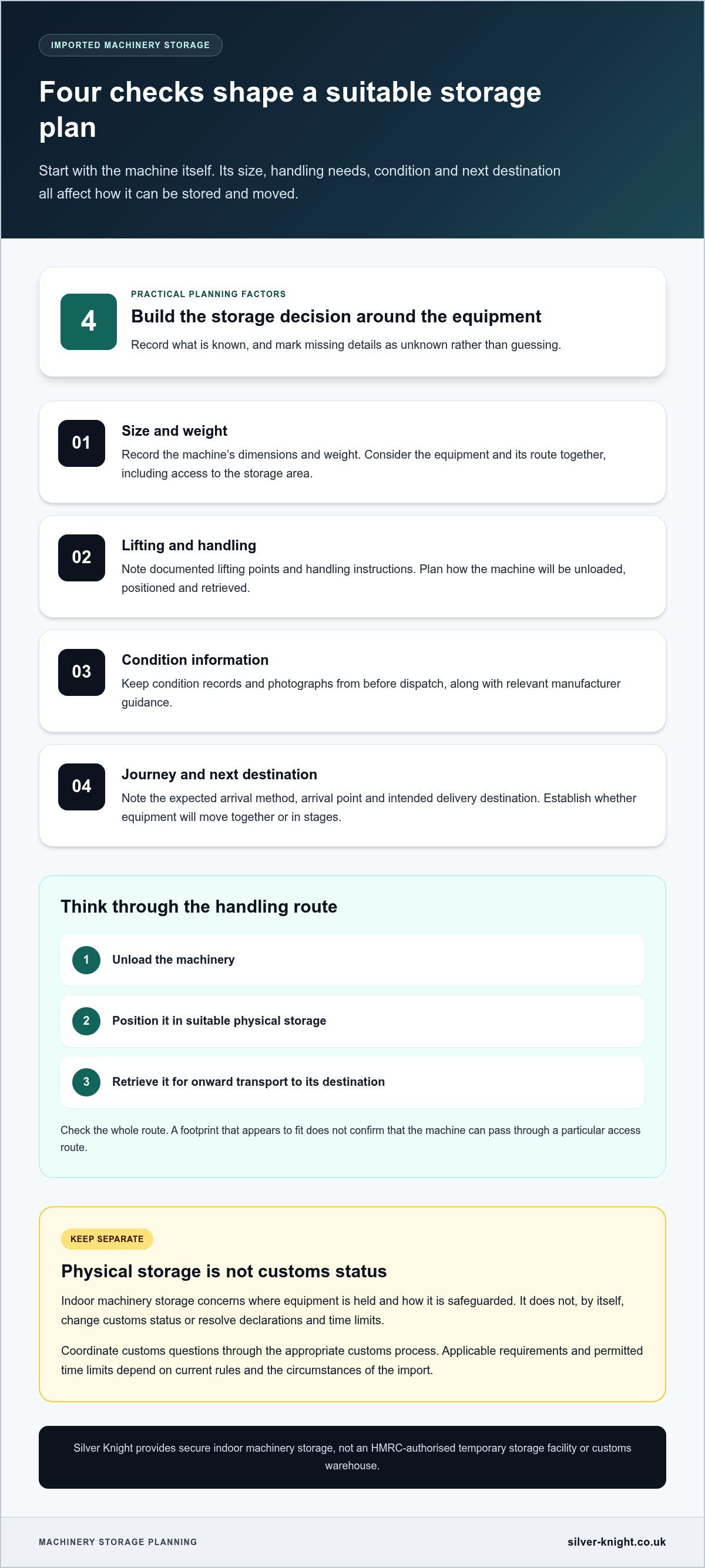
The right storage arrangement starts with the machine, not a general description of the space. Dimensions, weight, condition and handling needs all affect how equipment can be unloaded, positioned and retrieved. For temporary storage for imported equipment, record what is known and distinguish it from assumptions. A drawing or shipping note may give useful details, but it should not be treated as proof of every access or handling requirement.
What to assess before equipment arrives
Gather the information that will help plan the physical move and storage stage. Record the equipment’s dimensions and weight, identify lifting points and note any handling instructions supplied with it. Keep condition records and photographs from before dispatch, along with relevant manufacturer guidance. These details can help those planning the move understand what is arriving and provide a reference if the equipment’s condition needs to be reviewed later.
- Size and weight so the equipment and its route can be considered together.
- Lifting and handling details including documented lifting points and instructions.
- Condition information such as photographs and records made before shipment.
- Journey details including the expected arrival method and the next destination.
Keep documented requirements separate from assumptions. For example, don’t assume a machine can be moved through a particular access route simply because its footprint appears to fit. Note what the drawings and instructions state, then plan around the actual equipment and the intended movement. If a detail is missing, record it as unknown rather than filling the gap with a guess.
How handling and access affect the storage decision
Consider the whole handling sequence: how the machine will be unloaded, where it needs to be positioned, and how it will be retrieved for onward transport. Access affects each step. A plan that focuses only on the arrival vehicle may overlook the equipment’s route inside the storage area or the space needed to remove it later.
Plan access before arranging transport, so the arrival method and movement plan are considered together. Silver Knight’s specialist lifting equipment supports machinery moving and handling work. The suitable approach depends on the equipment and project, so base decisions on documented dimensions, weight and handling instructions rather than assumed facility capabilities.
For background on the regulatory framework for customs temporary storage, consult the relevant UK Customs Regulations for Temporary Storage. This is separate from assessing physical storage and machinery handling. Keeping the two questions distinct helps make the equipment plan clearer without treating a storage arrangement as a customs solution.
To discuss the machinery’s storage and handling needs as part of its onward journey, speak with Silver Knight’s team.
Plan heavy machinery transport alongside storage, so the equipment’s arrival, handling and next move are considered together.
Compare storage arrangements for imported equipment
The best option depends on the equipment, the destination site and how the next stage is organised. A convenient place to wait may not offer the access or handling needed for heavy machinery. Compare the physical arrangements on practical points, then coordinate any customs requirements separately. A storage location should not be assumed to have customs authorisation simply because it can hold imported goods.
Storage arrangement
Access
Equipment handling
Project coordination and onward movement
On-site holding
Close to the intended destination, but access depends on site space, readiness and operating arrangements.
May use existing site resources. The equipment’s size and handling needs still have to fit the site.
Can make sense if the site is ready and the next move is planned there. Less useful if the site cannot yet receive or position the machinery.
General warehousing
Access depends on the warehouse’s arrangements and the timing of retrieval.
May provide space to hold goods, but specialist machinery handling needs should be considered separately.
Can bridge a gap between arrival and delivery. The onward move and any required handling need their own plan.
Specialist indoor machinery storage
Access and retrieval should be planned around the equipment and its next destination.
Can be considered alongside the machinery’s handling requirements.
May suit heavy machinery or industrial components awaiting movement, with storage considered alongside lifting and transport.
When on-site holding or general warehousing may fit
On-site holding may suit equipment that can be received safely and stored without disrupting the destination’s work. If the area is still being prepared, or the machinery is arriving before installation can begin, keeping it there may create practical complications. General warehousing offers another physical holding option, but space alone does not establish how specialised machinery will be handled or moved.
When specialist indoor machinery storage may fit
Indoor storage may be worth considering for heavy machinery and industrial components that need to wait before installation or onward movement. The choice is strongest when the storage stage can be planned with lifting, retrieval and transport, rather than treated as a separate stop. Silver Knight’s secure warehousing and storage can be considered as part of that connected machinery movement plan.
Use the comparison to identify what matters most for this shipment: proximity to the destination, the equipment’s handling needs, or joined-up planning for its next move. Then confirm customs status through the appropriate process, independently of the physical storage choice. That distinction helps avoid treating a practical warehousing decision as a customs arrangement.
Plan international machinery transport alongside storage, so the equipment’s route from arrival to its final destination is considered as one project.
Plan the move into and out of temporary equipment storage
A clear movement plan connects the shipment’s arrival with storage, release and delivery to the receiving site. For temporary storage for imported equipment, keep customs coordination distinct from the physical logistics. The parties managing customs formalities can deal with that workstream, while the movement plan sets out how the machinery will be received, handled, stored and moved onwards. Coordinating dates and information across both tracks helps everyone work from the same plan without treating one as a substitute for the other.
Prepare equipment and arrival information
Start with the information needed to plan the equipment’s physical journey. Bring together its dimensions, weight, handling notes and intended destination, then share relevant details with the parties arranging the shipment and storage. Coordinate arrival information with those managing customs formalities too, so their arrangements and the physical movement plan can be aligned without confusing their separate responsibilities.
Keep a record of the equipment’s condition before it moves into storage. Dated photographs and a written note of visible condition can give the project team a useful reference at the next handover. The record need not make assumptions about what may happen during the journey. Its purpose is to document what was observed before movement, making it easier to review the equipment’s condition when it is retrieved or delivered.
Before the shipment is on its way, organise the practical details in one place. Include the planned arrival point, the intended storage location, the receiving site and the people coordinating each stage. If a detail changes, update the relevant parties. A current shared plan can reduce the risk of one part of the movement being arranged without considering the next.
Coordinate storage release and onward transport
Plan the exit from storage as carefully as the arrival. Consider when the site is expected to be ready, how the machinery will be retrieved and what is needed to move it from storage to its final position. The equipment’s route at the destination may affect the lifting and transport plan, so consider those needs together rather than leaving them until release.
For example, a machine may need to be collected from storage and delivered when installation work can begin. That sequence calls for coordination between the storage release, the transport and the receiving site. The right approach depends on the project and the equipment. Silver Knight’s machinery haulage and relocation connects movement planning with the machinery’s onward journey.
Keep customs status and release arrangements on their own track. The physical readiness of machinery for collection does not decide its customs position. Coordinate that position separately with the parties responsible for the relevant formalities, then align the physical collection and delivery plan with the project schedule.
To plan storage, handling and onward movement together, discuss your machinery move with Silver Knight.
Explore machinery storage and moving as connected parts of your import plan, from arrival through to the next stage of the project.
Choose a machinery storage partner for the next stage of your import
A suitable partner should help you plan around the equipment, not just the space it occupies. For temporary storage for imported equipment, weigh up whether the arrangement fits the machinery’s dimensions and condition, provides secure indoor storage, and connects sensibly with the handling and onward movement the project needs. These points help you judge whether storage is a useful part of the route to installation or delivery.
Keep customs status and declarations as a separate workstream. A physical storage arrangement does not, by itself, decide or manage the equipment’s customs position. Coordinate customs matters with the appropriate parties, while the storage and machinery-moving plan covers the equipment’s physical journey.
What Silver Knight can bring to an equipment storage project
Silver Knight provides secure indoor storage for heavy machinery and industrial components. Storage can be considered alongside machinery moving, installation or heavy haulage, helping you plan the interim stage in the context of what needs to happen next. Silver Knight draws on over 180 years of collective industry experience in machinery-related work.
That joined-up view matters when stored equipment will later need to be moved to a site or positioned for installation. Discussing the route in advance can help frame the practical questions around access, handling and onward movement. Silver Knight’s secure machinery storage is relevant when imported equipment needs an indoor holding stage before its next move.
What to include when discussing your requirements
Give a clear picture of the equipment and what the project needs from storage. Useful details include:
- Equipment dimensions and weight, plus any available handling instructions.
- Its current condition and any photographs or records that describe it.
- The expected destination and what needs to happen before delivery or installation.
- Your anticipated timing and any particular handling needs for arrival, storage or retrieval.
These details help keep the discussion grounded in the actual machinery and its intended route. If some information is still being finalised, explain what is known and what remains undecided. You can then discuss the storage and movement requirements in relation to the project, without assuming a particular lead time or facility specification.
Silver Knight brings machinery storage and moving experience together, so the conversation can cover both the interim stage and the next move. Share the equipment details, destination and project timing to start planning. Discuss your equipment storage requirements.
Silver Knight’s machinery storage and moving services can support planning for the next stage of your import.
Set your next import milestone with confidence
Before arranging the next stage, decide what needs to be true for the equipment to move forward. A clear project milestone can help connect the storage period to the wider import plan, whether that means a site is ready, installation can begin or onward delivery can be arranged. Give the decision an owner and revisit it as the project develops, so stored machinery doesn’t become an afterthought.
That practical focus is the value of planning temporary storage for imported equipment around the project, rather than treating it as a separate stop. You don’t need every detail settled before starting a conversation. A useful first step is to share what you know about the equipment and where it needs to go next, then discuss how storage and movement can fit the plan.
Ready to put the next stage in motion? Discuss your imported equipment storage requirements with Silver Knight and take a confident step towards delivery.
Frequently Asked Questions
Can imported equipment be stored before customs clearance?
Possibly, but it depends on the goods’ customs status and the arrangements at the place where they would be held. Ordinary machinery storage doesn’t itself authorise goods to remain there before clearance. Before planning a pre-clearance move, have the party handling your import formalities establish the permitted route and any applicable conditions. Then coordinate the physical transport plan with that answer, rather than assuming any warehouse can receive uncleared goods.
Is temporary storage the same as a customs warehouse?
No. A customs warehouse refers to a customs arrangement for goods, while machinery storage describes a physical place to keep equipment. The terms aren’t interchangeable, and a building used to store machinery doesn’t automatically have customs warehouse status. For your project, identify whether you need a customs arrangement, a place for the equipment to wait, or both. Keep those decisions distinct when coordinating the import.
How long can imported equipment stay in temporary storage?
There isn’t one period to assume for every import. The permitted time depends on the goods’ customs status and the current rules that apply to the arrangement. Ask the party responsible for the import formalities to confirm the relevant limit and dates for your shipment, then plan storage and onward delivery around them. Don’t treat a physical storage booking as extending or changing a customs deadline.
What information should I prepare before arranging machinery storage?
Prepare the machine’s dimensions, weight, condition details and any manufacturer handling instructions. Add photographs, the expected arrival method and the intended destination. It can also help to note whether the shipment includes separate components or several machines that may move at different times. This gives the project team a clearer picture of what needs to be received and handled, and helps focus discussions on the equipment rather than assumptions.
Can heavy imported machinery be stored indoors?
Yes. Silver Knight provides secure indoor storage for heavy machinery and industrial components. The practical arrangement should suit the equipment and the project, so share details such as its size, weight, condition and handling needs when discussing storage. Indoor storage can form a useful stage before machinery is moved to a site or installation can begin, with the onward movement considered as part of the plan.
How do I coordinate machinery storage with onward transport?
Set out who is coordinating storage, collection and delivery, then agree how changes to the project schedule will be shared. For example, if the receiving site’s readiness date changes, the storage and transport plans may need to be adjusted together. Keep the customs workstream separate, and align physical collection with the relevant arrangements. This helps avoid planning the next move around an assumption that has changed.
What happens if the installation site is not ready when equipment arrives?
If the site can’t receive the machinery, an interim storage arrangement may help separate the arrival from installation. Consider the equipment’s handling needs, the planned delivery route and what must be ready before it leaves storage. Keep the customs arrangements coordinated separately with the responsible party. This gives the project team room to organise the physical move around site readiness without treating storage as a solution to customs requirements.

Article by
David Ashby
I'm the Managing Director of Silver Knight Haulage & Machinery Ltd. Silver Knight Ltd is a family-run firm established in the West Midlands in 2005, with the aim of providing a cost-effective, yet professional, service to businesses for the removal, transportation, and installation of machinery, plant, and equipment here in the UK and worldwide. Between us, the Silver Knight workforce has over 50 years of experience with machinery and its operation.
Disclaimer
This article is intended for informational purposes only. Please ensure you seek expert advice or carry out your own research to confirm the information is suitable for your specific needs.