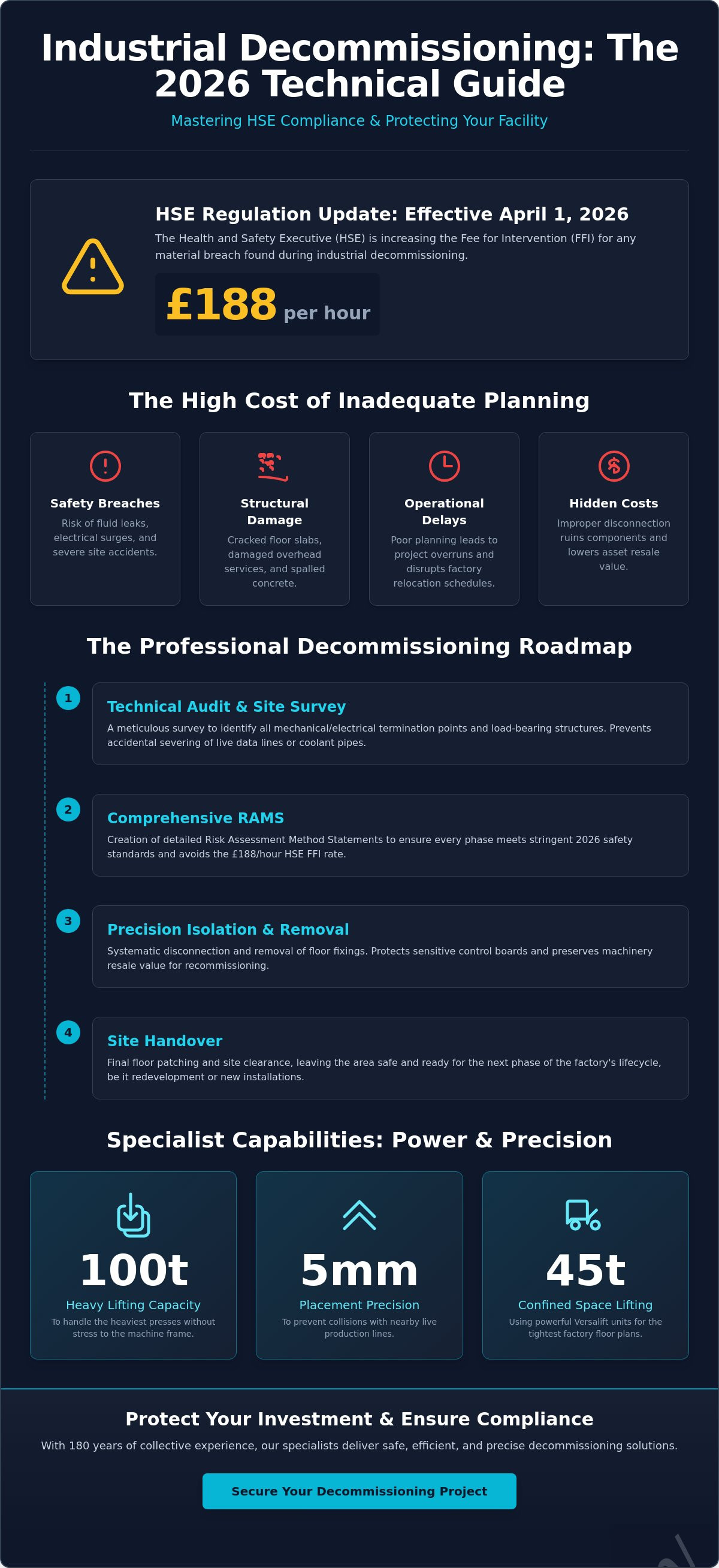
As of April 1, 2026, the Health and Safety Executive (HSE) has increased the Fee for Intervention (FFI) rate to £188 per hour for any material breach found during industrial decommissioning.
This regulatory shift means that any oversight can result in substantial financial penalties alongside operational delays.
You likely feel the pressure of maintaining HSE compliance whilst trying to avoid structural damage to your facility.
Crucially, we understand that hidden costs in factory clearance often stem from poor planning and a lack of technical oversight.
This guide will help you master the technical requirements and safety protocols necessary for successful asset removal within the UK manufacturing sector.
We'll provide a clear roadmap for your project, ensuring you understand the latest 2026 safety standards to minimise disruption.
Best practice dictates that precision is the only way to protect your investment.
As heavy lifting specialists, we advocate for using powerful lifting systems capable of moving 100 tonnes with accuracy to within 5mm.
Key Takeaways
- Understand the systematic steps required for safe industrial decommissioning to protect your factory floor from structural damage. Best practice involves a thorough technical audit before any mechanical or electrical isolations occur.
- As heavy lifting specialists, we advocate for the use of comprehensive RAMS to avoid the £188 per hour HSE Fee for Intervention rates. This ensures every phase of asset removal meets the stringent 2026 safety standards.
- Discover how to use powerful Versalift units capable of lifting 45 tonnes in confined areas to achieve 5mm precision during extraction. These technical capabilities prevent hidden costs associated with accidental building damage.
- Learn to synchronise your removal schedule with factory relocation plans to ensure assets are ready for immediate recommissioning. Efficient timeline management reduces operational disruption whilst moving between sites.
Table of Contents
-
Strategic Differences Between Decommissioning and Scrap Disposal
-
Safety Standards and Compliance for Heavy Plant Decommissioning
-
Integrating Decommissioning into Factory Relocation Projects
You can learn more about our machinery dismantle service to see how we handle complex disconnections.
Industrial Decommissioning Principles in UK Manufacturing
Industrial decommissioning is the systematic process of retiring heavy machinery assets from active service. It involves more than just turning off the power; it requires a detailed understanding of Decommissioning Principles to ensure the safety of the site.
To better understand this concept, watch this helpful video:
This phase is essential for maintaining the structural integrity of factory floors which often bear loads exceeding 50 tonnes per square metre. Crucially, the process integrates into the wider UK manufacturing logistics cycle by preparing space for new technology or site redevelopment.
Precision planning is a technical necessity when dealing with assets that weigh up to 100 tonnes. As heavy lifting specialists, we advocate for meticulous surveys to prevent damage to the building fabric during the removal phase.
Our engineers perform detailed surveys to identify all mechanical and electrical termination points. This technical oversight prevents the accidental severing of live data lines or coolant pipes.
The Scope of Modern Industrial Decommissioning
We differentiate between temporary decommissioning for machinery storage and permanent factory clearance. Temporary measures focus on preservation whilst permanent removal clears the path for total site reconfiguration.
Common assets requiring specialist attention include complex CNC centres and high speed press lines. Silver Knight brings 180 years of collective experience to these complex projects to ensure every bolt is removed safely.
Our team manages the entire lifecycle of the asset, from the initial audit to the final floor patch. Best practice ensures that every stage of the project is documented to satisfy insurance and safety requirements.
The systematic removal of floor fixings is performed with precision to avoid spalling the concrete surface. We ensure the site is left in a safe condition for the next phase of the factory lifecycle.
Why Professional Decommissioning is Crucial
Improper disconnection carries high risks of fluid leaks and electrical surges that can ruin sensitive control boards. Professional handling protects the resale value of industrial machinery by ensuring components remain in peak condition for future use.
We utilise powerful Versalift units with 45 tonne lifting capacities to extract equipment from the tightest floor plans. These machines offer precision to within 5mm, which is vital for preventing collisions with nearby live production lines.
Failure to use specialist equipment can result in cracked floor slabs or damaged overhead services. As heavy lifting specialists, we advocate for using the iron fairy fleet to maintain control in restricted heights.
Our experts use powerful hydraulic systems capable of moving 100 tonnes to ensure even the heaviest presses are handled without stress to the machine frame. This level of care is what separates professional decommissioning from basic scrap removal.
To ensure your project remains on schedule, you can book our machinery dismantle service for precision engineering support.
Technical Phases of Asset Decommissioning
UK manufacturing facilities are currently undergoing a 12% increase in floor space reconfiguration to accommodate automation.
This shift requires a systematic approach to retiring older assets through professional decommissioning.
Poorly planned removals lead to structural damage or HSE fines that disrupt production.
A multi-phase technical audit provides a clear roadmap for safe asset removal.
Best practice dictates that a site survey must identify load-bearing points and potential obstructions before any heavy equipment moves. This preparation ensures that the removal of 100 tonne assets doesn't compromise the building's structural integrity or floor slabs.
Crucially, we follow UK Safety Standards and Compliance to ensure every phase of the project meets legal requirements. As heavy lifting specialists, we advocate for a phased approach that prioritises safety and site preservation throughout the removal process.
Isolation and Fluid Management
Crucially, the first technical step involves the safe drainage of hydraulic oils and industrial coolants. We utilise specialised pumping systems to ensure zero-leakage during the removal of fluids from systems containing up to 5,000 litres.
Electrical isolation protocols are implemented to prevent high-voltage surges that could damage sensitive control boards. We use precision tools to within 5mm to disconnect delicate sensors and fibre-optic data lines without causing signal degradation.
Mechanical Dismantling and Lifting
We employ jack and slide systems for moving 30 tonne machines in tight spaces where overhead clearance is limited. These systems allow for lateral movement with millimetre accuracy to navigate around structural pillars and live production lines.
The Iron Fairy fleet is essential in low-headroom decommissioning environments where traditional cranes cannot operate. These compact units are capable of lifting 10 tonnes whilst maintaining a low profile for navigating through standard industrial doorways.
If you require technical support for complex machinery, our machinery dismantle service provides the expertise needed for safe extraction. Our engineers use powerful hydraulic gantry systems capable of lifting 100 tonnes to lift heavy press sections vertically before transport.
The final phase involves a comprehensive handover where the facility manager receives all documentation and safety certificates. This includes the final RAMS and a clean site declaration to confirm the area is ready for its next industrial use.
Protect your assets for international transit with our shipping container packing service to ensure safe delivery.
Strategic Differences Between Decommissioning and Scrap Disposal
Industrial assets often retain high commercial value even after twenty years of consistent production. Whilst scrap disposal focuses on the destruction of materials for metal recovery, decommissioning aims for the total preservation of functional integrity.
This strategic distinction allows for the future recommissioning of assets at new sites or their sale on the secondary market. Crucially, we follow the Technical Phases of Asset Decommissioning to ensure every component is documented and protected.
As heavy lifting specialists, we advocate for treating every machine as a precision instrument rather than industrial waste. This approach significantly reduces the environmental impact by extending the lifecycle of heavy plant through reuse instead of recycling.
Preserving a machine that has operated for 20 years requires a deep understanding of its specific mechanical wear patterns. By choosing professional decommissioning over disposal, you protect high-tolerance components that are often irreplaceable in older models.
This preservation ensures that the asset remains a viable financial tool rather than a liability on the balance sheet. We use powerful hydraulic systems capable of lifting 100 tonnes to move these machines without inducing frame stress.
Asset Preservation Techniques
Preserving the alignment of internal drive shafts requires bracing techniques that prevent even 1mm shifts during transit. We provide professional export packing that utilises moisture-resistant barriers to protect sensitive electronics from sea air during international transport.
Our team uses powerful vacuum sealing technology for 10 years of protection against corrosion in long-term storage. You can secure your global moves through our shipping container packing service which includes bespoke timber crating.
Commercial Value and Factory Clearance
A systematic factory clearance improves the property value of an industrial unit by returning the floor to its original condition. Best practice involves removing all redundant fixings and patching floor voids to meet the lease-end requirements of commercial landlords.
We possess the technical capacity to clear 5000 square metre facilities within 48-hour production windows. Our experts use specialised equipment to ensure that the removal of 100 tonne presses does not leave permanent scars on the reinforced concrete slabs.
Efficient clearance also reduces the holding costs for vacant industrial units by preparing them for immediate re-letting. Crucially, our iron fairy fleet allows us to navigate 5000 square metre facilities quickly without damaging existing overhead infrastructure.
We use precision to within 5mm when clearing floor fixings to ensure the structural slab remains intact. This level of care maintains the site's utility for future tenants who require high-load capacity floors.
You can ensure total compliance by using our heavy moving equipment hire service for your next project.
Safety Standards and Compliance for Heavy Plant Decommissioning
The Health and Safety Executive (HSE) increased the Fee for Intervention (FFI) rate to £188 per hour on April 1, 2026.
This makes regulatory compliance a financial priority for every decommissioning project.
Managing the risks of stored energy and heavy lifts requires more than just basic insurance.
As heavy lifting specialists, we advocate for a technical approach that exceeds standard legal requirements.
Crucially, every project must adhere to the Lifting Operations and Lifting Equipment Regulations (LOLER) 1998. We ensure that all equipment is inspected every 6 months to maintain absolute safety during the extraction of 100 tonne assets.
Provision and Use of Work Equipment Regulations (PUWER) compliance is equally vital for the dismantling phase. Our team verifies that every tool is suitable for the task, whether it is a small hand-held cutter or a powerful gantry system with a 100 tonne lifting capacity.
Best practice involves using qualified operators who hold a valid CPCS or NPORS licence for heavy plant. Their expertise allows for precise movements within 5mm, which is essential when working amongst live factory services.
Site safety is enhanced when using the Iron Fairy fleet for low-headroom lifts. These machines are designed to operate within 5mm of overhead obstructions without compromising the stability of the load.
Risk Management and Site Safety
Decommissioning presents unique hazards such as residual hydraulic pressure or unstable machine bases. We manage these site-specific risks by conducting a thorough audit of the machinery footprint before any work begins.
Crucially, full RAMS are provided for every single lift to ensure all personnel understand the safety boundaries. This documentation includes detailed calculations for floor loadings and crane outrigger pressures to protect your 5000 square metre facility.
We also account for the forthcoming changes to RIDDOR reporting which are under consultation until June 30, 2026. Staying ahead of these regulatory updates ensures your project remains compliant with the latest UK safety standards.
Professional Lifting Equipment Standards
General purpose forklifts often lack the stability needed for top-heavy industrial assets. We utilise specialised equipment like the Versalift fleet which provides 45 tonne lifting capacities in restricted aisles.
Our powerful gantry systems are maintained to rigorous standards to ensure they operate reliably for 15 years of heavy-duty service. If you need certified gear for your site, our heavy moving equipment hire service provides fully tested and compliant machinery.
Our maintenance logs are available for inspection for every piece of equipment we bring to your site. This transparency is part of our commitment to maintaining a zero-incident record across all manufacturing sectors.
As heavy lifting specialists, we advocate for the use of Jack and Slide systems when moving 30 tonne machines through narrow doorways. These systems provide a controlled method of relocation that eliminates the risks associated with suspended loads in confined spaces.
Streamline your entire move by consulting our factory relocation service for a seamless site transition.
Integrating Decommissioning into Factory Relocation Projects
The UK decommissioning market is projected to reach a value of USD 1.79 billion by the end of 2026.
This growth reflects a wider trend of industrial modernisation and factory relocation across the manufacturing sector.
Managing the gap between closing an old site and opening a new one remains a significant logistical hurdle.
Integrating the removal and installation phases into one workflow is the most effective solution for reducing downtime.
Professional decommissioning serves as the technical foundation for a successful relocation project. By treating the removal of 100 tonne assets as the first stage of installation, we eliminate the risk of missing components or damaged connections.
Timeline management between site A and site B is critical for minimising operational downtime. Using a single partner for the entire relocation cycle provides a unified point of contact and accountability for the machine's safety.
You can find more detail in our factory relocation services guide regarding technical removals. As heavy lifting specialists, we advocate for a holistic view where the end of one production line is simply the start of the next.
Planning for Recommissioning
Careful labelling and mapping of electrical terminations during decommissioning saves approximately 15% of the total installation time. We document every connection to ensure that complex CNC centres can be reassembled with precision to within 5mm at the destination facility.
Technical site surveys at the destination facility are essential for verifying floor load capacities before the machines arrive. Crucially, we ensure that the new production lines are positioned to within 5mm to align perfectly with existing overhead supply lines.
Nationwide and International Logistics
The transition from decommissioning to heavy haulage requires specialised transport frames designed to secure oversized equipment during high-speed transit. Silver Knight possesses the capability to move assets across the UK or globally using our own fleet of specialised vehicles equipped with air-ride suspension for sensitive machinery.
Coordination for oversized loads on UK motorways involves strict adherence to police notification periods and route planning. Our powerful tractor units are capable of pulling 100 tonnes across long distances whilst maintaining the safety of the cargo.
Best practice involves using a partner who understands both the dismantling and the transport requirements of heavy plant. We utilise our Versalift and iron fairy fleet, which are designed to operate in restricted loading bays, to load machines directly onto low-loaders for immediate dispatch.
Securing Your Industrial Future through Precision Decommissioning
Successful decommissioning requires a transition from simple dismantling to precision engineering. As heavy lifting specialists, we advocate for using powerful 100 tonne gantry systems to ensure site safety and structural integrity.
You've seen how technical audits and strict adherence to the £188 per hour HSE Fee for Intervention rates protect your bottom line. Best practice involves integrating these removal phases with your wider relocation strategy to maintain production momentum and avoid 10% downtime increases.
We offer collective 180 year industry experience to manage your most complex asset removals across the UK. Crucially, we provide full RAMS for every project to ensure 100% compliance with LOLER and PUWER standards during every lift.
You can contact our specialist 180 year engineering team to discuss your decommissioning project requirements and secure a technical survey for your facility. Our iron fairy fleet is ready to navigate your 5000 square metre facility with 5mm precision to protect your floor slabs.
Taking the right steps now ensures your machinery remains a valuable 20 year asset. We look forward to supporting your next factory transition with our specialist 100 tonne lifting fleet.
If you require expert assistance with your facility, you can explore our factory clearance services for a complete site solution.
Frequently Asked Questions
What is the definition of industrial decommissioning
Industrial decommissioning is the systematic process of retiring heavy machinery assets from active service whilst ensuring the site remains safe. Crucially, this process includes electrical isolation and fluid management to protect the structural integrity of factory floors.
Full RAMS provided for every project ensure that every 100 tonne asset is removed without risk.
Do I need a structural survey before decommissioning heavy machinery
Best practice dictates that a structural survey is essential when moving assets that exceed 50 tonnes per square metre in floor loading. This technical audit prevents damage to the building fabric during the extraction of heavy press lines.
Our team uses powerful Versalift units with 45 tonne capacities to ensure precision to within 5mm during the lift.
How long does it take to decommission a standard production line
A standard production line typically takes 3 to 5 days to clear depending on the complexity of the electrical and mechanical isolations. We utilise powerful hydraulic gantry systems capable of lifting 100 tonnes to accelerate the removal of heavy sections.
Every project follows a strict timeline to ensure your facility is cleared within a 48 hour production window.
Is decommissioning required for machinery being moved to storage
Yes, retiring assets for storage requires a systematic process to prevent the degradation of sensitive internal components. We apply moisture-resistant barriers that provide 10 years of protection against corrosion for assets in our secure warehouses.
As heavy lifting specialists, we advocate for bracing internal parts to prevent 1mm shifts during the transport phase.
What safety certifications are required for decommissioning teams
Specialist teams must hold valid CPCS or NPORS certifications to operate heavy plant and lifting equipment on industrial sites. Our operators are trained to use the iron fairy fleet with precision to within 5mm in restricted headroom environments.
Crucially, all our lifting gear undergoes LOLER inspections every 6 months to maintain absolute safety.
Can decommissioning be performed whilst the rest of the factory is operational
The decommissioning can be performed in a live environment provided that strict exclusion zones are maintained to protect the workforce. We use compact Versalift units designed to lift 45 tonnes whilst navigating narrow 3 metre aisles without disrupting nearby production lines.
Full RAMS provided for every project detail the specific measures taken to segregate activities from operational staff.

Article by
David Ashby
I'm the Managing Director of Silver Knight Haulage & Machinery Ltd. Silver Knight Ltd is a family-run firm established in the West Midlands in 2005, with the aim of providing a cost-effective, yet professional, service to businesses for the removal, transportation, and installation of machinery, plant, and equipment here in the UK and worldwide. Between us, the Silver Knight workforce has over 50 years of experience with machinery and its operation.
Disclaimer
This article is intended for informational purposes only. Please ensure you seek expert advice or carry out your own research to confirm the information is suitable for your specific needs.