What if the lowest heavy haulage price per mile UK quote doesn’t cover everything your move needs? A mileage figure can be a useful starting point, but it won’t tell you whether the quote accounts for specialist equipment, route planning, permits, loading or access at either site.
It’s reasonable to want a clear rate and a fair way to compare options. The difficulty is that two quotes with similar mileage can cover very different work, especially when machinery needs more than transport from A to B. A low headline figure may leave important parts of the move outside the quoted scope.
This guide explains what shapes a heavy haulage quote and what to look for beyond the per-mile rate. You’ll learn how load size and weight, route requirements, lifting needs and site access can affect the work, what a useful quote should set out, and which details to prepare when requesting a tailored quotation. That makes it easier to compare responsibilities and scope, not just miles.
Key Takeaways
- A heavy haulage price per mile UK figure is only useful when you know how the distance is calculated and what the quote covers.
- Load dimensions, weight, handling needs and site access can all affect the equipment and planning required.
- Compare quotes by checking route basis, equipment, responsibilities and exclusions, not just the headline mileage rate.
- Prepare clear load and site details, plus any available photographs or drawings, to support a more accurate quotation.
- For machinery moves, consider whether haulage needs to fit into a wider project involving lifting, installation or relocation.
Discuss your haulage requirements and explore transport planning shaped around your load and project.
What heavy haulage price per mile in the UK really tells you
A heavy haulage price per mile UK figure is one part of a transport quotation, not a complete price for every task involved in moving machinery. It helps describe the transport element, but only makes sense alongside the work included and the distance used to calculate it.
Before comparing figures, check that each quotation explains the journey distance and how mileage is counted. For example, does it cover the loaded journey only, or other parts of the vehicle’s route too? Without a clear basis, two rates may look similar while referring to different amounts of transport work.
Why one mileage figure cannot describe every heavy load
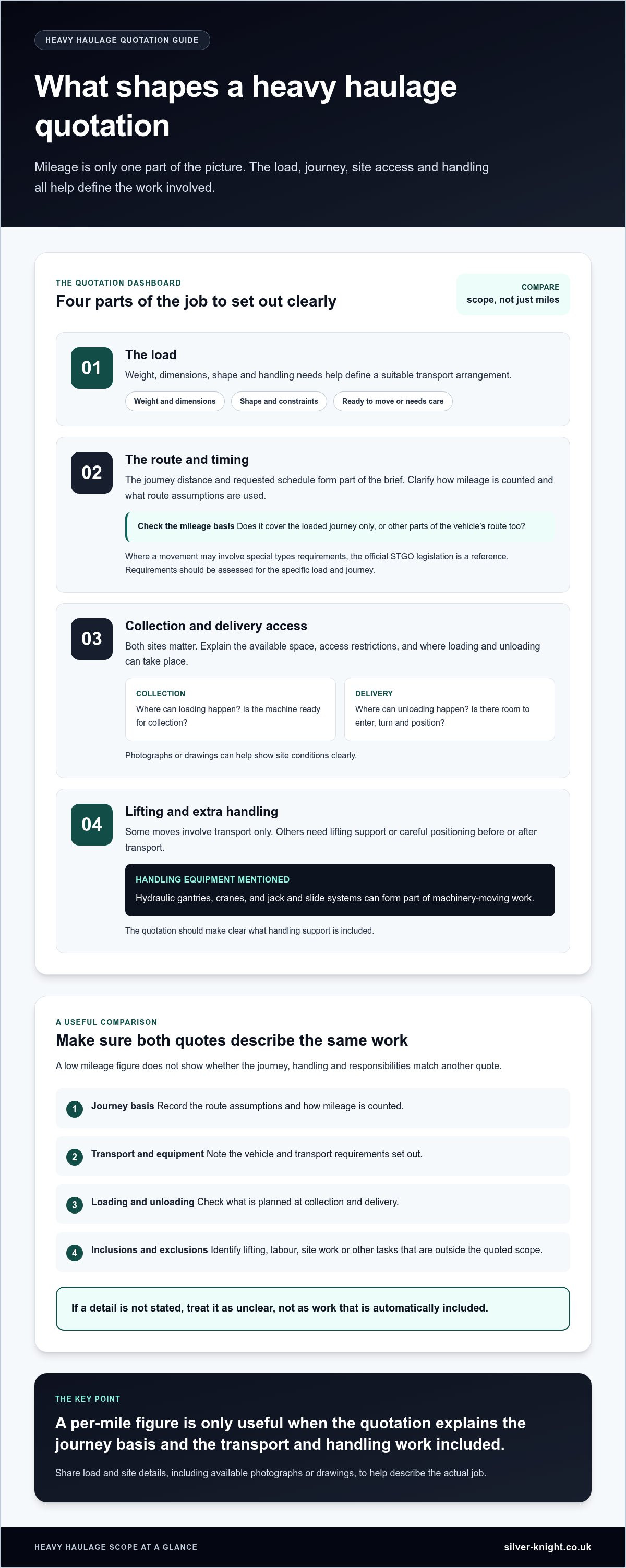
Weight, dimensions, shape and handling needs all help define the transport brief. A machine that is ready to load presents a different job from one that needs lifting into position at the collection site. Route distance alone doesn’t describe those tasks, or whether the vehicle can reach and manoeuvre at both sites.
For instance, one move might involve machinery that is ready for collection, whilst another requires lifting support and careful positioning at delivery. The journeys could be similar in distance, but the work around them is not. A heavy hauler is designed for specialist loads, but the vehicle is only one part of planning a machinery move.
What a heavy haulage quote may cover
A quotation may set out the transport and vehicle requirements, as well as any planned survey, specialist labour or lifting equipment. Where machinery moving forms part of a wider project, the scope may also need to cover lifting, positioning or installation. These elements should be stated clearly, rather than assumed to sit within a mileage rate.
Read the inclusions and exclusions together. If one quote covers transport only and another includes lifting or site work, the headline mileage figures don’t represent the same service. Silver Knight can tailor a quotation to the load, route and wider project scope, including machinery-moving requirements.
A per-mile figure is only useful when the quotation states the journey basis and the transport and handling work included.
Talk through your transport needs and explore a quotation shaped around the load, route and handling involved.
Which factors shape a UK heavy haulage quotation
The heavy haulage price per mile UK is shaped by more than distance. A useful quotation considers the load, the journey and what needs to happen at both ends. Accurate details help match the transport plan to the actual job, rather than relying on assumptions that could affect vehicle choice or handling.
Load details and site access that matter
Weight and dimensions help establish what transport arrangement may suit the load. Shape matters too. An awkward form or handling constraint can affect how machinery needs to be loaded and secured. Share any known requirements, including whether the machine can be moved as it is or needs particular care.
Collection and delivery sites are just as important. Explain the available space, any access restrictions, where loading and unloading can take place, and what arrangements are already in place. A vehicle may need room to enter, turn and position. Photographs or drawings can help show site conditions clearly.
Route, timing and handling requirements
The route, loading and unloading arrangements, and requested schedule all form part of the quotation brief. Timing may affect how the movement fits alongside site operations or other work. Where a movement may involve special types requirements, the official STGO legislation is a reference for the rules. Requirements should be assessed for the specific load and journey, not assumed from mileage alone.
Give the same level of detail about both ends of the journey. Machinery ready for collection with clear loading arrangements presents a different handling brief from equipment that needs lifting support before it can be placed on the transport. The heavy equipment haulage service can form part of a wider machinery-moving project.
When lifting equipment or extra handling changes the scope
Some moves involve transport only; others also need lifting or careful positioning. Silver Knight uses hydraulic gantries, cranes and jack and slide systems as part of machinery-moving work, with equipment selected to suit the project. These requirements affect the work being planned, so the quotation should make clear what handling support is included.
Share your load and site details to discuss a quotation tailored to the transport and project scope.
Compare your project requirements and consider the full scope of work behind each quotation.
How to compare heavy haulage quotes beyond the rate per mile
A low mileage figure may look attractive, but it doesn’t show whether the quotation covers the same journey, handling and responsibilities as another. Compare the details side by side and record what each quote says. If something isn’t stated, treat it as unclear, not as work that’s automatically included.
Comparable quotes need comparable scopes. Use a simple table to make gaps and differences easier to spot.
| What to compare | Quote A | Quote B |
|---|---|---|
| Collection | Record the collection point and loading arrangements | Record the collection point and loading arrangements |
| Delivery | Note the destination and unloading arrangements | Note the destination and unloading arrangements |
| Route assumptions | Write down the stated route and mileage basis | Write down the stated route and mileage basis |
| Handling and equipment | List included labour, lifting or specialist equipment | List included labour, lifting or specialist equipment |
| Responsibilities | Note what you or the site team must arrange | Note what you or the site team must arrange |
| Exclusions | Copy any work or costs stated as excluded | Copy any work or costs stated as excluded |
Look closely at collection and delivery conditions, route assumptions, and the division of work between the haulage team and your site staff. Don’t fill gaps by guessing. Ask for the scope to be made clear before treating two offers as like for like. The Department for Transport statistics provide wider context on road freight activity, but they are not a pricing guide for a specialist machinery move.
Separate transport from a managed machinery move
If the job is simply moving a load between two sites, focus on the transport scope and its collection and delivery arrangements. If the machinery also needs lifting, positioning or installation, compare those tasks as part of the project, not as though they’re covered by a mileage rate. Silver Knight’s machinery haulage and relocation service connects transport with wider machinery-moving requirements.
Use the comparison to identify differences, then discuss your project requirements for a quotation tailored to its load, route and scope.
Prepare a tailored haulage enquiry with clear load, route and site details.
What information to prepare before requesting a heavy haulage quote
A clear brief helps shape a quotation around the actual move, rather than a mileage figure based on missing or assumed details. Gather what you know before making an enquiry. If some information is unavailable, say so and share any useful supporting material, such as photographs, drawings or equipment documents.
Gather the load and route details
Work through these details in order. The more complete the information, the easier it is to understand the transport and handling requirements.
- Describe the machinery. Include its type, known weight and dimensions, plus details of its shape or any special handling needs.
- Set out the journey. Provide the collection and delivery addresses, along with any known access restrictions or available space at each site.
- Explain the site arrangements. Note how the machinery can be loaded and unloaded, who will be present, and whether the sites have any particular operating requirements.
- Share supporting information. Include photographs, drawings or equipment details if you have them. These can help explain the load and its surroundings more clearly.
- Describe the wider work. Flag whether dismantling, storage, lifting, positioning or installation forms part of the project, rather than transport alone.
Be as specific as you can, but don’t guess. If a weight or measurement is uncertain, mark it as an estimate so it isn’t mistaken for confirmed information. Clear details about collection, delivery and handling help tailor the proposal to the job.
Clarify what the quotation covers
Set out who is arranging loading, unloading and site preparation, and identify any work you expect to be included. Ask for the quotation to record inclusions, exclusions and customer responsibilities in writing. This makes it easier to see how the proposed work aligns with your plan and to avoid treating unstated tasks as part of the transport scope.
If the haulage sits within a larger site move, describe the wider sequence and any machinery-moving or installation work involved. Silver Knight’s factory relocation service connects transport planning with the needs of a broader relocation project.
Once you’ve gathered the details, send your load and site information for a tailored quotation.
Discuss your machinery move with a team that can consider the transport and the wider project requirements.
How Silver Knight approaches specialist heavy haulage in the UK
Silver Knight is a family-run specialist in machinery moving and heavy equipment haulage. With over 180 years of collective industry experience, the team plans quotations around the specific load, route, access and work involved. That means the heavy haulage price per mile UK is considered in the context of the full transport brief, rather than treated as the whole project cost.
When specialist machinery moving supports the transport
Some projects need transport alone. Others also involve lifting machinery at collection or delivery, positioning it within a site, or installing it as part of a relocation. These tasks affect the project scope and need to be considered alongside the journey.
Silver Knight uses hydraulic gantries, cranes and jack and slide systems as part of machinery-moving work, with equipment selected to suit the project. You can view the specialist machinery-moving equipment to learn more about the equipment used for these projects. Setting out handling needs early helps ensure the quotation reflects the wider work, not only the transport.
The next step towards a tailored quotation
To help shape a project-specific quotation, share the information you have about:
- the machinery type, known weight, dimensions and any handling needs
- the collection and delivery locations, including access details at each site
- loading and unloading arrangements, and any lifting or positioning support required
- related work such as installation, dismantling or a wider factory relocation
Photographs, drawings or equipment details can also help explain the load and site conditions. If some information is uncertain, identify it as an estimate rather than leaving the detail open to interpretation. Silver Knight tailors quotations to the load, route, access and project scope, so the proposed work can reflect the requirements you share.
Send your load and project details to discuss a tailored heavy haulage quotation with Silver Knight.
Plan your next machinery move with confidence
A heavy haulage price per mile UK figure only tells part of the story. To compare quotations fairly, look at the route basis, what handling and equipment are included, and who is responsible for each part of the move. Accurate load, access and site details help shape a proposal around the real scope, whether you need transport alone or support with lifting, positioning or installation.
Silver Knight is a family-run machinery-moving specialist with over 180 years of collective industry experience. Its project equipment includes hydraulic gantries, cranes and jack and slide systems, selected to suit the work involved.
Share your machinery details, route and site requirements to start a project-specific discussion. Discuss your heavy haulage requirements with Silver Knight and take the next step towards a well-planned move.
Frequently Asked Questions
How much does heavy haulage cost per mile in the UK?
There isn’t one rate that suits every job, so a single heavy haulage price per mile UK figure can be misleading. The quotation depends on the load, route and work involved. For machinery, handling needs, site access and specialist equipment may all affect the scope. Compare written quotations that explain the mileage basis and what’s included, rather than choosing by the headline rate alone.
What affects a heavy haulage quote?
A heavy haulage quote can depend on the machinery’s weight, dimensions, shape and handling needs, as well as the route and access at both sites. Loading and unloading arrangements matter too. If lifting or positioning is needed, that work should be reflected in the quotation. Share accurate details and use a written scope that sets out included work, exclusions and your responsibilities.
Is heavy haulage priced only by distance?
No. Distance is one part of the transport requirement, but it doesn’t describe the load, access conditions or handling work. A machinery move may also involve planning, specialist labour or lifting equipment. Check how the mileage has been calculated and what the quotation covers. Comparing the full scope gives a clearer view than looking at distance alone.
Can I compare heavy haulage quotes by price per mile?
Yes, but only if the mileage basis and services are comparable. Check that each quotation relates to the same load, collection and delivery requirements, and compare the handling, equipment and responsibilities listed. A lower mileage figure may cover a narrower scope. Record inclusions, exclusions and any work you need to arrange so you can compare the quotations on a like-for-like basis.
Why might machinery transport need more than a standard haulage service?
Some machinery moves involve more than taking a load between two sites. The equipment may need specialist lifting, careful positioning or installation as part of the project. Site access and loading arrangements also shape the work. Silver Knight provides machinery moving and installation alongside heavy haulage, with equipment such as hydraulic gantries, cranes and jack and slide systems used to suit project needs.
What information should I provide for a heavy haulage quote?
Share the machinery type, known weight and dimensions, collection and delivery details, and any access or handling requirements. Explain who will arrange loading and unloading, and whether lifting, dismantling, storage or installation is part of the job. Photographs, drawings or equipment information can help describe the move. Clear details allow Silver Knight to tailor a quotation to the load, route and project scope.

Article by
David Ashby
I'm the Managing Director of Silver Knight Haulage & Machinery Ltd. Silver Knight Ltd is a family-run firm established in the West Midlands in 2005, with the aim of providing a cost-effective, yet professional, service to businesses for the removal, transportation, and installation of machinery, plant, and equipment here in the UK and worldwide. Between us, the Silver Knight workforce has over 50 years of experience with machinery and its operation.
Disclaimer
This article is intended for informational purposes only. Please ensure you seek expert advice or carry out your own research to confirm the information is suitable for your specific needs.