A factory move is rarely approved on ambition alone. Getting management buy-in for a factory move means showing what the business could gain and how production, people, equipment and budgets will be protected along the way. If the benefits feel uncertain and disruption feels immediate, decision-makers need stronger evidence.
You may already know why a move matters, whether the aim is to support growth, improve operations or address limits at the current site. But competing departmental priorities can make a proposal difficult to assess. Build an evidence-led case that connects the move to business priorities and answers questions about continuity, risk, cost and implementation. Early input from a machinery relocation specialist can help shape a realistic scope. The goal is a clear decision backed by a practical plan, not simply a broad promise.
Key Takeaways
- Start with the business need, then assess possible solutions without treating a preferred site as a foregone conclusion.
- Compare the current site, the proposed move and credible alternatives using the same criteria and evidence from your organisation.
- For getting management buy-in for a factory move, connect each concern to supporting evidence, a response and an accountable owner.
- Present the proposal in a clear sequence, from business need and options through to risks, recommendation and the decision required.
- Turn approval into written conditions, named leads and agreed reporting, with the next commitment matched to the decision made.
Planning a factory move? Explore specialist factory relocation support.
Getting management buy-in for a factory move starts with the business need
A factory move is one possible response to a business need, not the need itself. A preferred building or site may look like the answer, but management first needs to understand the problem the business is trying to solve. Production may be constrained by the current layout, workflows may make it difficult to move materials efficiently, or the site may not support the equipment or capacity the business expects to need. State the issue before recommending a solution.
Set out a concise baseline: the current constraints, the business goals and what may happen if the organisation stays where it is. Draw on relevant records, such as production plans, equipment information, workflow assessments and business forecasts. Keep the case grounded in your organisation’s evidence, and identify any outcomes that still need to be tested.
For a useful perspective on aligning people around a major project, watch this video on stakeholder management.
What should a factory move proposal ask management to decide
Be specific about the decision you want. Are leaders being asked to approve an initial investigation, further project development or the move itself? Each requires a different level of evidence and commitment. Name the decision owner, the people who will contribute and the information management needs before its next decision.
Separate confirmed facts from planning assumptions and unresolved questions. For example, distinguish known equipment requirements from details that still need assessment. This helps management see what is established, where uncertainty remains and what work could reduce it. Buy-in means an informed decision, clear ownership and agreed conditions for proceeding, not simply general support for the idea.
How to connect the move to business priorities
Show how the business need relates to priorities such as operational capacity, workflow, resilience or future requirements. Describe the current problem using relevant internal evidence, then explain how a move could address it. Avoid promising improved output, lower costs or other benefits until the organisation has assessed and validated them.
Early input from a machinery relocation specialist can help shape a realistic scope by identifying practical considerations around equipment, lifting and transport. Silver Knight’s factory relocation service supports the move from an approved direction towards relocation activity. Effective change management also helps bring people into the process, so their needs are considered alongside operational plans.
As you shape a practical move scope, explore Silver Knight’s factory relocation support.
Build a factory move business case management can assess
A strong business case lets management compare options on equal terms. Agree the criteria first, then assess the current site, the proposed move and credible alternatives, such as changing the existing layout or equipment. This helps show whether relocation addresses the business need more effectively than other available choices.
Choose measures that matter to the organisation
Select measures linked to the project’s aims, such as usable capacity, workflow constraints, equipment requirements or the effect on production. For each measure, record the current baseline, the change being considered, the information source and the person responsible for it. If an estimate is uncertain, show a range or compare scenarios, and state the assumptions behind each one.
Separate costs and benefits by category rather than relying on a single headline figure. Use the organisation’s own estimates in pounds sterling and state what each figure includes. Consider the resources needed to plan and deliver the move, transition impacts, dependencies and potential effects on production. Set expected benefits beside these requirements, but label them as estimates until they have been assessed and validated.
Compare moving with staying or changing the current site
Staying put is still a choice, so assess its likely consequences alongside relocation and other viable options. Apply the same evaluation period, operating assumptions and criteria to each. For example, compare how each option addresses a workflow constraint, what work or resources it requires, and how it may affect production during implementation. This makes trade-offs clearer and reduces the risk of giving one option an unfair advantage.
For a relocation option, early specialist input can help clarify practical scope, including machinery moving, lifting and transport needs. Silver Knight’s factory relocation services can support the development of those requirements. Keep the comparison focused on what the evidence supports, not on benefits that have yet to be tested.
Finish with a short decision summary that management can review alongside the detailed evidence. Include the options assessed, key findings, confirmed facts, assumptions, uncertainties and the decision requested. Make clear what further information is needed and who will provide it. This gives leaders a traceable basis for deciding whether to proceed, commission more assessment or consider another option, and supports getting management buy-in for a factory move without overstating the case.
When assessing how to plan a move, explore specialist factory relocation support.
Address management concerns about disruption, risk and investment
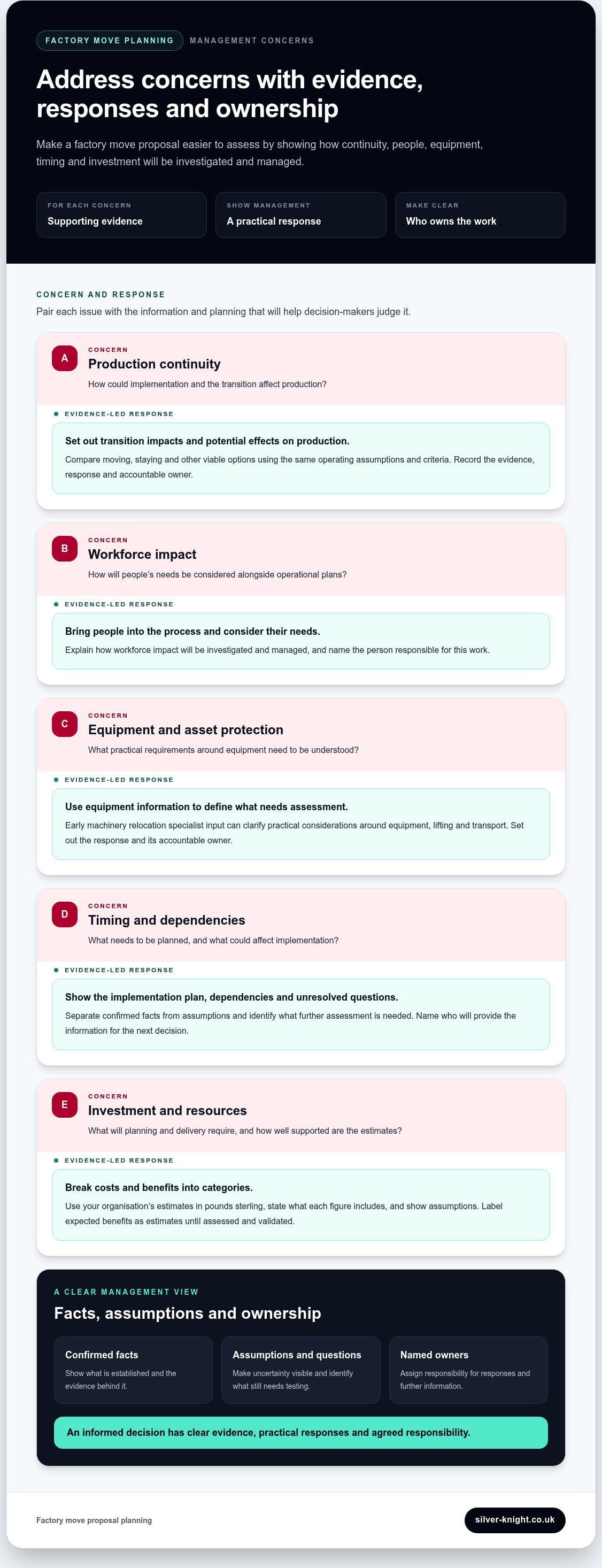
Management can assess a proposal more clearly when each concern has a practical response, supporting evidence and a named owner. Show how production continuity, workforce impact, asset protection, timing and investment will be investigated and managed. Don’t present mitigation as a promise that disruption or risk will disappear. Separate risks that planning can reduce from uncertainties that need further investigation, contingency planning or a management decision.
A simple risk and response table can help keep the discussion focused.
| Concern | Evidence to gather | Response to develop | Accountable owner |
|---|---|---|---|
| Production continuity | Production sequences, equipment dependencies and stock needs | Assess phasing, temporary arrangements or planned downtime | Operations lead |
| Workforce impact | Roles, skills and teams affected by the move | Plan communication, involvement and support through the transition | People lead |
| Machinery and asset protection | Equipment information, access requirements and installation needs | Coordinate disconnection, lifting, transport, positioning and recommissioning | Engineering or relocation lead |
| Timing and investment | Dependencies, resource needs and organisation-approved estimates | Set out assumptions, decision points and contingency options | Project sponsor and finance lead |
Build a realistic production continuity plan
Map how equipment, utilities, people, stock and production sequences depend on one another. A machine may be ready to move, for example, but the plan also needs to account for the services and processes it relies on before and after relocation. Use this map to assess whether work could be phased, temporary arrangements are practical or planned downtime is needed. A credible plan depends on accurate operational information, agreed priorities and clear ownership.
Plan machinery moving as a connected workstream
Machinery relocation involves linked tasks, from disconnection and lifting through transport, positioning and recommissioning. Silver Knight’s machinery moving and haulage can form part of the specialist workstream in the proposal. Access to specialist lifting equipment, including hydraulic gantries, cranes and jack and slide systems, is also a practical planning consideration. Early input can help define the scope and identify questions to resolve before the move plan is approved.
For getting management buy-in for a factory move, make uncertainty visible. State what is known, what needs assessment and who will return with the evidence. This gives leaders a sound basis for weighing investment and continuity without suggesting that every risk can be removed.
As you prepare a clear proposal and decision request, explore specialist factory relocation support.
Present the factory move proposal in a clear decision sequence
A well-ordered proposal helps leaders see how the evidence leads to the decision. Start with the business need, then set out the options considered, supporting evidence, key risks and your recommendation. Finish by stating exactly what management is being asked to approve, such as further assessment, project development or the move itself.
Keep the main summary brief, with supporting detail available for those who need it. Senior leaders may focus on the recommendation, investment and decision conditions, whilst operational teams need to understand dependencies, equipment requirements and potential effects on production. Use the same facts and assumptions throughout, even when the level of detail changes. Inconsistent figures or claims can undermine confidence in the proposal.
Involve the right contributors before the meeting
Bring in relevant representatives from operations, finance, facilities, the workforce and production. Ask each to identify requirements, dependencies and evidence from their area. For example, production can explain sequencing needs, whilst facilities can identify site-related requirements. Resolve conflicting assumptions before the meeting where possible. Record any remaining issues, who owns them and whether they need management input.
Prepare a decision pack that makes the next step clear
Include the recommendation, rationale, alternatives, evidence, risks and decision requested. Keep the main decision separate from supporting detail so leaders can review the key points quickly and explore the evidence as needed. A useful pack also shows dependencies, decision gates and next actions without presenting unagreed dates as commitments.
- Decision required: State what management is being asked to approve.
- Conditions: Set out any evidence or actions needed before the next stage.
- Owners: Name who will lead each agreed action.
- Open questions: Record what remains unresolved and how it will be addressed.
Plan the decision meeting around the questions that could change the recommendation. Give each question an owner and identify what evidence would answer it. This keeps discussion focused on decisions rather than revisiting every detail in the pack, and helps turn getting management buy-in for a factory move into a clear, accountable process.
If factory clearance forms part of the proposed scope, explain what needs to be cleared and how that work relates to the wider relocation. Silver Knight’s factory clearance services can be included as a defined workstream where relevant.
As you turn approval into a workable plan, explore specialist factory relocation support.
Turn factory move approval into a controlled next step
Approval should lead to a defined next action, not an open-ended commitment. Record the agreed scope, any conditions management set, the accountable leads and how progress will be reported. If leaders approved further assessment rather than the move itself, keep the next stage focused on gathering the evidence needed for that later decision.
Move from approval to practical planning
Confirm outstanding questions and who will answer them. Where required, arrange a technical site survey to help inform the project plan. Use its findings to build connected workstreams for machinery, transport, installation and operational readiness, with dependencies and decision points visible. This helps teams understand how one activity affects another, without treating early planning assumptions as fixed commitments.
Keep reporting proportionate to the decision made. A short update can track completed actions, unresolved issues, risks and any approvals still needed. If new information changes the scope or assumptions, take it back through the agreed decision route rather than allowing the project to expand without clear authority.
Use specialist input to develop the move plan
Specialist machinery relocation experience can help turn an approved direction into practical planning for lifting, transport and installation. Silver Knight brings more than 180 years of collective industry experience to machinery moving and factory relocation. Where the project requires it, hydraulic gantries, cranes and jack and slide systems can be considered as part of the lifting approach. The right choices depend on the equipment and site requirements, so include them in the project scope rather than assuming a method in advance.
For a business still getting management buy-in for a factory move, showing how approval leads to owned actions can make the proposal more credible. For a move that has been approved, the same discipline helps keep delivery aligned with the decision and its conditions.
To discuss your factory relocation requirements and the practical planning needed for the next stage, speak with Silver Knight about factory relocation.
Explore Silver Knight’s factory relocation support.
Make your next factory move decision with confidence
Getting management buy-in for a factory move starts with a clear business need and a fair comparison of the options. A credible proposal sets out the evidence, assumptions and risks, then makes the decision and next steps clear. Once approved, written scope, ownership and agreed reporting help turn that decision into a controlled plan.
Silver Knight supports machinery moving, installation and factory relocation, bringing more than 180 years of collective industry experience. Where project requirements call for them, hydraulic gantries, cranes and jack and slide systems can form part of the lifting plan. Early specialist input can help shape a practical scope for moving machinery and planning its installation.
Ready to discuss your project requirements? Discuss your factory move with Silver Knight and take the next step towards a workable relocation plan.
Frequently Asked Questions
How do you get senior management to approve a factory move?
Show how the move could address a clear business need, then support your recommendation with evidence, options and a realistic view of risks. Getting management buy-in for a factory move means asking for a specific decision, such as approval to investigate further or develop a project plan. Name the people responsible for the next actions, explain what remains uncertain and set out the conditions management wants met before proceeding.
What should a factory relocation business case include?
Include the business need, current constraints, options considered and evidence for your recommendation. Compare moving with staying or making changes at the current site using consistent criteria. Set out costs, benefits, resources, dependencies and possible production effects using your organisation’s own data. Clearly label confirmed facts, assumptions and open questions, then state the decision required and who will lead any agreed next steps.
How can I show the return on investment of a factory move?
Use internal estimates to compare the investment and transition requirements with the benefits the business expects to gain. Set out the assumptions behind each figure, the period being assessed and any relevant scenarios if estimates are uncertain. Include the consequences of staying as a comparison. Treat projected savings, capacity or workflow gains as estimates until they have been assessed against your organisation’s evidence.
How do you minimise production disruption during a factory relocation?
Map the dependencies between equipment, utilities, people, stock and production sequences before deciding how to stage the move. Use this information to assess whether work can be phased, temporary arrangements are practical or planned downtime is needed. A continuity plan should reflect the operation’s actual requirements and identify who owns each task. It can reduce and manage disruption, but shouldn’t promise that disruption will be eliminated.
Who should be involved in a factory move decision?
Involve the decision-maker and relevant contributors from operations, finance, facilities, the workforce and production. Each should identify requirements, dependencies and supporting evidence from their area. For example, production can explain sequence constraints, whilst finance can review estimates and assumptions. Bring differing views into the proposal early, resolve conflicting assumptions where possible and record any outstanding issues, their owners and the decision needed.
What are the main risks management will consider before a factory move?
Management may focus on production downtime, damage to equipment, budget overruns, worksite safety and the effect on employees. Show the evidence available for each risk, the planned response and an accountable owner. Separate risks that can be reduced through planning from uncertainties that need further investigation, contingency planning or a decision. This gives leaders a balanced view without suggesting that every risk can be removed.
When should a machinery relocation specialist be involved in factory move planning?
Involve a machinery relocation specialist while the scope is being developed, before key assumptions about lifting, transport and installation become fixed. Early input can help identify practical requirements and shape a more realistic plan for moving and recommissioning equipment. Silver Knight provides machinery moving, installation and factory relocation, backed by more than 180 years of collective industry experience and access to hydraulic gantries, cranes and jack and slide systems.
Planning a factory move? Talk to Silver Knight about your machinery moving and relocation requirements.
Article by
David Ashby
I'm the Managing Director of Silver Knight Haulage & Machinery Ltd. Silver Knight Ltd is a family-run firm established in the West Midlands in 2005, with the aim of providing a cost-effective, yet professional, service to businesses for the removal, transportation, and installation of machinery, plant, and equipment here in the UK and worldwide. Between us, the Silver Knight workforce has over 50 years of experience with machinery and its operation.
Disclaimer
This article is intended for informational purposes only. Please ensure you seek expert advice or carry out your own research to confirm the information is suitable for your specific needs.