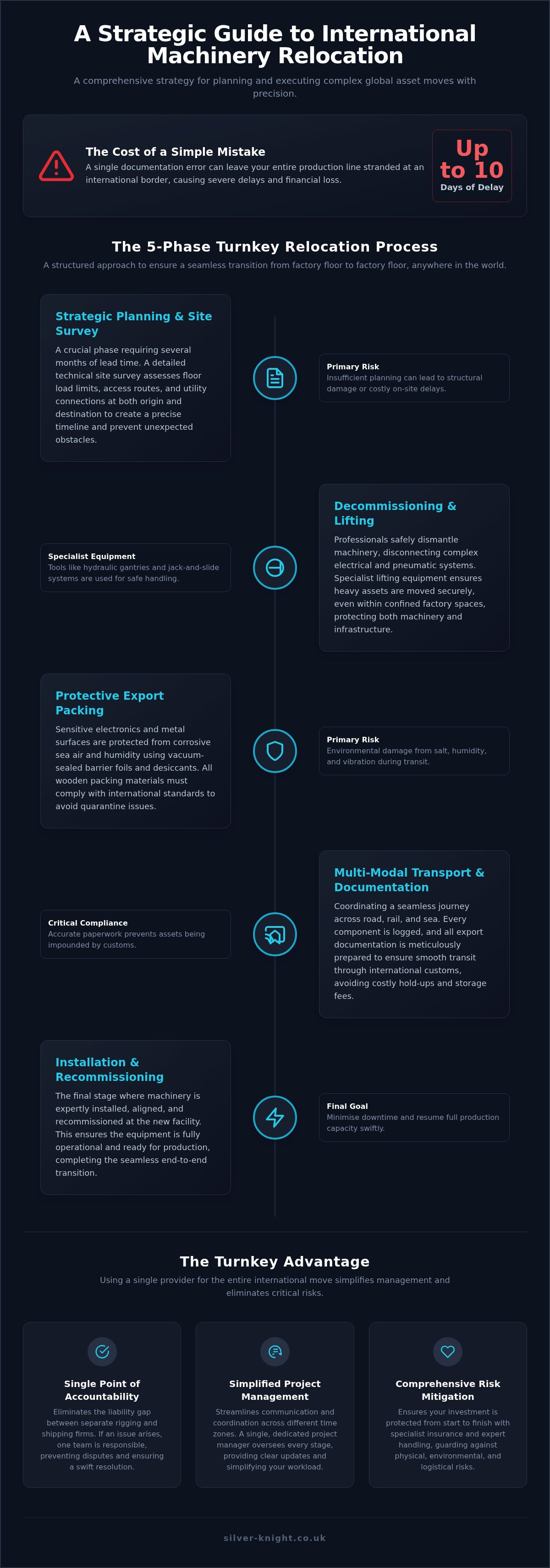
Did you know that a single documentation error can leave your production line stranded at an international border for up to ten days? For many manufacturers, the prospect of shifting heavy assets across the globe feels like a gamble with their most valuable investments. You likely worry about the corrosive effects of sea air on sensitive electronics or the sheer complexity of coordinating teams across different continents whilst trying to keep your project on track. Partnering with specialist international machinery movers is the only way to mitigate these risks effectively.
It is an intricate process that demands more than just a standard haulage firm. This guide provides a comprehensive strategy for planning your 2026 relocation with total precision. We will show you how to move from the initial decommissioning and bespoke export packing through to the final recommissioning at your new facility. You will learn how to maintain clear communication throughout the transit process and ensure your equipment meets every international standard. This approach gives you the confidence to expand your operations anywhere in the world without the fear of costly downtime or transit damage.
Key Takeaways
- Learn why standard transport insurance is often insufficient for global moves and how to mitigate physical risks during multi modal transit.
- Discover how professional international machinery movers use site surveys to build a precise timeline for decommissioning and installation.
- Understand how specialist tools like hydraulic gantries and jack and slide systems ensure safety when moving heavy assets in confined areas.
- Gain a clear understanding of the export documentation and international wood standards needed to avoid customs hold ups.
- Explore the value of a turnkey approach that handles everything from initial planning to final recommissioning for a seamless transition.
If you are planning a complex global relocation, you can find expert assistance from Silver Knight Haulage & Machineries Ltd.
The challenges of relocating industrial machinery across global borders
Moving industrial equipment across oceans involves a complex web of global freight transport networks. Unlike domestic moves, international machinery movers must account for the intense physical stresses of multi-modal transport. Machinery often shifts between cranes, container ships, and heavy lorries. Each transition increases the risk of structural damage or alignment issues if the handling is not precise.
Standard haulage insurance is often insufficient for these complex moves. Most standard policies have strict limits that don't reflect the true replacement value of high-tech plant or the costs of business interruption. For international projects, you need specialist coverage that accounts for the specific risks of sea transit and potential customs delays. This ensures your investment is protected from the moment it leaves the floor until it's safely installed.
A technical site survey is the foundation of any safe move. It identifies floor load limits and restricted access points at both the origin and destination before the project begins. This allows engineers to plan the exact lifting equipment and transport frames needed to navigate tight spaces without risking the building's structural integrity.
Identifying the primary risks of global plant relocation
Environmental factors represent a significant threat during long-distance relocation. Sea freight exposes delicate machinery to salt air and high humidity. These conditions can cause rapid corrosion on exposed metal surfaces if assets aren't protected with vacuum-sealed barrier foils and desiccants. Vibration during long sea voyages or rail transits also risks loosening internal components or damaging sensitive electronics. Additionally, improper lashing inside a shipping container can lead to catastrophic shifts during rough weather at sea.
The benefits of a coordinated turnkey approach
A turnkey service covers every stage of the move. This includes everything from the initial decommissioning to the final installation and recommissioning. This approach removes the liability gap that often occurs when you manage separate rigging and shipping firms. If a machine arrives damaged, separate contractors often blame each other for the failure. By using a single provider for international machinery movers services, you ensure a clear line of accountability whilst simplifying project management across different time zones.
For reliable support with your global relocation, you can partner with the specialists at Silver Knight Haulage & Machineries Ltd.
Strategic logistics and planning for international equipment transport
Planning a global move requires a lead time of several months to ensure every permit and vessel booking is in place. International machinery movers rely on a structured timeline that starts with a detailed inventory and ends with successful commissioning. Every component must be marked and logged so nothing's lost during trans-shipment. This level of organisation aligns with the broader International Transportation Policy goals of improving system efficiency and market access. Accurate documentation's the only way to prevent border delays that can cost thousands in storage fees. Precise planning saves time.
Conducting a technical site survey for export projects
A technical site survey's the most important step in the planning phase. It involves measuring every doorway, ceiling height, and turning circle along the egress route at the origin and the entry route at the destination. Engineers must evaluate floor loading capacities to ensure the weight of heavy machinery doesn't damage the facility or the equipment itself. It's also essential to identify utilities like high-voltage power lines or complex pneumatic systems that need professional disconnection. This prevents unexpected delays on the day of the move and ensures that the machinery dismantle service is carried out safely. Details matter here.
Coordinating multi modal transport routes for heavy loads
Moving heavy assets often involves multiple stages across road, rail, and sea. The UK leg usually relies on specialised low loaders and extendable trailers to reach the port. Coordination with local authorities is vital here; oversized loads often require police escorts or specific travel windows to avoid peak traffic. Once at the port, expertise in handling oversized industrial assets is critical to ensure safe loading onto the vessel. Whilst air freight's faster for urgent components, sea freight remains the standard for large-scale factory relocation service projects due to cost and capacity. Effective port handling requires knowledge of lashing points and weight distribution to keep the cargo stable during the voyage. Safety remains the priority.
If you need help mapping out your logistics, you can speak with our planning team today.
If you require a turnkey solution for your next global project, you should contact the team at Silver Knight Haulage & Machineries Ltd.
Specialist lifting and export packing for heavy industrial assets
International machinery movers must prioritise the physical integrity of every asset through bespoke timber crating designed for the specific weight and dimensions of the machine. This engineering ensures that the load remains stable despite the dynamic forces of sea transit. Without professional packing, even the most robust industrial equipment can suffer from structural fatigue or surface damage. Every crate is custom-built to provide a rigid foundation that prevents any internal movement during handling.
The benefits of professional shipping container packing services
Securing assets for a long voyage requires more than just loading them into a metal box. A dedicated shipping container packing service involves creating a custom internal bracing system that locks the machinery in place. This prevents any shifting during the multi-modal journey. To protect sensitive components from the corrosive effects of salt air, we wrap equipment in vapour barrier foil and include industrial desiccant to absorb moisture. This meticulous approach is especially important when navigating the complexities of global trade, as seen in the standards for U.S. Government Support for Machinery Exports. It ensures your equipment arrives in the same condition it left the factory floor.
Advanced lifting methods for restricted access environments
Moving heavy machinery in restricted environments requires a shift away from traditional lifting methods. Whilst cranes are useful in open spaces, they often lack the precision and clearance needed inside a busy production facility. Hydraulic gantry systems offer a superior solution for lifting in confined spaces because they provide high-capacity lifting without the need for huge overhead room. For moving massive loads across a factory floor, jack and slide systems are essential. They allow engineers to move equipment with extreme precision into its final position. Additionally, our Versa-Lift equipment combines the manoeuvrability of a forklift with the strength of a small crane, making it perfect for extracting machines from tight corners. You can see these systems in action on our equipment page. This specialised kit allows international machinery movers to handle the most challenging rigging tasks with total safety. Our operators use these systems to ensure that even the most delicate production lines are extracted without disturbing the surrounding infrastructure.
If you need professional assistance with your global logistics, you can trust the experts at Silver Knight Haulage & Machineries Ltd.
Navigating compliance and documentation for machinery exports
Success in global relocation depends on administrative precision as much as physical rigging. International machinery movers must manage a complex web of paperwork to ensure smooth border crossings. Essential documentation for leaving the United Kingdom typically includes the commercial invoice, packing list, and an original manufacturer's certificate stating the production year. Failing to provide accurate details can result in significant delays of five to ten days at international borders. Comprehensive insurance is also vital. It must cover every leg of the journey from the initial lift to the final installation.
Understanding international shipping regulations and standards
Compliance with international wood packaging standards, specifically ISPM 15, is mandatory for all export crating. This requires the use of heat treated timber to prevent the spread of pests across borders. When moving assets to Asia or Europe, you must account for specific local rules. Vietnam's Circular No. 30/2025/TT-BKHCN has introduced tighter technical criteria for used production lines in the semiconductor sector. Also, whilst moving equipment within the United States, you must distinguish between a relocation and a modification to ensure compliance with the 2021 edition of NFPA 79 for electrical safety. Local regulations regarding overweight permits also vary; in the US, fines for weight violations can range from $500 to $5,000.
Health and safety protocols for global rigging projects
Maintaining safety standards whilst working in foreign jurisdictions requires rigorous planning. Every project must be supported by detailed Method Statements and Risk Assessments that account for site specific hazards. It is essential to use certified riggers and equipment operators who understand international safety protocols. The process begins with professional decommissioning and machinery dismantle services to ensure the equipment is safe for transport. By following these protocols, international machinery movers can maintain a safe working environment regardless of the destination. This level of oversight ensures that all heavy lifting and transport activities meet the highest industry standards.
If you need help navigating the complex paperwork for your next move, contact our compliance team today.
To ensure your global move is handled with precision and care, you can partner with Silver Knight Haulage & Machineries Ltd.
Selecting a reliable partner for turnkey international relocation
Choosing the right international machinery movers is the most critical decision in your global expansion strategy. You need a partner that understands both the local UK regulations for heavy haulage and the complexities of international shipping. A turnkey provider manages the entire lifecycle of the move, which reduces the stress on your internal teams. This includes providing secure machinery storage if your new site isn't ready for immediate delivery. By centralising these services, you ensure that every stage, from decommissioning to final installation, is handled with consistent precision. This holistic approach prevents communication breakdowns between different contractors.
Family-run businesses offer a level of personal accountability that larger corporations often lack. When the reputation of the family is tied to the success of your project, you receive a higher standard of care and communication. This accountability is vital when navigating the uncertainties of global transit. Whether you are looking for international machinery movers or a local specialist, choosing a partner with global operational capacity and family values provides the best of both worlds. You gain the benefit of advanced equipment combined with a personal commitment to your project's success.
The value of 180 years of collective industry experience
Experience isn't just a number; it's the ability to solve unforeseen problems on-site without causing delays. With over 180 years of collective industry experience, a specialist team has likely encountered and overcome every possible challenge in factory relocation. This deep historical knowledge allows for more accurate risk assessments and efficient dismantling processes. When you use a factory relocation service with this pedigree, you're investing in a proven track record that ensures even complex industrial assets are handled safely.
Restoring operations with professional machinery installation
The final phase of any move is the most important for your bottom line. Professional machinery installation involves much more than just placing a machine on the floor. It requires precision positioning and expert levelling to ensure the equipment operates at peak efficiency. Having the same team handle both the transport and the recommissioning provides a seamless transition. They already understand the specific quirks of your machinery from the dismantling phase. This reduces the risk of errors and gets your production line running quickly.
If you are ready to begin your global transition, you can contact us for a bespoke international relocation quote today.
If you are ready to plan your next project, you can get support from Silver Knight Haulage & Machineries Ltd.
Planning your global industrial expansion for 2026
Relocating industrial plant across borders is a massive undertaking that requires technical rigging expertise and administrative precision. We've explored how bespoke export packing and specialist lifting equipment protect your assets from the stresses of multi-modal transit. By focusing on detailed site surveys and compliance with international standards, you can avoid the common pitfalls that lead to border delays and equipment damage.
Choosing experienced international machinery movers ensures your project is managed with total accountability. Silver Knight Haulage & Machineries Ltd brings over 180 years of collective industry experience to every move. We use specialist hydraulic gantry and jack and slide systems to handle heavy loads in restricted spaces, providing a comprehensive turnkey service from dismantle to install. This approach guarantees that your machinery's recommissioned quickly at its new destination.
Request a technical site survey for your international move to ensure your global relocation's executed with precision. Expanding your operations into new markets is an exciting step for any business.
Frequently Asked Questions
What does an international machinery moving service typically include?
A turnkey service typically includes decommissioning, dismantling, bespoke export packing, and transport. It also covers the management of customs documentation and the final installation at the destination. Professional international machinery movers handle every stage to ensure continuity and safety. This approach reduces the risk of damage because the same team manages the equipment from start to finish. It also includes the use of specialist lifting gear for heavy or delicate assets.
How do you protect heavy machinery from rust during sea transport?
Protection from corrosion involves wrapping the machinery in vapour barrier foil and adding industrial desiccant. This creates a moisture controlled environment inside the export crate or shipping container. Salt air is highly corrosive to exposed metal surfaces, so this barrier is essential for long sea voyages. We also apply rust inhibitive coatings to critical components when necessary. This ensures the equipment arrives in the same condition it left the factory floor, regardless of the humidity levels.
Do I need to dismantle my machines before the movers arrive?
You don't need to dismantle your own equipment if you choose a turnkey provider. Specialist movers offer a full decommissioning and dismantle service as part of the relocation package. This ensures that every part is correctly labelled and documented for easier recommissioning at the destination. It also guarantees that the dismantling is done using the correct lifting equipment to avoid structural damage. Handling this yourself can often lead to lost components or documentation errors.
What is the difference between a general haulier and a machinery mover?
A general haulier focuses solely on transport, whereas a machinery mover provides technical rigging and engineering expertise. Machinery movers use specialist equipment like hydraulic gantries and Versa Lift hire to handle heavy assets in confined spaces. They also understand the structural vulnerabilities of industrial plant. Whilst a haulier might move a pre packed container, international machinery movers manage the entire process from the factory floor to the final positioning and levelling at the new site.
Can you move heavy industrial equipment to restricted access sites abroad?
Yes, we can navigate restricted access sites by using specialist lifting technology. Hydraulic gantry systems and jack and slide systems allow us to move massive loads in areas where traditional cranes can't operate. We conduct technical site surveys at the destination to identify narrow doorways or low ceiling heights. This planning ensures we have the right gear to extract or install machinery safely without damaging the building's infrastructure or the assets themselves.
How is the cost of an international machinery move calculated?
Costs are calculated based on the weight and dimensions of the machinery, the distance of the move, and the complexity of the rigging. Other factors include the type of export packing required and the specific customs duties for the destination country. Every project is unique, so we provide bespoke quotes after a detailed evaluation of the site and the equipment. This ensures that all logistics, from permit fees to specialised trailers, are included in the price.
What insurance coverage is required for global industrial relocations?
You need comprehensive transit insurance that covers the full replacement value of your machinery. Standard haulage insurance is often too limited for high value industrial plant. The policy should cover every leg of the multi modal journey, including lifting operations and temporary storage. It is also important to check if the coverage includes business interruption. We recommend a policy that specifically accounts for the unique risks of international sea and road transport.
How long does it take to move a factory from the UK to Europe?
The duration depends on the scale of the plant and the specific European destination. A typical move can take anywhere from a few days to several weeks. This includes time for dismantling, packing, road transport, and crossing the border. Customs clearance usually takes a few days if all documentation is correct. We build a detailed timeline during the planning phase to ensure your production downtime is kept to an absolute minimum throughout the transition.
Article by
David Ashby
I'm the Managing Director of Silver Knight Haulage & Machinery Ltd. Silver Knight Ltd is a family-run firm established in the West Midlands in 2005, with the aim of providing a cost-effective, yet professional, service to businesses for the removal, transportation, and installation of machinery, plant, and equipment here in the UK and worldwide. Between us, the Silver Knight workforce has over 50 years of experience with machinery and its operation.
Disclaimer
This article is intended for informational purposes only. Please ensure you seek expert advice or carry out your own research to confirm the information is suitable for your specific needs.