Most people assume that moving heavy industrial machinery is simply a matter of loading it onto a lorry and driving it to the next site. It isn't. The road haulage is often the straightforward part. What truly determines whether a relocation succeeds or fails is the precision of the lift, the planning of the internal move, and the equipment chosen to execute both safely.
If you've ever faced the prospect of relocating a large machine, you'll know the anxiety that comes with it. The risk of damage to high-value assets, the headache of working within tight factory floors, and the complexity of UK regulations for oversized loads can make the whole process feel overwhelming. Those concerns are entirely valid.
This article breaks down the most important heavy machinery transport methods used by experienced industrial movers, covering everything from specialist lifting equipment to compliance with legal load requirements. Whether you're planning a full factory relocation or a single machine move, you'll find practical guidance here to help you protect your assets, reduce downtime, and keep the entire operation running smoothly from start to finish.
Key Takeaways
- Choosing the right heavy machinery transport methods depends on factors such as load weight, height restrictions, and site access, and getting this wrong can result in costly damage or delays.
- Specialised equipment like hydraulic gantry systems and jack and slide systems make it possible to move enormous loads safely in confined spaces where conventional cranes simply cannot operate.
- Thorough decommissioning and professional export packing are essential steps that protect sensitive components long before a machine ever reaches the lorry.
- UK haulage law places strict requirements on oversized and heavy loads, and understanding STGO regulations is critical to keeping your move legal and your team safe.
- Full factory relocations and international machinery moves require careful project management and logistics coordination to minimise downtime and protect your assets at every stage.
Planning a machinery move and not sure where to start? The team at Silver Knight Haulage & Machineries Ltd brings 180 years of collective industry experience to every project, helping businesses across the UK choose the right approach from the outset.
Common heavy machinery transport methods for industrial assets
Not every machine moves the same way. The weight, dimensions, centre of gravity, and destination site all influence which transport solution is appropriate. Understanding the core heavy machinery transport methods available for road haulage helps you make informed decisions before a single bolt is loosened.
The role of flatbed and low loader trailers
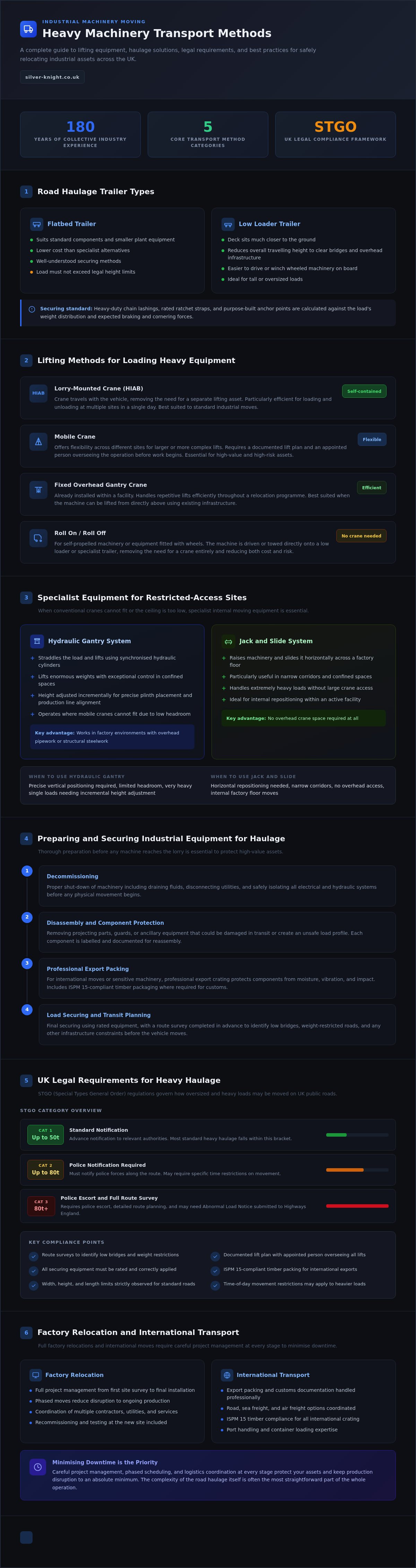
Flatbed trailers are the workhorses of industrial transport. They suit standard components, smaller plant equipment, and machinery that doesn't exceed legal height limits once loaded. Loading is straightforward, securing is well understood, and costs are generally lower than specialist alternatives.
Low loader trailers shift the loading deck significantly closer to the ground, which serves two important purposes. First, they reduce the overall travelling height of the load, making it possible to pass beneath bridges and overhead infrastructure that would otherwise be impassable. Second, the lower deck angle makes it far easier to drive or winch wheeled equipment onto the trailer without needing additional lifting equipment on site.
Securing machinery to either trailer type requires more than a few straps thrown over the top. Professional hauliers use heavy-duty chain lashings, rated ratchet straps, and purpose-built anchor points to prevent any movement during transit. The securing arrangement is calculated against the load's weight distribution and the expected forces during braking and cornering.
Lifting methods for heavy equipment loading
Getting a machine onto a trailer in the first place often requires a lift. The method chosen depends on what's available at the site and how large the load actually is.
Lorry-mounted cranes, sometimes called HIAB cranes, offer a practical solution for many standard industrial moves. The crane travels with the vehicle, which removes the need to arrange a separate lifting asset. They're particularly efficient when loading and unloading at multiple sites in a single day.
For larger or more complex lifts, professional contract lifting services become essential. These involve a fully planned lift using mobile cranes or fixed site equipment, with a appointed person overseeing the operation and a documented lift plan in place before work begins. This isn't optional for high-value or high-risk assets; it's the responsible standard.
Mobile cranes offer flexibility across different sites, whilst fixed lifting solutions such as overhead gantry cranes already installed within a facility can handle repetitive lifts efficiently. The choice between them often comes down to site access, available headroom, and whether the lift is a one-off or part of a longer relocation programme.
Roll on roll off methods are worth considering for self-propelled machinery or equipment fitted with wheels. Where a machine can be driven or towed directly onto a low loader or specialist trailer, the need for a crane is removed entirely, reducing both cost and risk.
Specialised lifting and moving equipment for restricted access
When conventional cranes can't reach a machine, or the ceiling simply won't allow it, the job doesn't stop. It calls for a different set of tools entirely. This is where specialised internal moving equipment separates experienced industrial movers from those who treat all heavy machinery transport methods as broadly the same.
Hydraulic gantries and jack and slide systems
A hydraulic gantry system works by straddling the load and lifting it using synchronised hydraulic cylinders. Because the lift is distributed across multiple legs, the system can raise enormous weights with exceptional control, even in spaces where a mobile crane would never fit. The lifting height can be adjusted incrementally, which matters enormously when positioning a machine onto a plinth or aligning it with a production line during installation.
The practical advantage over traditional cranes is headroom. Many factory environments have overhead pipework, structural steelwork, or low-clearance mezzanine floors that make a crane-based approach impossible. Hydraulic gantries operate within the available vertical space, making them the preferred solution for in-situ lifts inside working facilities.
A jack and slide system is a method for moving heavy loads over horizontal tracks when overhead space is limited. Once a machine is raised clear of the floor using hydraulic jacks, it can be slid laterally along greased or roller-fitted track sections to its new position. This approach is particularly effective when a machine needs to travel horizontally through a building without being lifted onto a vehicle at all.
Together, these two systems handle scenarios that would otherwise require partial demolition of a building or the complete disassembly of a machine. Neither outcome is attractive when time and budget are at stake.
Versa Lift hire for versatile machinery moving
A Versa Lift is a specialist machine mover designed to handle high-capacity lifts within a compact footprint. Unlike a standard forklift, which is limited in both reach and load capacity for tall or awkwardly shaped machinery, a Versa Lift can extend its mast significantly whilst maintaining stability under load.
In tight factory environments where a traditional forklift would struggle with a large press or CNC machine, a Versa Lift offers the capacity without requiring the wide operating radius of a crane. It's a practical choice for businesses relocating equipment within a facility or positioning newly delivered machines during installation. You can read more about how Versa Lift hire compares to other specialised lifting methods to understand which approach suits your situation.
If you're working with restricted access and need guidance on which equipment combination makes sense for your site, speak to the team at Silver Knight before committing to an approach.
Air film movers for internal relocation
Air film movers take a different approach entirely. Rather than lifting a load, they float it. A thin cushion of compressed air is forced beneath a load-bearing platform, reducing friction to almost zero. This allows a single operative to move a machine weighing several tonnes across a smooth floor with minimal physical effort.
The limitation is surface type. Air film movers require a flat, sealed floor to function correctly, which makes them ideal for modern factory environments but unsuitable for uneven or porous surfaces. Where the conditions are right, though, they offer a fast and low-risk method for repositioning heavy equipment without the complexity of jacking or gantry work.
Preparing and securing industrial equipment for haulage
The groundwork laid before a machine leaves its current site is just as important as the transport itself. Rushed or incomplete preparation is one of the most common causes of damage during industrial moves, yet it's also one of the most preventable. Getting this stage right protects the asset, the people handling it, and the timeline of the entire project.
Dismantling and decommissioning protocols
Complex machinery rarely travels intact. Protruding components, fragile assemblies, and awkward dimensions often make full-machine transport impractical or unsafe. A structured decommissioning process addresses this systematically rather than reactively.
Fluid drainage is a critical early step. Hydraulic oil, coolant, and lubricants must be removed before transit to prevent leaks that could damage the machine itself, contaminate other loads, or create hazardous conditions during handling. This isn't simply a tidiness measure; residual fluids shift the machine's weight distribution in unpredictable ways and can compromise securing arrangements during road haulage.
Dismantling should always follow the manufacturer's guidelines where they exist. Deviating from recommended sequences can cause damage that only becomes apparent during recommissioning, often at significant cost. Every removed component should be systematically labelled, photographed, and packaged before leaving the machine. A clear numbering system tied to a written record makes reassembly far more straightforward and reduces the risk of missing parts arriving at the destination. Silver Knight's machinery dismantle service applies this kind of structured approach to complex industrial assets, ensuring nothing is left to guesswork.
Documenting the condition of assets before the move begins is equally important. Photographs taken at multiple angles, with close-ups of any pre-existing marks or wear, provide a clear baseline if any dispute arises about damage during transit. This protects everyone involved.
Sensitive electronic components, control panels, and precision-machined surfaces need professional export packing rather than standard wrapping. Specialist packing materials absorb vibration and prevent moisture ingress, particularly relevant for machines travelling long distances or being placed into storage before installation.
Securing the load for national transport
Once a machine is on the trailer, the securing arrangement determines whether it arrives in the same condition it left. Weight distribution across the trailer deck affects both stability during transit and the legal axle weight limits that apply under UK haulage regulations.
Timber blocking and bracing provide internal stability for machines with uneven bases or irregular profiles. Blocks are positioned to prevent lateral movement and to spread the load across the trailer deck evenly. Chain lashings and rated straps are then applied with tension calculated against the machine's weight and expected transit forces.
For phased relocations, where machinery is moved in stages rather than all at once, industrial storage plays a practical role. Machines can be decommissioned, packed, and held securely until the destination site is ready to receive them, reducing the pressure to rush any stage of the process.
Choosing the right heavy machinery transport methods from the outset makes every subsequent step easier. Proper preparation and securing aren't afterthoughts; they're the foundation of a move that goes to plan.
If you'd like to talk through the preparation requirements for your specific equipment, the team at Silver Knight Haulage & Machineries Ltd can advise on the right approach before any work begins.
Legal requirements and safety standards for heavy haulage
Regulatory compliance isn't a box-ticking exercise in heavy haulage. It's the framework that keeps operatives safe, protects public infrastructure, and ensures your move doesn't result in enforcement action, fines, or worse. Understanding the legal landscape around heavy machinery transport methods is as important as choosing the right trailer or lifting system.
The Special Types General Order, commonly known as STGO, governs the movement of abnormal loads on UK public roads. It sets out three categories based on vehicle and load weight, with each category carrying different operational requirements. STGO Category 3 covers vehicles and loads exceeding 80 tonnes but not exceeding 150 tonnes gross weight, and movements in this category require advance notification to relevant highway authorities and, in many cases, the police. Loads exceeding 150 tonnes fall outside STGO entirely and require a specific individual order from the relevant authority before the move can take place.
Risk assessments and method statements are mandatory for complex industrial moves, not optional extras. A thorough risk assessment identifies every foreseeable hazard, from overhead power lines along the planned route to floor loading limits at the destination site. The method statement then documents exactly how each risk will be controlled, who is responsible, and in what sequence tasks will be carried out. These documents also form part of your compliance obligations under the Construction (Design and Management) Regulations, which apply to many industrial relocation projects.
Escort vehicles are a legal requirement for loads that exceed specified width or length thresholds. For very wide or exceptionally heavy cargo, police escorts may also be required at certain times of day or on particular road types. Failing to arrange the correct escort isn't just a regulatory breach; it creates genuine danger for other road users.
Navigating UK transport permits and routes
Route planning for an abnormal load goes well beyond choosing the quickest road. Every proposed route must be assessed for height restrictions, weight-limited bridges, and tight junctions that could prevent passage. Bridge authorities must be notified when a load could impose stress beyond a structure's rated capacity. Police notification is required for STGO Category 2 and 3 movements, with specific notice periods that must be observed before the move begins. Getting this wrong can halt a transport operation mid-journey.
Safety equipment and personal protective protocols
On site, the standards are equally demanding. Every operative involved in a machinery move must wear appropriate PPE for the task, including hard hats, steel-toecap footwear, high-visibility clothing, and gloves where manual handling is involved. The banksman plays a critical coordinating role during lifts and manoeuvres, acting as the sole point of communication between the crane or vehicle operator and the surrounding team. All lifting equipment, including chains, slings, shackles, and hooks, must hold valid certification under the Lifting Operations and Lifting Equipment Regulations (LOLER), with thorough examinations carried out at the legally required intervals.
If you need support ensuring your next move meets all relevant UK legal requirements, get in touch with the Silver Knight team to discuss your project in detail.
Professional factory relocation and international machinery transport
Every stage of a machinery move connects to the next. The care taken during decommissioning directly affects how safely a machine travels, and how well it travels determines how quickly it can be recommissioned at the other end. For full factory relocations and international moves, this chain of dependencies becomes even more critical, and the consequences of breaking it are felt immediately in lost production time.
Strategic planning for factory relocation
A full factory relocation isn't a single event. It's a sequence of carefully coordinated tasks, each one dependent on the one before it. The businesses that experience the least disruption are those that treat the move as a project rather than a job, with a clear schedule, defined responsibilities, and contingency built in from the outset.
Phased moving schedules allow production to continue on some lines whilst others are being relocated. This approach requires detailed planning to sequence which machines move first, but it can dramatically reduce the total period of business interruption. A thorough site survey of the destination is equally important before any equipment leaves the current facility. Floor loading capacities, doorway dimensions, ceiling heights, and utility connection points all need to be confirmed in advance. Arriving with a 15-tonne press to find the floor hasn't been assessed is an entirely avoidable problem. Silver Knight's factory relocation service applies this kind of structured project management to every move, from initial survey through to final installation.
Recommissioning is the stage that brings everything together. A machine that has been carefully dismantled, professionally packed, and correctly transported still needs skilled hands to bring it back into production. Fluid systems need refilling and bleeding, alignments need checking, and control systems need testing before the machine is trusted with live production. Cutting corners here can undo every good decision made earlier in the process.
Managing international machinery logistics
Moving heavy machinery across borders introduces a layer of complexity that goes well beyond choosing the right heavy machinery transport methods for the road journey. Container selection, load securing, and export packing all need to account for the extended transit times and variable handling conditions associated with sea or air freight.
Machinery being shipped by sea must be packed to withstand humidity, vibration, and the movement forces generated during ocean transit. Timber crating, desiccant packs, and vapour barrier wrapping are standard elements of professional export packing for this reason. Securing within the container must prevent any movement across the full journey, not just during loading.
Customs documentation adds another layer of responsibility. Accurate commodity codes, correct valuation declarations, and the right certificates of origin are all required for smooth clearance at the destination port. Errors at this stage can hold a shipment for days or weeks, with significant knock-on costs. Working with specialists who understand the specific requirements for machinery exports to Europe and beyond removes much of this risk. Silver Knight's international machine movers service handles the logistics coordination and documentation requirements that make cross-border moves considerably less stressful.
For businesses planning a relocation of any scale, getting specialist input early makes a measurable difference to the outcome. Silver Knight Haulage & Machineries Ltd brings 180 years of collective industry experience to projects across the UK and internationally, helping clients protect their assets and return to production as quickly as possible.
Plan your machinery move with confidence
Choosing the right heavy machinery transport methods is rarely straightforward, but the decisions you make early in the process shape everything that follows. From selecting appropriate trailers and lifting equipment to meeting UK legal requirements and managing the complexity of a full factory relocation, each stage demands careful thought and the right expertise behind it.
The key points to carry forward are simple. Preparation and securing are as important as the road journey itself. Specialist equipment like hydraulic gantries and jack and slide systems solve problems that conventional cranes cannot. And regulatory compliance isn't optional, it's the foundation every safe move is built on.
With over 180 years of collective industry experience and comprehensive national and international coverage, Silver Knight Haulage & Machineries Ltd has the knowledge and specialist equipment to handle moves of any scale. If you're ready to discuss your project, get in touch with the Silver Knight team today and take the first step towards a move that goes exactly to plan.
Frequently Asked Questions
What is the most secure method for transporting high value industrial machinery?
The most secure approach combines thorough decommissioning, professional export packing, and a purpose-built transport solution matched to the machine's weight and dimensions. Sensitive components should be removed and packed separately, with all remaining assemblies braced against transit forces. Choosing a specialist with documented lift plans, LOLER-certified equipment, and experience handling high-value assets significantly reduces the risk of damage from the moment the machine leaves its plinth.
Insurance coverage appropriate to the asset's replacement value is also essential. Confirm this is in place before any work begins rather than assuming standard haulage cover is sufficient.
How do I determine if my machinery move requires a specialised low loader?
A low loader is generally required when the combined height of the trailer deck and the machine would exceed standard height restrictions for UK roads, or when the machine's weight demands a trailer with a higher load rating than a standard flatbed provides. If your machine is particularly tall, heavy, or has a low ground clearance that makes loading onto a raised deck impractical, a low loader is almost certainly the right choice. A site survey and load assessment carried out before planning the move will confirm this.
Do I need a police escort for heavy machinery transport in the UK?
Whether a police escort is required depends on the weight, width, and length of your load, as well as the route being taken. Under STGO regulations, certain categories of abnormal load require police notification and, in some cases, a physical escort. Very wide loads or those travelling on specific road types during peak hours are most likely to trigger this requirement. Your haulier should assess the route and load specifications and arrange any necessary notifications well within the required notice periods.
What is the difference between machinery moving and general heavy haulage?
General heavy haulage focuses primarily on the road transport element, getting a load from one location to another using appropriate trailers and securing methods. Machinery moving encompasses a much broader scope, including decommissioning, internal relocation using specialist equipment like hydraulic gantries or jack and slide systems, export packing, and recommissioning at the destination. The heavy machinery transport methods used in a full machinery move are far more varied than those required for straightforward haulage.
Can heavy machinery be transported whilst fully assembled?
Some machines can travel fully assembled, but it depends on the dimensions, weight distribution, and structural integrity of the equipment during transit. Protruding components that create excessive height or width, or assemblies that could shift under braking and cornering forces, will typically need to be removed before the machine is loaded. Your specialist should assess each machine individually rather than applying a blanket approach, as unnecessary disassembly adds both cost and recommissioning time at the other end.
How long does a typical factory plant relocation take to complete?
There's no single answer, as the duration depends on the number of machines, their complexity, the distance between sites, and whether production needs to continue during the move. A single large machine might take several days from decommissioning through to recommissioning, whilst a full factory relocation involving dozens of assets could run across several weeks or months using a phased schedule. A detailed project plan produced after a site survey will give you a realistic timeline specific to your situation.
What insurance coverage is required for international machinery transport?
International machinery moves typically require specialist marine cargo insurance that covers the full replacement value of the equipment throughout the entire journey, including loading, sea or air transit, and delivery to the destination site. Standard haulage liability cover is unlikely to be sufficient for cross-border moves. You should confirm the scope of cover with your insurer before the move begins, paying particular attention to exclusions related to improper packing or pre-existing damage, and ensure documentation accurately reflects the machine's value.
How can I prepare my facility for the arrival of heavy lifting equipment?
Start by confirming the floor loading capacity of every area the equipment will travel through, not just the final installation point. Doorway widths, ceiling heights, and the condition of floor surfaces all need to be assessed in advance. Any overhead obstructions such as pipework, lighting rigs, or sprinkler systems should be identified and, where possible, temporarily moved. Access routes from the site entrance to the machine's destination should be clear of other plant, materials, and personnel before the lifting team arrives.

Article by
David Ashby
I'm the Managing Director of Silver Knight Haulage & Machinery Ltd. Silver Knight Ltd is a family-run firm established in the West Midlands in 2005, with the aim of providing a cost-effective, yet professional, service to businesses for the removal, transportation, and installation of machinery, plant, and equipment here in the UK and worldwide. Between us, the Silver Knight workforce has over 50 years of experience with machinery and its operation.
Disclaimer
This article is intended for informational purposes only. Please ensure you seek expert advice or carry out your own research to confirm the information is suitable for your specific needs.