The contractor with the biggest lifting equipment isn’t automatically the right choice for your factory move. The real test is whether they can plan and control the work around your machinery, site and production needs. Comparing industrial relocation contractors can be difficult when one firm specialises in machinery and another offers general commercial removals.
Look beyond broad claims and equipment lists. A move can involve more than lifting and transport, so establish who will manage each task, how the machinery will be handled and how disruption to your operation will be considered.
This guide gives you a practical framework for comparing contractors by technical capability, project control, safety planning and operational fit. You’ll learn what to ask about machinery handling, lifting systems, transport, installation and handover, and how to clarify responsibilities before work begins. Use the checks to build a shortlist around your specific relocation, not promises that lack detail.
Key Takeaways
- Choose industrial relocation contractors for their ability to control the project, not lifting capacity alone.
- Match the contractor’s experience and equipment to the machinery, site access and complexity of your move.
- Clarify who is responsible for each task, from planning and transport to installation and handover.
- Share machinery details and production priorities early to support a realistic relocation plan.
- Use relevant experience and services to compare potential contractors, rather than relying on broad claims.
Silver Knight’s machinery moving and factory relocation services cover work that may form part of an industrial move. The right scope depends on the machinery, sites and tasks involved.
What industrial relocation contractors manage in a complex move
An industrial relocation contractor plans and coordinates the movement of machinery and related project tasks, with the agreed scope shaped around the equipment, site and move. That differs from ordinary commercial removals, which may focus on general business contents rather than production machinery.
Moving one machine might involve lifting, transport and positioning at a new location. Relocating a production line or a wider industrial operation can mean coordinating several machines, site access, installation and the order in which equipment needs to move. The broader idea of Relocation of factories can also involve restructuring where manufacturing takes place, although a machinery move does not necessarily involve changing where a business operates.
This video offers a visual example of factory relocation work:
Which tasks can an industrial relocation contractor coordinate
Depending on the contractor and agreed scope, work may include planning, machinery dismantling, lifting, transport, positioning and installation. Some projects may also require storage between sites, factory clearance or international machinery transport. These are separate requirements to confirm, not automatic parts of every move.
Ask which tasks the contractor will manage and which remain with your own team or other providers. For example, confirm whether installation is included after transport, who is responsible for disconnecting the machinery, and whether temporary storage is needed while the destination site is prepared. A written scope helps prevent gaps and duplicated work.
When a specialist contractor may be a better fit
Specialist support may suit machinery that is heavy, difficult to access or needs careful positioning at its destination. The lifting method and equipment need to be considered against the load and site, so ask how the contractor will assess those details. Silver Knight lists machinery moving, installation and factory relocation among its services, with equipment such as hydraulic gantries and jack and slide systems. Confirm what is available and suitable for your particular project.
Coordination matters too. If production depends on equipment moving in a particular order, transport is only one part of the plan. A single machine move may need a focused scope rather than a full factory relocation. Assess industrial relocation contractors against the work you actually need done.
When reviewing Silver Knight’s machinery moving and relocation services, compare the listed capabilities with your required tasks, equipment and site conditions.
Industrial relocation contractors versus commercial removals providers
The difference isn’t simply the label a provider uses. Compare the work they’ll take responsibility for, the equipment and experience they can bring, and how clearly they explain the boundaries of their service. Commercial removals may suit general office contents, and some providers may also have relevant machinery capability. Check the proposed team and scope rather than assuming either way.
Use this comparison as a starting point, then ask each provider to confirm exactly what’s included for your move.
| Area | Questions to ask any provider |
|---|---|
| Technical planning | Will they assess the machinery, site access and move sequence, and explain the planned approach? |
| Lifting | What lifting equipment is proposed, and how will the provider check it suits the load and site? |
| Machinery handling | Can the team describe experience with comparable machinery and any dismantling or handling needs? |
| Transport | Does the scope cover transport, or is the provider only responsible for moving the load between agreed points? |
| Installation and handover | Is positioning or installation included, and what will count as completion of the agreed work? |
What to compare beyond transport
A vehicle and delivery plan don’t necessarily amount to a managed relocation. Check whether the proposal includes a site survey, lifting, movement, positioning and the agreed handover. Establish who will arrange site access, coordinate the sequence of work and communicate with your team. A haulier may be responsible for transport only unless other tasks are specifically agreed.
Ask each provider to explain how the machinery will be secured for the planned journey and what transport arrangements are included in the scope. Confirm who is responsible for this work and how requirements specific to the route or load will be addressed. These details make proposals easier to compare than general assurances about transport capability.
When commercial removals may not cover industrial needs
Discuss specialist capability if machinery is difficult to access, needs careful positioning or forms part of a production sequence. Ask for examples of comparable equipment or project complexity, and how the proposed team would manage the handling. This is a practical check, not an assumption that general removals providers lack the skills or equipment.
For machinery moves that include transport, compare the proposed scope with machinery haulage and relocation services. Check which tasks are available and suitable for your project, and whether transport is part of a wider relocation plan or a separate requirement.
Silver Knight’s machinery moving and relocation services can be assessed against the same scope and questions as any other provider on your shortlist.
How to assess industrial relocation contractors before appointing one
Choose for project fit, not the longest equipment list. A contractor may have specialist lifting systems, but suitability also depends on whether its team understands your machinery, site conditions, planned sequence and required handover. Ask for clear, relevant evidence and responsibilities that relate to your move.
To compare proposals fairly, give each provider the same information and ask them to describe the same scope. Set out which machines are moving, the origin and destination, known access constraints, production priorities and what you expect at handover. Ask each contractor to identify exclusions and work that depends on other suppliers. This makes differences between proposals easier to identify.
Questions to ask each contractor
Use direct questions to find out how the plan will work in practice:
- Who will survey the site and assess access, load requirements and the order of work?
- Which tasks are included, such as lifting, transport, positioning or installation, and which are excluded?
- Are any parts of the move dependent on your staff or another supplier?
- Who will coordinate site access and communicate changes to your team?
- What does the agreed handover cover, and how will you know the contracted work is complete?
Clear answers help distinguish a coordinated relocation from a transport-only arrangement. Record agreed responsibilities in the project scope rather than relying on verbal assurances or general descriptions.
Evidence that helps verify contractor suitability
Ask for examples of comparable machinery or similar project complexity. Look for relevant detail, such as how the contractor approached restricted access or coordinated a sequence of equipment moves, rather than unsupported promises about results. Request an outline of the proposed method and the equipment planned for your site, then ask why it suits the load and conditions.
Check that the proposed team and resources match the agreed work. A list of cranes or lifting systems doesn’t show by itself that a contractor has assessed how they’ll be used at your site. Ask what might need to change if access, timing or the move sequence is revised.
Ask each contractor to explain the safety arrangements and equipment checks relevant to your UK project, and how these will be reflected in the proposed plan. Look for clear, project-specific answers rather than relying on general claims.
Shortlist industrial relocation contractors by the strength of their project-specific answers. Experience and equipment matter when they match your requirements, but the deciding factor is a clear, workable scope with responsibilities your team understands.
Silver Knight’s machinery moving and relocation services can be considered alongside other options by comparing the proposed work, equipment and responsibilities with your project requirements.
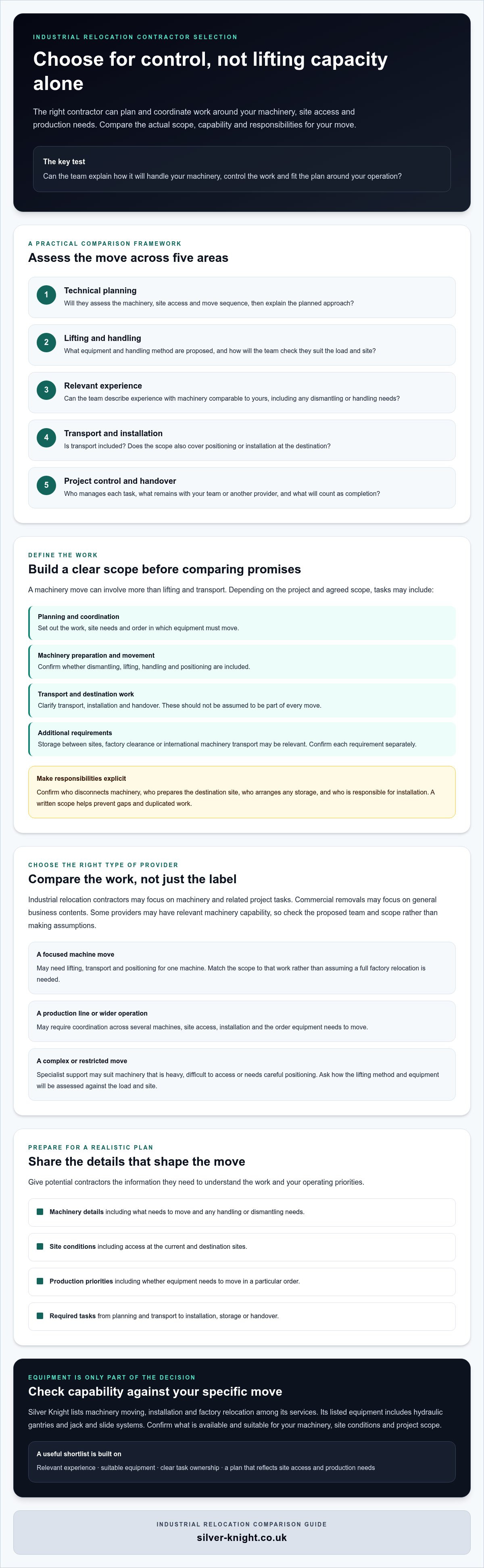
How to plan an industrial relocation with your chosen contractor
A clear sequence helps you and your contractor agree what needs to happen, who is responsible and what counts as a completed move. Use these steps to turn an initial discussion into a workable project plan.
- 1. Define the move. List the machinery involved, its current location and destination, and whether the work covers one machine, a production line or a wider site move.
- 2. Share operational priorities. Explain which equipment depends on other machines, what production constraints matter and any timing limits your team needs the contractor to consider.
- 3. Prepare for a site survey. Provide available equipment dimensions, known weights, photographs and relevant handling information. Point out access routes, building constraints and the intended position at the destination.
- 4. Agree the scope in writing. Confirm whether the work includes disconnection, decommissioning, dismantling, lifting, transport, installation or recommissioning. Identify exclusions and tasks assigned to your staff or other suppliers.
- 5. Coordinate the sites and teams. Agree who manages access, the move sequence and communication with your team. Decide how changes in scope or site conditions will be raised and approved.
- 6. Check the handover. Confirm that machinery is in the agreed position, identify any outstanding tasks and record who will complete them. Agree the next steps before treating the contracted work as finished.
Information to prepare for a site survey
Useful information helps the contractor assess the job and ask focused questions. Include dimensions and known weights where available, plus photographs that show the machinery and its surroundings. Describe the route from its current position to the exit, any access restrictions you know about, and where the equipment needs to go at the new site. Flag connections, dependencies on other machinery and operational timing constraints for your team to discuss.
Planning responsibilities and handover
Write down which party is responsible for each task. Don’t assume that transport includes disconnection, installation or recommissioning. If dismantling may be needed, discuss whether it belongs in the agreed scope and review machinery dismantling services as one possible option. Confirm what information or preparation each party must provide.
Before work starts, agree how the team will handle changes, such as an access issue or a revised machine position. At handover, check the agreed position, any incomplete work and the person responsible for each next step. This gives everyone a shared record of what has and has not been completed.
For a move involving machinery transport, installation or dismantling, the project discussion with Silver Knight can cover the requirements and the work to be considered.
Silver Knight lists machinery moving and installation among its services. Confirm the specific tasks and responsibilities required for your relocation.
Why consider Silver Knight for industrial relocation work
Once you’ve compared contractors against your project scope, Silver Knight may be worth considering if you need machinery moving alongside related relocation services. It’s a family-run specialist founded in 1996, with over 180 years of collective industry experience. These details provide context, but your decision should still come down to the proposed approach, responsibilities and suitability for your specific move.
Silver Knight’s relevant relocation capabilities
Silver Knight lists machinery moving, machinery installation, factory relocation and heavy haulage among its services. Its equipment includes hydraulic gantries, cranes and jack and slide systems. The right equipment depends on the machinery, site conditions and agreed scope, so confirm what is available and suitable for your project rather than assuming a particular system will be used.
For more detail on relevant services, see Silver Knight’s machinery moving and haulage services. Compare the tasks your move requires with the work the team could take on, and identify anything that would remain your responsibility or need another supplier. The scope should be agreed for each project.
What to share when requesting a project discussion
A clear outline helps keep the discussion focused on your actual requirements. Share:
- What machinery needs moving and its current condition, if known.
- The origin and destination, including any access details or site restrictions.
- Known dimensions and weights, plus photographs or handling information where available.
- Your production priorities, timing constraints and any tasks you expect to be included, such as installation or haulage.
You don’t need every detail finalised before an initial enquiry. Be clear about what’s confirmed and what still needs checking. The next discussion can help establish whether the required services appear to fit, what further information is needed and which responsibilities need to be agreed. An enquiry alone doesn’t confirm availability, equipment suitability or a site survey.
Use the same project-specific questions with every contractor you consider. That makes it easier to judge Silver Knight alongside other industrial relocation contractors on relevant experience, scope and operational fit, rather than broad claims or equipment lists alone.
Silver Knight’s machinery moving and installation services can be assessed against the requirements you have identified for your project.
Choose a contractor that fits your move
The right contractor is the one whose experience, equipment and responsibilities match your specific project. Compare proposals on the same scope, check how site access and production priorities will be managed, and agree what is included through to positioning and handover. A long equipment list alone won’t tell you whether a provider is the right fit.
Silver Knight is a family-run machinery moving and installation specialist with over 180 years of collective industry experience. Its equipment includes hydraulic gantries, cranes and jack and slide systems. The right equipment and service scope depend on your machinery, site and project requirements, so discuss these details before deciding whether the company is a suitable option.
If you’re comparing industrial relocation contractors, share what needs moving, the origin and destination, known access constraints, and any dimensions, weights or timing priorities you have. Contact Silver Knight to discuss your machinery relocation requirements and whether its services may fit the work.
Frequently Asked Questions
What does an industrial relocation contractor do?
An industrial relocation contractor coordinates specialist work to move machinery or plant equipment. Depending on the agreed scope, this may include planning, lifting, moving, transport, positioning, installation, storage or factory clearance. Responsibilities vary, so ask what is included and excluded. Clarify how the contractor will coordinate with your engineering and operations teams, especially if the move involves several machines or depends on production priorities.
How do I choose an industrial relocation contractor?
Start by defining what needs to move, the sites involved, access conditions and the tasks you expect completed. Compare industrial relocation contractors using the same project information, then assess relevant experience, proposed equipment, planning and responsibility for each task. Ask for examples of comparable work and clarify exclusions. A suitable contractor should explain how its proposed approach fits your machinery and site, rather than relying only on broad claims.
Are industrial relocation contractors different from commercial removals companies?
They can be, but the company label alone doesn’t confirm what a provider can manage. Commercial removals may focus on office contents and general business equipment, while machinery relocation can involve specialist handling, lifting, positioning and installation. Capabilities vary between providers. Ask who will carry out each task, what equipment and experience the proposed team brings, and whether transport, installation and handover are included in the agreed scope.
What information should I give a contractor before a site survey?
Share available machinery dimensions, known weights, handling details and photographs. Describe access routes, building constraints and the intended position at the destination. Explain any operational dependencies, production priorities and timing constraints that could affect the move. If you don’t have a detail, say so rather than guessing. This gives the contractor a clearer starting point and helps identify what information or checks may still be needed.
Does an industrial relocation contractor manage machinery installation as well as transport?
Some providers offer both, but you should confirm the scope in writing. Ask whether positioning, installation, reconnection or recommissioning is included, and who is responsible for each activity. Transport doesn’t automatically include installation. Silver Knight lists machinery installation among its services, but the tasks available for a particular move should be agreed directly. Also confirm the handover point and any work assigned to your team or another supplier.
How can I reduce disruption during an industrial relocation?
Explain early how the move may affect production, site access and other work, then agree the sequence, responsibilities and communication arrangements with the contractor. Provide accurate machinery and site details, and raise changes promptly so the plan can be reviewed. Set clear handover expectations, including any outstanding tasks and who will complete them. These steps support planning around your priorities, but likely downtime depends on the project and needs specific assessment.

Article by
David Ashby
I'm the Managing Director of Silver Knight Haulage & Machinery Ltd. Silver Knight Ltd is a family-run firm established in the West Midlands in 2005, with the aim of providing a cost-effective, yet professional, service to businesses for the removal, transportation, and installation of machinery, plant, and equipment here in the UK and worldwide. Between us, the Silver Knight workforce has over 50 years of experience with machinery and its operation.
Disclaimer
This article is intended for informational purposes only. Please ensure you seek expert advice or carry out your own research to confirm the information is suitable for your specific needs.