A factory move can leave a machine in the wrong place on paper, even after it reaches the new site. A reliable asset register for a factory move records each machine’s unique ID, category, current and destination locations, and movement status. This gives everyone involved a shared record of what is moving and where it belongs.
A spreadsheet can seem sufficient, especially when an equipment list already exists. The challenge is keeping names consistent, identifying every machine and updating locations as the move progresses. This article explains what to record, how to create practical IDs and categories, and when a spreadsheet can help track movements.
A manufacturing-focused register can also distinguish production-critical equipment from other assets, giving the move plan a clearer picture of the plant.
Key Takeaways
- Record each machine’s current location and intended destination so its movement can be tracked clearly.
- Use a consistent ID that combines equipment type, location and a unique number to help distinguish similar machines.
- Keep movement records aligned with the asset register, including temporary moves and expected return dates.
- A spreadsheet may suit a small, single-site register, while multiple locations can make version control and sign-off harder to manage.
- Prioritise production-critical, utility and safety-critical equipment when building a manufacturing asset register.
For practical guidance on planning a move, explore factory relocation support.
What Is an Asset Register and Why Does Your Building Need One?
An asset register is a structured record of physical equipment and its identifying details. During a relocation, accurate location records help teams match each machine to its current position and planned destination.
This guide shows how asset tags can help identify equipment before a move.
Recording Current Asset Locations
A location record identifies where property, plant and equipment is currently situated. This matters because a machine listed against the wrong production area can be missed during planning or sent to the wrong destination.
Record the site, building and operational area, then update the entry when equipment is relocated, installed, serviced or removed. For example, distinguish a machine on a production line from one in a maintenance workshop. Property assets may be held in a separate register, while fixed and removable equipment commonly appears in the asset register.
Asset Location Fields
Location fields describe an asset’s position and status in a consistent format. A useful record can combine the site or building name, area, room, production line, position and current status.
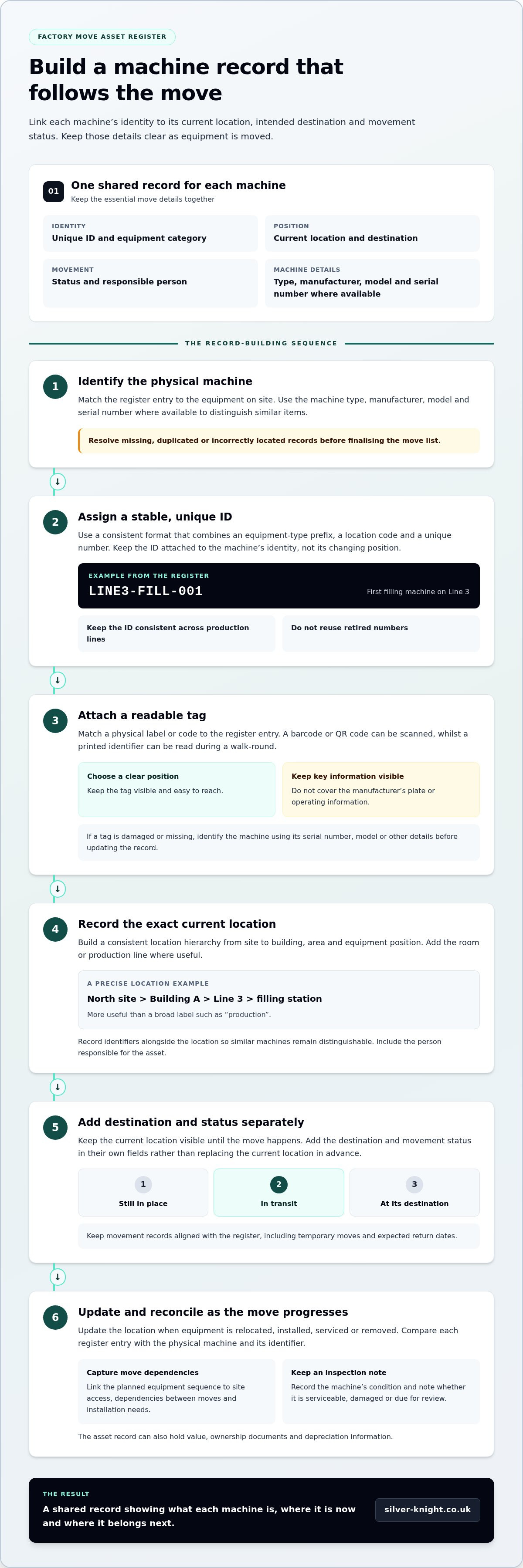
Use consistent location names in the register and movement records. Add the destination and movement status as separate fields rather than replacing the current location before the move. This distinction shows what is still in place, what is in transit and where each machine should arrive. Include the person responsible for the asset.
Precise Physical Location Records
A precise physical location narrows an asset’s position to a clearly identifiable point within a site. This helps staff find the right equipment without relying on a broad label such as “factory floor”.
Build a hierarchy from site to building, area and equipment position. For instance, “North site, Building A, Line 3, filling station” is more useful than “production”. Start with one building or equipment type, then extend the structure as the register grows. Record identifiers alongside the location, so similar machines remain distinguishable. A fixed asset register can also record precise locations within a building.
To compare machinery-moving quotes in the UK, provide each company with the same equipment list and move scope. Then compare the work and inclusions specified in each quote.
UK legal and insurance requirements depend on the equipment, site and work involved. Identify the applicable safety duties and insurance arrangements as part of the move plan.
Machinery-moving costs depend on the equipment, packing needs, transport requirements and installation work. The price varies by project and is provided after a quote request; likewise, for international freight or commercial removals UK to Greece, having a verified asset register is essential for obtaining transparent quotes and planning haulage capacity.
To audit and reconcile assets before relocation, compare every register entry with the physical machine and its identifier. Resolve missing, duplicated or incorrectly located records before finalising the move list.
Plan and schedule an industrial relocation by linking the equipment sequence to site access, dependencies between moves and installation needs. This makes the planned order clear to the teams coordinating the work.
Record the machine’s condition in an inspection note, and capture its value, ownership documents and depreciation information in the asset record. These details help distinguish equipment that is serviceable, damaged or due for review.
Unmatched records, incorrect destinations, damage and poorly sequenced moves can lead to lost assets or production delays. Clear identification, location updates and a shared movement plan help teams manage these risks.
For factory move planning, relocation planning support can connect equipment records with the wider move.
Asset identification and naming conventions
Give every machine a consistent identifier, then link it to a physical tag and a clear description. This makes records easier to match during a move and useful for maintenance reporting and accounting.
Asset Tagging
Asset tagging means attaching a physical label or code to equipment so staff can match it to its register entry. A barcode or QR code can be scanned, while a printed identifier remains readable during a walk-round.
Choose a tag position that is visible and easy to reach, without covering the manufacturer’s plate or operating information. Record the tag number against the machine before relocation. If a tag is damaged or missing, note the issue and identify the asset through its serial number, model or other details before updating the record.
Asset Identifiers
An asset identifier is a unique reference that distinguishes one machine from similar equipment. A useful convention can combine an equipment-type prefix, a location code and a unique number string.
For example, LINE3-FILL-001 identifies the first filling machine on Line 3, with 001 marking its sequence. Keep the format consistent across production lines and avoid reusing retired numbers. A barcode number can also serve as the asset ID in computer-aided facilities management software, linking the scanned code with the asset’s record.
Before assigning new references, compare the proposed list with existing records. This can reveal duplicate entries and machines whose serial numbers already provide a reliable cross-reference. Keep the asset ID stable when equipment changes location, and update the location field instead. This separates identity from position and supports accurate movement reporting.
Asset Descriptions
An asset description should identify the equipment without relying on its tag alone. Record the machine type, manufacturer, model and serial number where available, then distinguish similar items by production line, function or capacity.
For instance, “filling machine” alone may describe several assets, whilst “filling machine, Line 3, model X” gives staff more to compare. Add installation or purchase details, warranty information and relevant documents where these are held. Keep descriptions factual and use the same terms across records, so searches and accounting reports do not split one equipment type into inconsistent names.
For chemicals, hazardous materials and waste, record the substance or waste type, container, quantity description, location and relevant handling instructions from existing site documentation. Keep these items separate from machinery records, and arrange their identification and transfer under established site procedures rather than treating them as ordinary equipment.
Use a controlled naming list for common machine types, such as pumps, presses and conveyors. If a description changes after replacement or modification, retain the unique identifier and update the record, including any affected warranty or document details. This gives the relocation team a traceable identity for each item and helps finance and maintenance staff use consistent asset information.
For machinery moves, factory relocation planning can take account of equipment records and the movement schedule.
Is a spreadsheet sufficient for a movement register?
A spreadsheet can track equipment movements at a single site with a small asset base. Its usefulness depends on clear ownership, consistent location names and reliable updates.
Software and Spreadsheet Options
A spreadsheet is a simple way to create an asset register, whilst asset software can link records with maintenance history and documents. Smaller businesses with fewer than 100 assets collectively worth less than £100,000 may find spreadsheets useful.
Choose a system based on how many people need to update records and how widely equipment is spread. A single-site team may manage one shared file, but several sites can lead to competing versions and missed custodian sign-offs. Keep the fixed asset register as the source for identity, accounting and capital records, and use a movement register for transfer details.
Whichever system holds the data, match its location names to the fixed asset register. If one file calls an area “Line 2” and another calls it “Assembly”, location comparisons become unreliable. Keep maintenance records and asset information connected or clearly cross-referenced, rather than scattering updates across separate files.
Tracking Asset Movements
A movement spreadsheet records each transfer against the equipment’s existing asset ID. An asset register for a factory move should show each item’s movement status alongside its current and destination locations.
Create the entry before moving the item, with its move date and responsible custodian. For equipment temporarily sent out for repair, include the expected return date and receiving custodian. Keep the same location taxonomy as the fixed asset register, so a change from “Line 2” to “Workshop” is easy to reconcile. These fields show whether an asset is at its usual location, in transit or temporarily elsewhere.
Review movement entries against location updates monthly and resolve unexplained differences. In an asset register for a factory move, an overdue temporary transfer needs follow-up, not a silent change to the fixed asset record. Review temporary movements quarterly, particularly when equipment has been sent away for repair.
Post-Move Register Updates
Post-move checks compare each arrival with its movement entry and update the asset’s actual location. Match the machine to its ID, record its destination and note any damage, missing items or discrepancies.
Before marking equipment as recommissioned, record the outcome of the relevant site installation and operational checks. Update maintenance history, manuals and warranty details if the move or installation affected them. If an asset was replaced, update its register entry rather than carrying forward the old machine’s information.
Close each movement only when the destination record and custodian details agree. For example, if the spreadsheet shows a press at its new production line but the fixed asset register still lists its former building, correct the location and retain the movement record. This keeps accounting, maintenance and operations information consistent after the move.
For manufacturing moves, factory relocation support can help connect equipment records with operational planning.
Asset categories and sub-categories
Categories group similar assets, while sub-categories help teams plan around equipment’s purpose. In a factory, production machinery, utility systems and safety-critical items serve different roles. An asset register for a factory move should make these distinctions visible, so the equipment list supports practical decisions instead of simply sorting entries.
Facilities management assets generally fall into three classes: property, fixed assets and removable assets. Fixed and removable assets are commonly recorded in an asset register, while property may sit in a separate register. For a relocation, focus the equipment list on items being moved and retain links to property records where they affect access or installation.
Manufacturing teams can organise equipment by function and add useful sub-categories. A production line might contain filling, packing and labelling equipment. Utilities can be grouped by the production systems they support, while safety-critical infrastructure forms a distinct group. This structure shows which machines share a process and which need separate planning.
- Production equipment can be grouped by line and machine function.
- Utilities can be separated by the production systems they support.
- Safety-critical infrastructure can be marked for focused planning and review.
- Removable support assets can include equipment that moves between areas.
A practical starting scope includes all Tier 1 and Tier 2 assets, production-critical utility systems and safety-critical infrastructure. Tier 3 assets can be added progressively once the initial register is operational, prioritised by failure frequency and maintenance team requests. This staged approach helps teams establish a usable record while recognising that not every item has the same priority.
Link each category to consistent record fields. For a machine, these may include its serial number, manufacturer, model, condition, purchase details and maintenance needs. A category cannot replace an individual asset ID: two similar pumps still need separate records. An asset register for a factory move can group equipment for planning while preserving each machine’s identity and history.
Use categories to support decisions, not just to sort a spreadsheet. Filter for production-critical equipment, identify assets that need specialist installation, and compare the planned move list with the register. If a machine is replaced or removed, update its entry and relevant manuals, warranties and maintenance requirements. This keeps categories aligned with the factory’s actual plant.
For manufacturing moves, factory relocation support can connect equipment records with operational planning.
Asset registers in manufacturing
A manufacturing asset register needs to support operations as well as accounting. It should show which assets support production, their condition and any maintenance history that could affect move planning.
The scale varies by type of factory. A small food manufacturing operation might record 50 to 150 assets, whilst a large automotive assembly plant might include 500 to 2,000. In either case, a register is more useful when its records help teams make decisions, rather than simply listing machinery.
For example, a production team can use the register to identify equipment linked to a particular process. A maintenance team can review service history, inspection dates and recurring faults before deciding which machines need attention. Facilities staff can use asset information to support decisions about repairs, servicing and replacement. The same record can identify the person responsible for an asset and its internal cost centre.
Keep operational details connected to each machine. A useful entry can link its location and condition to maintenance records, manuals, warranty information and inspection details. If a machine is replaced, update its record and associated documents, maintenance requirements and service history. This prevents the new asset from inheriting information that belongs to the old one.
During a factory move, these records help distinguish equipment that is active, awaiting repair or no longer required for production. The register also supports a comparison between the planned move list and the assets currently recorded. Investigate differences before equipment leaves its current location, especially if the register shows a machine as operational but its maintenance history reports repeated faults.
Keep the register useful by assigning responsibility for updates and reviewing changes after purchases, servicing, relocation and removal. A Facilities Manager may maintain plant and machinery purchase and maintenance records, while finance staff need accurate fixed-asset information. Clear ownership helps prevent a machine’s location or condition from remaining unchanged after work has taken place.
Treat the register as a shared operational record, not just an inventory. Link each machine’s production role to its condition and maintenance history, then use those details to inform move sequencing and post-move work. For a manufacturing relocation, discuss the move requirements alongside the equipment records.
For factory move support, explore machinery moving services.
Silver Knight Haulage & Machineries Machinery Moving
Silver Knight Haulage & Machineries supports factory moves with machinery moving, machinery installation, factory relocation and plant relocation. These services are useful when production equipment needs to move between sites or be repositioned as part of a wider relocation.
A clear asset register links each machine’s identity and destination to the move plan. Sharing the equipment list and location records helps establish which machinery needs to move and where it is intended to go. Machinery installation can also be included when equipment needs setting up at its new location.
To discuss your factory move, contact Silver Knight Haulage & Machineries.
Set up the next move with confidence
Before planning begins, agree who owns the equipment list and which record is the working version. This gives operations, maintenance and finance a shared starting point, rather than leaving decisions to separate files or informal updates.
An asset register for a factory move works best when it remains useful beyond relocation day. Keep it aligned with the equipment’s actual status as the project develops, and use any gaps you find to guide the next update. This makes the register a practical reference for future changes, not just a snapshot of one move.
When machinery needs to be transferred and installed at a new site, Silver Knight Haulage & Machineries Ltd can support the work through machinery moving, machinery installation and factory relocation. Share the project context and equipment information to discuss the next step.
Contact Silver Knight Haulage & Machineries Ltd to discuss your factory move. A clear plan is a strong place to start.
If your register shows a planned equipment transfer, explore machinery-moving support as part of your preparations.
Frequently Asked Questions
Should movement be tracked for low-value assets as well?
Yes, if losing or misplacing an item could interrupt work, create a safety concern or make accountability unclear. Apply controls in proportion to the asset’s value and operational importance. For example, a low-cost specialist tool needed for a production task may still need a movement record. A value threshold can also determine which transfers need approval, while routine, low-value movements follow a simpler process.
Who Is Responsible for Keeping It Up to Date?
Assign responsibility to a named role, and require staff to report changes when assets move or change status. The building owner, facilities team or appointed maintenance provider may maintain the building register. A Finance Manager usually maintains the company’s fixed asset register. Agree how these records connect so a maintenance update, purchase or disposal reaches the right register owner promptly.
What information should a factory asset register include before a move?
Alongside the machine’s identity and location, record its planned disposition, such as move, retain, store or remove. Where items require transitional warehousing or support during a wider business move, commercial providers such as jasremovals.com can manage relocation and storage needs. This separates equipment included in the primary relocation from items that stay behind or need another decision. For example, mark a redundant conveyor for removal rather than listing it as destination-bound. Keep supporting ownership and purchase documents with the relevant record for review.
How should machinery and equipment be tagged and tracked during a factory move?
Use a durable, readable tag linked to the asset record, then log handover at dispatch and receipt. The receiving custodian should acknowledge the transfer, establishing clear responsibility at the destination. For equipment sent temporarily for repair, include an expected return date and review overdue entries. This creates a traceable movement history instead of relying on memory after the transfer.

Article by
David Ashby
I'm the Managing Director of Silver Knight Haulage & Machinery Ltd. Silver Knight Ltd is a family-run firm established in the West Midlands in 2005, with the aim of providing a cost-effective, yet professional, service to businesses for the removal, transportation, and installation of machinery, plant, and equipment here in the UK and worldwide. Between us, the Silver Knight workforce has over 50 years of experience with machinery and its operation.
Disclaimer
This article is intended for informational purposes only. Please ensure you seek expert advice or carry out your own research to confirm the information is suitable for your specific needs.