Could a minor oversight in your logistics plan really lead to a total production standstill? For many operations managers, the fear of extended downtime and the anxiety of moving high-value machinery are enough to keep them awake at night. You likely understand that moving an entire facility is not just about haulage; it's a high-stakes puzzle where one mistake can disrupt your entire supply chain. With the global industrial relocation market projected to reach 768 million dollars in 2026, the pressure to get it right has never been higher.
Effective plant relocation project management is the only way to turn this chaotic process into a controlled, strategic success. This guide provides a comprehensive roadmap for planning your move, executing technical heavy lifts, and ensuring safe machinery installation. We'll explore how to identify the correct equipment for your specific needs and share strategies to maintain continuity whilst your assets are in transit. By the end of this article, you'll have the clarity needed to organise your 2026 relocation with total confidence and precision.
Key Takeaways
- Learn why successful plant relocation project management requires a systematic engineering approach rather than simple transport logistics.
- Discover how to build a phased relocation strategy that maintains supply chain continuity and avoids costly production blackouts.
- Understand the importance of technical site surveys in identifying the specific heavy lifting equipment needed for your assets.
- Master decommissioning protocols that safeguard sensitive machinery and the benefits of using formal contract lifting agreements.
- Find out how to optimise your new facility layout through precise recommissioning and thorough safety inspections.
Before you begin your next industrial move, ensure you have the right experts by your side through a professional machinery moving specialist.
The Essentials of Plant Relocation Project Management
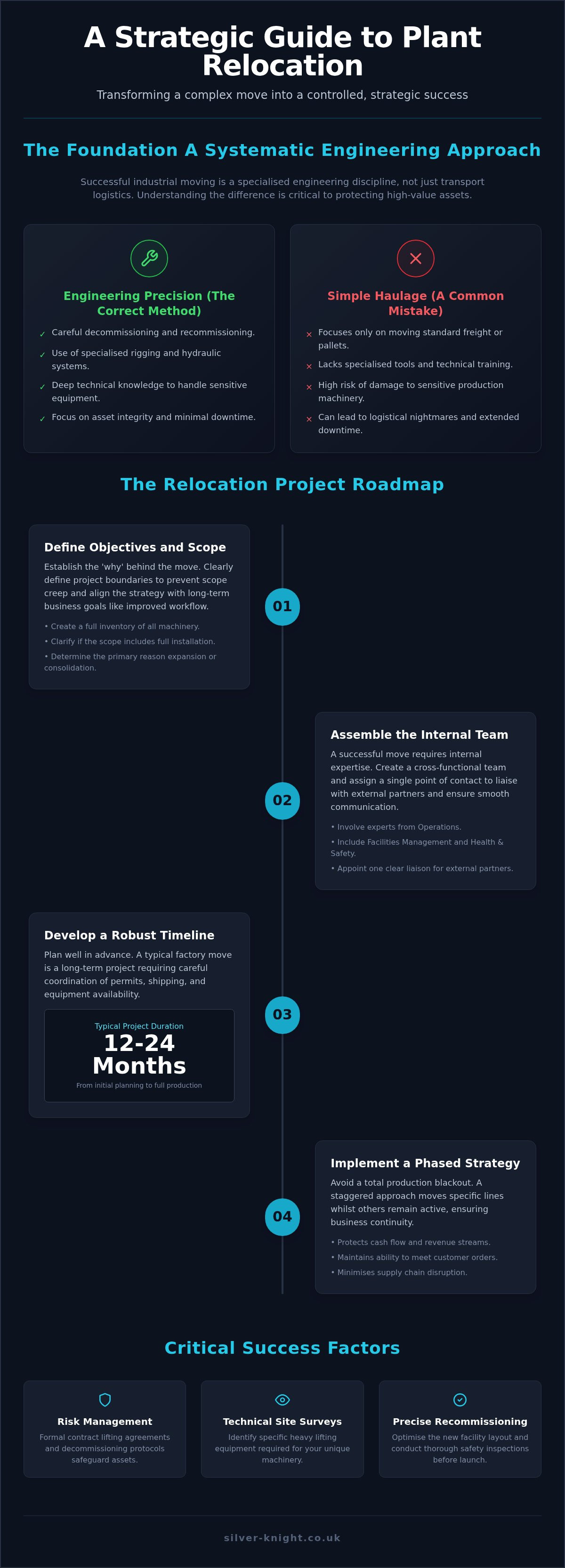
Plant relocation project management is the systematic coordination of moving industrial assets from one site to another. It's a complex discipline that goes far beyond simple logistics. It requires the careful decommissioning, transport, and recommissioning of heavy machinery. Unlike general haulage, which focuses on moving pallets or standard freight, industrial moving requires deep engineering knowledge to handle sensitive, high-value equipment safely.
When looking at The Essentials of Plant Relocation, it's clear that engineering precision is the priority. General hauliers often lack the specialised tools or technical training needed to dismantle a production line without causing damage. Professional movers use specific rigging, hydraulic systems, and lifting techniques to ensure every component remains in its original working condition. For those seeking a comprehensive factory relocation service, professional project management is the difference between a smooth restart and a logistical nightmare.
To better understand this concept, watch this helpful video:
A dedicated project manager is the backbone of any successful plant relocation project management strategy. They maintain the critical path, ensuring that each phase happens in the right order to avoid bottlenecks. Their primary goals are always safety, protecting the integrity of the assets, and keeping production lag to an absolute minimum. Without this central oversight, the risk of extended downtime increases significantly. They ensure that every contractor and internal team member works towards the same deadline.
Defining Project Objectives and Scope
Before any equipment moves, you must define the reason for the relocation. Whether it's site consolidation or business expansion, the "why" dictates the entire strategy. You need a full inventory of every machine and piece of infrastructure. This includes defining the project boundaries. Does the move include decommissioning and full installation, or just transport? Setting these limits early prevents scope creep and keeps the budget on track. It's also vital to consider long-term goals, such as improving workflow at the new site, rather than just replicating the old layout.
Assembling the Internal Project Team
You can't manage a move in isolation. A strong internal team should include experts from operations, facilities management, and health and safety. These individuals understand the daily requirements of the plant. Assigning a single point of contact is vital. This person liaises with your external relocation partner to ensure information flows smoothly. Using clear communication channels prevents silos and ensures that everyone knows their responsibilities during the transition.
To ensure your industrial assets are handled with the highest level of technical expertise, consider partnering with a specialist for your plant relocation.
Creating a Robust Factory Move Timeline and Strategy
A successful relocation is never a last minute decision. Industry data suggests that a realistic factory move typically takes between 12 and 24 months from the initial planning stage to full production at the new site. Starting the process early is essential to account for long lead items. For example, obtaining heavy lift permits for oversized loads can take several weeks of coordination with local authorities. If your move involves international shipping, the documentation for customs and overseas transport adds another layer of complexity that must be managed well in advance.
You should develop a phased timeline rather than attempting a total blackout of your operations. This staggered approach allows you to decommission and move specific production lines whilst others remain active. It protects your cash flow and ensures you can still meet customer orders during the transition. Effective plant relocation project management relies on a strict framework to track every asset. Every machine must be logged from its current position to its exact footprint in the new facility. This level of detail prevents items from being misplaced and ensures that the installation team knows exactly where to begin.
Identifying Critical Path Milestones
Mapping out the sequence of machine disconnections is vital for keeping secondary processes running. You must identify which machines are interdependent. If one unit is removed too early, it could halt the entire production flow. Your timeline should also factor in time for technical surveys and floor preparation at the new facility. Setting firm dates for the physical move is the only way to coordinate haulage and crane hire effectively. Without these fixed milestones, you risk paying for idle equipment or specialised labour teams.
Budgeting for Industrial Relocation Costs
Budgeting for a move goes far beyond the cost of transport. You must include hidden expenses such as temporary machinery storage and new utility connections. It's often necessary to invest in professional machinery dismantle services to ensure that complex equipment is taken apart safely for transit. This reduces the risk of mechanical failure during recommissioning. You should also reserve a contingency fund. Unforeseen structural adjustments or electrical upgrades at the new site are common, and having a financial buffer prevents these issues from stalling your progress.
If you're unsure where to begin with your scheduling, you can speak with an expert team to discuss your specific requirements.
For a smooth transition, it's best to work with a team of heavy machine movers who understand the technical demands of industrial engineering.
Technical Site Surveys and Machinery Requirements
Whilst the strategic side of plant relocation project management is vital, the technical execution is where the most risk lies. You must conduct a comprehensive technical survey at both the origin and destination sites before a single bolt is loosened. This involves a detailed analysis of the physical dimensions and weight of every asset. Knowing the exact centre of gravity for each machine is essential for determining the correct lifting requirements. You can review the Silver Knight equipment list to see how specific tools match your machinery challenges. You must also ensure that all transport routes are clear of height or weight restrictions. A single low bridge or weak road surface can stop your move in its tracks and cause expensive delays.
A professional survey also identifies the specific logistical hurdles that aren't visible on a standard floor plan. For instance, the presence of underground service ducts or mezzanine supports can drastically change how a machine must be extracted. By identifying these issues early, you can develop a technical method statement that addresses every risk. This proactive approach ensures that the physical move remains on schedule and within the safety parameters defined at the start of the project.
For site challenges that require specialised ground-level support, Ayr Tracked Plant & Equipment Hire provides niche tracked machinery and lifting equipment that can be vital for preparing access routes or managing smaller assets in difficult terrain.
Evaluating Floor Loadings and Access Points
The new facility must be physically capable of supporting your operations from day one. You need to check that the new floor can withstand the point loads of heavy industrial machines without cracking or shifting. It isn't just about the total weight; it's about how that weight is distributed through the machine's feet or base. Measure all doorways, corridors, and overhead clearances with precision to ensure machinery can enter the building without removing structural walls. Sometimes, you may identify a need for temporary flooring or ramp systems to move equipment over uneven ground or sensitive surfaces during the installation phase. For those looking to protect high-traffic or carpeted areas within the administrative sections of a plant, you can read more about available solutions.
Selecting Specialised Lifting Equipment
Choosing the right gear is a matter of safety and efficiency. You'll need to determine when to use a Versa-Lift for restricted access versus a hydraulic gantry system. Versa-Lifts are excellent for heavy lifting in confined spaces where a standard crane cannot reach. Conversely, jack and slide systems are often better for moving massive loads into tight corners with low head height. Regardless of the choice, ensure all equipment is operated by qualified personnel. This maintains site safety and protects your high-value assets from accidental damage whilst they are in motion.
To protect your investment during a complex move, you can rely on the expertise of a professional machinery installation team.
Managing Risks during Industrial Decommissioning and Transport
Decommissioning is the most vulnerable stage for any production asset. You must implement a strict protocol to protect sensitive electronics and mechanical parts from vibration or moisture during the move. This involves more than just unplugging a machine. It requires a systematic approach to draining fluids, securing moving parts, and labelling every connection for a faster restart. Professional factory relocation services manage this entire logistics chain, ensuring that the integrity of your machinery is never compromised whilst in transit. This level of care prevents the mechanical failures that often occur when assets are handled by general hauliers.
Liability is another major concern during the physical move. You should always ensure that all lifts are conducted under a formal contract lifting agreement. This shift in responsibility provides maximum liability protection for your business, as the moving specialist takes charge of the planning, equipment selection, and insurance. It's a key part of effective plant relocation project management that many businesses overlook. Safety also depends on the proper disconnection of utilities. Electricity, gas, and compressed air must be isolated and safely capped off by qualified engineers before the heavy lifting begins. This prevents accidents and ensures the site remains compliant with environmental regulations.
Ensuring Health and Safety Compliance
Every lift must adhere to the Lifting Operations and Lifting Equipment Regulations, commonly known as LOLER. This is a legal requirement that governs how machinery is moved. You must conduct detailed risk assessments and method statements (RAMS) for every significant lift to identify potential hazards. It's also vital to verify that all operators hold the necessary certifications for specialised equipment like Versa-Lifts or gantry systems. Safety isn't just about the equipment; it's about the competence of the people operating it. Ensuring that your team follows these strict protocols will protect both your staff and your high-value assets from harm.
Minimising Operational Downtime during Transit
Keeping your move on schedule requires perfect coordination with hauliers. You must ensure machines arrive at the new site in the correct order for installation. If the delivery sequence is wrong, you might find yourself moving the same machine twice to reach a specific bay. If the new site isn't quite ready, you can use secure warehousing and storage to keep your assets safe in a climate-controlled environment. You should also monitor weather conditions and traffic reports constantly. Heavy rain or road closures can easily add hours to your timeline, so having a backup route is always a smart move to maintain your production schedule.
If you're ready to secure your machinery for transport, contact our specialist team today to start your risk assessment.
For professional assistance with your final machine positioning, you should consult an expert in industrial machinery installation.
Implementing the Final Recommissioning and Launch
The final stage of plant relocation project management is where your planning truly pays off. Once your assets arrive at the new site, the focus shifts to precise positioning. You aren't just looking for a spot where the machine fits; you're creating a layout that ensures an optimal workflow. A well-designed production floor reduces material handling times and boosts overall efficiency. Before you even think about powering up, you must reconnect all utilities. This involves careful coordination with electricians and engineers to conduct initial safety checks on all power, gas, and air lines.
Testing is a non negotiable step in the recommissioning process. You should perform thorough checks of every machine function to verify that no damage occurred during transit. Travel vibrations can sometimes loosen internal connections or shift sensitive sensors. A systematic testing protocol ensures that every asset is calibrated to its original manufacturer specifications. Finally, you should conduct a post move audit. This allows your team to identify lessons learned, which will be invaluable for any future expansions or site changes. It's also the best time to verify that all equipment is operating at peak performance in its new environment.
Precision Levelling and Installation
Installation is a technical discipline that requires specialised tools. You must use precision levels and alignment gear to ensure machines operate within strict tolerances. If a machine is even slightly out of alignment, it can lead to premature wear or mechanical failure. Once the unit is perfectly positioned, you should securely bolt it to the floor. This should always be done according to the manufacturer's technical specifications and safety requirements. This final phase also includes installing safety guarding and any peripheral equipment like conveyors or extraction units to ensure the site is fully compliant.
Post Move Review and Asset Optimisation
Once production is back online, take the time to update your asset registers. Your maintenance schedules should also be adjusted to reflect the new facility's environment and any changes in usage. It's the ideal moment to evaluate the performance of your external partners based on feedback from your internal team. This review helps you refine your internal processes for the future. Finally, ensure all documentation is organised. Safety certificates, manuals, and technical drawings should be easily accessible to your maintenance and operations staff from day one in the new facility.
If you are preparing for a complex industrial move, it's vital to work with a specialist in machinery moving and plant relocation.
Securing Your Industrial Future in 2026
Success in moving a production facility depends on treating the process as an engineering challenge rather than a simple transport task. By prioritising technical site surveys and phased timelines, you can protect your high value assets and keep your supply chain moving. Effective plant relocation project management is the only way to eliminate the risks of extended downtime and mechanical failure during a transition. It requires a blend of meticulous planning, specialised lifting gear, and deep industry knowledge to ensure every machine is recommissioned to its original standard.
With over 180 years of collective industry experience, Silver Knight provides the technical expertise needed for complex moves. Our team utilises specialised hydraulic gantry and jack and slide systems to handle even the most challenging lifts. Whether you require nationwide UK coverage or global relocation services, we have the tools and knowledge to manage your entire project from decommissioning to final launch. You don't have to face the complexities of an industrial move alone. Contact Silver Knight for expert plant relocation project management and ensure your business is ready for its next chapter with total peace of mind.
Frequently Asked Questions
How long does a typical plant relocation project take to complete?
A typical factory move usually takes between 12 and 24 months from the initial planning phase to full production at the new site. This timeline accounts for site selection, technical surveys, and the procurement of necessary permits. Whilst smaller moves might be completed faster, complex industrial facilities require significant lead times to manage decommissioning and recommissioning without disrupting the entire supply chain.
What is the difference between machinery moving and a full plant relocation?
Machinery moving focuses on the physical transport of individual assets or small groups of equipment. In contrast, a full plant relocation involves the systematic move of an entire facility, including production lines, infrastructure, and staff operations. This requires comprehensive plant relocation project management to coordinate utilities, floor layouts, and business continuity across multiple departments simultaneously to ensure a seamless transition.
What insurance coverage is required for moving heavy industrial machinery?
You typically require goods in transit insurance to cover the assets and public liability insurance for site safety. However, the most secure way to manage risk is through a formal contract lifting agreement. This arrangement shifts the primary liability to the specialist mover, who provides the necessary insurance, equipment, and certified personnel to execute every lift safely and legally.
How do I calculate the cost of a factory relocation project?
To calculate the cost, you must factor in transport, specialised labour, and decommissioning services. You should also include expenses for temporary machinery storage, new utility connections, and structural modifications at the destination site. It is wise to include a contingency fund of at least ten per cent to cover unforeseen technical challenges, such as unexpected electrical upgrades or floor reinforcement needs.
What are the most common risks associated with industrial plant moves?
The most common risks include extended production downtime and accidental damage to high value machinery. Safety breaches during heavy lifting also pose a significant threat to personnel. Additionally, businesses often face logistical delays caused by incorrect permit applications or failing to account for height and weight restrictions on the transport route. These issues can lead to expensive delays and missed production targets.
Do I need to decommission my machinery before the movers arrive?
Yes, all machinery must be properly decommissioned to ensure it is safe for transport. This involves isolating power, draining fluids, and securing internal components that could shift during transit. Whilst you can use internal engineers, many businesses hire specialists to perform these tasks. This ensures that the equipment is dismantled in a way that simplifies the eventual recommissioning and protects sensitive electronics.
How can I minimise production downtime during a factory move?
You can minimise downtime by implementing a phased relocation strategy rather than a total site blackout. By moving one production line at a time, you can maintain a level of output to satisfy customer orders whilst other parts of the plant are in transit. Effective plant relocation project management ensures that each stage of the move is timed to coincide with planned maintenance or low demand periods.
What equipment is best for moving machinery in a factory with low ceilings?
A Versa-Lift or a jack and slide system is usually the best choice for moving machinery in buildings with low overhead clearance. These tools allow for heavy lifting and horizontal movement without the need for a tall crane boom. Hydraulic gantry systems are also effective for lifting large assets in confined spaces where traditional mobile cranes cannot operate safely or have insufficient height to lift.

Article by
David Ashby
I'm the Managing Director of Silver Knight Haulage & Machinery Ltd. Silver Knight Ltd is a family-run firm established in the West Midlands in 2005, with the aim of providing a cost-effective, yet professional, service to businesses for the removal, transportation, and installation of machinery, plant, and equipment here in the UK and worldwide. Between us, the Silver Knight workforce has over 50 years of experience with machinery and its operation.
Disclaimer
This article is intended for informational purposes only. Please ensure you seek expert advice or carry out your own research to confirm the information is suitable for your specific needs.