A factory move is far more than a simple haulage task; it is a high stakes engineering project where every minute of lost production directly hits your bottom line. If you are planning a turnkey factory relocation UK in 2026, you likely feel the weight of coordinating multiple contractors while worrying about potential damage to sensitive machinery. It is a common concern amongst industrial managers who need to maintain strict output schedules whilst overseeing a massive physical transition.
We understand that the complexity of moving heavy plant can feel overwhelming, especially with rising construction material prices and new safety standards for lifting equipment. This expert guide explains how to manage a seamless industrial move with minimal downtime by using professional turnkey strategies. You will learn how to secure a single point of accountability, ensuring your machinery is decommissioned, transported, and recommissioned to its original standards. We will cover the essential steps to achieve a safe, efficient relocation that protects your assets and your production targets.
Key Takeaways
- Learn how a turnkey factory relocation UK strategy provides a single point of accountability to manage every phase of your industrial move.
- Understand why technical site surveys are essential for identifying floor loading limits and access restrictions before any equipment is moved.
- Discover why specialised hydraulic gantry systems are the preferred solution for lifting heavy equipment in areas with restricted headroom.
- Follow a systematic approach to decommissioning and dismantling that prepares your machinery for safe transport and efficient recommissioning.
- Find out how to select a relocation partner with the technical experience required to minimise production downtime and protect your assets.
If you are planning a large scale move, you can find expert assistance from Silver Knight Haulage to ensure your project stays on track.
Understanding turnkey factory relocation in the UK
A turnkey factory relocation UK involves a holistic approach to moving industrial facilities. It is not just about moving boxes or pallets; it's a start to finish service that covers every technical detail. This comprehensive model includes the initial technical survey, decommissioning of utilities, transport, and the final recommissioning of equipment at the new site. By choosing this method, you ensure that every part of the move is synchronised under a single project management umbrella.
Dealing with one project manager reduces the administrative burden significantly. Instead of juggling five different contractors for electrical work, heavy lifting, and transport, you have one person accountable for the entire timeline. This reduces the risk of miscommunication which often leads to costly delays. In the context of 2026, where logistics costs are fluctuating, having a fixed point of accountability helps maintain budget control and operational stability.
To better understand how these complex projects are managed, watch this helpful video:
Specific sectors rely heavily on these managed moves to protect their modern manufacturing processes. Industries like automotive manufacturing and food production operate on just in time schedules where even a few hours of unexpected downtime can result in massive financial losses. Choosing a partner with national coverage across the United Kingdom is vital. It ensures they can manage logistics across different regions without relying on third party sub contractors who might not understand your specific safety requirements.
The benefits of a managed industrial move
Using professional machinery movers UK ensures that your high value assets are protected throughout the journey. Expert teams understand how to handle delicate components that are sensitive to vibration or tilt. By avoiding multiple separate contractors, you improve cost efficiency and maintain business continuity. This structured approach helps in minimising the operational lag that usually occurs when production lines are offline. It also simplifies the health and safety documentation, as one company oversees all risk assessments and method statements.
Turnkey vs general haulage
General haulage firms are excellent for moving standard goods, but they often lack the technical expertise required for industrial relocation. They rarely have the specialised lifting equipment, such as hydraulic gantries or Versa-Lifts, needed for heavy machinery. A dedicated relocation partner also offers superior insurance and liability protection tailored for industrial equipment. This ensures that your investment is fully covered under a comprehensive policy designed for complex engineering moves rather than a standard goods in transit agreement. It provides peace of mind that your machinery will be recommissioned to its original standards.
Expert planning is the foundation of any successful project, and you can explore professional relocation services to begin your journey with confidence.
Strategic planning and technical site surveys
A successful turnkey factory relocation UK begins long before the first machine is disconnected. Technical site surveys are non negotiable because they identify physical constraints that could derail the project. These surveys evaluate floor loading capacities to ensure the ground can support heavy plant and identify access restrictions like narrow doorways or low hanging pipework. Without this data, you risk machinery getting stuck or damaging the facility floor during transit.
Asset tagging plays a vital role in keeping large scale moves organised. Every piece of equipment, from a CNC machine to a workbench, is assigned a unique identifier. This ensures that every component is accounted for during the transition and nothing is left behind. Once tagged, these assets are mapped onto detailed floorplans of the new facility. This level of precision allows the relocation team to position machinery exactly where it needs to go, which facilitates a faster recommissioning phase. When the equipment arrives, the team knows exactly where it belongs.
The creation of a Risk Assessment and Method Statement (RAMS) is a core part of this planning stage. This document outlines exactly how each task will be performed safely and efficiently. It covers everything from the weight of the loads to the specific lifting equipment required for the job. If you need assistance with the initial planning phase, you can speak with our technical team to discuss your site requirements.
The technical site survey process
During a survey, plant relocation specialists look for potential bottlenecks that could slow down the move. They perform rigorous checks on overhead clearances and verify that floor weight capacities at the destination site match the technical specifications of your machinery. They also inspect utility connections, such as three phase power or compressed air lines, to ensure the new site is ready for immediate installation. This proactive approach prevents unexpected delays on moving day.
Health and safety compliance
Adhering to legal requirements is a priority for any industrial transport project. Professional planning ensures that all operations remain compliant with PUWER (Provision and Use of Work Equipment Regulations) and UK lifting regulations. These standards mandate that all lifting equipment is fit for purpose and that lifting operations are properly planned by competent persons. Clear communication between the relocation team and your staff is maintained throughout the project. This ensures that everyone on site is aware of the ongoing work and that safety protocols are strictly followed at all times.
To ensure your equipment is handled by experts using the latest technology, you can view our full range of services online.
Specialised lifting technology and heavy haulage
Executing a successful turnkey factory relocation UK requires a suite of engineering tools designed for extreme weights and tight spaces. Hydraulic gantry systems have become the preferred method for lifting heavy plant in environments with low headroom. These systems provide a stable and controlled vertical lift for loads exceeding 100 tonnes, allowing for safe movement within the confines of an existing production hall. They offer a level of safety and precision that traditional mobile cranes cannot match when working indoors.
When machinery is located in areas where even a gantry cannot reach, jack and slide systems are used. These systems allow engineers to lift a machine slightly and then slide it along a low profile track. It is an essential technique for moving massive industrial assets through narrow corridors or into basement levels. For smaller, high precision positioning, Versa-Lifts and specialised heavy duty forklifts are employed. These machines have a compact footprint but possess the power to move heavy CNC centres or injection moulding machines into their final operating positions.
Advanced lifting systems for restricted spaces
Modern factories are often packed with equipment, leaving very little room for manoeuvre. The use of specialised equipment allows relocation teams to operate safely in these restricted areas. Hydraulic gantries are particularly effective because they can be assembled around the machine, negating the need for large structural openings in the building. For sensitive industrial assets, jack and slide systems provide a vibration free movement that protects internal alignments and delicate electronic components from the shocks associated with standard lifting.
Heavy haulage and transport logistics
Moving oversized loads on UK roads involves complex coordination. In 2026, haulage rates for an articulated 44 tonne lorry typically start from £3.00 per mile, and planning must account for route surveys and potential escort requirements. According to The Manufacturers' Organisation, Make UK, maintaining supply chain resilience is a top priority, which is why having a dedicated fleet for industrial machinery transport is so beneficial. Lorry mounted cranes are often used for efficient loading at the source and unloading at the destination, reducing the need for additional hire equipment on site.
Securing assets for transport
Securing assets for transit is about more than just heavy duty strapping. Professional teams use bespoke timber blocking and internal bracing to prevent any internal movement that could cause damage during the journey. Weather protection is equally important, especially for sensitive electronic machinery. High grade shrink wrapping or custom crating ensures that moisture and road debris don't affect the equipment. This level of professional packing is a standard part of a managed move, preventing costly repairs and ensuring the machinery is ready for immediate recommissioning upon arrival.
If you are ready to begin your project, you can partner with an experienced relocation team to ensure a smooth transition for your business.
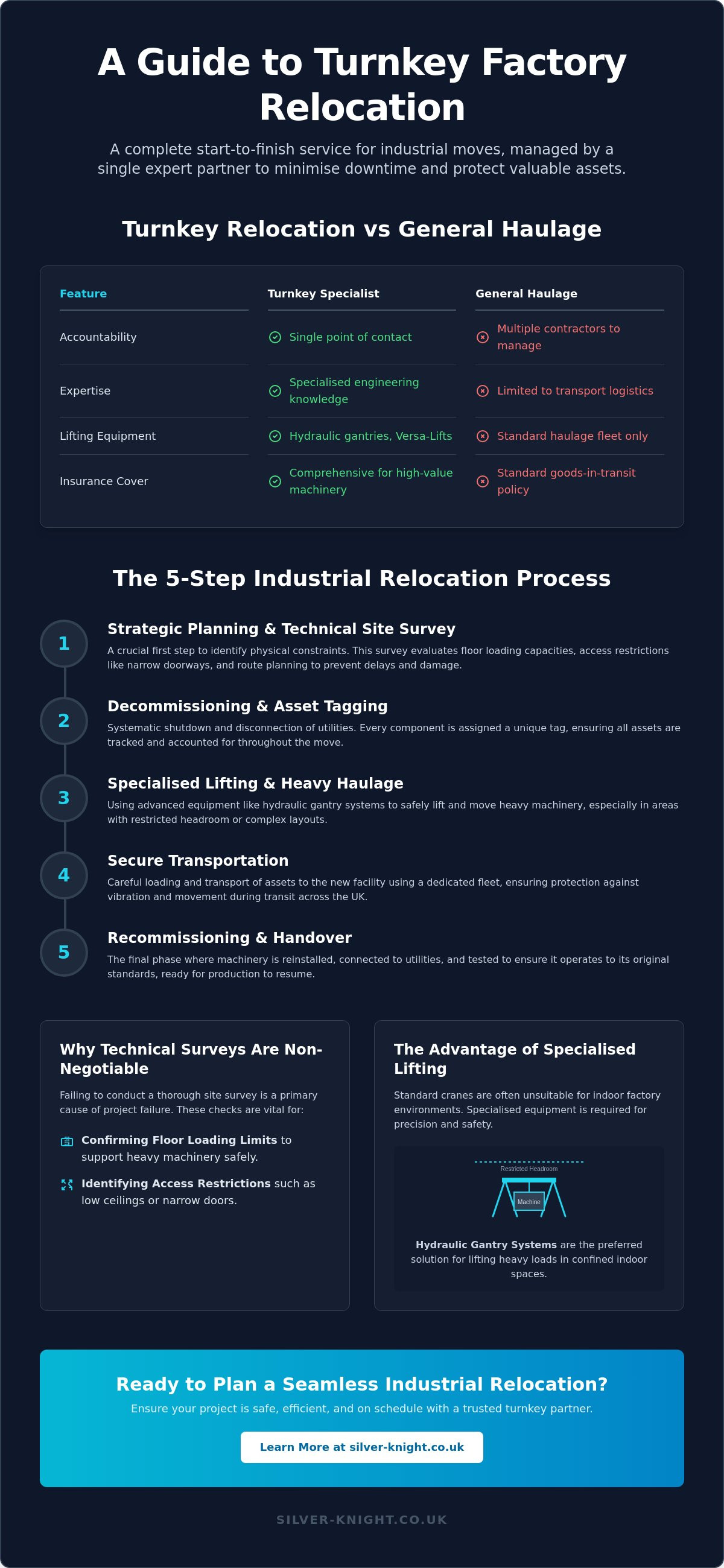
The step by step process of industrial relocation
A successful turnkey factory relocation UK is a multi phased operation that requires strict adherence to a technical timeline. Phase one starts with the systematic decommissioning and machinery dismantling of all equipment. Phase two involves the technical lifting and loading onto specialised transport vehicles using the methods discussed in previous sections. Phase three covers the secure transit using planned haulage routes, whilst phase four focuses on offloading, precision positioning, and the recommissioning of assets to their original operating standards.
During the transit phase in mid 2026, many operators benefit from the 12 month suspension of the Vehicle Excise Duty for HGVs, which helps manage transport costs. However, the real work happens at either end of the journey. Precision and documentation are the keys to avoiding production delays. If you need a detailed quote for your upcoming move, you can request a site visit from our engineers to assess your specific requirements.
Decommissioning and dismantling
This phase is about more than just pulling plugs; it involves the safe disconnection of complex electrical, hydraulic, and pneumatic systems. Engineers document all machine settings and software configurations before any disassembly starts. Every component is labelled with a unique code that matches the technical drawings and asset tags. This level of detail ensures that reassembly at the new site is accurate and efficient. It prevents the "puzzle piece" delays that often plague poorly planned moves where parts are separated without a clear record.
Installation and recommissioning
Once the machinery arrives at the destination, the focus shifts to precision engineering. Recommissioning is the most critical part of the process, yet it's often overlooked in general transport guides. It starts with levelling and securing the machinery in its new location using industrial anchors or anti vibration mounts. After the physical installation, engineers reconnect all utilities and perform a rigorous testing phase. This involves checking every function against the original manufacturer specifications to ensure the machine produces parts to the required tolerances. Only after these safety checks and performance tests are complete is the final handover performed. This ensures your production line is ready for immediate operation without the need for further adjustments by your own staff.
Selecting the right team is essential for a safe move, and you can discover more about our industrial expertise to find the support you need.
Choosing a reliable partner for plant relocation
When you are managing a turnkey factory relocation UK, the technical proficiency of your partner is the most important factor. You need a team that brings more than just transport equipment to the table. Silver Knight offers 180 years of collective industry experience, which provides a level of insight that newer firms simply cannot match. This heritage means that no matter how complex your machinery or how tight your access, our team has likely solved a similar challenge before. This collective knowledge allows us to anticipate risks before they become problems. Knowing how certain floor types react to heavy gantry loads or how specific machine sensors behave during transport is only learned through decades of hands-on work.
As a family run business, we provide a higher level of personal accountability than large, faceless corporations. When you entrust us with your high value assets, you are dealing with people who have a personal stake in the success of your move. This accountability translates into better communication and a more flexible service. If your schedule shifts or a technical issue arises on site, you have direct access to decision makers who can adapt the plan instantly. This commitment is backed by a national capability that spans the entire United Kingdom. We own and operate our own lifting fleet, including hydraulic gantries and Versa-Lifts. It ensures that the equipment arriving at your site is maintained to our own high standards and operated by staff who use it every single day. This eliminates the uncertainty that comes with sub-contracting specialised lifting tasks to external parties.
Experience and industry heritage
Heritage matters in industrial engineering. Decades of working in diverse environments help in solving complex relocation challenges that would stall less experienced teams. Long term industrial partnerships are built on trust and the consistent delivery of safe projects. Trust is earned through years of reliable service, and many of our clients have worked with us for decades because they know we prioritise their production targets as if they were our own. Our personnel undergo rigorous training to ensure they remain at the forefront of machinery moving standards. This ensures that every lift is executed with the highest level of technical competence and care.
The Silver Knight approach
Our approach centres on safety and precision in every project we undertake. We believe that a successful move is one where the client feels supported from the initial survey to the final bolt being tightened. We encourage you to seek a factory relocation service that offers full turnkey support rather than just basic transport. A fully managed turnkey factory relocation UK gives you the peace of mind that every technical detail is handled by experts. This allows you to focus on your core business whilst we ensure your production facility is ready for its next chapter.
To begin your journey towards a successful facility move, you can learn more about our industrial solutions online.
Secure your industrial future with expert relocation
Planning a turnkey factory relocation UK requires an engineering mindset and meticulous technical oversight. By prioritising detailed site surveys and using specialised lifting technology, you protect your high value assets and keep production downtime to an absolute minimum. A single point of accountability simplifies the entire process, from the first asset tag to the final recommissioning test. This structured approach ensures your transition is handled with the precision your business demands.
Silver Knight brings over 180 years of collective industry experience to every project. As a family run business with national UK coverage, we provide a personal service backed by a specialised fleet including hydraulic gantries and Versa-Lifts. Our team is dedicated to ensuring your machinery is moved safely and efficiently, allowing your business to thrive in its new location. We are here to support your growth every step of the way.
Contact our team for a professional factory relocation quote and take the first step towards a seamless transition. We look forward to helping you achieve a successful move.
Frequently Asked Questions
What exactly is included in a turnkey factory relocation
A turnkey project covers the entire lifecycle of the move from the initial concept to final production. This includes technical site surveys, decommissioning, dismantling, heavy haulage, and final recommissioning at your new facility. By choosing a turnkey factory relocation UK, you benefit from a single point of contact who manages every technical detail. This ensures that electrical and mechanical disconnections are handled safely and that all equipment is installed and tested to original standards.
How much time should I allow for a full factory move
The timeline depends entirely on the scale of your facility and the complexity of your machinery. Small workshops might take a few days, whilst large production plants can require several weeks of planning and execution. We recommend starting the consultation process at least three to six months before your desired move date. This allows sufficient time for technical surveys, route planning, and coordinating the decommissioning of utilities without rushing the transition.
Can you relocate heavy machinery to international locations
Yes, we provide international machinery transport services for businesses moving equipment outside of the United Kingdom. This involves specialised container packing, secure crating, and managing the logistics of sea or road freight. Our team handles the technical dismantling and ensures that assets are protected against the elements during long distance transit. We coordinate with global partners to ensure your plant is delivered and positioned safely at its final destination across the globe.
What kind of insurance do you provide for high value industrial assets
We maintain comprehensive insurance cover specifically designed for industrial relocation and machinery moving. Unlike standard haulage insurance, our policies cover the technical aspects of lifting, dismantling, and installation. This provides protection against accidental damage during every phase of the project. We always recommend that clients check their specific asset values against our standard cover limits to ensure full peace of mind for high value production lines and sensitive electronic equipment.
Do you handle the decommissioning of electrical and mechanical systems
Decommissioning is a core part of our managed service. Our engineers manage the safe disconnection of all electrical, pneumatic, and hydraulic systems before any dismantling begins. We document all machine settings and mark every connection to ensure accurate reassembly later. This proactive approach prevents damage to sensitive control systems and ensures that your machinery is ready for a smooth recommissioning phase once it arrives at the new site, reducing potential downtime.
How do you move heavy machinery through narrow access points
We use specialised lifting technology like hydraulic gantry systems and jack and slide systems to navigate tight spaces. These tools allow us to lift and move massive loads where traditional cranes or forklifts cannot operate. Our Versa-Lift fleet is also designed for high capacity lifting within a compact footprint. This equipment, combined with technical floor loading assessments, enables us to position heavy machinery with millimetre precision in restricted areas without damaging the building structure.
What is a technical site survey and why is it necessary
A technical site survey is a detailed assessment of both your current and future facilities. It is necessary to identify potential hazards such as low overhead clearances, narrow doorways, or insufficient floor loading capacities. During the survey, we map out the exact path for the machinery and plan the utility requirements for the new site. This planning phase is essential for a turnkey factory relocation UK to prevent unexpected delays, safety risks, or equipment damage during the move.

Article by
David Ashby
I'm the Managing Director of Silver Knight Haulage & Machinery Ltd. Silver Knight Ltd is a family-run firm established in the West Midlands in 2005, with the aim of providing a cost-effective, yet professional, service to businesses for the removal, transportation, and installation of machinery, plant, and equipment here in the UK and worldwide. Between us, the Silver Knight workforce has over 50 years of experience with machinery and its operation.
Disclaimer
This article is intended for informational purposes only. Please ensure you seek expert advice or carry out your own research to confirm the information is suitable for your specific needs.