What if the biggest challenge in an machinery import isn’t getting it to the UK, but moving it safely from the arrival point to its final position? That handover can involve different transport, access and lifting needs, especially when machinery is heavy or oversized.
Good planning is central to industrial machinery import logistics UK projects. You may need to decide which freight arrangements suit a particular machine, who handles each stage, and where a freight forwarder’s role ends and specialist machinery moving begins. Clear responsibilities and accurate project information help connect these stages.
This guide explains the main stages of a UK machinery import and how international transport connects with delivery and handling at the destination. You’ll learn what information to prepare, how to compare transport and lifting options, and how a specialist can support heavy haulage, machinery movement and project-specific lifting. The aim is to help you plan a coordinated journey from origin to site.
Key Takeaways
- Plan industrial machinery import logistics UK around the machine’s size, weight, lifting points and destination access.
- Map the journey from origin collection to final-site delivery, keeping freight, customs arrangements and specialist machinery handling distinct.
- Compare transport options against the shipment’s characteristics and the handling needed at its destination.
- Prepare details about the machine, its condition, origin, destination and intended installation area before arranging the move.
- Use specialist support with heavy haulage, machinery moving and lifting to connect an international shipment with its UK site.
For a coordinated move from overseas arrival to final placement, explore Silver Knight’s machinery moving and haulage services.
What industrial machinery import logistics into the UK involves
Industrial machinery import logistics UK means coordinating the movement of equipment from its origin to the UK site where it will be used. The journey can involve separate arrangements for international freight, import formalities, UK transport and the handling needed to get the machine into position. The plan works best when each stage is clearly connected to the next.
Machinery brings practical details that ordinary freight planning may not cover. Weight and dimensions affect how equipment can be transported and unloaded. Known lifting points inform handling plans, while the route into the building, available space and intended position shape the work at the destination.
Logistics covers the movement of goods through different transport modes. The Logistics UK overview provides context on the trade association and the wider logistics sector. For an individual machinery import, the freight journey is only one part of the plan.
How machinery imports differ from ordinary freight
A standard delivery may end at an unloading point. A machinery move can require planning beyond that point, particularly if the equipment is unusually heavy or its dimensions affect loading, transport or site access. Plan the route from the delivery point to the machine’s intended position, not just the journey to the premises.
For example, a machine may need to pass through a restricted entrance or be positioned within an operating area. In these cases, delivery, lifting and positioning are connected tasks. Consider them alongside the freight arrangements rather than leaving them until the shipment arrives.
The parties and handovers in an import journey
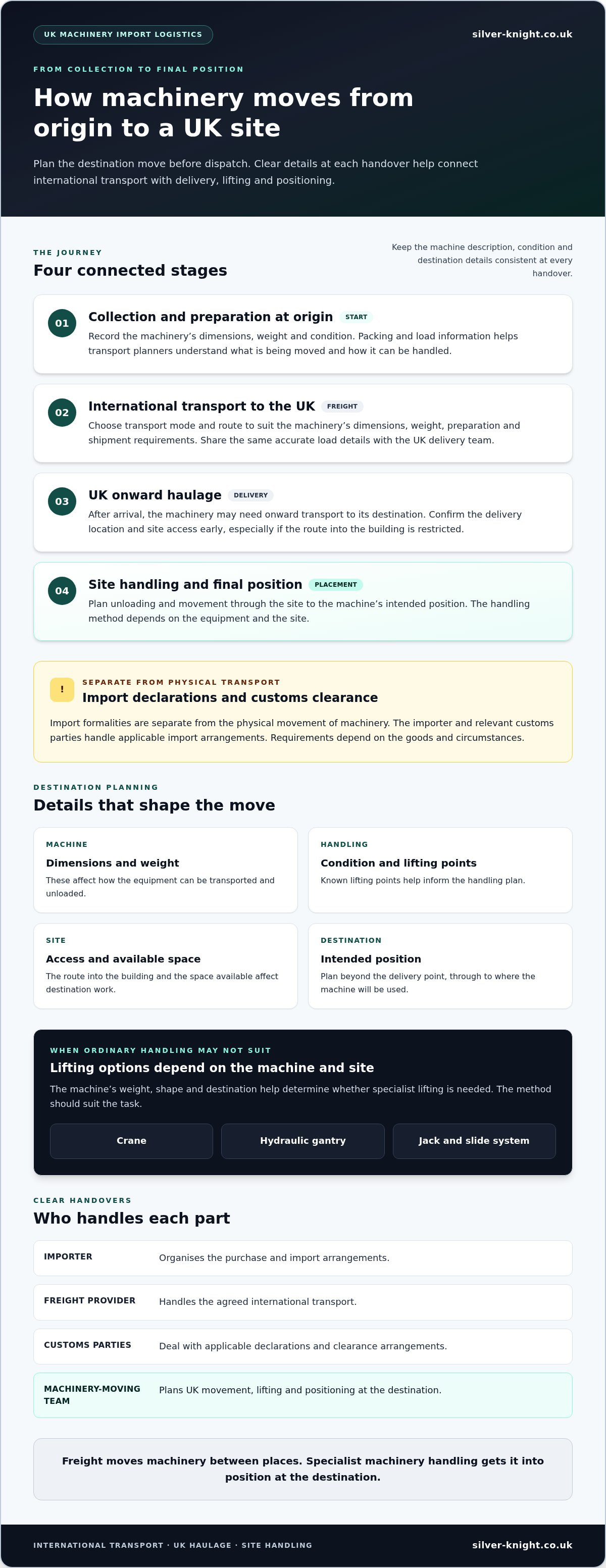
Different parties may manage different responsibilities. The importer organises the purchase and import arrangements. A freight provider handles the agreed international transport, while the relevant customs parties deal with declarations and clearance. A machinery-moving team plans the UK movement, lifting and positioning needed at the destination. These roles are distinct, even when the work is coordinated as one project.
A useful handover makes clear where international transport ends, where UK delivery begins and who is responsible for site handling. Missing details about the machine or access can complicate the next stage, so share practical information with all parties involved.
Freight transport moves machinery between places; specialist machinery handling gets it into position at the destination.
Silver Knight provides the specialist link between shipment and site. Its services include machinery moving, heavy haulage, installation and lifting, with international machinery moving supporting relocation projects. Customs declarations and freight forwarding are separate from these machinery-moving services.
For support connecting an international shipment with specialist machinery handling, explore Silver Knight’s machinery-moving services.
How an industrial machinery import moves from origin to UK site
A well-planned import is a sequence of connected stages, not a single booking. Each handover should carry the same accurate details about the machine, its condition and destination. Planning the final delivery before dispatch helps ensure the transport arrangements and destination requirements fit together.
From collection to arrival in the UK
The journey starts with collection at the origin and a decision about the transport mode and route. These depend on the machinery’s dimensions and weight, how it is prepared for transit, and the shipment’s requirements. Packing and load information helps transport planners understand what is being moved and how it can be handled. Keep those details consistent across transport paperwork and the information shared with the UK delivery team.
Import declarations and customs clearance are separate from the physical movement of machinery. The importer and relevant customs parties are responsible for the applicable import arrangements, while the freight provider organises the agreed transport. Requirements depend on the goods and circumstances, so consult current HMRC guidance on making an import declaration for official information.
From UK arrival to final positioning
Arrival in the UK is not necessarily the end of the journey. Machinery may need onward haulage to its destination, followed by movement through the site to its intended position. Share the delivery location, access details and known lifting or positioning needs early so they can inform the arrangements.
Some equipment can be unloaded and moved using conventional methods. Other machinery may need specialist lifting if its weight, shape or destination makes ordinary handling unsuitable. A crane, hydraulic gantry or jack and slide system may be considered, depending on the machine and site. The method should suit the task, rather than be assumed before the relevant details are known.
Silver Knight supports global relocation work through international machinery transport, alongside UK machinery moving, heavy haulage, installation and lifting. Coordinating these elements connects the international journey with the work required at the destination. Keep the machine description, dimensions, condition and delivery arrangements aligned at each handover, and raise changes promptly with the parties managing each stage.
Plan the destination move before dispatch so the shipment’s arrival, onward haulage and site handling can be coordinated around the machine and its final position.
For help planning UK machinery haulage and site handling, explore Silver Knight’s machinery-moving services.
Which machinery import logistics arrangement suits your shipment
The right arrangement depends on more than the distance between origin and the UK. The machine’s size, weight, route, transport requirements and final-site access all shape the plan. Compare freight options alongside the unloading and onward movement needed at the destination. A mode that suits the international leg still needs to connect with a workable UK delivery plan.
Road, sea, air and multimodal freight considerations
Each mode has different planning needs. The table gives a broad comparison, not a universal recommendation. Suitability depends on the machinery and route.
| Transport mode | Shipment characteristics | Planning considerations | Destination-handling needs |
|---|---|---|---|
| Road | Potentially suitable for routes where road transport can connect origin, transfer points and destination. | Consider vehicle access, the machine’s dimensions and weight, and any changes between transport legs. | Plan unloading and onward movement from the delivery point to the machine’s final position. |
| Sea | May suit machinery travelling by sea, depending on its size, preparation and route. | Allow for the handover between origin transport, the sea leg and UK onward transport. Keep load details consistent. | Plan how the machine will be collected after arrival and moved from the port or other agreed point. |
| Air | Could be considered for machinery and routes suited to air transport. | Assess the machine’s dimensions, weight and handling needs across each transfer. | Plan how it will be unloaded and moved to the site after arrival. |
| Multimodal | Combines two or more transport modes across the journey. | Coordinate the connections between modes and pass accurate machine information at each handover. | Include the final UK leg and site handling in the plan, rather than treating arrival as the endpoint. |
For industrial machinery import logistics UK, compare the complete journey, not just the main freight leg. A route involving several transfers may require careful coordination of load information and unloading arrangements. A simpler route may still need a separate plan for moving the machine from the vehicle to its intended position.
When specialist lifting changes the delivery plan
Consider specialist lifting when the machine’s weight, restricted site access or positioning requirements make conventional unloading or movement unsuitable. The destination may have limited space, or the equipment may need to be placed inside a building rather than left at an unloading point. These factors can affect the choice of transport and how delivery is arranged, so include them from the outset.
Hydraulic gantries, cranes and jack and slide systems are examples of equipment used for particular lifting and moving tasks. The right approach depends on the machine and the site. Silver Knight supports UK onward movement through machinery haulage and relocation transport, connecting freight arrival with specialist handling where the project calls for it.
Compare each option against the full route, transfer points and final position. This gives you a clearer basis for coordinating international freight with the haulage and lifting needed at the UK destination.
Preparing a machinery move? Explore Silver Knight’s machinery-moving support.
What to prepare before arranging a UK machinery import
Good project information helps the transport and destination teams plan around the actual machine, rather than assumptions. Gather details in one place and share updates if the shipment or site arrangements change. For industrial machinery import logistics UK, clear information about both the load and its final position can help identify practical issues before the move is under way.
Machinery and shipment information to gather
Use equipment records or other reliable documentation where available, and distinguish confirmed measurements from estimates. Include the machine’s identity and condition, along with relevant handling details.
- Machine name, model or other identifying details, plus its current condition.
- Overall dimensions and weight, noting whether figures are measured or estimated.
- Known lifting points, centre-of-gravity information and any fragile or vulnerable areas.
- Whether dismantling, packing or secure storage forms part of the wider project.
- Origin, expected shipment details and any known restrictions on handling or movement.
“Share the machine’s identity, dimensions, weight, condition, lifting details, origin, destination and site access to help scope the move.”
Destination and site information to share
Describe the route from the planned delivery point to the intended position. A simple site plan or photographs can help show the route and any access constraints, where available.
- Delivery address and the planned unloading or handover point.
- Relevant doorway, corridor and working-area dimensions, along with floor details that may affect movement.
- Turns, changes in level or other access features along the route.
- The machine’s intended installation or positioning area and any space needed to carry out the move.
- Site operating arrangements that may affect access or coordination with staff.
Share what is known without guessing. If measurements or access details are uncertain, label them clearly so they can be resolved during planning. This is especially useful where the route is tight or the machine must be positioned within an existing work area.
Keep transport details separate from customs paperwork. The importer and relevant customs parties manage the applicable declarations and clearance arrangements; a machinery-moving team plans the physical movement and handling. Requirements vary with the import, so consult current HMRC guidance for official information rather than relying on a transport checklist as customs advice.
Once the key details are gathered, they can inform the UK delivery and handling plan. Silver Knight’s machinery haulage and relocation transport supports the onward movement of equipment as part of a wider project.
For specialist support with machinery moving, explore Silver Knight’s services.
How Silver Knight supports industrial machinery imports into the UK
Silver Knight supports the part of an import journey that brings machinery from its UK arrival point to the place it needs to work. Services include machinery moving, heavy haulage, machinery installation and factory or plant relocation. This specialist role sits alongside international freight and customs arrangements, helping businesses plan the physical move at the UK end.
Matching specialist machinery moving to the project
The right approach depends on the machine, its route through the site and the work needed to position it. A straightforward delivery may call for different arrangements from a move into a restricted area or a factory relocation involving several machines. Silver Knight’s team considers the project requirements and shapes the moving and lifting plan around the equipment and destination.
For specialist UK movement, heavy equipment moving and haulage can form part of the wider project. Silver Knight uses equipment including hydraulic gantries, cranes and jack and slide systems. These resources can support lifting and moving machinery, depending on the task and site conditions.
Silver Knight is a family-run specialist with nationwide UK operations and global relocation experience. The team brings over 180 years of collective industry experience to machinery moving and installation work. This is relevant when physical delivery needs planning beyond transport to an address, particularly when haulage, lifting and final positioning need to work together.
Taking the next step with a clear project brief
A useful first discussion starts with the facts of the move. Share the machine’s identity, dimensions, weight and condition, along with its origin and intended UK destination. Include known lifting points, any dismantling or installation requirements, and details of the route from the delivery point to the final position.
Site access information can help clarify the scope. Note relevant doorways, floor conditions, working areas and any restrictions that may affect movement. If a measurement is estimated or a detail is not yet known, label it clearly. This keeps confirmed information separate from assumptions as the project is discussed.
A project-specific conversation can focus on the work Silver Knight supports, such as UK machinery moving, heavy haulage, lifting and installation. It does not replace the importer’s separate arrangements for freight or customs declarations. Instead, it helps define the machinery-moving scope and how it connects with the shipment’s arrival and destination requirements.
To discuss your machinery move, share the shipment and destination details with Silver Knight’s machinery-moving team.
Explore Silver Knight’s machinery-moving services for support with your project.
Set your machinery import project in motion
The next step is to turn your shipment information into a practical moving brief. Bring together the machine’s details, origin, intended UK destination and any access or positioning considerations. A clear brief helps focus early planning on how the equipment will be moved, lifted and installed at the site.
Silver Knight is a family-run specialist founded in 1996, with over 180 years of collective industry experience. Its equipment includes hydraulic gantries, cranes and jack and slide systems. These resources support project-specific machinery movement and lifting as part of the wider journey.
For industrial machinery import logistics UK, the destination move deserves attention before the machinery is dispatched. A conversation about your project can help define the moving scope and identify the details needed to plan the UK leg. Customs and freight arrangements remain separate responsibilities.
Discuss your machinery import project and share the shipment and destination details to take the next step with confidence.
Frequently Asked Questions
What does industrial machinery import logistics involve?
It involves coordinating the arrangements needed to bring machinery from its origin into the UK and on to its intended destination. In practice, map who is responsible for each stage, from collection and international transport to import formalities and site delivery. For example, a machine arriving before its destination is ready may need revised onward transport or storage arrangements, so consider timing and handovers together.
Do I need an EORI number to import machinery into the UK?
Businesses importing goods into Great Britain need a GB Economic Operator Registration and Identification number, known as a GB EORI. Northern Ireland arrangements can differ, so check the guidance for the location and type of import. An EORI relates to customs processes, not the physical machinery move. Read the current HMRC guidance on EORI numbers for details on applying and which number applies to your circumstances.
How long does it take to import industrial machinery into the UK?
There isn’t one standard timescale. Duration depends on factors such as the origin, route, transport mode, shipment arrangements, import processing and onward delivery plan. Additional handling or a complex route into the building can also affect the schedule. For industrial machinery import logistics UK, build a project timeline with input from the parties managing each stage, and allow time to resolve missing information or shipment changes.
Can oversized industrial machinery be delivered to a UK site?
Yes, oversized machinery can be moved to a UK site when the transport and destination arrangements suit the load and access conditions. Planning may need to account for the route, unloading space, site entrances and how the equipment will reach its final position. If conventional handling won’t suit the move, specialist heavy haulage or lifting may be considered. Silver Knight provides machinery moving, heavy haulage and lifting support for project-specific requirements.
How are machinery import logistics costs worked out?
Costs depend on the scope of the whole project, not just the international journey. Relevant factors can include the machine’s dimensions and weight, route, transport mode, handling or lifting needs, onward haulage, installation and storage requirements. Customs-related charges are separate from machinery-moving services. To understand a project estimate, make sure the requested scope states which transport and handling stages it covers and which arrangements sit outside it.
How do Incoterms affect an industrial machinery import?
Incoterms set out agreed responsibilities between seller and buyer for delivery, costs and risk at defined points in a goods shipment. The chosen rule can affect who arranges or pays for parts of the transport journey. It does not replace customs requirements or specify how machinery will be lifted and positioned at the destination. Check the rule named in the sales contract and align the freight handover with the separate UK site-move plan.
What details should I provide when planning an imported machine move?
Provide the machine’s identity, dimensions, weight, condition and available handling information, such as lifting points or known fragile areas. Include the origin, delivery address and intended final position, plus site access details that could affect movement. Photos, drawings or equipment records can help explain unusual features. State clearly which figures are confirmed and which are estimates, so the moving plan is based on reliable information.

Article by
David Ashby
I'm the Managing Director of Silver Knight Haulage & Machinery Ltd. Silver Knight Ltd is a family-run firm established in the West Midlands in 2005, with the aim of providing a cost-effective, yet professional, service to businesses for the removal, transportation, and installation of machinery, plant, and equipment here in the UK and worldwide. Between us, the Silver Knight workforce has over 50 years of experience with machinery and its operation.
Disclaimer
This article is intended for informational purposes only. Please ensure you seek expert advice or carry out your own research to confirm the information is suitable for your specific needs.