A costly decommissioning mistake can happen before a spanner is lifted: treating every machine as waste. In food machinery decommissioning, decide what should happen to each asset early. This helps prevent avoidable disruption and reduces the risk of damage during removal.
Planning can feel complicated when production schedules, site teams and machinery specialists all need to be considered. Some equipment may be suitable for relocation or storage, while other assets may need to be cleared. The right route depends on the machinery, its condition, ownership and plans for the site.
This guide explains how to plan the work, prepare equipment for removal and coordinate the people involved. You’ll learn how to assess each asset, identify a destination for machinery that will be reused, stored or cleared, and agree a practical sequence before work begins. Making these decisions early gives everyone a clearer plan.
Key Takeaways
- Give every machine a clear destination before removal, whether it will be reused, stored or cleared.
- Plan food machinery decommissioning around production priorities, site access and agreed working boundaries.
- Confirm who is responsible for technical disconnection and how the removal will be handed over to the site team.
- Compare each asset’s condition, future use and ownership status before deciding where it should go.
- Share details about the machinery, access and intended destination when discussing the project with a moving specialist.
Planning a machinery move or clearance? Speak with Silver Knight about decommissioning and machinery moving.
What food machinery decommissioning involves and when it is needed
Food machinery decommissioning is the planned preparation of equipment for removal, reuse, storage or clearance. It covers the work needed to take machinery out of its current role and prepare it for its agreed next destination. The destination is a separate decision: decommissioning does not automatically mean disposal.
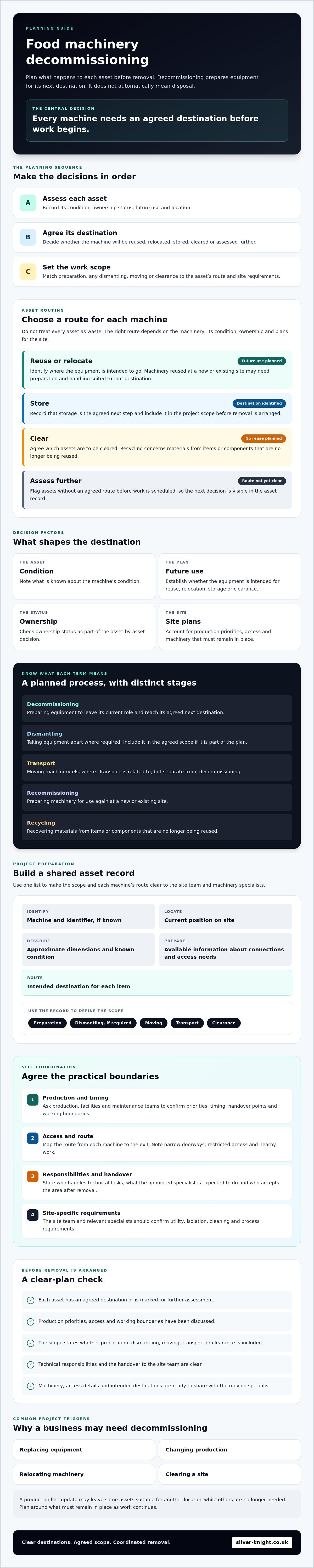
The terms are related, but not interchangeable. Decommissioning is the preparation process. Dismantling means taking equipment apart where required, while transport is moving it elsewhere. Recommissioning prepares machinery for use again at a new or existing site. Recycling concerns materials from items or components that are no longer being reused.
This video shows a food processing line being dismantled and loaded. Each project has its own scope, so use it as an illustration rather than a template.
What happens when food machinery is decommissioned
The scope depends on the machine, the site and its intended destination. Equipment earmarked for reuse may need a different level of dismantling and handling from machinery being cleared. Before disconnection or removal, the site team and relevant specialists should agree the work boundaries, access, production priorities and handover arrangements. Confirm site-specific utility, isolation, cleaning and process requirements with the people responsible for them.
If dismantling is part of the plan, include it in the agreed scope. Machinery dismantling services can form part of a wider move or clearance project, depending on what the site needs.
When a food business may need decommissioning
Common reasons include replacing equipment, changing production, relocating machinery or clearing a site. A production line update, for example, may leave some assets suitable for another location while others are no longer needed. Early planning helps identify priorities and practical constraints, such as access routes and equipment that must remain in place while other work continues. For a broader view of planning for unused assets, see Asset recovery.
There is no single sequence for every project. First agree each asset’s intended destination and the site-specific requirements, then define the preparation and removal work to match.
Planning a project? Talk to Silver Knight about machinery decommissioning and moving.
How to plan food machinery decommissioning around site and production needs
A clear plan helps the site team and machinery specialists understand what is included, what must remain operational and what happens to each asset. Start with a shared asset record, then confirm responsibilities and agree the work scope before arranging removal.
Build an asset list and agree the project scope
List each machine, its identifier if known, location, approximate dimensions and known condition. Add available information about connections, access needs and intended destination. Mark each item for reuse, relocation, storage, clearance or further assessment. This makes it easier to spot assets without an agreed route before work is scheduled.
Use the list to define what the project includes, such as preparation, dismantling, moving, transport or clearance. If dismantling forms part of the agreed work, review the machinery dismantling service information.
Coordinate production, access and responsibilities
Ask production, facilities and maintenance teams to confirm priorities, timing, handover points and working boundaries. Map the route from each machine to the exit, noting narrow doorways, restricted access and other work taking place nearby. The site owner and relevant technical specialists should confirm project-specific requirements, including utilities, isolation and process arrangements.
Make responsibilities explicit. People authorised by the site should confirm technical tasks, while the machinery moving or clearance scope should state what the appointed specialist is expected to handle. This helps avoid assumptions about who disconnects equipment, prepares it for removal or accepts the area after the work.
- Identify: record each asset and its location.
- Assess: note its condition, available connection details and likely access constraints.
- Assign: agree whether it is for reuse, relocation, storage, clearance or further assessment.
- Coordinate: confirm production priorities, timing, routes and responsibilities with the site team.
- Agree: document the removal scope, handover points and any requirements confirmed by responsible specialists.
Keep waste decisions separate from the machinery move plan. If equipment or components are to be treated as waste, confirm appropriate handling and documentation with the site’s responsible team and relevant waste specialist.
Planning machinery removal? Explore machinery decommissioning and moving support.
What happens during food machinery disconnection, dismantling and removal
Once the removal scope and destination are agreed, the work can be planned in stages. The exact sequence depends on the equipment and site, so there is no single method for every project. Before work begins, confirm who is responsible for technical disconnection, what checks or sign-off the site requires, and how the area will be handed back.
Coordinate disconnection and dismantling
The site owner and relevant technical specialists should confirm arrangements for utilities and process connections. Technical disconnection must be carried out by people with the appropriate responsibility and knowledge of the equipment and site. The moving team needs to know when the machinery is ready to handle and what remains connected or in place.
Some machinery can be moved intact, while other equipment may need partial or full dismantling to pass through access points or suit onward transport. Agree this in advance, including how parts will be identified and kept together if the asset is intended for reuse. Where dismantling is in scope, review the machinery dismantling service.
Plan lifting, removal and onward movement
Before lifting or moving begins, establish a clear route from the machinery’s position to the exit and onward destination. The handling plan should take account of the equipment’s condition, size, available weight information, access constraints and any parts that have been removed. A tight route or restricted access may affect whether machinery can be moved intact or needs further dismantling.
Select lifting equipment and methods only after the site and machinery have been assessed. Depending on the task and confirmed suitability, options may include cranes, hydraulic gantries or jack and slide systems. These are not interchangeable solutions, and no method should be assumed suitable without considering the specific conditions.
- Confirm readiness: the responsible site specialists confirm disconnection arrangements and any required technical sign-off.
- Prepare the machinery: agree any dismantling needed for access, handling or transport.
- Move and hand over: follow the agreed route, then confirm the machinery or cleared area has reached the planned handover point.
Keep site requirements, moving responsibilities and handover arrangements clear between the teams. This helps the removal follow the agreed scope without assuming that every machine or site needs the same approach.
Planning the next step for machinery? Explore machinery moving, storage and factory clearance support.
Should food machinery be relocated, stored or cleared
The right destination depends on the asset, not just the project. Consider its condition, ownership, likely future use and the plans for the site before deciding whether it should be moved, stored or cleared. During food machinery decommissioning, recording a destination for each machine helps prevent reusable equipment being treated as waste or unwanted items being left without an agreed route.
| Route | May suit when | Questions to ask |
|---|---|---|
| Relocation | The machinery is intended for use at another site or production line. | Is the new location confirmed? Is the asset’s condition suitable for its planned use? |
| Storage | The next location or use is not yet decided, but the equipment may be needed later. | Who owns the machinery? How long might it be held, and what handling or storage arrangements are needed? |
| Clearance | The machinery is no longer required and the premises or area needs to be cleared. | What must be retained, removed or assessed separately, and who has authority to decide? |
When relocation or storage may suit the asset
Relocation can make sense when a machine has a defined role at another site or on a different line. Before arranging the move, check that the receiving site, access route and intended use are understood. If the equipment may be needed but its destination is not ready, storage could provide an interim option. Silver Knight offers secure machinery storage. Agree the storage requirements and onward plan for the asset.
When factory clearance may be the better route
Clearance may suit machinery that the owner has decided is no longer needed, particularly when an area or wider premises must be vacated. Before work starts, confirm which assets are included, what will stay and whether any items need separate assessment. Factory clearance is not the same as recycling: a machine may be removed as part of clearance, while decisions about recovering or recycling its materials are made separately.
Assessing an asset for clearance does not guarantee that it can be reused, sold or recycled, or that it has a particular value. Keep those outcomes open until the owner has made the relevant decisions and the asset has been assessed.
For help planning machinery relocation, storage or factory clearance, contact Silver Knight to discuss the project.
How to arrange food machinery decommissioning with a moving specialist
Choose a partner whose agreed scope matches the machinery’s next step, whether it will be moved, stored or cleared. Before appointing anyone, check who will handle dismantling, lifting and transport, how site access will be assessed, and what information the site team must provide. Clear answers help you compare the proposed scope with production needs and site responsibilities.
What to share when requesting an assessment
Give the specialist enough detail to understand the equipment and site. An equipment list, photographs, available dimensions and notes on condition can help establish likely handling needs. Include access routes and restrictions, production priorities, preferred timing and known site requirements. The site owner and relevant technical specialists should confirm requirements for utilities, isolation and handover.
Be clear about the intended outcome for each asset. Is it going to another site, into storage or for clearance? If you’re still deciding, say so. This gives the project team a chance to identify what needs further assessment before agreeing the removal scope.
How Silver Knight can support the next steps
Silver Knight provides machinery moving and decommissioning, with related services including machinery dismantling, specialist lifting, heavy haulage, machinery storage and factory clearance. Which services are relevant depends on the machinery, site conditions and agreed destination. Ask how the proposed scope covers dismantling, lifting, onward transport and handover, and which technical tasks remain with the site’s responsible specialists.
For a UK destination, Silver Knight operates nationwide. International machinery relocation is also available when an asset is moving overseas. The people and equipment required can only be considered in light of project details, such as machinery dimensions, access, route and any dismantling needed.
- Which assets are included, and what is excluded?
- What access or route information is needed before the work is planned?
- Who is responsible for technical disconnection and site handover?
- How will machinery be handled and moved to its agreed destination?
- What information is still needed to confirm the scope?
Share these details with Silver Knight’s machinery moving and decommissioning team to discuss your machinery, site requirements and intended outcome.
Planning machinery work? Explore Silver Knight’s machinery moving and decommissioning services.
Plan the next step with a clear route for every asset
A successful project starts with clear decisions. Identify which machinery will be relocated, stored or cleared, then agree the scope, access arrangements and responsibilities with the site team and relevant technical specialists. This gives everyone a shared plan for food machinery decommissioning before work begins.
Silver Knight is a family-run machinery specialist founded in 1996, with over 180 years of collective industry experience. Its services include machinery moving, decommissioning, dismantling, storage and factory clearance, supported by specialist lifting equipment. The right support depends on your machinery, site and intended outcome.
Ready to discuss your plans? Discuss your machinery decommissioning project with the team. With the key details and next destination in view, you can take the next step with greater confidence.
Frequently Asked Questions
What is food machinery decommissioning?
Food machinery decommissioning is the preparation of equipment for removal from its current position or use. The agreed scope may include coordination with the site team, disconnection by responsible specialists, dismantling and handling. Decommissioning is the process, not the final decision about whether machinery will be relocated, stored, cleared or recycled. The work varies with the machine, site conditions and intended destination for each asset.
How do you prepare food machinery for decommissioning?
Start with an asset list and record each machine’s location, condition and intended destination. Check access routes and site restrictions, then coordinate timing and priorities with production and technical teams. Ask the site team to confirm who is responsible for utility and process connections. Verify cleaning, isolation, handover and other project-specific requirements with the relevant site specialists before agreeing the work scope.
Can food machinery be moved to another site after decommissioning?
Yes, relocation may be an option if the equipment is suitable for reuse and the owner has identified a destination. The plan depends on the machine’s condition and dimensions, whether dismantling is needed, access at both sites and the transport arrangements. Not every machine will be suitable to move or reuse. Ask for an assessment of the equipment and route before deciding that relocation is the right option.
What happens to food machinery that is no longer needed?
The owner can assess whether the machinery should be relocated, stored, cleared or considered for material recovery. The right route depends on its condition, ownership decisions, possible future use and the site’s needs. Machinery clearance means removing equipment from a site, while recycling concerns recovering materials. They are not interchangeable, and neither resale nor recycling is guaranteed. Confirm the intended outcome for each asset before work begins.
Does food machinery need to be dismantled before removal?
Not always. Whether dismantling is needed depends on the machine, available access, the removal route and the transport plan. Some equipment may be moved intact, while other machinery may need partial or fuller dismantling to suit the route. The site team and moving specialist should agree the scope in advance, including what happens to removed parts. There is no single method that suits every machine and site.
Who should disconnect food machinery before it is moved?
Before work begins, identify who is responsible for each utility, process connection and technical sign-off. Disconnection should be handled by specialists who are appropriately responsible for the equipment and site arrangements. Responsibilities can vary between projects, so confirm them with the site owner and relevant technical team rather than making assumptions. The machinery moving team should know when equipment is ready to handle and what remains within its agreed scope.
How do I choose between machinery storage and factory clearance?
Storage may suit equipment that could be used again but has no confirmed destination yet. Clearance may be appropriate when the owner has decided the machinery is no longer needed onsite. Check ownership, condition, likely future use and timing for each asset, then agree its next step. A site assessment can help clarify handling and storage needs, but it will not predetermine whether reuse, storage or clearance is best.

Article by
David Ashby
I'm the Managing Director of Silver Knight Haulage & Machinery Ltd. Silver Knight Ltd is a family-run firm established in the West Midlands in 2005, with the aim of providing a cost-effective, yet professional, service to businesses for the removal, transportation, and installation of machinery, plant, and equipment here in the UK and worldwide. Between us, the Silver Knight workforce has over 50 years of experience with machinery and its operation.
Disclaimer
This article is intended for informational purposes only. Please ensure you seek expert advice or carry out your own research to confirm the information is suitable for your specific needs.