What if a lift needs more control than a conventional crane can offer? Limited space, restricted headroom or awkward access can make equipment choice difficult. The benefits of using a hydraulic gantry can include controlled lifting and flexibility around site constraints, but it won’t suit every machinery move.
When valuable or heavy machinery is involved, the lifting method needs to suit the load and the space available. Access routes and floor conditions matter too. A gantry may be worth considering when these factors make other options difficult, but the right choice depends on the details of the job.
This article explains when a hydraulic gantry may offer control, access and flexibility, and which site and load factors affect equipment choice. You’ll also find out what to gather before discussing a planned move, including the machinery’s weight and dimensions, available headroom, access routes and floor conditions. This information can help you assess whether a gantry is suitable instead of assuming it’s the answer.
Key Takeaways
- The benefits of using a hydraulic gantry can include controlled lifting and flexibility when access or headroom affects the move, but it won’t suit every job.
- Compare a gantry with cranes and jack and slide systems by considering the task, access and how the machinery needs to be positioned.
- Before seeking a specialist assessment, gather the machine’s details and note the route, available headroom, floor conditions and destination.
- Understanding the load path helps you discuss how the machinery needs to move through the site and where equipment may need to be positioned.
- Operated lifting equipment may form part of a wider machinery move. Silver Knight’s equipment range and experience can inform a discussion about your project.
For an overview of specialist lifting options, explore Silver Knight’s machinery moving services.
The benefits of using a hydraulic gantry for heavy machinery
Heavy machinery lifts can involve restricted access, limited headroom or equipment that needs careful positioning. The lifting method must suit both the load and the site. A hydraulic gantry may offer useful control and flexibility, but it isn’t automatically the right choice for every move.
A hydraulic gantry is a system used to raise and position heavy loads as part of a planned move. Its value depends on how the lift can be organised around the machinery and site, rather than on a benefit that applies to every project.
For a visual introduction to hydraulic gantry lifting, watch this video from LGH North America.
What makes a hydraulic gantry useful for machinery moves
A gantry can support a planned vertical lift and controlled positioning, which may help when machinery needs to be raised or set down carefully. The lift plan needs to account for where the system can be positioned and how the load will travel. For general background on gantry cranes, see this overview of gantry cranes.
Space is a key consideration. Where conventional crane access may be unsuitable, a gantry could be considered, subject to a site assessment. Silver Knight’s lifting equipment range includes hydraulic gantries, cranes and jack and slide systems.
The project conditions that can make gantry lifting valuable
Restricted access or limited headroom can affect which lifting methods are practical, but neither condition guarantees that a gantry will fit the job. Consider the machinery’s dimensions, weight and destination together. A load may be difficult to position even if it can be lifted, and a clear lifting area may not resolve obstacles along the route.
The benefits of using a hydraulic gantry depend on the load, site conditions and lift plan. Before choosing equipment, identify the available access, headroom, floor conditions and intended position of the machinery. These details help a lifting specialist assess whether a gantry is suitable or another method should be considered. Don’t assume it will be safer, faster or cheaper without a project-specific assessment.
For an overview of equipment used in machinery moves, explore Silver Knight’s lifting and moving services.
How a hydraulic gantry can improve lifting control and access
Controlled machinery lifting involves more than raising a load. The team needs to understand the route, where the machinery will be set down and what could obstruct the move. A hydraulic gantry may support a carefully planned lift and positioning task, but the right approach depends on the load and site.
Controlled lifting and precise positioning
Control is a planning objective, not a guaranteed result of choosing a particular system. A lift plan should consider how the machinery will be raised, moved and placed, including its intended final position. For example, a machine may need to pass through an access route before being positioned in a specific part of a building. Assess the complete load path, not just the lifting point.
Mapping that sequence helps identify where equipment needs to be positioned and whether the route presents constraints. The plan should account for the machinery, the working area and the destination. Assess the lifting method as part of the overall move rather than assuming it will suit every stage.
Access and headroom considerations
Entry routes, overhead obstructions, limited headroom and the surrounding work area can all affect equipment choice. A gantry may be considered where crane access is unsuitable, but restricted space alone doesn’t confirm that it will fit. Assess the system’s position and the planned load path against the site conditions.
Before discussing options, note route restrictions, overhead obstacles, available working space and the machinery’s intended position. Silver Knight’s specialist lifting equipment information provides broader context on the systems used for machinery moves.
A hydraulic gantry may help with controlled machinery lifting when the planned route and site conditions suit its use.
If you’re planning a lift, share the machinery details, route, access, headroom and destination when you discuss your lifting requirements. These details can help inform an assessment of whether a gantry or another method may be appropriate.
Explore Silver Knight’s machinery moving equipment to see the types of systems used for planned machinery moves.
Hydraulic gantry or another lifting method for your machinery move
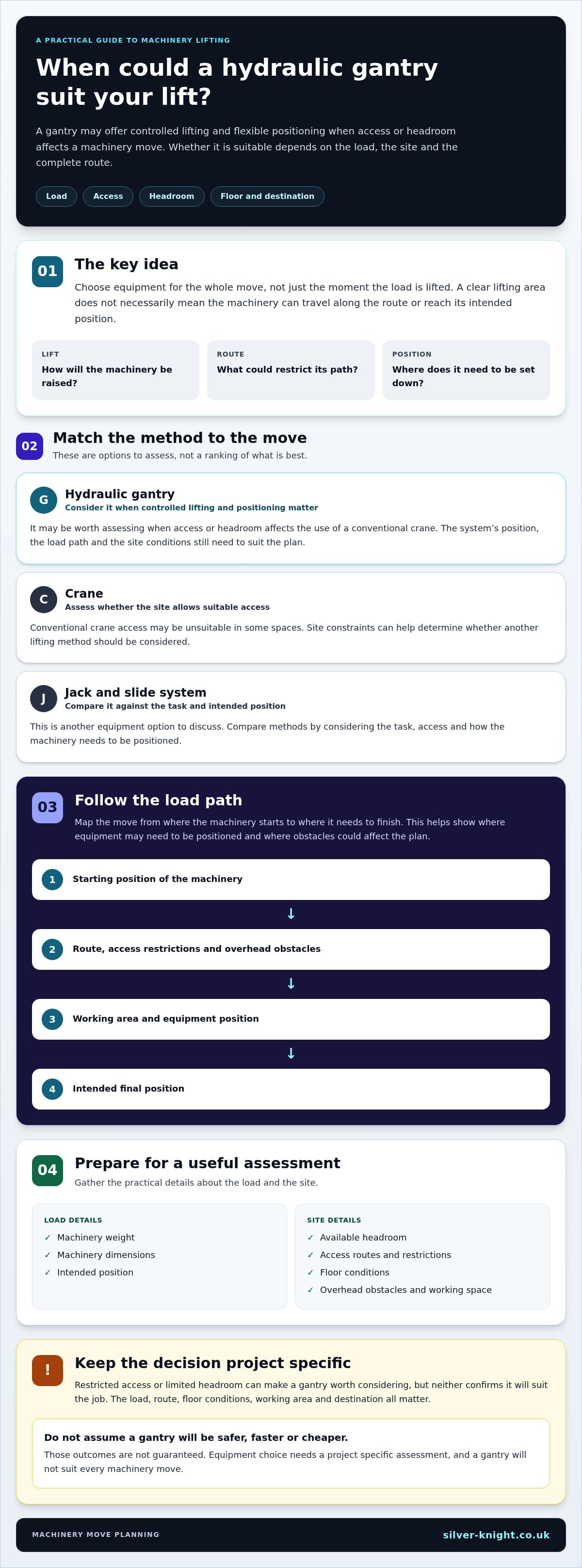
A hydraulic gantry isn’t automatically the best choice for heavy or awkward machinery. The right method depends on the task, how the load needs to be positioned and what the site allows. A lift plan and site survey help specialists compare options against the actual route and working conditions.
| Method | May be considered for | Points to assess |
|---|---|---|
| Hydraulic gantry | A planned lift and positioning task | Available working space, access and how the load needs to be raised and set down |
| Crane | A lift where the site and planned arrangement allow crane use | Access for the crane, the lifting area and the load’s route to its final position |
| Jack and slide system | A move where machinery needs to be lifted and shifted along a planned route | The route, floor conditions and how the system fits into the wider move |
When a gantry may suit better than a crane
Access and working space can influence whether a crane is practical, but they don’t prove that a gantry will fit. Assess where equipment can be positioned, how the load will be lifted and what obstacles affect the route. Crane suitability also depends on site conditions and the planned lift, so review the job before ruling either option in or out.
How gantries differ from jack and slide systems
A gantry may be considered for lifting and positioning. A jack and slide system may be relevant when the move also involves shifting machinery along a route. The systems address different parts of a job, so they can be assessed individually or as part of a wider move plan. Silver Knight’s machinery moving equipment page gives an overview of its equipment range.
The benefits of using a hydraulic gantry depend on how well it suits the full task, not just the machine’s weight or shape. Share the machinery details, access route, available space, floor conditions and destination with the lifting team. They can assess the whole move and advise whether a gantry, crane, jack and slide system or a combination may be appropriate.
For an overview of equipment used in machinery moves, visit Silver Knight’s machinery moving services.
How to assess whether a hydraulic gantry suits your lift
Start an assessment with clear information about the machine and the complete move, not just its weight. Details about access, the route and the destination help a lifting specialist decide whether a hydraulic gantry is suitable or another method may be more appropriate.
Information to gather before discussing the lift
Collect the information you have before making an enquiry. If a detail is unknown, say so rather than guessing. Include:
- Machine details, including its dimensions, weight and any known handling or positioning requirements.
- The route, from the machine’s current position to its intended destination, noting changes in direction and areas where it may need to be repositioned.
- Access and headroom, including entrances, restricted areas and overhead obstructions along the route.
- Floor conditions in the working area and along the planned route, together with any relevant information you have about them.
- The destination, including where the machine needs to be placed and any constraints around that position.
Site drawings and photographs can help explain the layout, access points and potential obstructions. Show the route and destination as well as the machine’s current location.
Questions to raise with a lifting specialist
Ask how the machine’s details and site conditions will inform equipment selection, and what further information is needed to assess the lift. Confirm whether the proposed scope covers lift planning, operated equipment and any related machinery-moving support. If operated equipment may be needed, review the heavy moving equipment hire information and clarify what’s included for your project.
Load, height, access and floor requirements are specific to each project. A competent lifting team needs to confirm them before selecting equipment or planning the move. Consider a gantry suitable only after the relevant site and machinery details have been assessed.
Once you’ve gathered the available details, discuss your planned machinery lift with Silver Knight’s team to establish what further assessment is needed.
Explore Silver Knight’s machinery moving services to learn how lifting equipment can fit into a wider project.
Using Silver Knight for a planned hydraulic gantry lift
Choosing a lifting system is one part of planning a machinery move. The lift may also need to fit into a wider relocation or installation, moving machinery from its current position to a new location. Discussing the full requirement can help clarify which equipment and support may be relevant. The right scope depends on the project, and not every move needs the same equipment or services.
From equipment choice to a coordinated machinery move
Silver Knight provides operated lifting equipment, including hydraulic gantries, cranes and jack and slide systems. The company is family-run and has over 180 years of collective industry experience. Its equipment range and experience are useful context for a project discussion, but they don’t determine which option will suit a particular lift.
Depending on the project, equipment selection may form part of machinery moving, installation or a wider factory or plant relocation. If your plans include moving machinery beyond the lift itself, see Silver Knight’s machinery moving and haulage service. Ask what the proposed scope includes and whether operated equipment and a qualified operator are relevant to your requirements.
What to include in an initial project enquiry
Give the lifting team a clear starting point. Include the machine’s known weight and dimensions, its current position and intended destination, and any handling or positioning requirements you know about. Describe the route between the two points, including access restrictions, limited headroom, obstructions and floor conditions. Site drawings or photographs may help explain details that are difficult to describe.
Also outline the support you’re looking for. Say whether you’re discussing a lift only or a wider machinery move, installation or relocation. Flag uncertain details rather than estimating them. The lifting team can then confirm what further information is needed and assess project-specific load, height, access and floor requirements.
The benefits of using a hydraulic gantry depend on how well the equipment suits the planned lift and wider move. To discuss your machinery, site conditions and required scope, contact Silver Knight about your project.
Plan your machinery lift with confidence
The benefits of using a hydraulic gantry depend on the machinery, the site and the planned lift. A gantry may suit a move where controlled lifting and positioning matter, while cranes or jack and slide systems may be more appropriate for other tasks. Compare options against the full route, access, headroom, floor conditions and destination to identify the right questions for an assessment.
Silver Knight has over 180 years of collective industry experience and uses hydraulic gantries, cranes and jack and slide systems. Its operated lifting equipment hire includes a qualified operator. The team can discuss how equipment may fit your machinery move and confirm project-specific requirements with you.
Share the machine’s details, site conditions, route and intended destination to start a useful conversation. Discuss your machinery lifting requirements with Silver Knight and explore what may suit your project.
With the right information and a considered assessment, you can take the next step towards a well-planned machinery move.
Frequently Asked Questions
What are the main benefits of using a hydraulic gantry?
The benefits of using a hydraulic gantry can include controlled lifting and flexible positioning for a planned machinery move. A gantry may be considered if crane access is unsuitable or if the load needs careful positioning within the available space. These are potential benefits, not guarantees. Suitability depends on the machinery, access, headroom, floor conditions, route and destination, all of which need to be assessed for the specific lift.
When should you use a hydraulic gantry instead of a crane?
Consider a hydraulic gantry instead of a crane only when an assessment shows that it better suits the lifting task and site conditions. Access, working space, how the load must be lifted and where it needs to go all matter. A crane may also suit some restricted sites, depending on the planned arrangement. Share the full route and destination with a lifting specialist before deciding between methods.
Can a hydraulic gantry be used in a confined space?
Possibly, but a confined space doesn’t automatically make a hydraulic gantry suitable. The team must assess whether there’s enough access and working room for the equipment, machinery and planned lifting arrangement. Headroom, obstructions, floor conditions and the route to the final position all affect the decision. Provide site drawings or photographs if available, and ask a lifting specialist to confirm whether the system can be used.
How does a hydraulic gantry help position heavy machinery?
A hydraulic gantry can support a planned lift and positioning task, allowing the lifting method to be considered alongside the machinery’s intended final location. The lift plan needs to account for the load path, including where the machine starts, how it must travel and where it will be set down. The positioning approach depends on the equipment, load and site, so discuss these details with the lifting team.
Is a hydraulic gantry better than a jack and slide system?
Neither system is automatically better. A hydraulic gantry may be considered for lifting and positioning, while a jack and slide system may suit a different stage of a machinery move, such as shifting equipment along a planned route. The choice depends on the task, access, floor conditions and destination. A lifting specialist can assess whether one system or a combination of equipment is appropriate for the full move.
What information is needed to plan a hydraulic gantry lift?
Provide the machine’s known weight and dimensions, its current position and intended destination, and any handling or positioning requirements. Describe the route and note access restrictions, available headroom, obstructions and floor conditions. Site drawings or photographs can help show the working area. If some details are unknown, say so rather than estimating. A competent lifting team should confirm project-specific requirements before the equipment and lift plan are agreed.
Does hiring a hydraulic gantry include an operator?
It depends on the provider and agreed hire scope, so check what’s included before arranging equipment. Silver Knight’s operated lifting equipment hire includes a qualified operator. When discussing a project, clarify whether the proposed support covers the equipment and operator, and whether it also includes any machinery moving or other lifting support you need. The right arrangement depends on the specific move.

Article by
David Ashby
I'm the Managing Director of Silver Knight Haulage & Machinery Ltd. Silver Knight Ltd is a family-run firm established in the West Midlands in 2005, with the aim of providing a cost-effective, yet professional, service to businesses for the removal, transportation, and installation of machinery, plant, and equipment here in the UK and worldwide. Between us, the Silver Knight workforce has over 50 years of experience with machinery and its operation.
Disclaimer
This article is intended for informational purposes only. Please ensure you seek expert advice or carry out your own research to confirm the information is suitable for your specific needs.