What if the biggest risk in a plant move isn’t the machinery, but the handover between the people responsible for it? A turnkey plant relocation can bring dismantling, lifting, transport and installation under one managed plan, but the label alone won’t prevent delays or production disruption.
It’s understandable to want one clear route through a complex move. When contractors, work packages and site teams are working to different assumptions, gaps can appear between tasks, leaving equipment waiting or key decisions unresolved. Good project management makes those responsibilities and handovers visible before work begins.
This guide explains what turnkey industrial project management can involve, how it compares with coordinating separate contractors, and what to include in a practical relocation plan. You’ll learn how to map the scope, plan interfaces between dismantling, lifting, transport and installation, and reduce avoidable delays and handling risks. The focus is on control, not just the turnkey label, so you can assess which delivery approach best fits your plant, programme and production needs.
Key Takeaways
- A turnkey plant relocation is planned around an agreed scope, with responsibilities mapped across each stage rather than limited to moving equipment.
- Build the plan from a clear project brief and survey, using machinery details, site access and destination readiness to shape the sequence of work.
- Compare coordinated delivery with separate workstreams by looking at who manages interfaces, decisions and handovers.
- Prepare an asset list, note operational priorities and constraints, and define what must be complete before production can resume.
- Use the project requirements to shape the right mix of machinery moving, lifting, transport and installation support.
Discuss your relocation project
What turnkey plant relocation means for an industrial project
Moving a plant involves more than getting machinery from one site to another. Equipment may need to be prepared, dismantled, lifted, transported, positioned and installed, with each stage dependent on information and decisions from the one before it. If responsibility for a handover is unclear, work can stall even when each contractor is ready to do their own task.
Turnkey plant relocation describes coordinated delivery against an agreed project scope. That scope sets out the work, responsibilities and interfaces being managed, rather than assuming that every move includes the same tasks. A turnkey approach can connect several stages under one coordinated plan, while a transport-only appointment or a single-task contract covers a narrower part of the move.
This video offers another perspective on turnkey relocation planning:
What can a turnkey industrial project include
A project may begin with a brief and site survey, followed by a plan for machinery preparation and dismantling. The sequence can then cover lifting, loading, transport, unloading, positioning and installation. Silver Knight’s machinery moving and installation work can form part of this coordinated scope, with the activities shaped around the equipment and the requirements of each site.
Commissioning, utility connections, controls work and other specialist tasks should be treated as scope decisions, not automatic inclusions. Record who is responsible for each activity, what information or access they need, and what must be ready before they can start. Factory relocation planning can bring related move activities into a defined project scope.
Why scope and handovers matter
Gaps often appear at boundaries. For example, a lifting team may be ready to position a machine, but the receiving area may not be clear. Or dismantling may finish without a shared record of how parts and connections should be handled during installation. Clear ownership, dependencies and agreed handover points help teams prepare in the right order and reduce duplicated effort.
Document asset details, access limits, lifting needs, production priorities and acceptance requirements. State what “complete” means for each stage, including who receives the equipment and what information must pass with it. Wikipedia’s overview of turnkey projects describes the wider idea of delivering a completed outcome to a buyer, but a plant move still needs its own clearly defined boundaries.
Turnkey delivery is a coordinated set of agreed tasks and handovers, tailored to the machinery, site and operational needs of each project.
Talk through your project requirements
How turnkey relocation planning connects each project stage
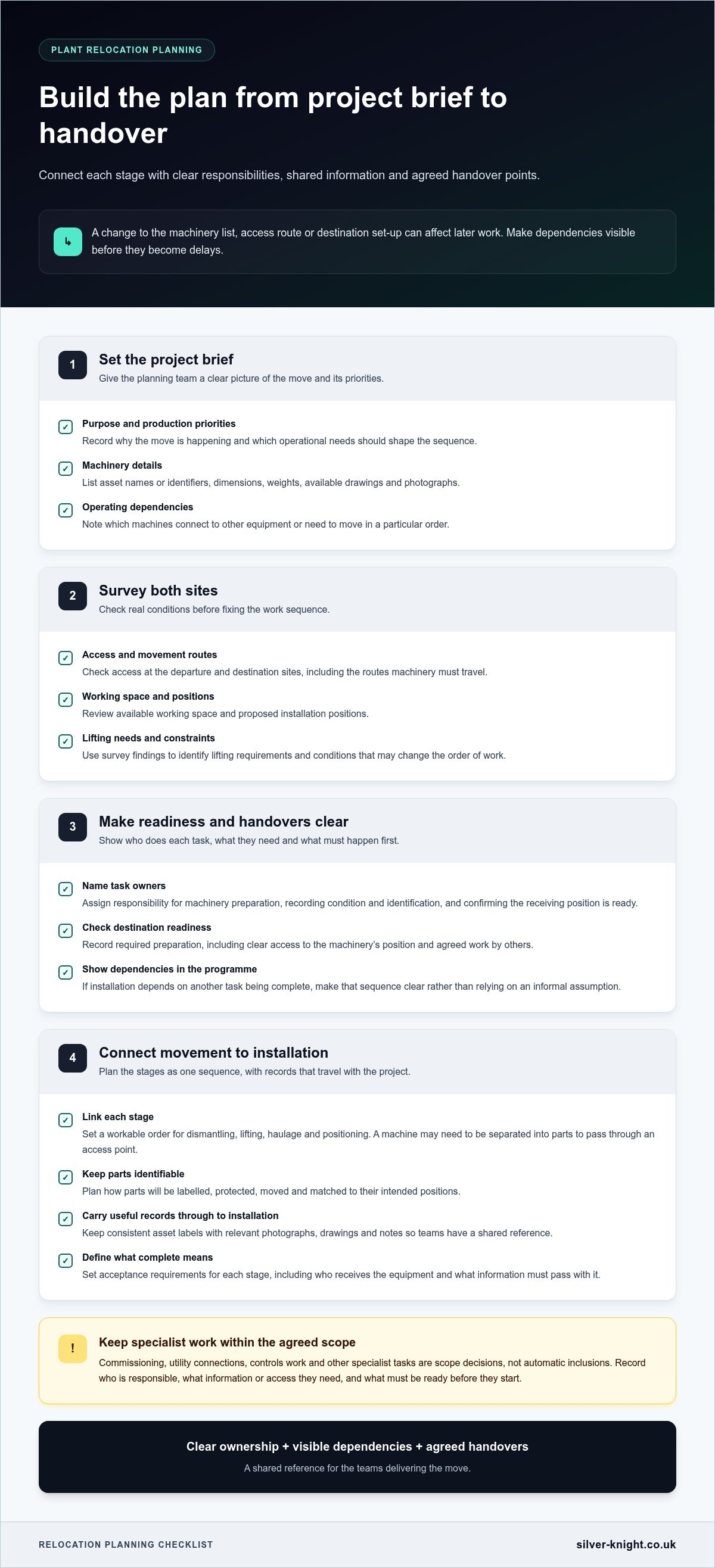
A relocation plan works best when it follows the job from the first project brief through to installation and handover. Each stage uses information gathered earlier, so a change to the machinery list, access route or destination set-up can affect later work. A clear sequence helps teams spot those dependencies before they become delays.
For turnkey plant relocation, planning should also name the person responsible for each task and handover. The exact responsibilities depend on the agreed scope. For example, the plan can show who prepares machinery for dismantling, who records its condition and identification, and who confirms that the receiving position is ready before transport is arranged.
From project brief to site survey
Start by recording the purpose of the move, production priorities and the machinery involved. Useful inputs include asset names or identifiers, dimensions, weights, available drawings, photographs and operating dependencies. Note which machines connect to other equipment or need to be moved in a particular order. This information gives the planning team a more complete picture than an asset list alone.
A site survey can then test the plan against actual conditions. Check access to both sites, movement routes, available working space and proposed installation positions. Survey findings help shape lifting requirements and identify constraints that may affect the order of work. This information supports factory relocation planning, with the sequence and responsibilities set for the particular project.
Destination readiness matters just as much as the departure site. Record what needs to be prepared before machinery arrives, such as clear access to its position and any agreed work that must be completed by others. If a machine cannot be installed until another task is finished, show that dependency in the programme rather than leaving it as an informal assumption.
From dismantling and movement to handover
Once the sequence is understood, connect dismantling, lifting, haulage and positioning into a workable order. For instance, a machine may need to be separated into parts before it can pass through an access point. The plan should identify how those parts will be labelled, protected, moved and matched to their intended positions. Silver Knight’s machinery dismantling work can sit within this wider sequence.
Records made during preparation can guide installation later. Use consistent asset labels and keep relevant photographs, drawings and notes with the project information. These records can help the installation team identify components and understand the intended arrangement. They don't replace specialist instructions or agreed responsibilities, but they give teams a shared reference when the machinery reaches its destination.
Before the move, agree what the handover includes. It may cover confirmation that equipment is positioned and installed, outstanding tasks, relevant records and the person accepting each stage. Reconnection, commissioning and other specialist work should be included only where they form part of the agreed scope. A short handover record helps distinguish completed work from tasks that remain with another workstream.
Planning a move? Discuss the project sequence with Silver Knight.
Discuss a coordinated relocation approach
Turnkey project management compared with separately managed contractors
The right delivery model depends on the move, not on a label. A project involving a single machine and a straightforward journey may need less coordination than a move involving several machines, lifting operations, transport stages and installation at a new site. The key question is how much coordination the work needs, and who will take responsibility for keeping the separate tasks connected.
With turnkey plant relocation, an agreed scope can place connected activities within one coordinated plan. Separately appointed specialists can also be the right fit, particularly when a facility already has a project team with the time and experience to manage interfaces. Neither approach removes the need to define responsibilities and handovers.
| Area to compare | Coordinated scope | Separate workstreams |
|---|---|---|
| Schedule | One planned sequence connects included tasks. | The facility or its project team aligns separate schedules. |
| Accountability | Responsibilities are set out across the agreed scope. | Each appointment covers its own task, so interfaces need clear ownership. |
| Equipment and movement | Machinery moving, lifting and transport can be planned as connected stages. | Each workstream arranges its part, with coordination between them managed separately. |
| Project fit | Can suit moves with several linked stages or dependencies. | Can suit a defined task or a move managed by an experienced in-house team. |
When coordinated delivery can simplify a complex move
Each additional machine or movement stage creates more points where timing and access must align. A lifting operation may depend on equipment being ready, a route being clear and transport being available at the right time. A planned sequence can make these dependencies visible and identify who owns each interface, including the handover from lifting to haulage or from positioning to installation.
The lifting method also affects the plan. Depending on the site and machinery, specialist options can include hydraulic gantries or jack and slide systems. Silver Knight uses specialist lifting equipment where appropriate to the project. The equipment choice and movement plan need to match the specific requirements, rather than being assumed in advance.
What to compare before choosing a delivery model
Look beyond the number of contractors. Compare who will coordinate the schedule, manage site interfaces, plan equipment and connect machinery moving with installation, haulage or storage where these are needed. Also consider the facility’s capacity to make decisions and resolve clashes between workstreams. Separate appointments may offer flexibility, but they rely on someone taking an active role in joining the work together.
Coordination may make responsibilities and dependencies easier to follow, but it doesn’t automatically reduce cost or time. Those outcomes depend on the project scope, site conditions and how well the plan is followed. Before selecting an approach, map the tasks, interfaces and decisions your own team will manage. Silver Knight can discuss how machinery moving, lifting, transport and installation may fit a coordinated relocation scope.
Plan your plant relocation with our team
How to prepare a plant relocation brief and reduce avoidable disruption
A useful relocation brief gives the project team a shared starting point. It helps turn operational priorities and site details into decisions about what moves, in what order and what must be ready at each stage. It doesn’t need to answer every technical question, but it should show what is known, what remains uncertain and who can provide missing information.
Information to gather before planning begins
Bring together records from the people who know the machinery, the production process and both sites. A practical brief can cover:
- Assets such as an equipment list, identification details, available drawings, photographs, dimensions and recorded weights.
- Movement constraints including known access limits, preferred routes, restricted areas and any preparation needed before machinery can be moved.
- Operational priorities such as which production areas matter most, which assets are linked, and any sequence the move needs to respect.
- Destination readiness including the intended positions for machinery and work that must be finished before equipment arrives.
- Handover requirements describing what records or completion information each team needs to pass on and who will accept the work.
Keep confirmed details separate from estimates or open questions. For example, if a drawing is old or a measurement has not been checked on site, mark that clearly. This gives the project team a prompt to resolve the point during planning instead of treating an assumption as fact.
Transport requirements should also be considered early. The machinery list, route information and movement sequence help establish how haulage fits with lifting and site access. Silver Knight’s heavy equipment moving and haulage can form part of a wider relocation scope, with the plan tailored to the project’s machinery and requirements.
How to plan around operational dependencies
Map how equipment, production areas and site services depend on one another. A machine may feed another part of the process, share a work area or rely on services that need to be dealt with before it can be moved. Ask operational staff to identify these links, then record which assets can move independently and which need a defined order.
Use that information to shape the sequence around the facility’s real production needs. Decide which areas must remain available for as long as possible, where work can be phased, and what level of interruption the business needs to plan for. A schedule should reflect those priorities, not assume that every area can stop or restart at the same time.
Agree handover points between preparation, movement and installation. Record who confirms an area is ready, who takes responsibility for machinery at each stage and what must be completed before production teams resume their work. These decisions can help reveal clashes while there is still time to adjust the plan. They can’t guarantee a fixed downtime period or production outcome, which depends on the site and agreed scope.
Use your brief to discuss a plant relocation plan with Silver Knight.
Discuss your relocation requirements
How Silver Knight supports turnkey plant relocation projects
A relocation plan is only useful if the work can be matched to the machinery, site conditions and operational priorities. Silver Knight supports turnkey plant relocation by bringing relevant machinery moving, installation, factory relocation, haulage and lifting activities into a project scope shaped around those needs. Not every move requires every service or type of equipment, so the agreed work reflects the specific requirements of the project.
Silver Knight is a family-run specialist, established in 1996, with over 180 years of collective industry experience. That background informs a practical approach to planning the movement of machinery and linking the stages that need to work together. The project brief, site information and intended handover provide the basis for defining responsibilities and identifying where specialist support is needed.
Matching moving and lifting services to the project
Machinery moving, heavy haulage and installation can each form part of a wider relocation scope. Their order matters. For example, the plan may need to connect machinery preparation with lifting, transport and positioning, then set out how installation fits with the destination site’s readiness. Agreeing these interfaces helps make clear what is included and where one stage hands over to the next.
Lifting requirements depend on the machinery and site. Silver Knight’s equipment includes hydraulic gantries, cranes and jack and slide systems, which can be considered where they suit the move. Specialist lifting equipment hire may also be relevant for projects with particular handling needs. The equipment used is determined by the project, rather than assumed to be the same for every relocation.
Some projects also need storage, decommissioning or recommissioning as part of their agreed scope. Defining these requirements early helps connect them to the movement plan and clarify who is responsible for each task. The goal is a practical sequence, with the services and equipment selected to fit the work.
Taking the next step with a project discussion
To start shaping a scope, bring together a clear outline of the machinery, the move’s objectives and the main constraints. Include available equipment records, access information, production priorities, destination readiness and any dependencies between assets. It’s also useful to describe the intended handover, such as what needs to be complete before the receiving team takes responsibility.
This gives the project discussion a useful starting point. Silver Knight can use the requirements to shape proposed work around the machinery, sites and agreed responsibilities. If some details are still being gathered, identify them as open points so they can be considered as planning develops. The resulting scope should make clear which activities connect, where handovers sit and what the project needs to achieve.
Ready to discuss your move? Talk to Silver Knight about your plant relocation.
Turn your relocation plan into a clear next step
A move becomes easier to discuss when operational priorities are set beside the machinery list. Bring production, engineering and site teams together to identify what must keep running, which assets depend on one another and what information is still missing. That shared view can help shape a realistic scope for turnkey plant relocation, with decisions based on the facility’s needs rather than assumptions.
Use the brief as a working document. Update it as access details, destination readiness and handover needs become clearer, and make sure the people responsible for each stage can see the same plan. This gives the project a practical starting point and helps teams focus on the decisions that need attention before work begins.
Silver Knight can discuss your machinery, objectives and site constraints, then shape the proposed work around the agreed requirements. Start a conversation about your relocation plan and take the next step towards a move with clearly defined responsibilities.
Frequently Asked Questions
What does turnkey plant relocation include?
It includes the tasks agreed for the move, which may cover planning, machinery moving, lifting, haulage and installation. Other work, such as decommissioning, recommissioning or utility connections, should be clearly assigned if needed. For example, a scope can state whether the relocation team installs machinery whilst the site’s engineering team handles service connections. That distinction helps everyone understand what is included and where their responsibilities begin.
Is turnkey industrial project management suitable for a single machine move?
Yes, it can suit a single machine if the move has several connected tasks or interfaces to manage. A machine might need dismantling, specialist lifting, transport and installation, each with different site requirements. For a more straightforward move, a narrower scope may be sufficient. The useful test is whether coordinated planning helps manage the tasks and responsibilities, not simply how many machines are being moved.
Can a plant relocation be phased to keep some production running?
It may be possible to phase a move around areas that need to remain operational, but the sequence depends on the facility and its production links. Identify which equipment can move independently and which assets share processes, space or access routes. The plan can then show proposed phases and decision points. This supports operational planning, but it cannot guarantee that production will continue uninterrupted.
Who is responsible for reconnecting machinery after a relocation?
Responsibility depends on the agreed scope and should be recorded before the move. Machinery installation or recommissioning may be part of the relocation work, whilst utility connections or specialist controls work may sit with another named team. Set out who handles each connection, what information they need and who confirms readiness for the next step. This avoids assuming that transport or positioning automatically includes reconnection.
How do project teams prepare machinery for lifting and transport?
Preparation should follow the machinery’s requirements and the agreed movement plan. The team responsible for preparing each asset can identify what must be disconnected or removed, protect vulnerable parts, and label components that will be handled separately. Keep relevant records with the asset information so they can guide later installation. Lifting and transport arrangements should be planned around the machine and site, rather than relying on a general method.
What information is needed to plan an industrial plant relocation?
Alongside machinery details and site information, provide the project’s purpose, key operational priorities and a named contact for decisions. Note any assets that must move together, areas that need to stay accessible and known uncertainties in the records. If the move has several stages, explain what the business needs to achieve at each handover. This helps the planning team focus on the details that could affect sequence or readiness.
Can machinery be stored temporarily during a plant relocation?
Yes, machinery storage can be included when equipment cannot move directly into its intended position or when timing between sites does not align. Plan storage as part of the move, not as an unrecorded pause. Identify each item, keep its movement records with it and note when it is expected to leave storage. Silver Knight provides industrial machinery storage as part of its relocation-related services.

Article by
David Ashby
I'm the Managing Director of Silver Knight Haulage & Machinery Ltd. Silver Knight Ltd is a family-run firm established in the West Midlands in 2005, with the aim of providing a cost-effective, yet professional, service to businesses for the removal, transportation, and installation of machinery, plant, and equipment here in the UK and worldwide. Between us, the Silver Knight workforce has over 50 years of experience with machinery and its operation.
Disclaimer
This article is intended for informational purposes only. Please ensure you seek expert advice or carry out your own research to confirm the information is suitable for your specific needs.