A technical lifting assessment should examine the task, the load, the work area and the lifting method, then identify practical ways to reduce injury risks. Technical lifting studies explain how an assessment can support safer handling, but recommendations must reflect the workplace task. The certificate to expect depends on what the assessment or training covers.
It is understandable to want clarity about both the assessment and its paperwork, especially when safe lifting matters to staff and daily operations. This article explains what an assessment involves, how its findings can inform injury prevention, and how to understand any certificate alongside the assessment record.
You’ll also learn what to consider when arranging an assessment, from the load and lifting method to the conditions around the task. The aim is to clarify the process and the practical findings a useful assessment should provide.
For practical support with machinery moves, explore Silver Knight’s services.
Key Takeaways
- Understand how a lifting assessment examines the task, load and work area to identify practical ways to reduce risk.
- Learn what details a useful study can record, including the proposed lifting method, equipment and controls.
- Find out how to distinguish a task-specific lifting study from a training certificate, and what each document is for.
- Explore how UK lifting requirements and BS 7121 relate to planning and carrying out lifting work.
- See how Machinery Moving and installation support can fit into a wider plant or factory move.
For machinery moves involving planned lifting, Silver Knight’s machinery services can form part of the wider project.
Assessment and certificate
A workplace lifting study examines a specific task, its hazards and the controls needed to carry it out. It is not automatically a fitness qualification, so check what the document assesses before treating it as evidence of competence.
When a Study Is Required
Consider a written, task-specific study when the load, route, equipment or surroundings make a lift harder to control. Moving a heavy machine through a restricted factory space, for example, raises different planning issues from a clear, routine lift. Assess the hazards and people involved rather than relying on weight alone as the trigger.
UK lifting requirements focus on managing risk and planning work safely. A study can explain how to control a particular lift, but the phrase “technical lifting study” does not identify a standard certificate or a universal trigger. The key question is whether the plan clearly communicates the hazards, method and precautions.
Preparing and Approving a Study
The study should be prepared by someone with relevant knowledge of the lifting task, equipment and site conditions. Anyone reviewing it should understand those details and be able to identify gaps in the proposed method. Look for clear responsibilities, not just a signature or job title.
For example, a machinery-moving plan should explain how the route, lifting points and equipment suit the load. Those responsible for the work can check whether the steps are practical at the actual site. If the load or conditions change, review the plan before proceeding instead of relying on an outdated version.
Preparation and Review Steps
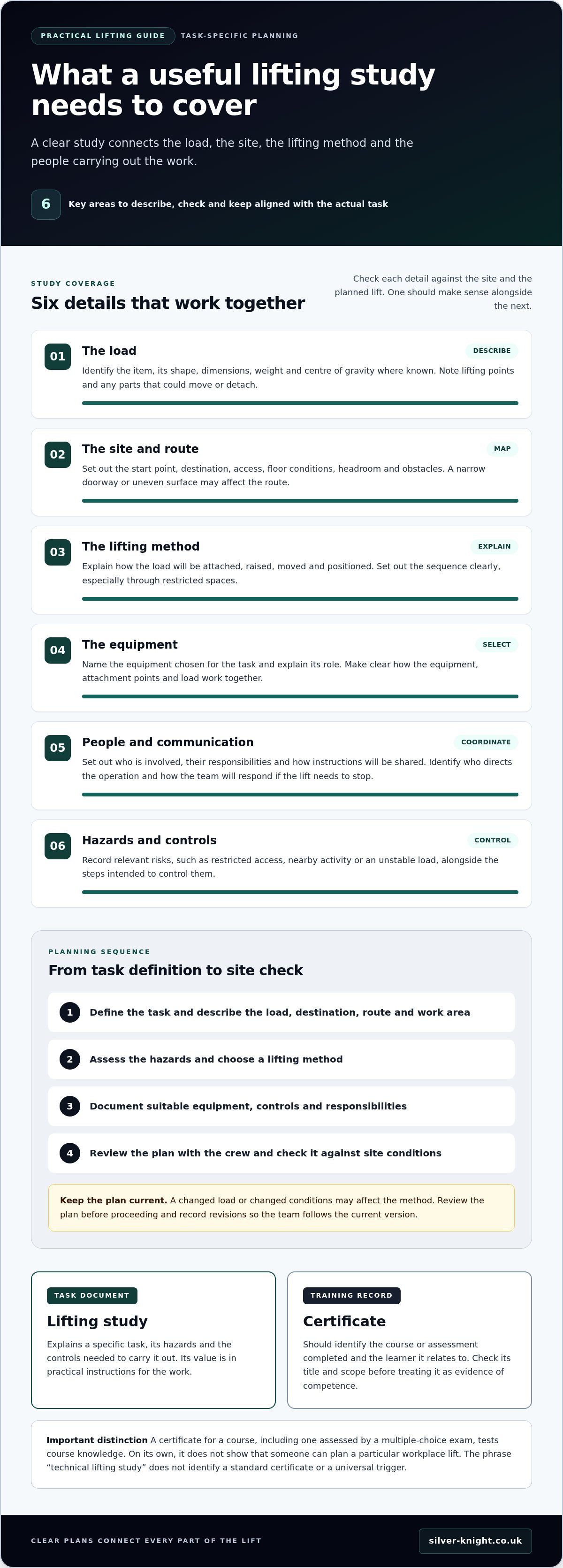
Start by describing the load, destination, route and work area. Identify the hazards, choose a lifting method, then specify suitable equipment and controls. Before the lift, check the completed plan against site conditions, crew roles and the work sequence.
The planning sequence is straightforward: define the task, assess its risks, document controls, then review the plan with the people carrying out the lift. A final site check may reveal an obstructed route or changed conditions that affect the method. Record revisions so the team follows the current plan.
A study is a task document, not automatically a training certificate. A certificate should identify the course or assessment completed and the learner it relates to. For instance, the Technical Lifting: Foundations course uses a multiple-choice exam. That tests course knowledge; on its own, it does not demonstrate that someone can plan a particular workplace lift.
This distinction matters because fitness coaching and workplace lifting address different tasks. A programme covering the bench press, shoulder exercises and muscle development may teach fitness lifting technique. Its focus on science, exercise and muscle growth does not replace a site-specific plan for moving equipment. Read the certificate’s title and scope, then match them to the work in question.
Before using a study, make sure it gives the team practical instructions. It should name the load, lifting method, equipment, route, hazards, controls and responsibilities. A reviewer can compare these details with the actual task and identify what needs updating. The document’s value lies in guiding the work, not simply carrying an approval mark.
A lifting study for a machinery move should reflect the equipment and site, alongside the machinery moving support involved.
What information is included in a technical lifting study?
A useful study turns a proposed lift into clear, task-specific instructions. It describes the load, lifting method, equipment, route and people involved. Moving a machine through a factory doorway, for example, needs different planning from lifting it in an open work area.
The document should give the team enough detail to understand what will happen, in what order and under which controls. A study that names equipment but overlooks access, load stability or communication leaves practical questions unanswered. Check every detail against the actual site and planned work.
- Load details: identify the item, its shape, dimensions, weight and centre of gravity where known. Note lifting points and any parts that could move or detach.
- Site and route: describe the starting position, destination, access points, floor conditions, headroom and obstacles. A narrow doorway or uneven surface may affect the planned route.
- Lifting method: explain how the load will be attached, raised, moved and positioned. Include the sequence clearly, especially where the load must pass through a restricted space.
- Equipment: name the equipment selected for the task and explain its role. The plan should make clear how the equipment, attachment points and load work together.
- People and communication: set out who is involved, their responsibilities and how instructions will be shared. Identify who directs the operation and how the team will respond if the lift needs to stop.
- Hazards and controls: record relevant risks, such as restricted access, nearby activity or an unstable load, alongside the steps intended to control them.
The details should connect, not sit as unrelated checklist entries. If a machine’s dimensions affect the route, the study should show how the route and chosen method account for them. If the lifting points affect attachment, the method should explain how the load will be secured. This makes the document easier to follow at the worksite.
Drawings, photographs or marked-up site plans can clarify a complex arrangement. A route sketch, for instance, can show the intended travel path and where access must remain clear. Visual material supports the written instructions; it should not replace essential details such as responsibilities, equipment or the lifting sequence.
Include the document’s scope and revision details so readers can identify the task it covers and confirm they have the current version. If the load, route, equipment or site conditions change, review the relevant instructions before relying on them. A study is useful when its recorded method still matches the lift being carried out.
Use the study as a practical briefing document. Before work starts, the team can follow the sequence, understand their roles and identify the relevant controls. The clearest technical lifting studies show everyone involved how the load, worksite and each action connect.
When is a technical lifting study required under UK lifting regulations?
No single load figure determines whether a lifting study is needed. Assess the task, its hazards and the controls required. A complex lift, such as moving machinery through a restricted factory route, needs more detailed planning than a straightforward lift in a clear area.
Separate the need to plan a lift safely from the title of the paperwork. A written study can record how to control a specific operation, but its title alone does not show whether it addresses the actual risks. Consider the load, lifting method, equipment, route and working environment together. Technical lifting studies are useful when they clearly set out these task-specific details.
- Load: Is its weight, shape or centre of gravity difficult to manage?
- Access: Does the route include a doorway, low headroom, uneven flooring or an obstruction?
- Equipment: Does the method rely on specific lifting equipment or attachment points?
- Work area: Could nearby activity, restricted space or changing site conditions affect the operation?
- Sequence: Does the task involve several stages, such as lifting, moving and positioning a machine?
Each answer helps show how much detail the plan needs. A machine passing through a narrow doorway, for example, needs a route and positioning method that account for the restriction. If the load’s characteristics affect how it can be lifted, the study should address that connection rather than treating the load and route separately.
Review the plan whenever a change could affect the method. A different machine, blocked access, altered equipment or new work nearby may change the hazards. Compare the written instructions with site conditions before the operation proceeds. If they no longer match, revise the plan and brief the people involved on the updated steps.
For a routine task, a clear existing plan may already cover the relevant conditions. For a less familiar or more involved lift, a dedicated study can make the method, responsibilities and controls easier to communicate. What matters is whether the plan gives the team practical instructions for the specific operation, not whether the paperwork has a particular title.
Use this test: can the team identify the load, understand the chosen method, follow the route and know how the hazards are controlled? If any answer is unclear, the planning needs more work. Technical lifting studies should answer these practical questions and distinguish useful, task-specific planning from paperwork that does not guide the lift.
Who is qualified to prepare and approve a lifting study in the UK?
The person preparing a lifting study needs practical knowledge of the specific operation, including the load, lifting method, equipment and site conditions. Someone familiar only with paperwork may miss a detail such as a machine’s restricted access route or unsuitable lifting point.
Job title alone is not a reliable measure of competence. Consider whether the author can explain why the proposed method suits the task. For a machinery move, they should understand how the load will be handled, what equipment is involved and how the route affects the operation.
Preparation and approval are different functions. The author develops the method and records the relevant hazards and controls. A suitable reviewer checks whether the plan is clear, consistent and workable at the intended location. The approver should have enough relevant knowledge and authority to accept the proposed arrangements for that operation.
A useful review tests the plan against real conditions. The reviewer can compare the stated route with the factory layout, check that the equipment matches the method and confirm that responsibilities are clear. If the plan depends on a particular lifting point, it must address that detail rather than leave the team to guess.
- Relevant experience: Has the preparer worked with comparable loads, equipment or site constraints?
- Technical understanding: Can they explain the chosen method and its key limitations?
- Site knowledge: Have access, floor conditions and nearby activity been considered?
- Review authority: Can the approver identify weaknesses and require changes before work proceeds?
- Clear records: Does the document identify its scope, author, reviewer and current revision?
Training records can support an assessment of competence, but a course title alone cannot show whether someone can plan every type of lift. Experience with one arrangement may not prepare someone for a different machine, lifting system or restricted site. Match their knowledge to the task, then check whether they can explain the proposed controls clearly.
Approval should also follow the organisation’s own process. The responsible people need to know who reviews the plan, who accepts it and how changes are handled. If the route changes or different equipment is proposed, review the relevant details again. A signature on an earlier version does not show whether the revised method remains suitable.
In practice, choose a preparer who understands the operation, then have a suitably informed person review the assumptions and instructions. The strongest evidence is a study that answers practical questions about the actual lift, not a title or certificate considered on its own.
What UK laws and standards apply to lifting studies, including LOLER and BS 7121
LOLER and BS 7121 are key references in UK lifting discussions, but they serve different purposes. A lifting study should connect the relevant requirements and guidance to the specific operation, rather than rely on a document title or standard reference alone.
LOLER is the commonly used name for the Lifting Operations and Lifting Equipment Regulations 1998. For a particular lift, the practical question is how the operation and equipment will be managed safely. A study can record the planned method and its controls, but it does not replace the wider responsibilities attached to carrying out lifting work.
BS 7121 is a British Standard series relating to the safe use of cranes. Its relevance depends on the lifting method and equipment involved. A crane operation may need planning that takes account of the applicable guidance, while a task using a different method may require different technical considerations. The study should make its scope clear.
Keep the legal framework, standard and task plan distinct:
- LOLER: identify how the lifting operation and equipment are addressed within the applicable legal framework.
- BS 7121: consider the relevant guidance where crane use falls within the task.
- The study: explain how the planned method applies to the load, equipment and worksite.
For example, a crane lifting a machine into a factory needs a plan that reflects the operation being carried out. The study should relate the selected method to the actual load and site conditions. A reference to BS 7121 without relevant task details does not explain how the lift will be performed.
Likewise, naming LOLER in a document does not, by itself, show how the operation has been assessed. Read the plan for clear links between the equipment, method, hazards and controls. Any standard reference should support the task instructions, not stand in for them.
Standards can be revised, and different provisions may apply to different work. Use the edition and guidance relevant to the operation when preparing or reviewing a plan. The document should identify the guidance behind its method and explain how that method fits the site. This helps reviewers understand the plan’s basis without treating a citation as proof of safe execution.
For a complex crane lift, align the task plan with the applicable LOLER framework and relevant BS 7121 guidance. Then review the details against the actual operation, including its equipment and working conditions. The purpose is practical: the written plan should show how the lift will be managed, not merely list regulations or standards.
Silver Knight Haulage & Machineries Ltd and machinery moving
For help planning a machinery move, explore Silver Knight Haulage & Machineries Ltd’s machinery moving services.
Silver Knight Haulage & Machineries Ltd can help with machinery moving, installation and relocation as part of a wider plant or factory project. Its services include Machinery Moving, Machinery Installation, Factory Relocation and Plant Relocation.
For example, a factory move may involve shifting equipment from its current position before installing it at the new site. Coordinating the move and installation can help you plan how machinery fits into the wider relocation. If your project involves several machines or a changed factory layout, discuss the scope and how the move connects with your operational plans.
To discuss machinery moving or a factory or plant relocation, contact Silver Knight Haulage & Machineries Ltd.
Make the next move with a clear plan
Use the assessment to inform decisions about the work ahead. Before machinery is moved or installed, bring the people responsible for the operation together to agree how the plan fits the site and project. A technical lifting study is most useful when it informs practical decisions rather than sitting apart from them.
For a machinery move or wider factory project, Silver Knight Haulage & Machineries Ltd can support the next stage with machinery moving, machinery installation or factory relocation. Discuss the project scope to connect the lifting work with the wider move.
Contact Silver Knight Haulage & Machineries Ltd to discuss your machinery project. A clear conversation can help you take the next step with confidence.
Frequently Asked Questions
What type of assessment is involved?
It is a task-based assessment of the proposed lift and working conditions, not a fitness test. The assessor considers what is being moved, the route, access, equipment and people involved. Moving a machine into a production area, for example, may require checking whether it can pass through the entrance and reach its final position. Technical lifting studies can turn those findings into practical instructions for the operation.
What are technical lifting studies in the UK?
In the UK, these documents analyse and plan a particular lifting operation. They set out how the work is intended to proceed and help communicate relevant hazards, controls and responsibilities. The term does not name a universal qualification or certificate. A study for relocating a machine, for instance, should relate to that move rather than serve as general proof that someone can plan every lifting task.
What information and site surveys are needed before preparing a lifting study?
Gather details about the load, including its dimensions and known weight, current position, destination and any available drawings. A site survey can record access routes, doorway dimensions, headroom, floor conditions and obstructions. Photographs and measured plans, for example, can reveal a tight turn that affects the proposed route. Technical lifting studies can use these details to make the planned method relevant to the actual work area, supported by specialists like Silver Knight Haulage & Machineries Ltd.
What is the difference between a lifting study, lifting plan and method statement?
A lifting study examines a specific task, its hazards and the controls needed. A lifting plan records the proposed method, equipment, route, sequence and responsibilities, whereas a method statement provides a broader, step-by-step description of how to carry out the overall construction or installation activity safely.

Article by
David Ashby
I'm the Managing Director of Silver Knight Haulage & Machinery Ltd. Silver Knight Ltd is a family-run firm established in the West Midlands in 2005, with the aim of providing a cost-effective, yet professional, service to businesses for the removal, transportation, and installation of machinery, plant, and equipment here in the UK and worldwide. Between us, the Silver Knight workforce has over 50 years of experience with machinery and its operation.
Disclaimer
This article is intended for informational purposes only. Please ensure you seek expert advice or carry out your own research to confirm the information is suitable for your specific needs.