A machine can reach the factory floor and still be a long way from ready for production. Precision installation of manufacturing equipment involves planning the site and delivery, moving and positioning the machinery, aligning it with connected systems, then testing and commissioning it. Each stage helps the equipment fit the facility and work as intended.
It’s easy to focus on lifting and placement, especially when machinery is large, heavy or sensitive. But successful installation also depends on understanding the plant layout, preparing the work area and coordinating everyone involved, so delivery, assembly and testing work together.
This guide covers the main stages, from site preparation and safe lifting to mechanical alignment, testing and handover. It explains what industrial assembly and installation involve, why precision matters, and how planning around existing equipment and production needs can help avoid unnecessary disruption.
For support with machinery moving and installation, Silver Knight Haulage & Machineries Ltd can help plan the next steps.
Key Takeaways
- Plan the site, access routes and delivery schedule before machinery arrives to help limit disruption and avoid installation delays.
- Coordinate the lifting and positioning work so heavy or sensitive equipment can be moved safely.
- Understand how alignment checks can help identify issues that may lead to vibration, wear or reduced performance.
- Bring mechanical and electrical work together with testing, staff training and commissioning before handover.
- Consider specialist machinery moving and installation support when equipment needs positioning or integration into a plant.
Good sequencing connects site preparation, delivery and testing, while project information can help with planning the work.
What Are The Key Steps In The Mechanical Equipment Installation Process?
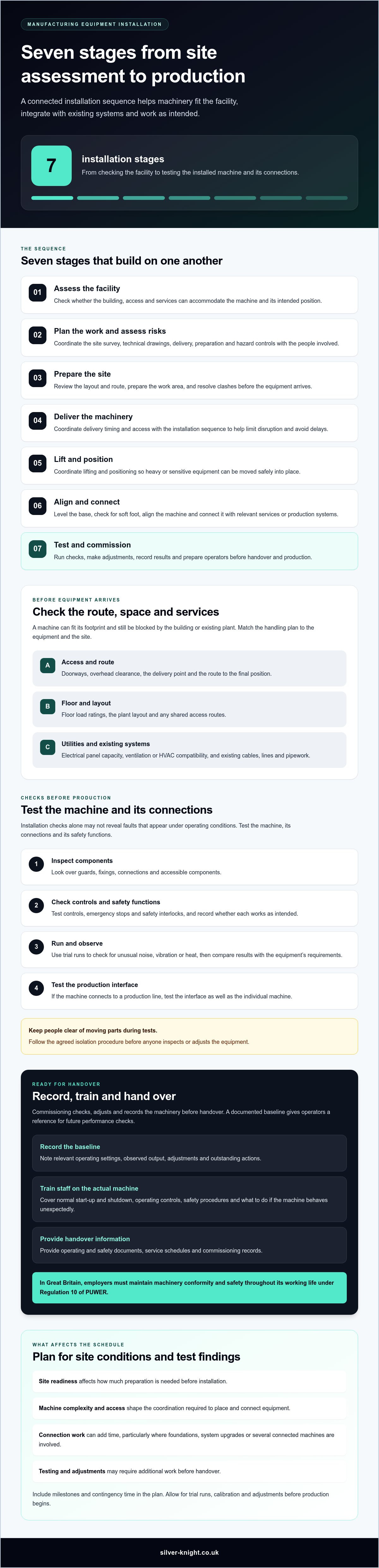
Installation typically starts with a facility assessment, followed by planning, site preparation, delivery, positioning, connection and testing. The time needed for precision installation of manufacturing equipment depends on site readiness, machine complexity, access and the work required to connect existing systems.
Testing and commissioning also affect the schedule. Faults or adjustments may require additional work before handover.
A pre-alignment demonstration can show how levelling the base and checking for soft foot support accurate installation.
Facility Infrastructure and Site Conditions
A facility assessment establishes whether the building and its services can accommodate the machine. Access, floor capacity and utilities all influence where equipment can be placed and how it can be connected.
Review the plant layout, floor load ratings, doorways, overhead clearance and route from the delivery point to the final position. Check electrical panel capacity and ventilation or HVAC compatibility, as well as existing cables, lines and pipework. A machine may fit its footprint but still be blocked by a low beam or shared access route. Match the handling plan to both the equipment and the site.
Pre-installation Planning and Risk Assessment
Pre-installation planning coordinates the site survey, technical drawings, delivery, preparation and hazard controls. Resolving clashes before equipment arrives can help prevent rework and delays.
Involve operators, maintenance leads, engineers and other contractors in reviewing the sequence. Assess whether each unit suits the planned assembly, then examine hazards where units connect, including moving parts, controls and utilities. According to the Health and Safety Executive, in Great Britain, the person constituting an assembly of machinery is responsible for ensuring that the complete assembly complies with the Supply of Machinery (Safety) Regulations 2008. The Health and Safety Executive states that equipment intended for use in potentially explosive atmospheres is subject to the 2016 ATEX Regulations.
Final Testing and Installation Timescales
Final testing checks the installed machine and connected systems before production begins. It can reveal faults that were not apparent during assembly.
Allow time for trial runs, calibration and adjustments, then record the results and any changes. Test relevant safety interlocks and emergency stops, and assess performance against operating requirements. Straightforward placement may need less coordination than foundation work, system upgrades or several connected machines. Site access, delivery timing, coordination between trades and test findings all affect the schedule, so include milestones and contingency time in the plan.
Effective commissioning depends on coordinated installation work, including machinery installation support.
System testing, staff training and commissioning
Commissioning checks that installed machinery works safely and meets its intended production demands. In Great Britain, employers must maintain machinery conformity and safety throughout its working life under Regulation 10 of PUWER.
Inspection and System Testing
Inspection and system testing cover the machine, its connections and safety functions before production begins. Checks during installation alone may not reveal faults that appear under operating conditions.
Begin with a visual inspection of guards, fixings, connections and accessible components. Then test the controls, emergency stops and safety interlocks, recording whether each works as intended. If the machinery connects to a production line, test the interface as well as the individual machine. A faulty sensor or control signal, for example, can interrupt the wider process even when the machine runs correctly on its own.
Use trial runs to observe operation and check for unusual noise, vibration or heat. Compare results with the equipment’s requirements and record any adjustments. Keep people clear of moving parts during tests, and follow the agreed isolation procedure before anyone inspects or adjusts the equipment.
Commissioning and Performance Baselines
Commissioning is the final process of checking, adjusting and recording machinery before handover. A documented baseline gives operators a reference for future performance checks.
During commissioning, the team can run the machine through its intended operating sequence, verify settings and make adjustments before production. Record relevant results, such as operating settings, observed output and outstanding actions. The right measures depend on the machine and its role in the plant, so the baseline should reflect its design and expected use, not an unrelated benchmark.
Staff training should cover normal start-up and shutdown, operating controls, safety procedures and what to do if the machine behaves unexpectedly. Use the actual control panel and operating sequence during instruction. Before handover, provide operating and safety documents, service schedules and commissioning records. This gives operators clear guidance and supports consistent use across shifts.
Safe Installation and Commissioning
Safe commissioning controls access and energy while machinery is tested, adjusted and prepared for use. Preventing unexpected start-up helps protect workers from moving parts and connected systems.
During installation or maintenance, machinery should be locked out and tagged out to prevent accidental start-up. Before a trial run, agree who can authorise energising the equipment and who must stay outside the test area. Maintain clear communication between operators, engineers and electricians, especially where a control panel can start connected machinery.
For a newly assembled or modified powered gate in Great Britain, the relevant requirements of the Supply of Machinery (Safety) Regulations 2008 must be met before it enters service. For other machinery, apply the relevant requirements to its design, assembly and use. Close commissioning by recording test results, outstanding actions and the person accepting handover, so production staff know the equipment’s status.
Precision alignment and laser alignment technology
Alignment places machinery in the intended position and relationship to connected components. In a motor and pump, even small errors between shafts can increase vibration, wear and downtime.
Levelling, mechanical assembly and shaft alignment are related tasks, but each checks a different aspect of the installation. Recording measurements helps verify alignment before the equipment operates.
Equipment Positioning and Levelling
Positioning and levelling place equipment on its base and set it to the required orientation. An uneven base can affect how the machine sits and connects to other components.
Installers use precision levels to check base flatness and equipment level. They can also check for soft foot, where part of the equipment base does not contact its mounting surface evenly. Correcting this before securing the machine helps provide stable support. Record the measurements and final position so future checks can use the same reference points.
Mechanical Assembly and Component Alignment
Mechanical assembly fits and secures parts, then checks that connected components are correctly related. Poor fit or alignment can put components under strain during operation.
For a motor and pump, check the base and coupling before assessing shaft alignment. Feeler gauges can verify clearances, while dial indicators measure runout and alignment. Micrometers and callipers can check dimensions when a component’s fit needs verification. Assemble components according to the equipment design and manufacturer’s specifications rather than forcing them into position.
Laser alignment systems measure the relative position of rotating shafts to help align them accurately. Readings can reveal angular misalignment, where shafts meet at an angle, and parallel misalignment, where their centre lines do not match. Correcting both can help reduce unwanted vibration, noise and machinery wear.
Laser readings are one part of alignment, not a replacement for checking the base and connections. A sound sequence is to verify the mounting surface, position the equipment, check for soft foot, then measure and correct shaft alignment. Recheck after adjustments, since moving one component can affect its relationship with connected parts.
Operating temperature also matters in some installations. Thermal growth can cause equipment to expand during operation, so alignment targets may need to account for that movement. Use the equipment’s design information to set the target rather than assuming cold alignment will remain unchanged in service.
Keep alignment measurements from before and after adjustment in the installation record. They give maintenance teams a reference if vibration or performance changes later. The records can also help distinguish an alignment issue from another fault, such as a worn component or a change in the machine’s support.
Accurate alignment supports reliable operation, but it depends on the entire mechanical setup. A carefully aligned shaft can still be affected by soft foot, poor base contact or an incorrectly fitted component. Checking these elements together helps reduce avoidable wear and production disruption.
What Is Industrial Assembly and Installation?
Industrial assembly and installation bring machinery, its components and connected services together so they can operate as intended. Coordinating mechanical, electrical and structural work helps each part fit the plant layout and its intended use.
For example, a production line may need a machine secured to a foundation, connected to an electrical supply and integrated with existing controls. The sequence matters because work on one interface can affect the next trade’s tasks.
Coordinating Installation Specialists
Coordination brings millwrights, electricians, fabricators and machinists together under one installation plan. A delay or mismatch between trades can leave equipment unfinished or prevent safe testing.
Millwrights can assemble and position mechanical parts, while electricians connect wiring and control panels. Fabricators may adapt supports or guards, and machinists can work on component fit. Clear drawings, agreed access and a shared work sequence help prevent clashes. For example, electrical connections should follow the agreed machine position, rather than being routed before the final layout is established.
Each specialist needs to understand how their work connects to the next stage. A change to a support frame may affect machine level; a change to wiring may affect control testing. Coordinating these details helps the assembled machine meet its required tolerances and supports product quality and consistency.
Turnkey Installation of Imported Machinery
Turnkey installation coordinates an imported machine’s arrival, assembly, connection and commissioning as one project. Delivery and installation must fit the receiving facility’s layout and production plan.
The work can include arranging delivery, moving equipment into position, fitting components, connecting electrical, hydraulic or pneumatic systems, and testing the completed installation. Reviewing drawings and site conditions helps identify where the machine must interface with existing plant systems. Handover records can include operating instructions, safety procedures and service schedules.
Correct installation also supports machinery lifespan. Poorly fitted components, excessive vibration or unsuitable operating conditions can contribute to premature wear and failure. Temperature and humidity may affect performance, so consider the environment around the machine during installation and operation. Planned inspections and preventative maintenance help identify changes before they interrupt production.
Industrial assembly may also be part of machinery removal or a wider factory move. Before dismantling equipment, identify its components, connections and lifting points, then plan how each part will be protected and handled. Machinery storage can bridge the gap between removal and reinstallation if the new site is not ready. Once the equipment arrives, the installation team can position and reconnect it, then test it in its new surroundings.
Whether you are installing a single machine or relocating a plant, coordination is fundamental: bring people, equipment and site requirements together in the right order. This gives the production team a clear route from assembly to operation and maintenance.
Delivery, lifting, rigging and positioning
Delivery and positioning move machinery from its transport vehicle to its planned place inside the facility. A proper plan connects the access route, lifting method and final position before the equipment arrives.
Match the delivery vehicle and unloading point to the site route. Check doorways, turning space, floor conditions and overhead obstructions along the way. A machine may fit its production footprint but still be unable to pass through a doorway or beneath a beam. Clear the route and agree how to keep people and other vehicles away during the move.
Plan the lift around the equipment’s weight, dimensions, centre of gravity and available access. Cranes, hoists, hydraulic gantries or forklifts may be suitable, depending on the machinery and site. The lifting equipment and movement sequence must suit both the load and the available space. For example, restricted headroom may change how a machine is raised or transferred into position.
Before lifting, the team should agree roles, signals and communication protocols. Establish a safety zone around the load, particularly in a tight or active production area. Having one person direct the movement helps keep instructions clear while operators follow the agreed plan. Stop the lift if visibility, communication or the load’s movement changes unexpectedly.
- Confirm the machine’s delivery route and unloading area.
- Match lifting equipment to the load, access and final position.
- Agree signals, responsibilities and the safety zone before movement.
- Position the machine carefully, then check its orientation against the installation plan.
Rigging connects the load to lifting equipment and helps control its movement. Slings and other lifting arrangements must suit the machinery and attach at appropriate lifting points. An unbalanced load can tilt or swing, making it harder to control. Check that attachments are secure and that the planned route leaves room to guide the load without placing anyone beneath it.
Once the machine reaches its position, lower it in a controlled way and check its orientation against the layout. Leave space for connections, operator access and future maintenance. For example, placing a machine too close to a wall can block access to service points or connected equipment.
Imported machinery needs delivery planning that accounts for packaging as well as the equipment. Imported machinery crates may need to comply with ISPM 15 requirements. Check the crate and unpacking plan before delivery, then stage components so they can be moved safely in installation order.
Clear coordination between transport, lifting and installation supports a smooth move from vehicle to production position. Keep the lift plan, site controls and applicable regulations aligned throughout the work. This helps the team manage each transfer carefully and prepare the machine for installation.
For support with moving or installing manufacturing equipment, explore Silver Knight Haulage & Machineries Ltd.
Silver Knight Haulage & Machineries Ltd for Machinery Moving
Silver Knight Haulage & Machineries Ltd provides Machinery Moving and Machinery Installation for businesses handling heavy equipment, new machinery or plant layout changes. Its services also include Factory Relocation and Plant Relocation, connecting machinery movement with a wider site move.
Consider specialist support when equipment needs careful handling, positioning or installation as part of a production change. Coordinating the move with the next installation stage can help ensure machinery reaches its planned position ready for the work ahead.
To discuss machinery moving or installation for your facility, contact Silver Knight Haulage & Machineries Ltd through its website.
Prepare your plant for its next change
A precision installation of manufacturing equipment can help your plant adapt to future production needs. Treat the completed installation as a foundation for the next change: keep equipment records accessible and ensure that anyone responsible for future modifications understands the layout and interfaces.
When machinery needs moving or installing, or a wider factory relocation is planned, Silver Knight Haulage & Machineries Ltd offers Machinery Moving, Machinery Installation and Factory Relocation. These services support projects where equipment must be transferred, positioned or integrated as part of a facility change.
Set out the move or installation requirements, including the machinery involved and its intended destination, then discuss the work with the team. Contact Silver Knight Haulage & Machineries Ltd to discuss your machinery project and take a clear next step for your site.
Frequently Asked Questions
Why Choose Professional Installation Services?
Professional installation brings machinery handling, assembly and site coordination together as one project. It can be especially useful when equipment must pass through restricted access or be installed in an active production area. For example, a new machine may need to enter through a shared loading bay while other plant remains in operation. Coordinated planning helps organise the move and installation around the facility layout and production needs.
What is precision installation of manufacturing equipment?
Precision installation of manufacturing equipment is the process of placing and fitting machinery so it operates according to its design and intended use. It considers how the machine sits, connects and works with surrounding components. For example, a production machine may need its control signals to communicate correctly with the line. Clear installation records also give maintenance teams a reference when investigating later changes.
What are the steps for installing manufacturing equipment accurately?
Accurate installation follows a planned sequence, with checks at every stage. Confirm the machine’s requirements, prepare the work area, receive and move the equipment, assemble it, connect services and test the completed setup. If a machine is joining an existing line, check that its signals and controls work with neighbouring equipment. Record changes made during installation so operators understand the final configuration and have the information they need for routine use.
What tools and measurement methods are used for precision equipment installation?
Tool choice depends on the machine and the task. Torque wrenches control fastener tightening, while feeler gauges check clearances. For bearing fits, controlled heating or a hydraulic press can help mount components without forcing them through rolling elements. Check fit and internal clearance, and apply lubricant according to the equipment design and manufacturer’s specifications. Using the appropriate lubricant quantity helps avoid problems caused by too little or too much.
What installation tolerances apply to industrial machinery and equipment?
There is no single tolerance for every industrial machine. Limits depend on the design, manufacturer’s specifications, connected components and intended operating conditions. A rotating machine, for example, may have specified alignment and clearance requirements. Temperature and humidity can also affect performance. Use the acceptance criteria for the specific machine and record measurements against them. This gives maintenance teams a baseline for recognising changes during later inspections.
How much does this type of installation cost in the UK?
The price depends on the project scope and is provided after a quote request. Cost factors include machinery size and weight, site access, lifting and transport requirements, installation complexity, specialist labour and equipment, and whether a site survey is needed. A machine with clear access and simple connections has a different scope from one requiring coordinated lifting or integration with existing plant. The quote reflects the work required for that installation.
How do installers level, align and anchor manufacturing equipment?
Installers establish a stable base, position the machine according to its installation requirements, then secure it with fixings suited to the equipment and mounting surface. Chemical anchors or mechanical floor fixings may be appropriate. After securing the machine, check its position again, as tightening the fixings can affect its setting. For connected machinery, confirm that anchoring has not changed the relationship between components or restricted access to service points.
What are the risks of incorrect machinery installation and how can they be reduced?
Incorrect installation can contribute to excessive vibration, premature wear, reduced efficiency, component damage or unsafe operation. Poorly connected electrical, hydraulic or pneumatic services can also disrupt the wider plant. Reduce these risks by assessing how machinery interfaces with existing systems, following equipment specifications and recording installation checks. After handover, planned inspections and preventative maintenance can help identify developing faults, such as changing vibration or unusual operating behaviour, before they interrupt production.

Article by
David Ashby
I'm the Managing Director of Silver Knight Haulage & Machinery Ltd. Silver Knight Ltd is a family-run firm established in the West Midlands in 2005, with the aim of providing a cost-effective, yet professional, service to businesses for the removal, transportation, and installation of machinery, plant, and equipment here in the UK and worldwide. Between us, the Silver Knight workforce has over 50 years of experience with machinery and its operation.
Disclaimer
This article is intended for informational purposes only. Please ensure you seek expert advice or carry out your own research to confirm the information is suitable for your specific needs.