What if you could hand over the coordination burden of a machinery move without handing over control? With outsourced industrial move management, a specialist can help bring planning, lifting, transport and installation together. That matters when your own team is already juggling production, site operations and unclear responsibilities. A poorly coordinated move can put pressure on all three.
You should still set the priorities and make the operational decisions that belong to your business. The right support helps make responsibilities clear and keeps you informed as the project progresses. This article explains what a specialist can coordinate or deliver, how to maintain oversight, and how to plan a practical route from the initial scope to machinery relocation.
We’ll look at how machinery moving, heavy haulage, specialist lifting equipment and installation can fit into different project scopes. You’ll also see how working with a machinery-focused partner such as Silver Knight can simplify coordination while keeping your team involved at the key stages.
Key Takeaways
- Outsourced industrial move management can connect planning, machinery handling, lifting, transport and installation within a clearly defined project scope.
- Set out responsibilities and handovers for each workstream so internal teams and specialist support know who is doing what.
- Compare in-house and outsourced approaches by considering your team’s capacity, coordination workload and access to specialist machinery support.
- Prepare an equipment list, available drawings, site details, constraints and operational priorities to create a practical starting brief.
- Keep oversight by agreeing how decisions, progress updates and completion will be managed throughout the move.
What outsourced industrial move management covers
Outsourced industrial move management means bringing in specialist support to plan and coordinate some or all of the work involved in relocating machinery. Rather than treating the move as a single transport task, it considers how equipment will be prepared, handled, lifted, moved through the site, transported and positioned at its destination. The scope depends on the machinery, the sites and the outcome your business needs.
Planning connects those activities. For instance, machinery may need to be dismantled or disconnected before it can be moved, while the route out of the building and the destination layout can affect the lifting and transport approach. Installation or recommissioning may then form part of the project, if required. Not every move needs every service, or follows the same sequence. A clear scope helps identify what is included and where one workstream hands over to another.
This project view reflects operations management principles, where facilities and production needs are considered alongside the work itself. In practice, machinery plans need to account for operational priorities, site access and the requirements of the equipment being moved. The aim is to make the separate activities work together, not to apply a standard package to every project.
How industrial move management differs from general removals
Household and office relocations tend to focus on belongings, furniture, packing and delivery. Machinery projects have different planning needs. The equipment’s size, weight and handling requirements can affect the method of movement, the lifting equipment needed and the route through the building. Transport and destination access also matter, as does how the machinery will be positioned and installed.
These details shape the work and its interfaces. A move might involve machinery moving and heavy haulage, specialist lifting, installation, or a combination of activities. The right sequence depends on the equipment and project scope, rather than a general removals checklist.
When outsourcing can make sense for a machinery project
Outsourcing may be useful when a project includes several connected workstreams, specialist lifting needs or coordination tasks that your internal team has limited capacity to manage. A specialist can bring relevant moving, haulage, lifting and installation activities into a more joined-up plan, reducing the number of separate interfaces your team needs to coordinate.
Delegating coordination doesn’t mean handing over business control. Your team still sets production priorities, decides when work can take place and approves key choices that affect site operations. The specialist supports delivery within those decisions. Agreeing responsibilities, approval points and how progress will be shared helps everyone understand who is coordinating the work and who retains authority over operational matters.
Silver Knight supports machinery-focused projects through moving, installation, factory and plant relocation, heavy haulage and specialist lifting equipment. The practical starting point is a clear discussion of the move’s scope, site requirements and priorities, so the support can be shaped around the work rather than treated as a standard removals job.
Plan your machinery relocation
Which responsibilities to include in an outsourced industrial move
A useful scope makes each workstream and handover visible. It should show what the machinery specialist will deliver, what your site or production teams will manage, and where the two need to coordinate. The right split depends on the equipment, the sites and the move’s operational priorities, so treat the plan as project-specific rather than a standard package.
Set the project boundary and responsibility split
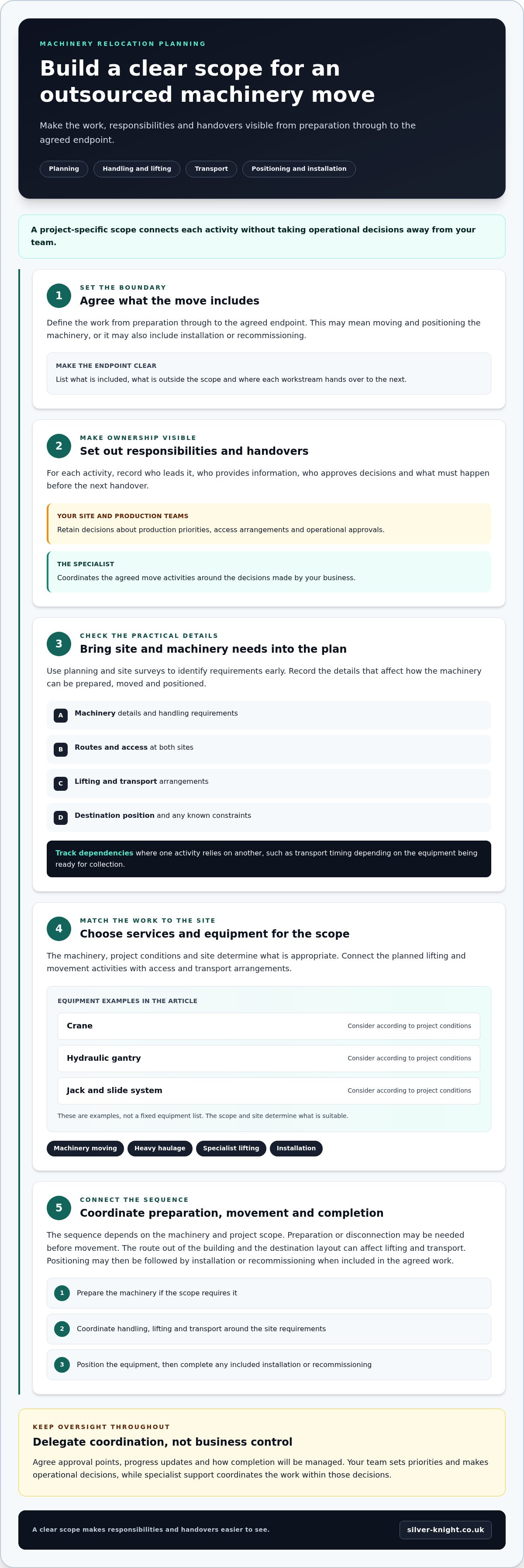
Start by defining the move from preparation through to the agreed endpoint. That might mean machinery is moved and positioned, or it may include further work such as installation or recommissioning. Your team retains decisions about production priorities, access arrangements and operational approvals. The specialist can coordinate the agreed move activities around those decisions.
A responsibility schedule can make the interfaces clear without locking the project into a fixed template. For each activity, record who leads it, who provides information, who approves decisions and what needs to happen before the next handover. For example, site teams may prepare access, machinery specialists may handle movement, and installation work may begin once positioning is complete.
Use planning and site surveys to identify practical requirements early. The scope can cover machinery details, movement routes, access at both sites, lifting needs, transport arrangements and the intended destination position. Recording constraints and dependencies helps teams spot where one activity relies on another, such as transport timing depending on the equipment being ready for collection.
Match specialist services and equipment to the scope
Machinery handling and lifting requirements should guide the choice of equipment. A crane, hydraulic gantry or jack and slide system may be relevant for different project conditions, but the scope and site determine what is appropriate. Operated lifting equipment can form part of the work where the project calls for it. Set out the planned lifting and movement activities clearly so they connect with site access and transport arrangements.
Some projects also need machinery prepared before it can be moved. If dismantling is part of the agreed scope, machinery dismantling services can sit alongside movement and later installation. Storage may help when equipment cannot go straight to its destination. Factory clearance can be relevant where the project includes clearing equipment from a site, while recommissioning may form a later stage. Include only the activities the project requires.
For equipment selection, the US Occupational Safety and Health Administration provides guidance on material-handling equipment. It is a US reference, not UK guidance, so use it for context rather than as a substitute for UK requirements or project-specific planning.
Silver Knight can bring machinery moving, lifting, haulage and installation into a scope shaped around the project. Discuss the responsibilities for your machinery move to start defining the workstreams and handovers.
Talk through your project requirements
Outsourced or in-house management for an industrial move
Choosing between internal and outsourced coordination depends on the work involved and the capacity available inside your business. A move with a clear scope and a named internal lead may be manageable in-house. If several activities need to connect, or specialist lifting and transport are involved, external support can bring relevant machinery expertise into the plan.
Outsourcing coordination doesn’t mean surrendering business decisions. Your team retains control of production priorities, site operations and approvals. The specialist’s role is to coordinate or deliver the agreed move activities within those parameters. The comparison below can help you decide where each approach best fits.
| Consideration | In-house management | Outsourced management |
|---|---|---|
| Internal capacity | Works best when a team member has time and authority to lead the move alongside other duties. | Can add specialist coordination when internal capacity is limited or the project has several workstreams. |
| Coordination workload | Your team joins up site access, machinery handling, transport and installation interfaces. | A specialist can coordinate agreed activities across machinery moving, lifting and haulage. |
| Specialist requirements | Internal ownership still needs suitable specialist moving and lifting capability for the work. | Relevant machinery moving and haulage capabilities can be brought into the project scope. |
| Client oversight | Your team leads coordination and retains direct oversight of the work. | Your team retains operational decisions and approvals while delegating agreed coordination tasks. |
When internal coordination may be workable
Internal coordination may suit a simpler move where the equipment, route and destination are understood, workstreams are limited, and a named person can manage handovers. That lead still needs to align site teams with the machinery and transport activities, and keep decisions moving when one task depends on another. Managing the project internally doesn’t remove the need for suitable machinery moving or lifting capability.
When specialist outsourced coordination may help
Specialist support may be useful when a move combines machinery movement, lifting, haulage and destination installation, or when your team can’t readily coordinate each interface. A machinery specialist can bring relevant machinery haulage and relocation support into the project. This can clarify how activities fit together, but it doesn’t guarantee lower costs, less downtime, reduced risk or a shorter project.
For outsourced industrial move management, agree what the specialist will coordinate, what your team will decide, and how approvals will be handled. This keeps the division of work clear without blurring accountability. Silver Knight supports machinery moving, haulage and installation projects, with the scope shaped around the work required.
Start planning your machinery move
How to prepare and govern an outsourced machinery move
A clear brief gives your machinery specialist a useful starting point and helps your team retain oversight as planning develops. Gather what you already know, flag gaps and record who can make decisions. The aim isn’t to predict every detail in advance. It’s to give the project team enough information to define the scope, identify dependencies and agree how changes will be handled.
Build a clear project brief before planning starts
Bring together an equipment list with machinery names or identifiers, known dimensions and weights, and any available drawings. Record the origin and destination, the required outcome for each item, and whether the work sits within a wider factory relocation service. If information is incomplete, mark it clearly so it can be followed up during planning rather than treated as fact.
Add the site details that could shape the work. These might include access routes, available space, operating constraints, site contacts and any known restrictions on when work can take place. Note production priorities and dependencies too. For example, one machine may need to be removed before another can move, or installation may depend on the destination area being ready.
Use the brief to agree what successful completion means. That could include moving specified equipment to an agreed position or completing a defined installation stage. Keep the outcome specific enough to review later, and distinguish the specialist’s deliverables from decisions your business needs to make.
Keep decisions, handovers and progress visible
Once the scope is taking shape, agree named contacts for your team and the specialist. Set out who can approve changes, who provides site information and how urgent issues should be raised. A simple responsibility record can capture these points, while scheduled progress updates give decision-makers a regular view of what is complete, what is next and where input is needed.
Map the milestones and dependencies in the order that suits the project. Dismantling may need to finish before lifting; lifting and loading need to align with haulage; installation may depend on the destination being prepared. Recommissioning, where included, can follow installation. Mark the handover at each stage and identify who confirms that the next activity can proceed. The choice of specialist lifting systems should also be considered as part of the planned method, alongside the machinery and site details.
During delivery, record decisions and changes in one agreed place so the team is working from the same information. At completion, review the agreed outcomes, note any outstanding actions and capture lessons that could help with future moves. This gives outsourced industrial move management a clear close, as well as a controlled starting point.
Bring your equipment information, site details and operational priorities together with Silver Knight’s machinery relocation team to begin shaping a practical project brief.
Discuss your industrial move with Silver Knight
How Silver Knight supports outsourced industrial move management
Silver Knight Haulage & Machineries Ltd is a family-run specialist in machinery moving, installation and factory and plant relocation, with over 180 years of collective industry experience. For businesses considering outsourced industrial move management, its machinery-focused capabilities can help shape a project scope around the work required, rather than a general removals package.
Depending on the move, the scope can bring together machinery moving, heavy haulage, installation, storage and operated lifting equipment. Some projects may need support with only a specific stage, whilst others may involve several connected activities. Your business continues to set its operational priorities and make decisions about production and site access. Clear responsibilities help align specialist work with those priorities.
Bring machinery moving and specialist lifting into one project scope
A machinery move may require equipment to be handled within a site, loaded for transport and positioned at its destination. Silver Knight provides heavy equipment moving and haulage, with specialist equipment including hydraulic gantries, cranes, jack and slide systems, and Versa-Lifts. The right approach depends on the machinery, site conditions and planned move, so equipment and activities are considered in relation to the project scope.
For example, a project may need lifting and movement at the origin, followed by haulage and installation at the destination. If the new site is not ready for immediate placement, machinery storage may form part of the plan. A wider factory or plant relocation can also include additional work such as clearance, decommissioning or recommissioning where these activities are required. The scope should make clear which stages Silver Knight will deliver and where your team or other project activities are involved.
Bringing relevant capabilities into one discussion can help clarify the interfaces between moving, lifting, transport and installation. It also gives your team a way to identify what information is needed for planning, such as equipment details, access arrangements and the intended destination. The final scope can then reflect the requirements of the machinery and the site, rather than assuming every project needs the same services.
Move from project scope to a practical next step
To begin, gather an equipment list, available drawings, origin and destination details, access information and any known constraints. Add operational priorities, such as production considerations or dependencies between machines. These details help establish what the move involves and which activities may need to connect.
Silver Knight serves customers nationally across the UK and also provides international relocation services. Whether the project involves machinery moving within a site, factory relocation or transport across borders, sharing the scope and relevant site information is a practical starting point for discussing the work.
For support with machinery moving, lifting, haulage, storage or installation, contact Silver Knight to discuss your project requirements.
Take the next step towards a planned machinery move
A machinery relocation becomes easier to shape when the starting point is clear, even if some details still need to be worked through. Bring together what you know about the equipment, site access, operational constraints and the outcome you need. You can also note which decisions must stay with your team and where specialist input would help. This gives your first discussion a practical focus, without requiring every part of the move to be settled in advance.
With outsourced industrial move management, the aim is to agree a scope that supports your project while keeping your business priorities in view. Silver Knight is a family-run machinery moving specialist with over 180 years of collective industry experience, specialist lifting equipment and nationwide UK service coverage.
Discuss your industrial move with Silver Knight and take the next step towards defining the support your machinery project needs. A clear starting point can help you move forward with confidence.
Frequently Asked Questions
Can outsourced industrial move management cover machinery moves across the UK?
Yes. Silver Knight serves customers nationally across the UK, supporting machinery moves between sites as well as relocations within a facility. The project scope can include moving, haulage and installation, depending on what the machinery and destination require. For a move involving more than one site, share the origin and destination details at the outset so the transport and handling activities can be considered together.
Can Silver Knight coordinate an international machinery relocation?
Yes. Silver Knight provides international machinery transport and global relocation services. An international project can involve several linked stages, including preparing machinery for movement, transport and delivery to the destination. Share the route, equipment details and intended outcome so the project scope can reflect the full journey. Any arrangements beyond Silver Knight’s machinery relocation work should be identified separately in the project plan.
Can machinery be stored during an industrial relocation?
Yes. Machinery storage can be included when equipment cannot move directly from the original site to its destination. For example, the receiving area may not be ready when machinery is removed, leaving a gap between the two stages. Include storage needs in the project discussion, along with which equipment needs to be held and how storage fits with the planned onward move.
What information should I prepare before discussing an industrial move?
Prepare whatever information is available about each machine, such as its identifier, known dimensions or weight, and any drawings. Note the origin and destination, site access details, operating constraints and your intended outcome. It can also help to separate confirmed details from estimates or unanswered questions. This gives the initial discussion a useful foundation without holding things up while you gather every missing detail.
Can specialist lifting equipment be included in an outsourced machinery move?
Yes. Specialist lifting equipment can form part of the project scope where the machinery and site conditions call for it. The lifting approach needs to fit the planned movement, available access and destination requirements. Share relevant site information and machinery details so the lifting work can be considered alongside the other move activities. The specific equipment used is determined by the requirements of the project.
Does outsourcing industrial move management mean the client loses control?
No. Your business can retain control of production priorities, operational decisions and approvals whilst delegating agreed coordination or delivery tasks. Before work begins, make clear who can approve changes to the scope and who decides whether operational conditions are suitable for planned activities. This helps keep business authority with your team and gives the specialist a clear framework for carrying out the agreed work.
Can an industrial move include dismantling and recommissioning?
Yes. Dismantling and recommissioning can be included where the project requires them. For example, machinery may need to be dismantled before it can be moved, then installed and recommissioned at its destination. Include these stages in the scope so their handovers connect with the movement and transport plan. The work included will depend on the machinery and the outcome your business needs from the relocation.
Article by
David Ashby
I'm the Managing Director of Silver Knight Haulage & Machinery Ltd. Silver Knight Ltd is a family-run firm established in the West Midlands in 2005, with the aim of providing a cost-effective, yet professional, service to businesses for the removal, transportation, and installation of machinery, plant, and equipment here in the UK and worldwide. Between us, the Silver Knight workforce has over 50 years of experience with machinery and its operation.
Disclaimer
This article is intended for informational purposes only. Please ensure you seek expert advice or carry out your own research to confirm the information is suitable for your specific needs.