An installation can look finished and still be a long way from ready for handover. For machinery installation contractors UK, the difference often comes down to whether the site team, installer and equipment manufacturer agree what “complete” means before testing starts.
It’s understandable to expect a successful test to settle the question. But without clear acceptance criteria and a written record, missed checks or unresolved issues can lead to rework, delays and uncertainty about who is responsible for the next step.
This practical site acceptance testing checklist helps you agree what to verify before testing begins, record the installation checks and capture any outstanding actions. It covers the key areas to review, from positioning and installation details to safeguards, operation and supporting documents, with responsibilities made clear between the parties involved. Use it to create a shared record of what has been checked, what still needs attention and what must be in place for a controlled handover.
Key Takeaways
- Set the test scope, acceptance criteria and responsibilities before work begins, so everyone knows what the handover depends on.
- Use a simple record to link each installation check with its evidence, owner and status.
- See how machinery installation contractors UK can support planning for machinery positioning and a clear project handover.
- Work through an adaptable sequence of checks and keep unresolved issues visible until they are addressed.
- Bring installation planning and acceptance requirements together to help make the handover more controlled.
Discuss your installation project.
What site acceptance testing means for a new machinery installation
Site acceptance testing, usually shortened to SAT, is a set of project-specific checks carried out at the installation site. The checks compare the installed machinery with requirements agreed for the project, and the results help the parties record whether those requirements have been met. There is no single sequence that suits every machine or installation.
SAT is the agreed, site-based process for checking an installation against its project requirements and recording the outcome. The equipment specification and relevant project documents should set out what is to be checked and what evidence will support acceptance. A useful general overview of acceptance testing also distinguishes site acceptance testing from other forms of testing.
Where applicable, factory acceptance testing (FAT) takes place before equipment is delivered. It can check agreed requirements at the manufacturer’s facility, while SAT considers the machinery as installed at its intended site. The two stages can complement each other, but a factory test does not by itself record whether site-specific requirements have been met.
How site acceptance testing differs from installation completion
Moving machinery into position and completing installation activities are not the same as demonstrating that agreed acceptance criteria have been met. Physical placement is one part of the project; the checks, supporting evidence and recorded acceptance decision provide a separate record of whether the defined requirements are satisfied.
For example, project documents may specify where a machine is to be positioned. The SAT record can show that the agreed position was checked against those documents, who completed the check and whether the result was accepted or needs follow-up. This makes the basis for handover clearer than a note stating only that the machine has been installed.
Who should contribute to acceptance
Depending on the project, participants may include the site representative, the installation team and the equipment manufacturer. Their roles should be agreed for the particular installation rather than assumed to be the same on every job. A named owner for each check helps ensure the right person supplies or reviews its evidence.
Record who is responsible for completing each check, who reviews the result and who tracks any open issue. This reduces the chance of a check being missed or a handover question being left without an owner. For machinery installation contractors UK, clear coordination between the site team, installer and manufacturer can make the acceptance record easier to use.
Before testing starts, bring together the relevant specification, drawings and project requirements. Use these to define the checks and the evidence expected, and record any agreed limits or conditions. If a requirement changes, update the shared record so the team is working from the same basis. This keeps the acceptance decision tied to the actual project, not to an assumed universal test list.
Talk through your machinery installation.
Agree SAT criteria before machinery installation checks begin
Set the acceptance criteria before anyone begins site checks. This gives the site representative, installation team and equipment manufacturer a shared reference, rather than leaving each person to make their own judgement about what counts as complete. For machinery installation contractors UK, clear criteria also help keep the checks focused on the actual equipment and project requirements.
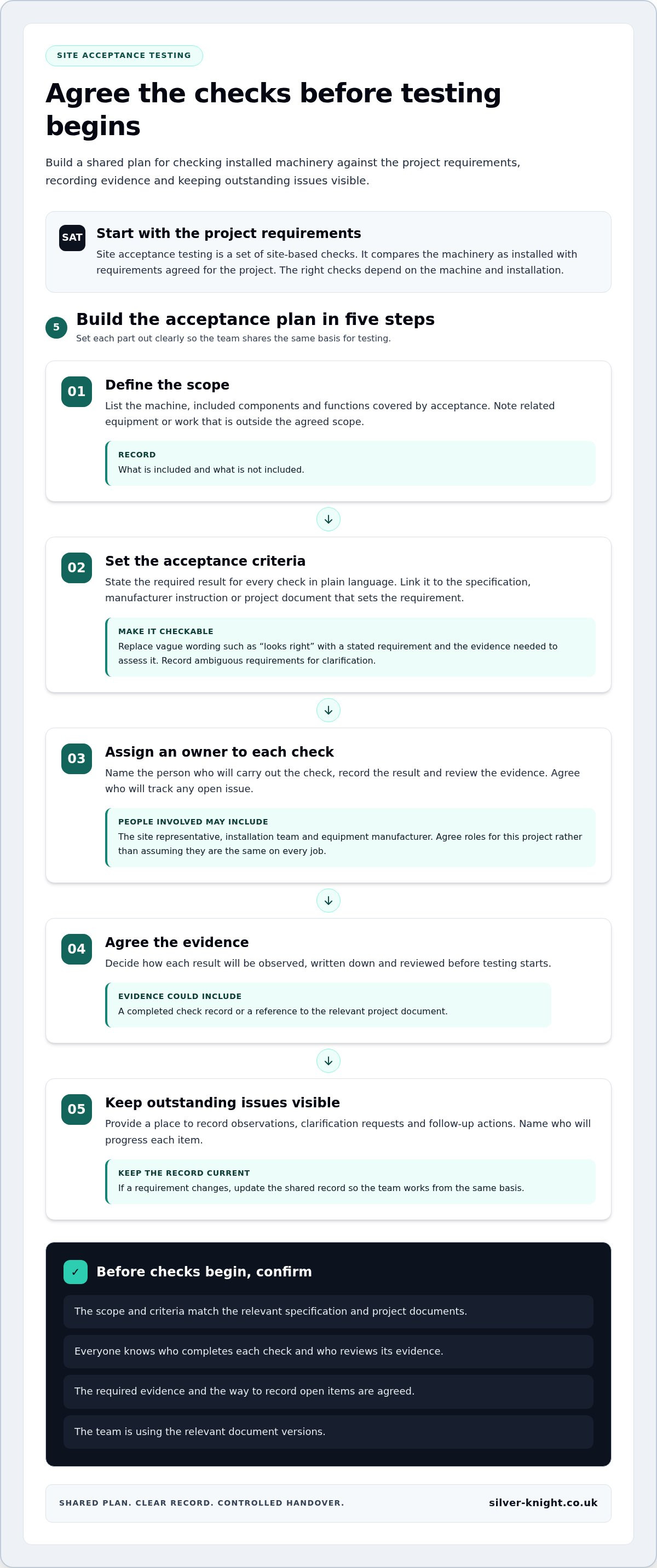
Use a short planning record to capture the points below. Keep each item specific enough to be checked and recorded.
- Scope: List the machine, included components and functions covered by the acceptance process. Note any related equipment or work that sits outside the agreed scope.
- Acceptance criteria: State what result is required for each check, in plain language, and name the specification, manufacturer instruction or project document that sets the requirement.
- Owners: Assign a named person to carry out each check, record the result and review the evidence.
- Evidence: Agree what will demonstrate the result, such as a completed check record or a reference to the relevant project document.
- Outstanding issues: Provide a way to record observations, clarification requests and follow-up actions, including who will progress each item.
Set the scope and acceptance criteria
Start with the equipment specification, manufacturer instructions and project documents. Use them to identify the features and functions that are relevant to this installation, rather than relying on a generic checklist. For example, if a document sets out an agreed machine position, write that as a check and state which drawing or requirement it comes from.
Before testing starts, agree how each result will be observed, written down and reviewed. Avoid vague wording such as “looks right”. A clearer criterion identifies the requirement and the evidence needed to show whether it has been met. If a requirement is ambiguous, record it for clarification rather than treating an assumption as a pass.
Prepare people, documents and the site
Gather the documents needed to carry out and assess the checks, including the relevant equipment information, installation records and project requirements. Make sure the people involved know which version of each document applies. A named owner should be clear for every check, with a separate person identified where review or sign-off is part of the agreed process.
Coordinate site access, safe working arrangements and the order of checks with the site team before the test begins. Consider whether the required people, equipment and documents will be available at each stage. If access or a missing record prevents a check, log the issue and agree how it will be resolved. This is different from recording a failed criterion: an incomplete check needs follow-up, not an assumed pass.
Keep the decision categories distinct. Mark a criterion as passed only when the agreed evidence supports that outcome. Record observations that need explanation as queries, and identify any further action, owner and status. If you’re planning an installation, talk through the project requirements as part of preparing for a clear handover.
Discuss installation requirements with our team.
Compare installation checks with evidence needed for acceptance
A useful acceptance record makes it easy to see what was checked, what requirement applied and what happened next. Match every check to suitable evidence and a named owner, rather than relying on a general note that the installation is complete. The table below is a template. Adapt it to the equipment and project documents, and include a check only when it forms part of the agreed scope.
Acceptance evidence should link each recorded result to its agreed criterion, the relevant machine or component and the person responsible. That link lets reviewers follow the reasoning behind a result and see whether an open point still needs attention.
| Check area | Evidence to record | Owner | Status |
|---|---|---|---|
| Positioning, if specified | Recorded observation linked to the applicable project drawing or requirement | Named person agreed for the check | Agreed status or open action |
| Alignment, if specified | Result and method of observation required by the project documents | Named person agreed for the check | Agreed status or open action |
| Connections, if specified | Relevant record or witnessed check identified in the project requirements | Named person agreed for the check | Agreed status or open action |
| Function, if specified | Observed result recorded against the stated requirement | Named person agreed for the check | Agreed status or open action |
Match each check to suitable evidence
Use the evidence type called for by the project, whether that is a document, a measurement or a witnessed check. Reference the relevant requirement and identify the machine or component, so the record remains traceable. For example, a positioning observation should point to the project document that defines the intended position, not simply state that the machine “looks right”.
Separate pass results from open actions
Use pass, fail or not tested only if those terms are part of the agreed process. If a check cannot be completed or its result needs clarification, record that plainly as an open point, with an owner and next action. Don’t hide exceptions in general notes or treat an incomplete result as acceptance unless the project criteria explain how it should be handled.
Before closing the record, compare each result with its criterion. Confirm that the evidence is readable, attributed and linked to the correct equipment. If a result differs from the requirement, state what needs resolving and who will follow it up. This gives the site representative and installation team a practical view of what is complete and what remains open.
For machinery installation contractors UK, a consistent record can support clearer communication across the site team, installer and manufacturer. It also helps the handover focus on documented outcomes, rather than assumptions about what was checked.
Plan a clear machinery installation handover.
Use this practical checklist during and after site acceptance testing
Use the agreed project documents as your reference throughout the checks. This checklist is a practical sequence to adapt, not a set of universal technical tests or pass values. Include only checks and functions that appear in the acceptance criteria, and record any change to the agreed approach so participants share the same understanding.
Checklist for checks at the installation site
- Confirm the machine and scope. Identify the equipment and any components included in the agreed acceptance scope. Check that the documents being used relate to the machinery under review.
- Check the requirement before observing. Find the relevant criterion in the project documents or manufacturer instructions. Don’t assume a generic tolerance, measurement or operating condition applies.
- Carry out only the agreed checks. Observe the installation details and functions named in the criteria. These might include positioning, alignment, connections or function, but only where they are specified for the project.
- Record each result as it happens. Use the agreed format to note the check, result, date and responsible participants. Link the entry to its supporting document, measurement or witnessed observation where required.
- Pause and record uncertainty. If the criterion is unclear, access prevents a check or the result cannot be established, note the issue. Don’t convert an incomplete check into a pass.
A clear entry lets someone reviewing the record understand what was checked and how the result relates to the agreed requirement. For example, record the relevant document reference alongside an observation, rather than relying on a brief note that gives no context. This is useful for machinery installation contractors UK and site teams alike, especially when several people contribute to the checks.
Checklist for records and unresolved actions
- Review the scope against the completed record. Compare the agreed list of checks with the entries made. Flag missing results and evidence that cannot be linked to a criterion or piece of equipment.
- List exceptions clearly. Record what remains unresolved, why it is open and which machine or component it relates to. Keep exceptions visible rather than burying them in general notes.
- Assign each next step. Name an action owner and state what needs to happen next. Agree how progress will be recorded and reviewed within the project.
- Document the outcome. Record the acceptance decision, including any conditions, in the agreed handover documents. Keep the supporting checks and open actions with that record.
Every unresolved exception needs a named owner and a documented next step. This makes open work easier to track and helps prevent an assumption of completion from replacing an agreed decision.
For support planning machinery positioning and installation requirements, discuss your machinery installation handover with our team.
Discuss your machinery installation requirements.
Plan machinery installation and handover with Silver Knight
A clear handover starts with planning how the machine will reach its intended position and what the site needs to be ready for installation. Access routes, working space and the planned position can all affect the move and the preparation that follows. Silver Knight provides machinery moving and installation services, helping connect these stages in a single project plan.
Acceptance requirements should fit the actual installation and the project documents. Silver Knight can support machinery installation planning around the agreed scope, site access and positioning requirements. This is not a claim of a standard SAT certification or universal testing process. The checks and acceptance record remain specific to the equipment and the requirements agreed by the project participants.
Bring moving and installation planning together
Planning the move alongside the final position helps the team consider how the machinery will be brought into the building and placed where it needs to go. For machinery installed as part of a wider move, factory relocation planning can connect the movement of equipment with the site preparation and installation stages. This gives the project team a clearer basis for coordinating access and handover expectations.
Silver Knight is a family-run UK specialist with over 180 years of collective industry experience. For complex installations, early planning can bring the moving, positioning and installation requirements into view before work begins. That context helps the parties identify practical dependencies, such as access arrangements and the information needed to prepare the installation site.
Plan specialist lifting around the installation
The equipment needed to move and position machinery depends on the project. Silver Knight uses hydraulic gantries, cranes and jack and slide systems, with the suitable approach shaped by the installation requirements. These systems are part of the planning picture, not proof that any particular acceptance check has been completed. Explore the specialist lifting equipment used to support machinery moving and installation projects.
Discussing the project scope early can help bring together the move, intended position, site access and installation requirements. Share the equipment involved and the planned installation context with the Silver Knight team to discuss how its machinery moving and installation services can support your project. A well-planned move and a clearly recorded handover give everyone a stronger shared understanding of what has been completed and what remains to be addressed.
Discuss your project scope and machinery installation requirements with Silver Knight.
Set your next installation up for a clear handover
Before the project moves into action, bring the people involved together around the practical decisions that will shape the installation. Confirm who needs to contribute, which project documents will guide the work and how changes will be shared. Agreeing these points early can help keep expectations aligned as the project progresses.
A shared plan helps teams working with machinery installation contractors UK keep site preparation, equipment movement and installation requirements connected. It also gives the team a useful starting point if the scope changes, access arrangements need attention or a handover question arises.
Silver Knight supports machinery moving, installation and factory relocation projects. To talk through your plans and the requirements for your machinery, discuss your machinery installation project with the team.
With the right people involved and project needs clearly understood, you can take the next step towards an installation that is planned around your site and a handover everyone can approach with confidence.
Frequently Asked Questions
Is site acceptance testing the same as commissioning?
Not necessarily. Commissioning activities prepare equipment for operation, while site acceptance testing checks agreed requirements at the installation site. A project may include both, but its documents should make their scope and records clear. Don’t assume commissioning means the machine has been accepted. For example, keep the commissioning record and acceptance decision distinct, so the project team can see what each document confirms and whether any agreed acceptance points remain open.
Who is responsible for site acceptance testing?
Responsibility depends on the project agreement between the site team, installation team and equipment manufacturer. Before checks begin, identify who carries out each one, who witnesses it and who records the result. Teams working with machinery installation contractors UK can use a responsibility schedule to make those roles visible. If two people believe the other is recording a result, the schedule helps expose the gap before the acceptance review.
What documents should be available for a site acceptance test?
The relevant documents depend on the machine and the project requirements. Useful starting points include the equipment instructions, agreed acceptance criteria, installation records and project test forms. Keep the applicable versions together, so the team can trace each result to the requirement it addresses. If a document or criterion is missing, record the gap and agree how to resolve it. Don’t fill it by borrowing an assumed technical requirement from another installation.
What happens if machinery fails a site acceptance test?
Record the result against the relevant criterion and describe what did not meet the agreed requirement. Assign an owner and a next action, then follow the project process to decide whether correction or a repeat check is needed. Don’t quietly change the criterion or record an unresolved exception as a pass. The close-out record should show what was done and how the project team resolved the issue or carried it forward.
Can a machine be accepted with outstanding issues?
That depends on the project’s agreed acceptance criteria and how they deal with open work. For each issue, record the project team’s assessment, the person responsible and the agreed next step. If acceptance is conditional, state the conditions clearly in the handover record. This gives later readers a fair picture of what was accepted and what remains outstanding, without assuming that every open item must prevent acceptance or can be ignored.
How should site acceptance testing be recorded?
Use a consistent record that identifies the machine, the criterion, the result, the participants and any supporting evidence. If a check was not completed, note that and give the reason using the project’s agreed status terms. Keep entries clear enough for someone who was not present to follow. A dated revision history can also help the team understand when a record was updated and which version reflects the final agreed outcome.
Does every new machinery installation need the same acceptance tests?
No. The right checks depend on the equipment, its instructions, the project scope and the site requirements. Treat a checklist as a starting point, then remove items that do not apply and add only checks supported by the project documents. For example, a criterion for one machine may not suit another. Record where each requirement comes from, rather than copying technical limits or pass values from an unrelated installation.

Article by
David Ashby
I'm the Managing Director of Silver Knight Haulage & Machinery Ltd. Silver Knight Ltd is a family-run firm established in the West Midlands in 2005, with the aim of providing a cost-effective, yet professional, service to businesses for the removal, transportation, and installation of machinery, plant, and equipment here in the UK and worldwide. Between us, the Silver Knight workforce has over 50 years of experience with machinery and its operation.
Disclaimer
This article is intended for informational purposes only. Please ensure you seek expert advice or carry out your own research to confirm the information is suitable for your specific needs.