A relocation plan can fail at the board table before a single machine moves. When presenting a relocation plan to the board, the challenge is not simply to explain why a move is needed. Directors need clear evidence that the proposal supports business priorities, that options have been weighed fairly and that production, people, safety and customer commitments have been considered.
Too little detail can leave important questions unanswered; too much can bury the decision in project detail. A strong presentation sets out the business case, compares the practical consequences of each option and shows where the main risks sit. It also explains the assumptions behind the proposed timing and budget, the likely effect on output and what could prompt a change of plan.
This guide explains how to shape the business case, compare relocation options and set out dependencies, mitigations and decision points. It covers how technical surveys, lifting, transport and installation fit into a board-approved project, with operational continuity in view from the start. The aim is a clear decision, agreed next steps and a relocation plan that can be managed with confidence.
Key Takeaways
- Frame the relocation around the business outcome and the specific decision the board needs to make.
- Summarise the assets, workstreams, site needs and dependencies so the project scope is easy to assess.
- When presenting a relocation plan to the board, compare viable options against the same operational criteria.
- Make major risks easier to manage by linking each one to its operational impact, mitigation, owner and review point.
- End with a clear recommendation, the assumptions that still need attention and the immediate next steps.
For specialist support with the practical planning behind a factory move, explore Silver Knight’s machinery relocation services.
Start with the business case for the relocation
The board needs to decide whether the proposed factory move supports the business well enough to justify the next stage of work. Make that decision clear from the outset. Explain why the current arrangement needs to change, what the move is intended to achieve and exactly what approval you are requesting.
A useful business case sets out the rationale, options and expected outcomes. The Business Case overview explains the general concept, but a factory relocation case also needs to address practical matters such as machinery, site constraints and continuity of operations.
To see how a move plan can be updated as plans change, watch this short video.
State the case for change
Describe the current operational issue using evidence the business holds, such as capacity records, maintenance information, production plans or findings from a technical site survey. Be precise about the constraint. For example, explain whether the existing layout limits access to equipment or the site cannot accommodate planned operational needs. Do not present a possibility as a proven fact.
Explain what may happen if the current arrangement continues, using measured language. Then connect the proposed move to business priorities and practical outcomes, such as making room for required assets or positioning machinery to support operations. A factory relocation can involve surveys, specialist lifting, haulage and installation, so show how each workstream supports the intended outcome. See the factory relocation service for more on this project-based work.
A board-ready relocation plan links a verified need to a defined outcome, a considered route forward and a clear decision for directors.
Make the board decision explicit
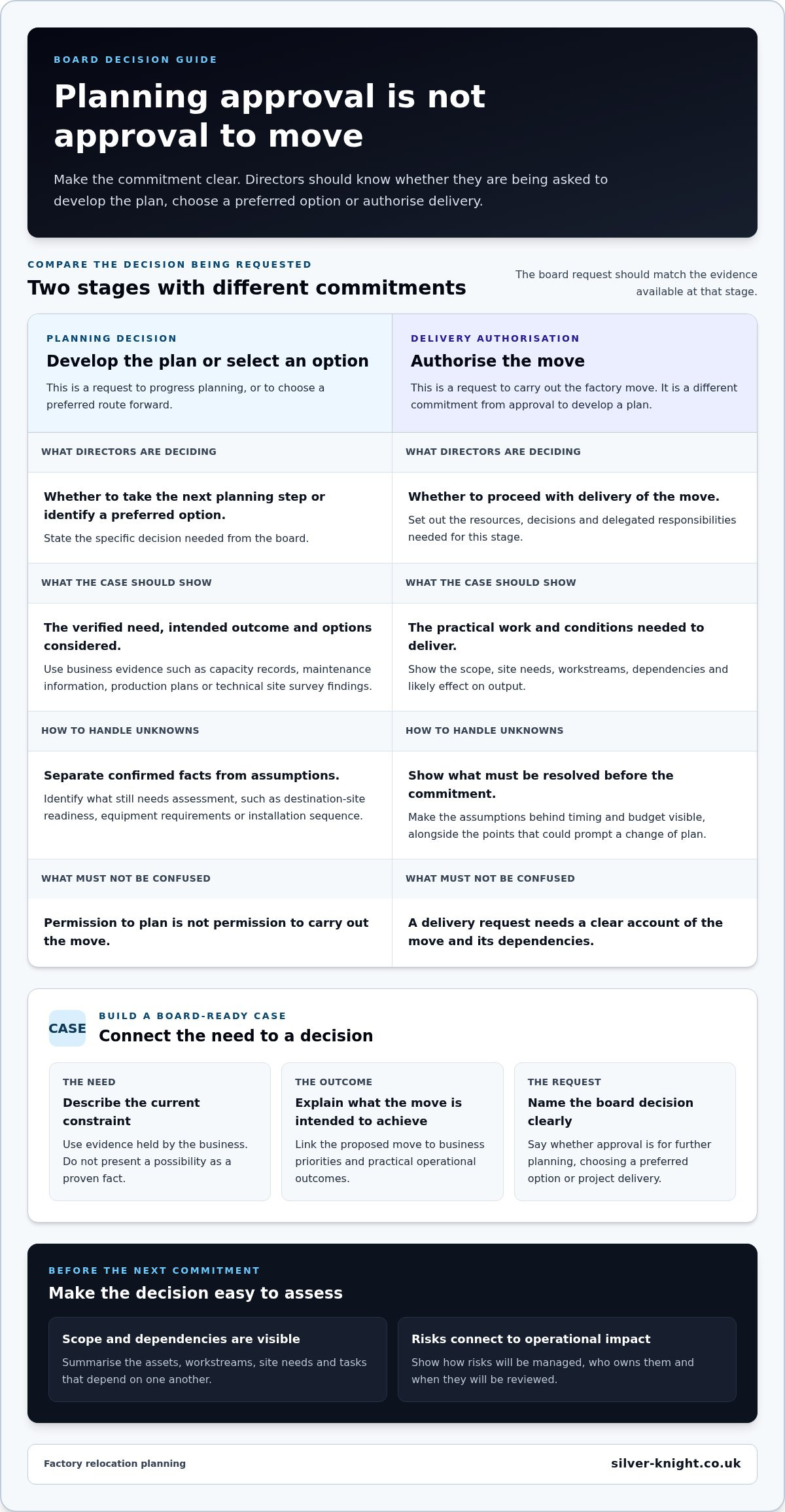
State whether directors are being asked to approve further planning, select a preferred option or authorise project delivery. Name the resources, decisions and delegated responsibilities needed for that stage. Keep the request proportionate: approval to develop a plan is not the same as approval to carry out the move.
Separate confirmed facts from assumptions that still need assessment, such as destination-site readiness, equipment requirements or the sequence of installation work. This helps directors see what they can decide now and what evidence is needed before the next commitment.
For practical support with machinery and factory moves, explore Silver Knight’s relocation expertise.
Build the relocation plan around scope, assets and dependencies
The board can only assess a factory move if directors can see what is included and how the work fits together. Present a concise summary of assets and workstreams, rather than a long inventory without context. Show which equipment is moving, what each asset needs and where a delay in one task could affect the wider project.
Define what is moving and what the project includes
Group machinery by current location, function, handling needs and relationship to production. For each group, note whether it needs dismantling, specialist lifting, haulage, storage or installation. Include related work such as factory clearance or international transport when relevant, and distinguish equipment that is moving from items that will remain in place.
A factory relocation involves linked workstreams, not just transport between sites. Show which activities are in scope, who needs to contribute and what must be ready before each stage begins. A technical survey can clarify machinery requirements and site conditions, grounding the plan in assessed needs rather than assumptions.
Map the sites, sequence and operational interfaces
Summarise what needs assessing at both locations: access routes, available space, lifting requirements, equipment positioning and installation needs. Note interfaces with production, utilities, building work or other teams where they could affect timing or safe access. Mark details that still need assessment.
Then show the dependencies in order. Survey findings inform the method and sequence. Disconnection or dismantling must be coordinated before lifting. Lifting and transport depend on access and equipment, while positioning comes before installation and recommissioning. If dismantling is part of the work, explain what it involves and how the machinery will be prepared for movement.
Agree the scope and dependencies before approval, so the board can judge the full work involved and the conditions needed to deliver it.
A clear summary could show each asset group alongside its origin, destination, handling approach, installation work and key dependency. This makes gaps easier to spot, such as machinery arriving before the destination area is ready or a move relying on a survey that has not taken place. Keep the summary brief, with supporting detail available for directors who need it.
For a project-specific view of how surveys, lifting, transport and installation connect, speak with Silver Knight about factory relocation planning.
For project support with machinery moves and lifting, explore Silver Knight’s relocation services.
Compare relocation options using clear board criteria
Present viable options against the same criteria so directors can see the practical differences rather than weigh unrelated claims. The right comparison depends on the factory, assets and business priorities. For example, a staged move may help maintain some activity during the work, while a single coordinated move may reduce the number of separate move stages. Include only options that are realistic for the sites and project scope.
Set criteria before recommending a preferred option
Choose criteria that reflect the business case and the decision the board must make. Separate essential requirements, such as access for machinery or a workable way to maintain operations, from preferences that could be traded off. Use the same evidence and level of detail for every option. Mark gaps for assessment rather than filling them with assumptions.
| Criterion | Option A, staged move | Option B, coordinated move |
|---|---|---|
| Operational continuity | Assess how production could continue between stages and which interfaces need managing. | Assess the effect of concentrating the move into a coordinated period. |
| Scope and dependencies | Show which assets move in each stage and how one stage depends on another. | Show the full asset and workstream scope, including installation requirements. |
| Site constraints | Assess whether both sites can support the proposed sequence and temporary arrangements. | Assess access, space and readiness for the planned move and positioning work. |
| Handling approach | Identify the lifting and transport needs for each stage. | Identify the lifting and transport needs for the full move. |
| Financial inputs | Set out project-specific costs and any additional inputs related to separate stages. | Set out project-specific costs and the resources required for the coordinated plan. |
Consistent criteria make options comparable by showing the same operational demands, constraints and financial inputs for each approach.
Explain why the recommended option is preferred
Link the recommendation to the business case. Explain how it responds to the operational need, site conditions and continuity priorities, then state the trade-offs openly. A staged move may require more coordination between stages; a coordinated move may concentrate activity into a shorter sequence. Describe how the project plan would manage the relevant trade-off and identify any evidence still needed before approval.
The handling approach can affect which options are practical. Technical surveys help inform the lifting plan, with equipment such as hydraulic gantries, cranes or jack and slide systems considered in relation to the machinery and site. See specialist lifting systems and equipment for examples of equipment used in machinery moves.
Use this comparison to support a decision, not to imply that one approach suits every factory. For help considering machinery moving and lifting requirements for a relocation, speak with Silver Knight’s team.
For practical support with factory relocation planning and delivery, explore Silver Knight’s machinery moving services.
Show how the plan will manage risk, disruption and delivery
A board-ready plan turns risks into actions with named owners, not just a list of concerns. For each material risk, show the possible effect on production or delivery, the mitigation, who is accountable and when progress will be reviewed. Set out the schedule in phases, with milestones and decision points rather than unverified dates or durations.
Turn risks into owned actions
A technical site survey can inform decisions about access, lifting, transport and installation before the delivery plan is finalised. Record open findings as assumptions or actions, with an owner and review point. For example, if access at either site could limit the planned handling approach, assess it before confirming the move sequence.
Use a simple risk register to make responsibilities clear:
- Site access: Restricted access could delay equipment movement. Assess routes and site conditions. The project lead owns the action and reviews it after the survey.
- Asset condition: An unexpected issue could affect handling or installation. Record known condition information and agree how new findings will be reported. The machinery lead reviews this before the move.
- Sequencing: A delay in one workstream could hold up later tasks. Map dependencies between disconnection, lifting, transport and positioning. The project lead checks progress at each milestone.
- Operational downtime: The move could interrupt planned activity. Coordinate the move sequence with operational leads and agree how continuity will be monitored. Review the approach at each decision gate.
Present a phased schedule and continuity approach
Show how the work progresses from assessment to restart, and include a decision gate before the project moves into the next phase.
- Assess: Complete technical surveys and identify access, asset and installation needs.
- Prepare: Confirm scope, responsibilities, site readiness and the planned approach to disconnection and lifting.
- Move: Coordinate lifting and transport with the agreed sequence and operational arrangements.
- Install and restart: Position machinery, complete installation and recommissioning, then report readiness against agreed operational checks.
For each phase, show dependencies and what must be ready before work proceeds. Explain how production or site activity will be protected, such as by coordinating asset moves with operational priorities and making any planned interruption visible to the relevant teams. Transport planning should connect the handling method and site access to the sequence. Silver Knight’s machinery moving and haulage service covers these practical elements.
Use the same reporting route throughout the project. At agreed review points, the board should be able to see progress, exceptions, decisions needed and any change to the risk picture. Discuss your factory relocation requirements with Silver Knight.
Planning a factory move? Explore machinery relocation support from Silver Knight.
Close with a clear recommendation and board decision
End with the choice directors need to make, not another summary of every project detail. Lead with the preferred option and the specific approval requested. Then give the reasons, main trade-offs and controls that will help protect operations. Keep technical information, such as detailed asset lists or survey findings, in an appendix or referenced project document.
Create a concise board summary
A short summary should make the recommendation understandable on its own. State how the preferred option addresses the business need, what it involves and which risks or dependencies could affect delivery. Be open about unresolved assumptions, such as destination-site readiness or the handling approach for particular machinery. Explain what evidence will be gathered to resolve them and when directors will receive an update.
Separate approval to continue planning from approval to deliver the move. For example, the board may be asked to approve a preferred option and the next stage of surveys, while reserving final delivery approval until scope, site readiness and project inputs have been reviewed. Make clear what the current decision enables, who can act under it and which commitments depend on a later decision gate.
A concise recommendation could follow this pattern: “Approve the preferred relocation option for further planning, with the project lead to complete the outstanding assessments and return for a delivery decision once the scope, dependencies and operational controls are clear.” Adapt the wording to the actual decision and authority requested. Do not imply that a later approval is already in place.
Make the next steps straightforward
After the recommendation, set out the immediate actions, accountable roles and information needed. Focus on what must happen as a result of the board’s decision.
- Project lead: Record the decision, actions, owners and review points, then report progress through the agreed route.
- Operations lead: Provide production priorities and identify how the transition could affect site activity.
- Technical team: Arrange or complete the assessments needed to clarify access, asset requirements and destination-site readiness.
- Relocation planning team: Use survey findings to develop the lifting, transport, positioning and installation sequence.
Specialist machinery moving experience can help connect technical survey findings with practical decisions about lifting and transport. Silver Knight supports machinery moving, installation and factory relocation as project-based work, helping turn the approved scope into a delivery plan.
When presenting a relocation plan to the board, finish by restating the recommendation, the approval sought and the next review point. Keep the final request direct so directors can record a clear decision and the project team knows what to do next. Discuss your factory relocation project with Silver Knight.
Planning a factory move? Explore machinery relocation support from Silver Knight.
Move forward with a clear board decision
A strong relocation proposal gives directors a clear reason to act, a fair comparison of options and a practical view of risks, dependencies and next steps. When presenting a relocation plan to the board, distinguish the approval needed now from decisions that depend on further surveys or project detail. This helps the board make a confident decision without overlooking operational continuity.
Specialist input can help turn the approved scope into a workable plan for machinery surveys, lifting, transport and installation. Silver Knight brings over 180 years of collective industry experience and uses equipment including hydraulic gantries, cranes and jack and slide systems for machinery moving projects.
Discuss your machinery relocation plan with Silver Knight to explore practical support for your project. With a clear case, defined responsibilities and agreed next steps, you can take the proposal to the board with confidence and move the planning forward.
Frequently Asked Questions
What should a relocation proposal to the board include?
Include the business case, decision requested, project scope, options, risks, operational impact, dependencies and delivery plan. Explain how the preferred option supports business priorities and identify who owns key actions. Keep the main paper concise, with supporting technical detail in an appendix or referenced project document. Make assumptions visible so directors can see what they are approving, what remains undecided and what evidence is still needed.
How do you justify a factory relocation to the board?
Start with the operational reason for change and support it with relevant business evidence. Explain the likely effect of keeping the current arrangement, then compare feasible options against consistent criteria. Set out expected outcomes, disruption, risks and mitigations without relying on unsupported savings claims. Finish with a clear recommendation and specific approval request. This gives directors a sound basis for deciding whether to progress planning or approve a later delivery stage.
What risks should a machinery relocation plan address?
Assess project-specific risks involving asset condition, site access, lifting, transport, installation, sequencing and operational disruption. For each material risk, explain its possible effect, planned mitigation, accountable owner and review point. A technical site survey can inform the move plan by identifying equipment and site requirements before delivery decisions are finalised. A generic checklist alone is not enough, as controls need to reflect the machinery and locations involved.
How can I present relocation costs without having a final quote?
Show the cost categories and assumptions behind them rather than presenting an unsupported total. Separate known project inputs from items that depend on survey findings, asset scope or decisions about the move sequence. Explain how these factors may affect each option and when the figures will be refined. State whether approval is being sought for further planning or project delivery, so the board understands the limits of the current cost information.
How do you minimise disruption during a factory move?
Plan around site readiness, operational dependencies and the sequence for disconnecting, handling, transporting, positioning and recommissioning machinery. Identify critical assets and agree how production or other site activity will be managed during the transition. Set out milestones, owners and decision points so delays or changes can be addressed. Base the sequence on the equipment, both sites and the operating requirements assessed for the specific project.
Who should be involved in preparing a relocation plan for the board?
Bring together people responsible for operations, project delivery, finance, facilities and affected production areas. Include technical input on machinery, site conditions, lifting, transport and installation, then assign clear owners to actions and risks. Experienced machinery relocation support can help shape practical survey and delivery planning. Silver Knight Haulage & Machineries Ltd provides machinery moving, installation and factory plant relocation, drawing on over 180 years of collective industry experience.

Article by
David Ashby
I'm the Managing Director of Silver Knight Haulage & Machinery Ltd. Silver Knight Ltd is a family-run firm established in the West Midlands in 2005, with the aim of providing a cost-effective, yet professional, service to businesses for the removal, transportation, and installation of machinery, plant, and equipment here in the UK and worldwide. Between us, the Silver Knight workforce has over 50 years of experience with machinery and its operation.
Disclaimer
This article is intended for informational purposes only. Please ensure you seek expert advice or carry out your own research to confirm the information is suitable for your specific needs.