A machinery move can be decided before equipment leaves its current site. Choosing heavy machinery moving companies UK businesses can rely on means looking beyond transport. The project may also need specialist lifting, careful handling, access planning and installation. If these stages aren’t planned together, site constraints or unclear handovers can put equipment at risk and add to downtime.
The machine’s weight, dimensions, route through the site and destination all shape what a workable move involves, so a standard transport plan may not be enough. This guide explains which capabilities matter for different machinery and site conditions, what information helps shape a plan, and how to coordinate moving, installation and transport.
Silver Knight Haulage & Machineries Ltd is a family-run specialist in machinery moving, installation, factory and plant relocation, and heavy haulage, with over 180 years of collective industry experience. The sections below cover the key stages of a complex move, from assessing equipment and site access to coordinating lifting and transport, so you can identify what your project needs.
Key Takeaways
- When comparing heavy machinery moving companies UK businesses consider, assess how each capability fits the full project, rather than treating transport as the only requirement.
- Match lifting, moving, haulage, installation, clearance or storage to the machine and the access available at both sites.
- Gather the machine’s available dimensions, weight and handling information, along with details of its origin, destination and project requirements.
- Compare planning, lifting, transport and installation to see how each stage supports the move.
- Consider how machinery moving, installation, relocation and heavy haulage can be planned as connected parts of one project.
Plan the move around your equipment and site requirements. Explore Silver Knight’s machinery moving services.
What heavy machinery moving companies UK projects may need
A heavy machinery moving company plans and carries out the handling, lifting and transport of industrial equipment to suit the machine, the site and its destination. The work can involve moving equipment within a building, relocating it between sites, or coordinating its positioning and installation at the destination.
Unlike general freight, a machinery move can involve more than loading equipment for transport. A machine may need to be lifted and manoeuvred through a restricted space before it can be secured for haulage. Household removals, by contrast, are organised around domestic belongings and living spaces. Industrial equipment calls for a plan built around its specific handling and site requirements.
When a machinery move needs specialist handling
Access can shape the job as much as the equipment itself. A large or heavy load may need careful manoeuvring through a factory, around other machinery or into a precise position. The plan should account for the route, including doorways, turning space and any known restrictions, as well as where the equipment needs to end up. The right approach depends on the machine and the conditions at both sites, rather than on a standard moving method.
For example, a factory relocation may involve removing equipment from a working area, moving it out of the building and transporting it to a new site. A plant move may have different access and positioning requirements. These examples show why planning should cover the route through each site and the intended destination, rather than assuming every machine needs the same handling.
How moving, installation and haulage fit together
Lifting and positioning are distinct from haulage. Lifting is about raising or manoeuvring equipment at a site, while haulage carries it between locations. Once it arrives, installation may be needed to place the machinery in its intended position. When a project includes several of these stages, treat them as connected tasks and plan how equipment will pass from one stage to the next.
Bringing those capabilities together can clarify responsibilities and reduce the risk of a gap between removal, transport and installation. Silver Knight’s machinery moving and haulage services connect these parts of a move. When comparing heavy machinery moving companies UK projects need, consider how well each company’s capabilities match the full job, not simply whether it can transport a load.
See how Silver Knight’s machinery moving services can fit your project. Explore the services.
Which machinery moving capabilities match your project
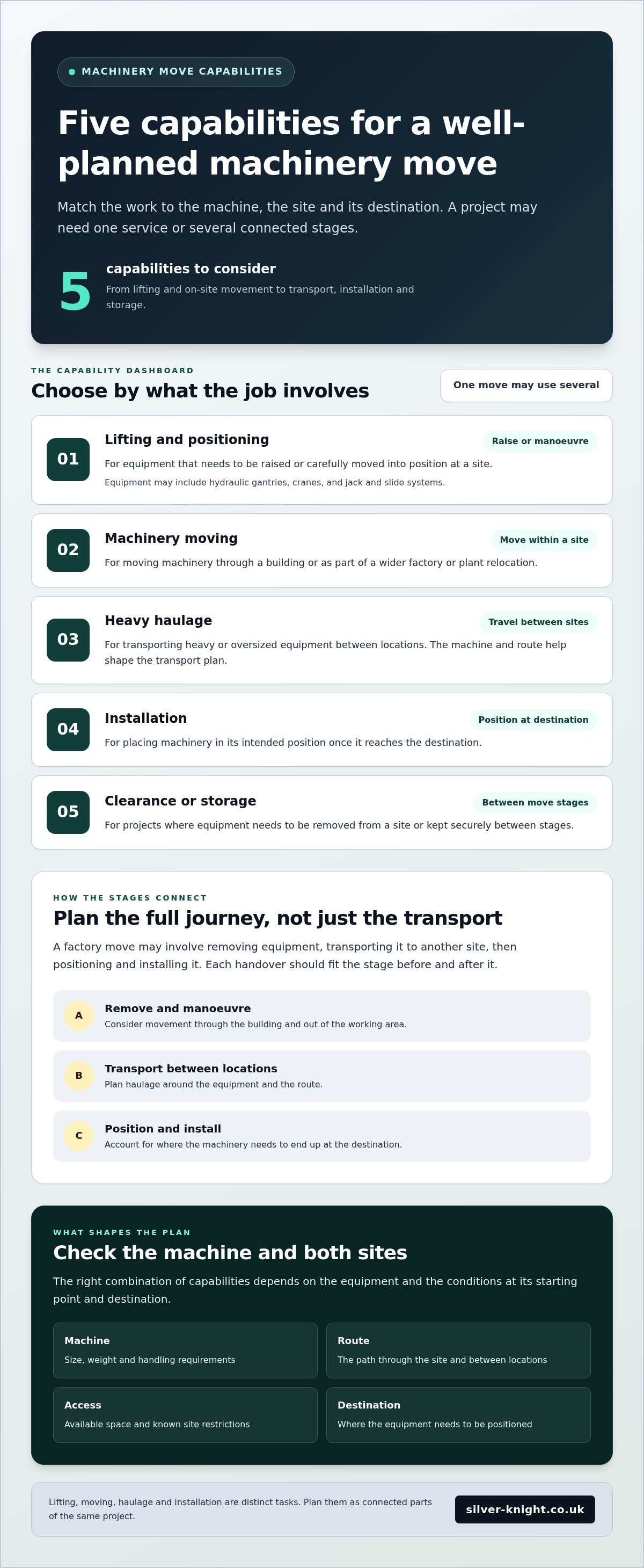
A machinery move may need one service or several linked capabilities. The right mix depends on what must happen to the equipment, where it is now and where it needs to go. Map the job from removal through to its next use. This helps identify the main requirements: lifting, moving within a site, transport, installation, clearance or storage.
- Lifting and positioning: For equipment that needs to be raised or manoeuvred into place.
- Machinery moving: For moving equipment within a building or as part of a wider relocation.
- Heavy haulage: For transporting heavy or oversized equipment between sites.
- Installation: For placing machinery in its intended position at the destination.
- Clearance or storage: For projects where equipment must be removed from a site or kept securely between stages.
These services aren’t interchangeable. A machine’s size and weight, the route through a building, available access and the destination requirements all affect which combination makes sense. For instance, removing equipment from a factory, transporting it to another site and positioning it there may call for lifting, haulage and installation as connected stages. Planning around the full task helps avoid treating each stage as an isolated job.
Lifting and moving machinery within an industrial site
Specialist lifting and positioning can help move machinery through an industrial site where space or the final position affects the approach. Silver Knight uses hydraulic gantries, cranes and jack and slide systems, tailoring the equipment and plan to the machine and site. The specialist lifting equipment used depends on the project. For broader guidance on safe work equipment use, the Health and Safety Executive Machinery Guidance is a useful reference.
Transporting equipment between UK sites
Transport is one part of a machinery move, not a substitute for planning how equipment is removed and positioned. Heavy haulage may be needed for heavy or oversized machinery travelling between UK sites. The machine and route help shape the transport plan. If a project involves moving equipment beyond the UK, international machinery transport can form part of the wider relocation, while lifting and handling requirements remain tied to the machinery and site.
To identify the capabilities your project needs, consider each stage from the machine’s starting position to its destination. Silver Knight can plan the combination of moving, lifting, haulage and installation around the equipment and site conditions.
See how Silver Knight’s machinery moving services can support your project. Explore the services.
How to compare heavy machinery moving companies UK buyers consider
Compare capabilities against the work your project involves, rather than treating a service list as a league table. A transport-only move and a full factory relocation have different requirements. Use the comparison below to see how each capability relates to a project need.
| Capability | Project requirement it addresses | What to consider |
|---|---|---|
| Project planning | Coordinating the stages of a move | How the plan accounts for the equipment, site access and destination |
| Lifting and positioning | Moving machinery into or out of a specific location | Whether the approach suits the load and available space |
| Transport and haulage | Carrying machinery between sites | How the transport stage connects with removal and delivery |
| Installation | Placing machinery at its intended position | Whether positioning at the destination is part of the required work |
| Related services | Addressing other project stages | Whether clearance or storage is needed as part of the wider move |
Project fit depends on the machinery, available access and the services the move requires. A project involving transport alone has a different scope from one that also needs lifting, positioning and installation. Use those stages as practical comparison points when reviewing what each company can do.
Specialist machinery moving versus transport-only haulage
Haulage covers the journey between locations. A machinery move may also involve lifting equipment at the origin, moving it through a site and positioning it at the destination. If these stages are part of your relocation, transport alone won’t cover the full scope. Silver Knight provides machinery moving, installation and heavy haulage, so these connected requirements can be considered together.
Matching specialist equipment to the move
Equipment choice should reflect the load and working space, not a one-size-fits-all assumption. Site constraints and handling needs help shape the approach. Silver Knight uses hydraulic gantries, cranes and jack and slide systems for machinery moving. These are examples of different equipment options, not a claim that every project needs each one. Explore machinery moving equipment to understand the types used.
When comparing heavy machinery moving companies UK projects may involve, focus on how each capability answers a defined need. This makes it easier to see whether the service mix covers the work from removal through to the required destination stage.
Planning a machinery move? See how Silver Knight supports machinery projects. Explore the services.
What to prepare before planning a heavy machinery move
A clear brief helps shape a move plan around the equipment, sites and outcome you need. You don’t need every detail resolved before an initial discussion. Gather the information already available, note what still needs to be established and describe any known constraints.
For an initial project discussion, gather the machine’s identification, available dimensions and weight, handling information, origin and destination, site access details, and the outcome and services required.
Create a clear machinery and site brief
Start with the machine, then describe its current position and where it needs to end up. Keep relevant technical or handling documents together, and include any dimensions or weight details you have. For each site, note access points, the route, restricted space and other known limitations that could affect moving or positioning the equipment.
Use this sequence to organise the information:
- Identify the equipment. Record its name or identification details and gather available dimensions, weight and handling documentation.
- Describe the origin. Note where the machinery is currently located, how it can be accessed and any known site constraints.
- Describe the destination. Explain where the equipment needs to go and what access or space considerations are known there.
- Set out the required outcome. State whether the work involves moving, installation, clearance, storage or a combination.
Be clear about what is known and what isn’t. If you don’t have a particular measurement or document, say so rather than estimating. This gives the project team a useful starting point without turning unknown details into assumptions.
Plan the service scope and project sequence
Next, outline the stages you expect the move to involve. For example, equipment may need to be removed from its current position, transported and installed at a new site. A wider relocation may also involve clearing areas or storing machinery between stages. If the project involves moving a whole site, factory relocation services can form part of the wider plan.
Note operational considerations your team already knows, such as when an area needs to be available or whether other work must happen first. These details can clarify dependencies and the order of tasks. Keep them factual and distinguish confirmed plans from preferences or open questions.
Heavy machinery moving companies UK projects rely on need a clear picture of the equipment and the work required. Use your brief to explain the full scope, not just the transport leg. Share your machinery move requirements with Silver Knight to start shaping a project around the equipment, site and services needed.
Learn about Silver Knight’s machinery moving support. Explore the services.
How Silver Knight supports heavy machinery moves across the UK
Silver Knight Haulage & Machineries Ltd supports machinery moves across the UK, bringing machinery moving, installation and heavy haulage together. The work is planned around the machinery and site requirements, so the project scope can reflect what needs to happen at the origin, during transport and at the destination.
The business is family-run and has over 180 years of collective industry experience. Its project-led approach starts with understanding the equipment and sites, establishing the services needed, then shaping the plan around the move. Whether the requirement involves one machine or a wider relocation, the relevant capabilities depend on the project rather than a fixed package.
Connected support from machinery moving to installation
Moving machinery and installing it can be connected parts of one project. If equipment needs lifting or positioning as well as transport, planning these stages together can clarify how the job progresses from removal to its intended place. Silver Knight provides machinery moving and installation alongside heavy haulage, allowing the service scope to cover the stages relevant to the equipment and site.
For work that extends beyond a single machine, factory or plant relocation may be more appropriate. This can involve planning around the wider site move, rather than viewing each item as a separate transport task. Silver Knight’s factory relocation services support projects where equipment and site requirements need to be considered together.
Start a project conversation
A useful starting point is a clear outline of the machinery, where it is now, where it needs to go and what you want the move to achieve. Include the dimensions, weight and handling details you have, plus known access constraints at each site. If the move includes installation, clearance or storage, note that too. These details help shape a service plan around the work required.
Silver Knight tailors its planning and equipment choices to the machinery and site conditions. A project involving restricted access may need a different approach from one where transport between sites is the main requirement. Setting out the full scope helps connect the right stages, whether the job involves moving one machine or relocating a factory or plant.
If you’re comparing heavy machinery moving companies UK businesses can use, consider whether their services address the full scope of your project. Silver Knight brings machinery moving, installation, factory and plant relocation, and heavy haulage together for projects nationwide. Discuss your machinery moving project and share the equipment, site details and outcome you need.
Explore Silver Knight’s machinery moving support for your operation. View the services.
Set your machinery move in motion
A machinery move is also a chance to plan what happens around it. Consider how the work fits with your production schedule, who needs to coordinate on site and when the equipment needs to be ready for its next role. Bringing these decisions into the project conversation early can help make the move a workable part of your wider plans, rather than treating it as a transport task alone.
Choosing between heavy machinery moving companies UK businesses can use is easier when you’re clear about the result you need and what the project must account for. You don’t need every detail settled before taking the next step. Start with the equipment, the sites and the outcome, then discuss how the work can be shaped around those needs.
Discuss your machinery moving project with Silver Knight and take the next step towards a plan that fits your operation.
Frequently Asked Questions
What does a heavy machinery moving company do?
A heavy machinery moving company plans and carries out the movement of industrial equipment. This may involve handling it at a site, transporting it and placing it at its destination. The exact work depends on the project. Moving a production machine to another part of a factory, for example, differs from relocating it to a new site. Heavy machinery moving companies UK businesses use may also provide installation or related services as part of the project.
Can heavy machinery moving companies move equipment within an operating factory?
Yes, machinery can be moved within a factory that remains in operation, with the plan shaped around the site and the work taking place there. Share which areas are in use, where equipment needs to pass and any access limits. This gives the project team a clearer picture of how the move fits the factory environment. The movement plan should account for the site’s operational requirements, rather than assume the building is empty.
Can machinery be moved without dismantling it?
Sometimes, but it depends on the equipment, its dimensions and the route from its current position to its destination. If the machinery can pass through available access points and be handled in its existing form, dismantling may not be needed. Where the site or move requires it, dismantling can be considered as part of the work. Share available machine information so the proposed approach reflects the actual conditions.
Do heavy machinery moving companies provide installation as well as transport?
Some specialists provide both machinery installation and transport. Silver Knight offers these as part of its machinery services, so a project can include moving equipment between sites and positioning it at its destination. This is useful when delivery alone isn’t the full requirement. Set out what needs to happen after arrival, such as placing the machine in its intended position, when describing the project scope.
Can a UK machinery moving company arrange international machinery transport?
Yes, Silver Knight provides international machinery transport as well as UK machinery moving. For an international project, outline the equipment, its starting point and destination, and the outcome you need. This helps define the transport scope alongside any machinery moving or installation work involved. International projects can have different planning needs from a move within the UK, so share the available details early in the project discussion.
What information is needed to plan a heavy machinery move?
Start with the machine’s identification, available dimensions and weight, and any handling information or documents you have. Describe where it is now, where it needs to go, and known access restrictions at both sites. Include the result you need, such as relocation, installation or storage. If some details aren’t available, explain what’s missing rather than guessing. Photos of the equipment and access route can also help illustrate the situation.
How are specialist lifting systems used to move heavy machinery?
Specialist lifting systems help raise, manoeuvre or position machinery where the task calls for more than straightforward movement. Silver Knight uses hydraulic gantries, cranes and jack and slide systems, with the approach selected to suit the equipment and site. These systems aren’t interchangeable, and not every move needs the same method. Available machine details and site conditions help inform which lifting approach is suitable for a particular project.
Article by
David Ashby
I'm the Managing Director of Silver Knight Haulage & Machinery Ltd. Silver Knight Ltd is a family-run firm established in the West Midlands in 2005, with the aim of providing a cost-effective, yet professional, service to businesses for the removal, transportation, and installation of machinery, plant, and equipment here in the UK and worldwide. Between us, the Silver Knight workforce has over 50 years of experience with machinery and its operation.
Disclaimer
This article is intended for informational purposes only. Please ensure you seek expert advice or carry out your own research to confirm the information is suitable for your specific needs.