What if a machinery move disrupted more than the equipment being transported? Energy projects often depend on tightly connected work, so an asset’s dimensions and weight, site access, lifting requirements and delivery timing can all affect what happens next. That is why energy sector machinery logistics needs to be planned as a coordinated operation, not simply a journey from one place to another.
Getting heavy equipment safely to site is only part of the job. The move also needs to fit site constraints and the wider project schedule, with handling, lifting and transport planned together. This article explains the main stages of a machinery logistics project, the practical details that shape a suitable move and how coordination can support operational continuity. Silver Knight provides machinery moving, contract lifting, heavy haulage and machinery installation to help bring these stages together around the equipment and site requirements.
Key Takeaways
- Build an energy sector machinery logistics plan around the asset, site conditions and required final position, not transport alone.
- Use a site survey to inform handling choices, access planning and the order of work.
- Compare transport-only coordination with a wider scope that includes machinery moving, lifting and positioning.
- Prepare key details for the logistics brief, including asset information, collection and delivery constraints, and preferred sequence.
- Silver Knight brings over 180 years of collective industry experience to machinery moving, installation and relocation projects.
For machinery moves involving lifting, positioning or haulage, Silver Knight can coordinate the work.
What Energy Sector Machinery Logistics Needs to Coordinate
A machinery move is rarely just a vehicle carrying an asset from one address to another. The equipment may need preparing, lifting, moving through a restricted area, delivering in a particular sequence and positioning ready for the next stage of work. Each part affects the plan.
Energy sector machinery logistics is the planning and coordination of machinery handling, movement and delivery, from collection through to the asset’s required position. Unlike general freight, it considers how the equipment will be handled and how the move fits the site and project sequence. The term Project Cargo and Heavy Lift is also used for the movement of large, heavy or critical equipment.
This video shows automated logistics examples for the solar industry.
Which energy projects may involve machinery moves
Wind, oil, gas and electricity projects can all involve machinery or large components that need specialist handling. Examples include wind turbine parts, pumps or compressors, and electrical transformers or generators. These are examples of equipment used across the sector, not a record of any particular company’s project history.
The asset itself shapes the move. Its dimensions and weight affect how it can be handled and transported. Its lifting points, shape and condition may also influence the equipment and sequence required. A plan suited to one machine may not suit another, even if both are travelling to the same site.
Why operational continuity belongs in the plan
Site access, delivery timing and the order of work can affect other activity around the move. A vehicle that arrives before an access area is ready may disrupt site movements. Equipment delivered before the lifting team or installation stage is prepared may need to be held or handled again. Mapping these interfaces helps teams reduce avoidable disruption, although no logistics plan can promise uninterrupted operations.
Logistics planning starts before transport because the route, handling method, site access and delivery sequence need to work together. Agreeing the required final position early helps define what the move must achieve. Arrival at the site is not necessarily the finish point.
- Confirm where the asset will be collected and where it must end up.
- Identify access limits and the lifting or handling steps between those points.
- Align delivery timing and sequence with the surrounding project work.
When the scope includes moving, lifting and positioning, these activities can be planned as connected stages. Machinery moving and haulage bring those requirements into the same plan, so it accounts for the asset’s journey across the site as well as its transport.
For a move that needs planning across lifting, transport and positioning, Silver Knight can coordinate the connected stages.
How Energy Machinery Moves Are Planned from Survey to Positioning
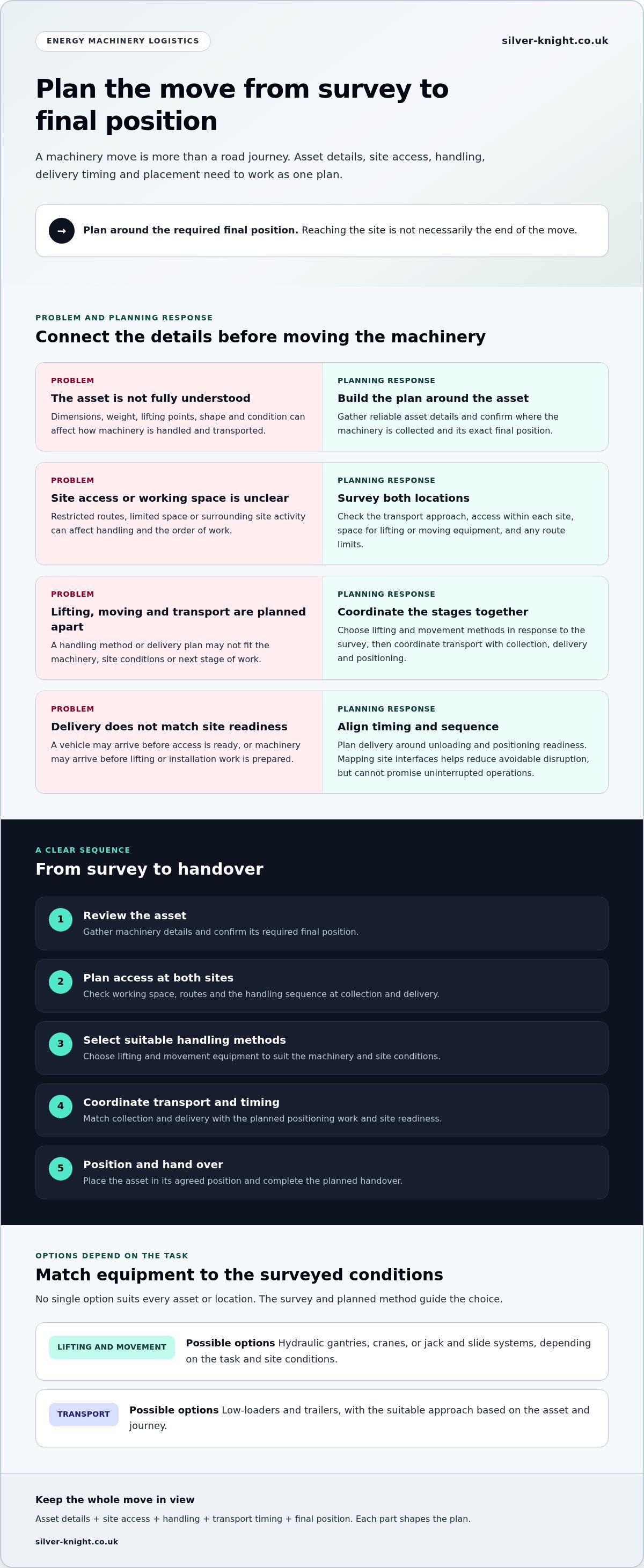
A well-planned move follows a clear sequence, with the asset, sites, handling and transport considered together. The precise method depends on the machinery and conditions at both locations, so a plan for one move may not suit another.
In energy sector machinery logistics, a technical survey helps turn the required outcome into practical steps. It can identify whether the asset can pass through the available access route, where lifting or handling can take place, and how delivery should fit the work at each site.
Survey the asset and both locations
Start by gathering reliable information about the machinery and its destination. Include its dimensions and weight, known handling needs, the collection point and the exact final position. If the machine must enter a building or pass through a restricted area, record the route and any limits on working space.
Survey both ends of the journey. Consider the transport approach, access within each site, space for lifting or moving equipment, and any site activity that could affect the sequence. This helps the plan cover the full move rather than just the road journey. Silver Knight’s machinery moving and haulage service brings transport and machinery movement into the same project scope.
Coordinate lifting, transport and placement
With the survey information in hand, the team can plan the stages in order:
- Review the asset details and confirm the required final position.
- Plan access, working space and the handling sequence at both sites.
- Select suitable lifting and movement methods for the machinery and conditions.
- Coordinate transport with the planned collection, delivery and positioning work.
- Place the asset in its agreed position and complete the planned handover.
Different equipment can support different moves. Hydraulic gantries, cranes or jack and slide systems may be used for lifting or movement, depending on the task and site conditions. Choose equipment in response to the survey and planned method, rather than by assumption. No single option suits every asset or location.
Planning the stages together helps identify practical conflicts early, such as limited space for moving equipment or a delivery sequence that does not match site preparation. It also gives everyone involved a clearer view of what must happen before the asset reaches its final position. The plan should reflect the machinery and conditions at both sites.
To plan machinery handling and transport as one project, discuss the move with Silver Knight.
Choosing the Right Logistics Approach for Energy Machinery
The right approach depends on what must happen between collection and the asset reaching its final position. Transport-only coordination can suit a straightforward journey where loading and unloading arrangements are already in place. If access is restricted, lifting is complex or the machinery needs careful positioning, the scope may need to include those activities too.
Use the comparison below to identify which interfaces need coordinating. It is a starting point, not a fixed package. Actual requirements depend on the machinery, both sites and the project sequence.
| Project need | Coordination to consider | Relevant service categories |
|---|---|---|
| Move machinery between accessible locations with loading arrangements agreed | Collection, transport, delivery timing and unloading responsibilities | Heavy haulage or machinery transport |
| Handle machinery where access or positioning is challenging | Handling method, lifting arrangements, site access and final placement | Machinery moving, contract lifting and equipment hire |
| Hold machinery before the destination is ready | Storage timing and the onward movement to the destination | Machinery storage and haulage |
| Move machinery across international borders | Transport stages and coordination between the relevant locations | International machinery transport |
When transport alone may not cover the move
Haulage covers the journey, but the asset still needs to be loaded, unloaded and placed. If machinery must pass through a restricted entrance or be moved within a building, the work around the vehicle can be just as important as the transport itself. Planning these interfaces together helps define who is responsible for each stage and when it needs to happen.
Where access or handling calls for specialist equipment, cranes, hydraulic gantries or jack and slide systems may be considered according to the task and site. Silver Knight’s heavy moving equipment hire provides machinery-moving equipment as part of the project plan.
When storage or international coordination enters the scope
Sometimes the asset cannot move directly to its destination. The site may not be ready, or delivery may need to fit a later stage of work. Storage can then become a planned link between collection and onward delivery, with the timing of both movements included in the overall scope.
Set the scope around the work required at each stage. This makes it easier to decide whether transport alone is suitable or whether moving, lifting, storage or international transport should be planned together.
For help defining the scope of a machinery move, talk to Silver Knight about coordinating the work.
Preparing an Energy Machinery Logistics Brief
A useful brief gives the moving team a clear picture of the asset, both sites and the outcome the project needs. For energy sector machinery logistics, it should cover more than collection and delivery addresses. Clear details help shape the handling method, identify constraints early and align the move with other work.
A machinery move plan is shaped by accurate asset details, site conditions, the required final position and the sequence of work. Use the checklist below to gather information before planning begins. If a detail is unknown, flag it for discussion rather than relying on a guess.
Information to gather about the machinery
Start with the equipment itself. Record its dimensions and weight, along with any known handling points or requirements. Include a description or photographs if they help explain its shape, condition or location. If the machinery may need dismantling to move, note this in the brief so preparation and onward work can be considered together.
Be precise about the destination. State not only the delivery site, but also where the asset needs to be positioned after arrival. For moves involving preparation for transport, Silver Knight’s machinery dismantling service can form part of the wider plan.
- Asset dimensions, weight and available handling information
- Collection point and any known restrictions around the machinery
- Whether dismantling or other preparation may be needed
- Delivery location and the required final position
Site and schedule details to organise
Describe access at both ends of the move. Include the approach route within each site, available working space and any restrictions that could affect vehicles, lifting or movement. Note changes in level, narrow passages or shared working areas where relevant. These details help inform the site discussion and show where the planned sequence may need adjusting.
Timing matters too. Record preferred delivery windows, the order in which the asset should arrive and any dependencies on site preparation or other project work. Identify the people or teams responsible for access, lifting arrangements and receiving the machinery. Agreeing who is involved helps prevent a gap between arrival and the work needed to move the asset into position.
- Site access routes and available working space
- Known restrictions or activity that may affect handling
- Preferred delivery timing and sequence
- Teams coordinating access, lifting and receipt of the asset
Bring these details together in one brief and flag uncertainties clearly. The more accurately the asset, sites and intended sequence are described, the easier it is to develop a move plan that reflects the project’s conditions.
To discuss a machinery logistics brief and the work it needs to cover, speak with Silver Knight.
How Silver Knight Supports Energy Sector Machinery Logistics
Energy sector machinery logistics can involve several connected stages, from understanding the asset and site conditions to arranging lifting, transport and final positioning. Silver Knight is a family-run machinery-moving specialist providing machinery moving, installation and plant relocation. Its services bring relevant parts of a project together, with the scope shaped around the machinery and locations involved.
Planning is specific to each move. Start with the asset’s dimensions and weight, where it needs to go, the access available at both sites and the intended sequence. These details help establish which stages need coordinating and where lifting or haulage fits. The aim is to plan around the project’s requirements, rather than assume the same approach will suit every machine or site.
Machinery moving capabilities for complex projects
Some moves call for specialist equipment to handle machinery in restricted or challenging spaces. Silver Knight uses hydraulic gantries, cranes and jack and slide systems. The appropriate method depends on the asset, access and site conditions, so equipment choice is part of planning rather than a one-size-fits-all decision.
Machinery moving, heavy haulage and installation can be planned as connected stages. For example, the plan may need to account for how an asset is handled before transport, how it reaches the destination and how it is moved into position. A joined-up scope can make responsibilities and interfaces clearer for everyone involved.
When a project needs machinery movement alongside transport, Silver Knight’s heavy equipment moving and haulage service covers those requirements. The scope can include haulage alone or coordination with lifting and positioning.
Discuss the requirements of your machinery move
To begin planning, bring together the details that describe the job clearly:
- The machinery’s dimensions, weight and any known handling needs
- Collection and delivery locations, including access constraints
- The required final position and any installation needs
- Your preferred sequence and relevant project timing
- Other teams whose work depends on access, lifting or receipt of the asset
Sharing this information gives the discussion a practical starting point. If some details are not yet available, explain what is known and what still needs to be established. The plan can then be developed around the machinery and conditions at both sites, rather than relying on assumptions.
Silver Knight brings over 180 years of collective industry experience to machinery moving and relocation projects. To discuss your move, share the asset details, site constraints and intended sequence.
For support planning machinery moves around site and equipment needs, explore Silver Knight’s specialist machinery services.
Set Your Machinery Move in Motion
A clear next step is to turn the project’s known details into a practical discussion. Consider what the machinery needs to do at its destination, what could affect access or handling, and which parts of the wider project depend on its arrival. This keeps energy sector machinery logistics focused on the outcome, not just the journey.
You do not need every detail finalised before discussing the move. Bring the information you have about the asset, site conditions and preferred sequence. Silver Knight can discuss how machinery moving, lifting, haulage and positioning fit together for your project.
Discuss your machinery logistics project with Silver Knight and take the next step towards a move planned around your equipment and site requirements.
Frequently Asked Questions
What does energy sector machinery logistics include?
Energy sector machinery logistics can cover planning for equipment surveys, handling, lifting, transport and positioning. The scope depends on the asset, both sites and the work sequence. A move may need only transport coordination if loading and unloading are already arranged. If the equipment also needs lifting, storage or installation, those stages can be included in the wider plan so responsibilities are clear.
How do you plan logistics for moving heavy energy equipment?
Start with reliable information about the equipment and the required outcome at its destination. Drawings, photographs or equipment records can help clarify details if the asset is difficult to describe. A site survey can connect the machinery’s handling needs with the available space and access. The plan should also identify who is responsible for preparing the asset and receiving it, so each handover is understood.
Can machinery logistics help reduce disruption to an energy project?
Careful coordination can help reduce avoidable disruption, although it cannot guarantee uninterrupted operations. For example, if a work area must be cleared before machinery arrives, that dependency can be made clear in the schedule. Project teams can then align access and receiving arrangements with other site activity. A clear sequence also gives teams a shared reference if conditions change and the plan needs review.
What information should I provide for an energy machinery move?
Provide the equipment’s identifying details, collection and delivery locations, handling information and intended position after delivery. Add access limits, preferred timing and known dismantling or storage needs. If some details are estimates, label them as such and explain what still needs checking. This separates confirmed information from open questions and gives the planning discussion a practical basis.
Does energy equipment always need a crane to be moved?
No. A crane is one possible method. Depending on the machinery and site, hydraulic gantries or jack and slide systems may also be suitable. The choice depends on the move as a whole, including the available working space and how the asset must be positioned. A survey helps assess the options. Choosing equipment by appearance alone can overlook important access and handling details.
Can machinery be stored during an energy project relocation?
Yes. Silver Knight provides secure indoor storage for heavy machinery and industrial components. In the brief, note why storage is needed, which asset is being held and how storage fits into the onward move. This connects the storage stage with the wider relocation plan and the next delivery or installation activity.
Can energy machinery be transported internationally?
Yes. Silver Knight provides international machinery transport as part of machinery relocation work. An international move needs transport arrangements coordinated with the equipment’s collection, destination and onward handling. Include the origin and destination, asset details and any planned dismantling or installation in the project brief. The route and overall scope depend on the machinery and locations involved, so these details help shape the plan.
Contact Silver Knight to discuss your machinery move, including the equipment, site requirements and stages that need coordinating.

Article by
David Ashby
I'm the Managing Director of Silver Knight Haulage & Machinery Ltd. Silver Knight Ltd is a family-run firm established in the West Midlands in 2005, with the aim of providing a cost-effective, yet professional, service to businesses for the removal, transportation, and installation of machinery, plant, and equipment here in the UK and worldwide. Between us, the Silver Knight workforce has over 50 years of experience with machinery and its operation.
Disclaimer
This article is intended for informational purposes only. Please ensure you seek expert advice or carry out your own research to confirm the information is suitable for your specific needs.