A safe transport plan starts before a machine is lifted. Dismantling industrial machinery for transport begins with assessing the equipment, identifying and isolating power sources, and planning the removal sequence. Labelled parts, clear records and suitable protection help prepare machinery for transport, storage or disposal.
Taking a machine apart is only part of the challenge. Keeping track of its connections and components matters just as much. A careful plan protects parts and makes handling them at their destination more straightforward.
This guide explains how to assess and dismantle machinery, sort and protect its parts, document wiring and instructions, and manage safety during the work. It also covers how dimensions, weight and destination affect preparation for transport, storage or disposal.
Key Takeaways
- Plan the dismantling sequence around the machine’s condition, connections and components to help prevent damage.
- Sort parts by whether they are intended for reuse, recycling or disposal, and protect them to suit their condition and destination.
- Record wiring, connection points and manufacturer instructions so the equipment is easier to reassemble.
- Keep the work area controlled and prepare suitable tools and safety equipment before dismantling begins.
- Plan packaging, handling and transport around the machinery’s dimensions, weight and intended destination.
Planning a machinery move links dismantling order with site access and handling. Machinery moving information can help frame those connected stages.
Dismantling stages - how do you take a machine apart without risking damage?
Dismantling industrial machinery for transport means assessing its condition, isolating power and utilities, then removing components in a planned order. The sequence should protect the equipment and preserve the information needed for reassembly.
Disconnecting machine power and utilities
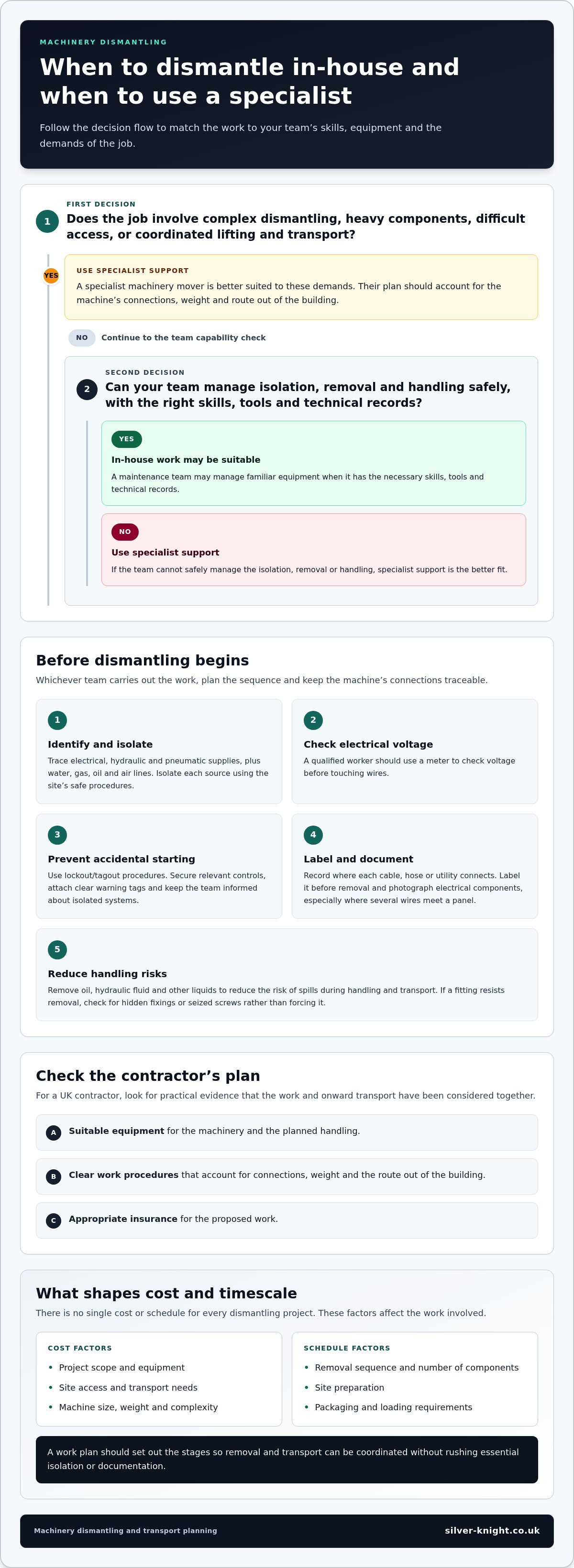
Identify every connection, including electrical, hydraulic and pneumatic supplies. Trace water, gas, oil and air lines before separating them, and isolate each source using the site’s safe procedures. A qualified worker should use a meter to check electrical voltage before touching wires. Remove oil, hydraulic fluid and other liquids to reduce the risk of spills during handling and transport.
Record where each hose, cable and service connects, then label it before removal. For example, mark a sensor cable and its matching connection point to distinguish it from similar components later. Check for leaks, corrosion and damaged connections. If a fitting resists removal, look for hidden fixings or seized screws rather than forcing it.
Applying lockout, tagging and documentation
Use lockout/tagout procedures to prevent machinery starting during dismantling. Isolate power sources, secure the relevant controls and attach clear warning tags. Each tag should identify the isolated component or supply and warn workers not to reconnect it. Keep the team informed about which systems remain isolated as work progresses.
Document each disconnection as it happens. Note the cable, hose or utility, its connection point and the label used. Photograph electrical components before removing them, especially where several wires meet a panel. These records help the team follow the dismantling sequence and reconnect the correct components during installation.
Choosing in-house or specialist support
A maintenance team may manage familiar equipment if it has the right skills, tools and technical records. A specialist machinery mover is better suited to complex dismantling, heavy components, difficult access or work requiring coordinated lifting and transport. The key question is whether the team can manage isolation, removal and handling safely.
When selecting a UK contractor, look for suitable equipment, clear work procedures and appropriate insurance. Ask how the proposed sequence accounts for the machine’s connections, weight and route out of the building. These details show whether the plan considers both the equipment and its onward transport.
Planning costs and timescales
The work involved depends on the machinery’s size, weight and complexity. A machine with multiple utilities, delicate electrical components or difficult access requires more planning than a straightforward unit. Transport needs also depend on the dimensions and weight of dismantled sections, as well as loading arrangements and site access. Costs vary by project; scope, equipment, access and transport needs are among the factors that shape a quote.
There is no single timescale for dismantling and transport. The schedule depends on the removal sequence, number of components, site preparation, packaging and loading requirements. A work plan should set out these stages so the team can coordinate removal and transport without rushing essential isolation or documentation.
Planning how components will be handled after dismantling is part of a successful move. Machinery moving information can help connect parts preparation with the next stage.
Sorting dismantled parts for reuse, recycling or disposal
After disassembly, inspect and sort each component according to its condition and intended use. Clear records and suitable protection help keep reusable parts identifiable during storage, transport and later assembly.
Sorting parts for reuse or disposal
Check each part for wear, damage and contamination before deciding where it should go. Set aside serviceable components for reuse, separate recyclable materials and identify items for disposal. Record the dismantling date and location, item description, handling decision and catalogue number or internal designation. This creates a traceable record for every part.
For scrap, separate metals, remove excess plastics and clean off residual oil. Machinery waste containing hazardous substances should be handled by a specialised, authorised company. Keep these items separate from ordinary recyclable materials and record how they are being handled. Clear sorting helps prevent useful components from being mistaken for scrap.
Clean reusable parts with compressed air or a soft brush, then inspect them again. Where suitable, apply anti-corrosion oil or protective film to reusable metal components to reduce corrosion during storage or transit. Record existing marks or damage so they are not mistaken for damage that occurred during the move.
Labelling and securing parts
Mark each part and its packaging with the catalogue number or internal designation. Match labels to the dismantling records and group components by machine section or assembly stage. For example, keep a removed unit’s associated fittings together rather than putting them in a general box. This makes parts easier to identify at the destination.
Choose protection to suit each component. Place heavy parts on pallets and secure them against movement. Use anti-static packaging for delicate electronic components and suitable padding for other parts. Label packages to match the records. Packaging should keep parts stable without covering identification marks needed for assembly.
Dismantle mechanical components in a controlled sequence. Code and record parts as they are removed, including their position and orientation where these matter for reassembly. Keep linked internal parts together and avoid mixing similar-looking items from different machine sections. If a component is stuck, check for hidden fixings before applying force. This helps protect mating surfaces and delicate internals.
Before packing, compare the parts with the dismantling record. Check that every item has a destination, a readable label and suitable protection. This final review can reveal missing fittings or unrecorded damage while components are still being organised for reuse, recycling or disposal.
Clear technical records connect dismantling with later installation. Use information about the machinery’s next location to shape the documentation.
Documenting wiring diagrams and manufacturer instructions
Good technical records turn dismantling into a repeatable sequence rather than a collection of disconnected tasks. Gather machine information before work starts, then record each change in a format the reassembly team can follow.
Gathering machine information
Before the project begins, gather the machine’s available technical documentation, equipment specifications and manufacturer instructions. Identify the model and main assemblies, then compare the paperwork with the equipment on site. This can reveal missing details, later modifications or differences between a drawing and the installed machine.
Decide what the project record needs to contain before dismantling starts. Assign responsibility for photographs, connection records and component notes, and identify any special tools required. Photograph the machine from several angles, then take close-ups of panels, cable routes and connection points. Give files clear names linked to the relevant machine or assembly.
Keep wiring diagrams with the matching machine records. Note which drawing applies to each electrical panel and connection. If a diagram differs from the installed layout, record the observed arrangement separately. Keep the original drawing unchanged and distinguish site notes from it. This helps technicians tell manufacturer information apart from changes recorded during the project.
Preparing reassembly documentation
Build the reassembly record as dismantling progresses. Give each assembly and connection a consistent identifier, then use it in photographs, notes and diagrams. Record component position and direction wherever orientation matters. For example, photograph a connector in place before removing it, with its position clear in the image.
Document the work in practical stages. Note which assembly came away first, what it connected to and which fittings belong with it. Keep manufacturer instructions alongside the relevant records rather than relying on memory or loose paperwork. Technicians at the destination can then follow the documented sequence and consult the matching instructions.
Before the equipment leaves the site, compare the records with the dismantled machine. Check that each major assembly has a clear identifier, photographs and connection details. Add notes about parts that differ from the drawings or need careful positioning. Keep the technical file accessible with the equipment during transport and reassembly.
A useful record helps technicians identify the correct connection, component position and relevant instructions. Check that these details are clear for every assembly. This gives the reassembly team a practical reference when preparing the machine for operation at its new location.
Documenting dismantling can help technicians during reassembly. A dismantling project can include preparing detailed technical documentation for reassembly at a new location. The plan may also cover gathering machine information, defining the records required, assigning tasks and identifying any special tools.
These decisions establish what to record and who is responsible before components are removed. As work progresses, link each assembly to its photographs, connection details and relevant instructions. At handover, technicians can use the documented sequence to match removed parts with their recorded positions and connections. Keep site observations distinct from original manufacturer information, so recorded changes are not confused with the source drawing. Keep the technical file with the equipment for reference during reassembly.
Occupational health and safety compliance
Safe dismantling requires controlled access, clear responsibilities and a planned method. In the UK, consider the requirements for machinery isolation, lifting, workplace access, transport and waste handling that apply to the work and site.
Meeting safety and environmental requirements
Before work starts, define the dismantling area and restrict access to authorised workers. Mark the boundary, control entry points and keep visitors away from moving equipment. Agree who can stop the work if a new hazard arises, such as an unexpected connection or unstable component.
Walk the planned route from the machine to the loading point. Look for obstructions, uneven floors, overhead services and areas where other work is taking place. Include these findings in the work plan, then organise the sequence so people and machinery do not compete for the same space. A clear route can also make handling more efficient.
Environmental controls matter during removal. Collect oil, hydraulic fluid and other liquids in suitable containers rather than allowing spills onto floors or into drains. Keep contaminated materials separate from reusable parts. Machinery waste containing hazardous substances should be handled by a specialised, authorised company. Record what has been removed and how it is being handled.
Checking applicable UK regulations
No single rule covers every part of a dismantling project. Relevant UK requirements depend on the tasks, equipment, site and transport arrangements. Consider each stage separately: isolating machinery, lifting and moving components, controlling workplace access, loading for transport and managing waste.
For each stage, document the hazards, agreed controls and people responsible. For example, the lifting plan should identify the component being moved, its route and the exclusion area. The dismantling plan should also explain how workers will respond if the equipment differs from its records or expected condition.
Follow the site’s safety procedures alongside the task plan, and make sure workers understand their roles before dismantling begins. Check that the planned equipment suits the component and access conditions. If the work changes, pause and review the controls before continuing. Keep records of decisions and changes with the project documentation.
Standards and procedures are useful only when they shape the work on site. A practical review should cover isolation, access, handling, transport and waste as connected stages. This helps teams spot gaps between dismantling and loading, such as an unsecured component or a route still being used by other workers.
Preparing machinery for transport, storage or disposal
Preparation depends on the machinery’s dimensions, weight and destination. A thorough plan connects dismantling, protection, loading and transport when dismantling industrial machinery for transport.
Planning oversized road transport
For UK road moves, determine permit and escort requirements from the load, vehicle and route details. Assess dimensions, weight and the planned journey before selecting transport. Consider how the machine will be divided and loaded, as dismantled sections may still be oversized.
Map the route from the loading point to the destination. Consider access at both ends, turning space and obstacles that could affect the load. Share the machinery’s dimensions and weight with the transport planner. These details help match the load to a suitable vehicle and identify route constraints early.
Oversized machinery may need specialist transport rather than a standard vehicle. Smaller dismantled components can often travel in standard containers, while larger pieces may require specialised solutions. For international sea transport, allow for the journey and its conditions. Sea transport can expose machinery to damaging conditions, so suitable packing is important.
Dismantling, packing and transport steps
Follow a clear sequence from the dismantled machine to its destination:
- Measure and plan. Record each section’s dimensions and weight. Decide how each part will be handled, packed and loaded.
- Prepare components. Clean and inspect parts, then protect them for their destination. Use anti-static packaging for delicate electronic components.
- Pack and label. Match package labels to the dismantling records. Choose protection that suits each part’s shape, weight and transport conditions.
- Secure for movement. Place heavy components on pallets and secure them against shifting. Check that each package can be handled and loaded safely.
- Coordinate delivery. Align dismantling, packaging, loading and transport schedules. Confirm the destination can receive each load and keep the records with the machinery.
A single plan for dismantling, packing, loading and transport helps coordinate the stages. Match each component’s protection and handling to its size, weight, condition and destination.
For a machinery move, explore Silver Knight Haulage & Machineries Ltd machinery moving services.
Before dismantling, assess the machinery’s configuration, connections and potential challenges, and gather the necessary tools and safety equipment. The project plan can include a work schedule and site preparation. Secure dismantled components for transport, storage or reassembly.
Silver Knight Haulage & Machineries and machinery moving
Silver Knight Haulage & Machineries can coordinate industrial machinery moving when dismantling, handling and transport need to work together. Its Machinery Moving service supports transfers between locations, while Machinery Installation helps place machinery at its destination.
For a wider site move, Factory Relocation and Plant Relocation cover machinery movement as part of relocating a factory or plant. The right support depends on the equipment and scope of the project. Share the machinery details, destination and intended outcome to discuss the next step.
To discuss moving your machinery, contact Silver Knight Haulage & Machineries.
Plan the next move with confidence
Before work begins, turn the move into a clear project brief. Set out the machinery’s destination, whether it will be reused, stored or retired, and who will manage each stage. This gives your team a shared starting point and aligns the dismantling plan with what needs to happen next. A well-planned approach to dismantling industrial machinery for transport supports a smoother handover from the current site to the next stage of operation.
Silver Knight Haulage & Machineries Ltd provides Machinery Moving and Machinery Installation, as well as Factory Relocation. These services can help when equipment needs to move to a new position or as part of a wider factory move. Share your project requirements with Silver Knight to discuss the next step.
Contact Silver Knight Haulage & Machineries Ltd to talk through your machinery move and plan what comes next.
Frequently Asked Questions
How do you assess a machine’s technical condition before dismantling?
Assess the machinery’s condition by comparing a visual inspection with maintenance records and manufacturer specifications. Note leaks, corrosion, unusual wear and recent faults, then record where each issue appears. Check whether the current configuration matches the drawings, especially if the machine has been modified. This baseline helps distinguish existing defects from damage during removal and highlights components that may need extra care during handling.
What is disassembly?
Disassembly is the controlled process of taking a machine apart into components or assemblies. It may involve removing covers, separating connected units and removing internal parts in a planned order. Unlike breaking equipment down for scrap, disassembly can preserve parts and their relationships for reuse or reassembly. For example, a production line can be separated into identifiable units rather than dismantled into a pile of mixed components.
What health and safety risks arise when dismantling industrial machinery, and how can they be controlled?
Risks include unexpected movement, stored energy, falling components, fluid leaks and people entering the work area. Control them by isolating equipment, restricting access and agreeing who directs each task. Before lifting a component, check its stability and the route it will follow. Keep workers clear of suspended loads, and stop work if the machine’s condition differs from the planned method.
How should machinery parts be labelled, protected and documented for reassembly?
Give each part a unique identifier linked to its machine section, then use the same code in photographs and records. Mark the orientation of components that could be fitted more than one way. Keep small fittings in labelled containers with their associated assembly, rather than loose in a shared box. Choose packaging to suit each part, and keep labels visible after packing.

Article by
David Ashby
I'm the Managing Director of Silver Knight Haulage & Machinery Ltd. Silver Knight Ltd is a family-run firm established in the West Midlands in 2005, with the aim of providing a cost-effective, yet professional, service to businesses for the removal, transportation, and installation of machinery, plant, and equipment here in the UK and worldwide. Between us, the Silver Knight workforce has over 50 years of experience with machinery and its operation.
Disclaimer
This article is intended for informational purposes only. Please ensure you seek expert advice or carry out your own research to confirm the information is suitable for your specific needs.