A crane is not always the best answer for a difficult lift. In complex and technical lifting projects, the load’s weight is only part of the picture. The route it must travel, available access, floor conditions and nearby equipment all affect how it can be moved.
If machinery needs to pass through a restricted space without damage or unnecessary disruption, choosing the right method can feel daunting. Crane-led lifting may suit some sites, while hydraulic gantries or jack-and-slide systems may work better where access or movement is constrained.
This guide explains what makes a lifting project technically demanding and how site conditions affect the choice of equipment and approach. It also covers the information that helps define a clear scope, from load details and route measurements to operational constraints. With careful planning, you can assess the options and see how lifting fits into a wider machinery relocation or installation project.
Key Takeaways
- Assess load dimensions, centre of gravity and sensitivity, not just weight.
- Bring together load details, site drawings, access routes and operational constraints to help shape a clear lifting plan.
- Compare cranes, hydraulic gantries and jack-and-slide systems against the requirements of the site and the move.
- Prepare the project information you have so the scope and possible methods can be considered clearly.
- Consider how lifting connects with machinery movement, installation or relocation to coordinate the wider project.
For machinery moving and lifting planned around site constraints, explore Silver Knight’s services.
What makes complex and technical lifting projects challenging
A lift becomes technically demanding when several factors interact. The load may be heavy, but its dimensions, balance, sensitivity and route can matter just as much. Access, headroom, floor conditions and nearby work can further limit the available options.
A technically complex lift is one where the load, route and site constraints need to be planned together, because changing one part can affect the whole move. This is a more useful test than weight alone. A compact machine may be difficult to position in a confined space, while a larger item may have a clear route and working area.
How load characteristics affect lifting decisions
Weight is only one part of understanding a load. Its shape and dimensions affect how it can be accessed and handled. Its centre of gravity and weight distribution influence balance, so planners need accurate information about the machine and any components that may shift or require separate handling.
Sensitivity matters too. Precision machinery or equipment with delicate components may need a controlled movement that limits unwanted tilting, jolting or contact with nearby structures. The overview of lifting equipment introduces different equipment types used to handle loads. The right choice for a particular project depends on the load and site conditions.
Why site access and the final position matter
Doorway width, headroom and working space can affect which equipment can reach the load and how it can be used. Overhead obstructions may restrict lifting height, while tight turns or narrow routes can make it harder to move machinery through a building. Assess the whole route, not just the point where the lift begins.
The destination matters from the outset. A machine may need to pass through an opening, turn into a production area and finish in a specific position. That final position can influence the direction and sequence of the move. Planning backwards from the destination can reveal access issues early.
Floor conditions are another part of the picture. The condition and available space at working and travel points can affect the methods under consideration. If equipment must move across a site before or after lifting, assess the route and the areas where it will be positioned. These details help connect machinery handling with the wider equipment used for machinery moves.
In practice, complexity often comes from the combination of constraints rather than one difficult feature. A sensitive machine, restricted access and a precise final position each add planning requirements. Together, they shape the lifting approach, movement sequence and information needed to define the work.
To plan a lift as part of a complete machinery move, see how Silver Knight supports machinery projects.
How project planning connects the lift to the wider machinery move
Planning needs to connect the lift with everything that happens before and after it. Start by defining the project brief, then gather load and site information, review the route and destination, and develop a method that accounts for the whole move. If any of these details changes, review the plan.
A site survey turns drawings and assumptions into a practical view of access, working space and route conditions, helping inform the choice of method. It can reveal details that are easy to miss in a brief, such as a restricted approach to the work area or limited space at the final position. For complex and technical lifting projects, this helps connect the proposed lift with the machinery’s actual journey through the site.
What information helps define the project scope
Bring together the information already available, even if some details still need to be established. This gives the planning discussion a clear starting point and helps identify where further checks or measurements may be useful.
- Load dimensions, weight, handling information and any known sensitivity or movement concerns.
- Site drawings or photographs showing access points, working areas and possible obstructions.
- The intended route, including turns, changes in level and areas where machinery must pass or be positioned.
- The final position and any requirements for orientation or installation.
- Operational constraints, such as nearby work, access restrictions or the need to limit disruption.
Incomplete or outdated information can leave important questions unresolved during planning. Share what is known and identify any gaps so the project team can focus on details that may affect the scope and method.
How lifting fits into relocation and installation
The lift is one stage of a larger sequence. Machinery may need to be prepared or moved within a building, lifted, transported and positioned at its destination. Installation or recommissioning may follow. Planning these stages together helps account for handovers, access and the equipment needed at each point, rather than treating the lift as a separate task.
For example, a machine moved out of a production area may need a lifting method that also allows it to reach a loading point. At its new site, unloading and positioning may be just as important as the original lift. Coordinating machinery movement with machinery haulage and relocation can bring these connected stages into one scope.
Plan with the relevant UK requirements and project arrangements in mind. References from other jurisdictions are not a substitute for UK guidance. For example, OSHA’s lifting equipment requirements relate to the United States and should not be treated as UK regulations.
Share the brief, available drawings and site information with a machinery-moving specialist to develop a project-specific scope. Silver Knight’s machinery moving and lifting expertise can be considered alongside the wider relocation or installation work.
For lifting options planned around your site and the wider machinery move, discuss the project with Silver Knight.
Which lifting approach fits the project's access and movement constraints
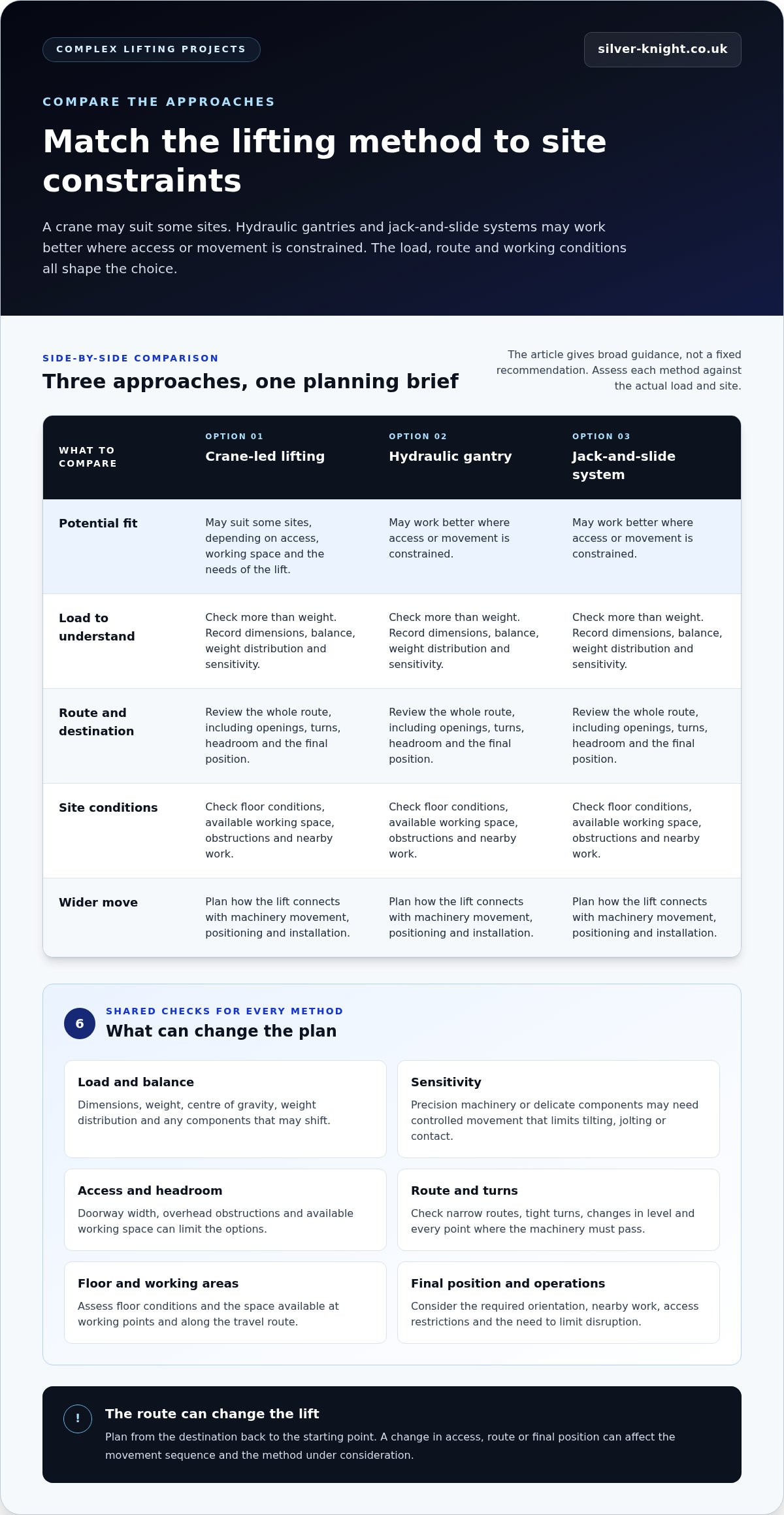
The right approach depends on how the load can be reached, lifted and moved into position. A crane may suit a site with suitable lifting access, while a hydraulic gantry or jack-and-slide system may be better suited to different space or movement constraints. No method is the automatic choice. Consider the load, route and destination together.
The comparison below is a starting point, not a substitute for project-specific assessment. Headroom, working space and the required direction of movement can all affect which approach is practical.
| Project constraint | Approach to consider | Planning question |
|---|---|---|
| Suitable access for lifting from above | Crane-led lifting | Can the load be lifted and landed along a workable path? |
| Limited space around the load | Hydraulic gantry | Can the system be positioned and operated within the available area? |
| A need to move machinery horizontally in a controlled way | Jack-and-slide system | Can the route and final position accommodate the planned movement? |
When crane-led lifting may suit the move
A crane may be suitable when the site allows the load to be lifted from its starting point and placed at the required landing position. The plan still needs to account for the path through the air, nearby obstructions and the space available to set down the machinery. A clear lift at the start does not guarantee an easy landing, so assess both ends of the move.
When gantries or jack-and-slide systems may be considered
Where access or working space makes a crane-led approach less suitable, a hydraulic gantry may offer another way to lift machinery. Jack-and-slide systems can support controlled horizontal movement, which may be useful when equipment needs to travel through a restricted route or into a precise position. The whole site layout matters, not just one feature.
For complex and technical lifting projects, compare methods against the required movement as well as the initial lift. A machine might need to rise, travel sideways, pass through an opening and then be positioned for installation. That sequence may call for a different approach from one designed only to raise the load.
Silver Knight uses cranes, hydraulic gantries and jack-and-slide systems for machinery-moving work. These lifting systems can be considered in relation to access, movement and positioning needs. Assess the intended route and final position alongside the lifting method, rather than choosing equipment on load weight alone.
To discuss lifting equipment and machinery movement for your project, explore Silver Knight’s support.
How to prepare for a complex lifting project
Good preparation helps turn an early idea into a workable project scope. You do not need every answer before starting a discussion, but gathering the information you have makes it easier to identify what needs measuring, checking or coordinating. For complex and technical lifting projects, involve people who understand the machinery, the site and the work that must continue around the move.
Information to prepare before discussing the lift
Put the available details in one place. Documents and photographs can help explain the job, particularly where drawings do not show the current site layout or machinery condition.
- Machinery details, including dimensions, weight information, handling points and available manuals or technical documents.
- Site information, such as drawings, photographs, access points, working areas and known route obstacles.
- Movement requirements, including the intended route, final position, orientation and any installation needs.
- Operational constraints, such as areas that must remain accessible, nearby work and preferred working windows.
- Project contacts, including who can answer technical questions, explain site conditions and describe operational needs.
Make clear which details are measured, which come from documents and which are estimates. This gives the project team a better basis for discussion and helps flag information that may need checking before the scope is settled. Note dependencies too, such as equipment that must be removed first or access that relies on another task being completed.
How to reduce uncertainty around disruption
Consider how the move may affect production, staff access and nearby work. Note restricted working windows, areas that need to stay clear and activities that depend on the machinery being available. These details can influence the order of work and help everyone understand when access or production may be affected.
Bring site, engineering and operations contacts into the planning discussion early. Each can offer a different perspective: engineering can explain machinery requirements, site teams can describe access and working conditions, and operations staff can identify dependencies. Agreeing who will share updates and who needs to know about changes can also support clear communication as the plan develops.
For a wider factory move, lifting may form one stage in a sequence that includes machinery moving, transport and installation. Connecting these activities through factory relocation planning can help keep dependencies in view. Record the intended outcome, known constraints and open questions, then review them as the scope takes shape.
To discuss your project scope and the information needed to plan the lift, contact Silver Knight.
Choosing specialist support for complex and technical lifting projects
Choosing support means looking beyond the lifting equipment itself. The scope should explain how the lift relates to the machinery’s movement, transport and final positioning. For complex and technical lifting projects, clear coordination helps everyone understand what is included and how the stages fit together.
Useful points to consider include whether the project approach:
- Considers the load, access conditions, route and intended end position as connected parts of the task.
- Includes experience in machinery lifting and movement, rather than focusing only on lifting equipment.
- Matches the proposed equipment and method to the site and movement requirements.
- Sets out responsibilities, dependencies and communication between the people involved.
- Accounts for transport or installation work that follows the lift.
What an integrated lifting and moving approach can address
Where lifting is part of a relocation, connecting it with machinery movement and transport can help keep the sequence clear. Silver Knight provides machinery moving, machinery installation, contract lifting and heavy haulage. The work can be scoped around the project requirements, rather than assuming every service applies. Where equipment-led support is relevant, heavy moving equipment hire is also available.
When discussing a project, share the information gathered during preparation and explain what the move needs to achieve. Identify anything still uncertain, who can answer technical or operational questions, and which activities depend on the lift. This gives the discussion a practical focus and helps define the scope.
Discuss the project with Silver Knight
Silver Knight brings over 180 years of collective industry experience to machinery moving and lifting work. Share the machinery details, site constraints, route and intended outcome to start a practical discussion about the project scope and the support it requires.
To plan a lift as part of machinery moving, installation or relocation, discuss your project with Silver Knight.
Set your lifting project up for its next step
Turn your project requirements into a clear brief. Note what the move needs to achieve, what is already known and which questions still need answers. This gives the planning conversation a practical focus from the outset.
For complex and technical lifting projects, consider how the lift fits into the wider work and what needs to happen before and after it. A shared understanding of the aims can help shape a scope that reflects the machinery and the site.
Silver Knight provides machinery moving, installation and lifting support tailored to project requirements. Discuss your lifting project with Silver Knight.
Frequently Asked Questions
What makes a lifting project technically complex?
A project is technically complex when several conditions need to be managed together, such as an awkward load, a confined work area and a precise final position. The interactions matter: changing the order of work may affect access or how the machinery can be handled. For example, if part of a machine needs to be removed before it can pass through an opening, that affects the planned sequence.
Can heavy machinery be moved without using a crane?
Yes. Depending on the load and the site, heavy machinery can sometimes be moved using other specialist systems. Hydraulic gantries and jack-and-slide systems may be suitable where a crane is not the best fit for the available access or required movement. The method depends on the full task, including how the machinery will be raised, moved and positioned, rather than weight alone.
What information is needed to plan a machinery lift?
Useful information includes the machinery’s dimensions and weight, available handling instructions, and documents explaining how it should be prepared or handled. Include details of parts that need to be removed or secured, along with photographs or drawings of the route and work area. It also helps to identify who can answer technical questions and who is responsible for site operations.
How do hydraulic gantries differ from cranes for machinery lifting?
A crane and a hydraulic gantry are different lifting approaches, and each needs to be assessed against the job layout. A crane-led plan depends on suitable lifting access and a workable path to the landing position. A gantry approach needs space to position its equipment around the work. Comparing set-up space, access and the movement required can help narrow down the options.
Can one specialist coordinate lifting, machinery moving and transport?
Yes. Silver Knight provides machinery lifting, machinery moving and heavy haulage, so these stages can be considered as connected parts of a project scope. This helps clarify how machinery will move from its current position to transport and onwards to its destination. It also gives the project team a chance to identify handovers and dependencies between tasks.
What should a site survey assess before a complex lift?
A site survey should check whether the proposed route and work area match the available information, including access dimensions, headroom, working space and floor conditions. It should also consider where equipment can be positioned and how the machinery will reach its final location. Recording differences between site conditions and existing drawings helps resolve unknowns before settling the working method.
Does Silver Knight support machinery lifting projects across the UK?
Yes. Silver Knight provides machinery moving and lifting services nationwide across the United Kingdom. The project scope can take account of the specific site, machinery and movement requirements, whether the lift is a standalone task or part of a wider relocation.

Article by
David Ashby
I'm the Managing Director of Silver Knight Haulage & Machinery Ltd. Silver Knight Ltd is a family-run firm established in the West Midlands in 2005, with the aim of providing a cost-effective, yet professional, service to businesses for the removal, transportation, and installation of machinery, plant, and equipment here in the UK and worldwide. Between us, the Silver Knight workforce has over 50 years of experience with machinery and its operation.
Disclaimer
This article is intended for informational purposes only. Please ensure you seek expert advice or carry out your own research to confirm the information is suitable for your specific needs.